


Reliable Connectivity Is Just as Important as Flight Performance
Modern drones are becoming far more than flying cameras.
Today, drones are used for:
- Infrastructure inspection
- Precision agriculture
- Public safety
- Mapping and surveying
- Warehouse inventory
- Mining operations
- Industrial monitoring
At the same time, onboard computing is evolving rapidly. AI processors, multiple cameras, LiDAR, thermal imaging, and edge computing are becoming standard components of professional UAV platforms.
While engineers often spend months selecting flight controllers, sensors, and AI hardware, one component is frequently underestimated:
The wireless communication module.

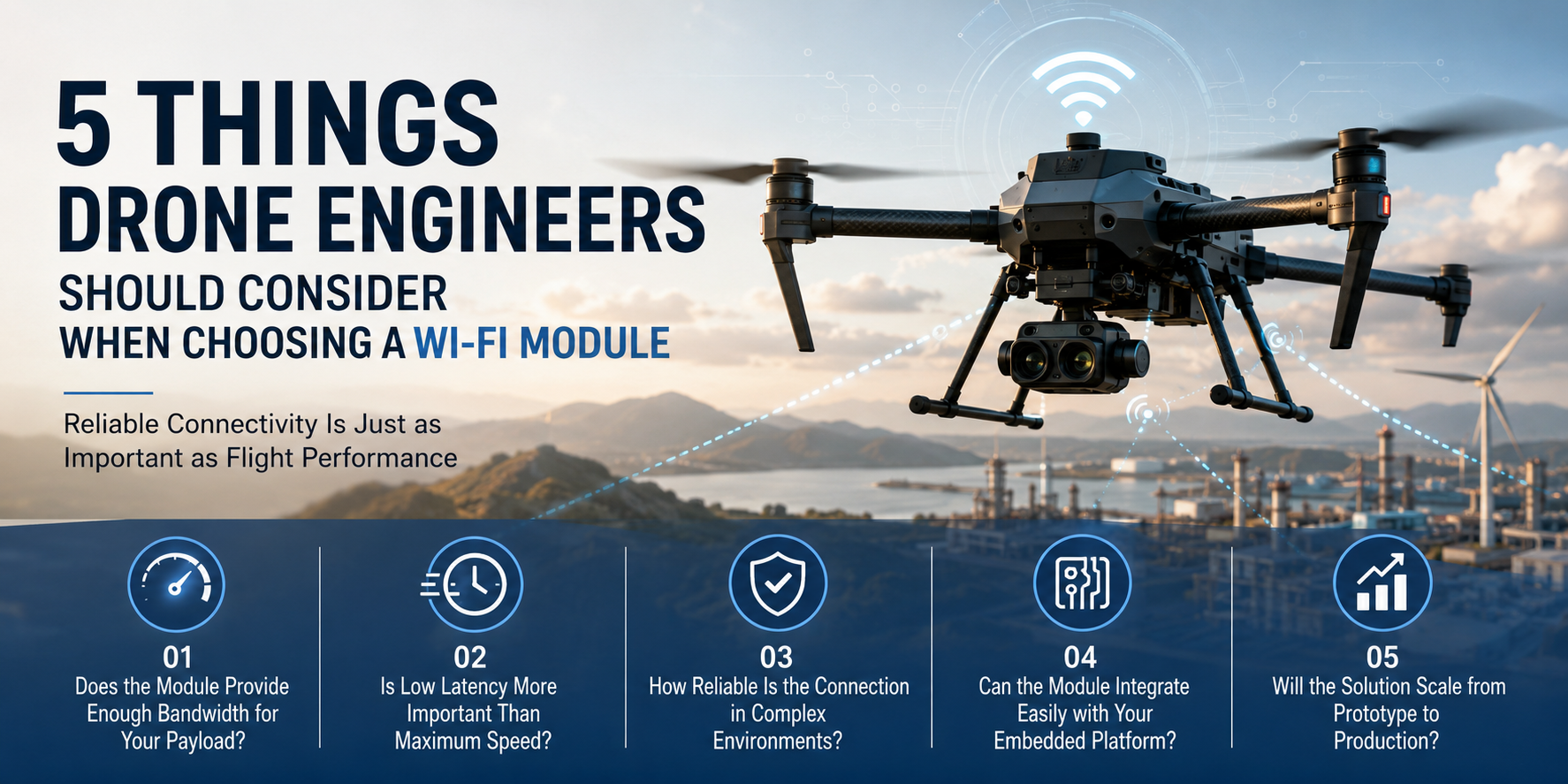
A poorly chosen Wi-Fi module can become the bottleneck of an otherwise excellent drone design.
Here are five key factors every drone engineer should evaluate before selecting a wireless communication solution.
1. Does the Module Provide Enough Bandwidth for Your Payload?
Not every drone transmits the same type of data.
A basic inspection drone may only send telemetry and compressed video.
An AI-powered drone may simultaneously transmit:
- Multiple HD video streams
- AI inference results
- Telemetry data
- Sensor information
- Remote control commands
As payloads become more sophisticated, wireless bandwidth quickly becomes a limiting factor.
When evaluating a Wi-Fi module, consider:
- Maximum throughput
- Number of spatial streams
- Channel bandwidth
- Support for Wi-Fi 6 or Wi-Fi 7
Higher bandwidth doesn’t simply improve video quality—it also creates more capacity for future upgrades.
2. Is Low Latency More Important Than Maximum Speed?
Many engineers focus on peak data rates.
However, drones often benefit more from consistent low latency than from maximum theoretical throughput.
For applications such as:
- Remote piloting
- Autonomous navigation
- AI-assisted obstacle avoidance
- Real-time monitoring
Stable communication is far more valuable than occasional bursts of high speed.
Look beyond the headline specifications and evaluate how the wireless solution performs under continuous, real-world workloads.
3. How Reliable Is the Connection in Complex Environments?
Drones rarely operate in ideal radio environments.
They may fly near:
- Buildings
- Metal structures
- Industrial equipment
- Trees
- Utility infrastructure
These environments introduce interference, signal reflections, and changing link conditions.
A reliable Wi-Fi module should support features that help maintain stable communication under challenging conditions.
Modern technologies such as Wi-Fi 6 and Wi-Fi 7 introduce significant improvements in efficiency, interference management, and overall reliability compared with earlier generations.
For industrial UAVs, connection stability is often more important than achieving the highest benchmark speeds.
4. Can the Module Integrate Easily with Your Embedded Platform?
Selecting a Wi-Fi module is not only about radio performance.
Engineers should also consider integration.
Questions worth asking include:
- Does it support Linux or OpenWrt?
- Are software drivers actively maintained?
- Is the hardware interface compatible with your design?
- Is documentation readily available?
- Can the module integrate with NVIDIA Jetson or other edge AI platforms?
Reducing development complexity can significantly shorten time-to-market.
Choosing a well-supported platform often saves more engineering time than selecting a module based solely on specifications.
5. Will the Solution Scale from Prototype to Production?
Many wireless solutions perform well during prototyping.
Production introduces different challenges:
- Long-term availability
- Industrial reliability
- Certification requirements
- Thermal performance
- Supply chain stability
Choosing a communication platform with a clear product roadmap helps avoid redesigns later in the project lifecycle.
Engineers should think beyond the first prototype and evaluate whether the wireless solution can support future production volumes and product evolution.
Connectivity Is Becoming Part of the Drone Architecture
Modern drones are evolving into flying edge computing platforms.
A typical professional UAV now combines:
- Flight control systems
- AI processors
- Vision sensors
- Navigation systems
- High-speed wireless communication
Each subsystem depends on the others.
Even the most advanced AI algorithms become less effective if communication is unstable.
Reliable wireless connectivity is no longer just another hardware component.
It has become part of the overall system architecture.
Looking Ahead
The next generation of drones will continue to demand:
- Higher bandwidth
- Lower latency
- More reliable wireless links
- Better support for AI workloads
- Faster integration with embedded computing platforms
Selecting the right Wi-Fi module today is not simply about improving communication performance.
It is about building a platform that can support the future of autonomous aerial systems.
As drones become smarter, wireless connectivity will play an increasingly important role in enabling safe, efficient, and scalable operations.
Because in autonomous systems, intelligence may guide the mission—but connectivity keeps it flying.
What factors matter most when your team selects a wireless communication solution for UAV projects?
I’d be interested to hear how other drone engineers approach this decision.