


Choosing Between 2.4GHz, 5GHz and 6GHz Antennas: A PtP/PtMP Design Guide
When designing a wireless link, it’s tempting to simplify antenna selection down to:
Pick the right connector → pick the highest-gain antenna → connect it to the radio.
For industrial wireless, point-to-point (PtP), and point-to-multipoint (PtMP) deployments, that approach often produces disappointing real-world results.
What actually determines link performance is a combination of frequency, antenna gain, radiation pattern, polarization, bandwidth, cable loss, mounting position, and the physical environment. This becomes especially clear when comparing 2.4GHz, 5GHz and 6GHz side by side.
Why Frequency Changes the Whole Design Approach
Higher frequency means shorter wavelength:
Band Approx. Wavelength Typical Role 2.4GHz ~12.5 cm Long-range coverage, better penetration 5GHz ~6 cm Balance of capacity and range 6GHz ~5 cm High capacity, cleaner spectrum
At the same distance under otherwise comparable conditions, higher frequencies suffer greater free-space path loss: 5GHz has roughly 6.4 dB more path loss than 2.4GHz, and 6GHz has roughly 8 dB more than 2.4GHz. The gap between 5GHz and 6GHz, however, is only about 1.6 dB.
So the common claim that “6GHz doesn’t go far” is an oversimplification. The better engineering question is:
What link budget, antenna gain, channel width, and propagation environment does this specific application actually require?
2.4GHz: When Coverage Matters More Than Capacity
2.4GHz has the longest wavelength of the three bands, which gives it an edge when the RF path includes obstacles, vegetation, walls, or other obstructions — and it can deliver better coverage at a given transmit power than higher bands.
The trade-off is that 2.4GHz spectrum is crowded: Bluetooth, legacy WiFi, IoT devices, and other systems all compete for the same limited channel space. In PtMP deployments, this matters because a sector serving multiple clients is effectively sharing airtime across all of them.
2.4GHz tends to make sense when coverage matters more than peak throughput, when the path has obstacles, when clients are spread far apart, in rural or low-congestion environments, or for lower-bandwidth industrial telemetry/IoT applications. But for a high-capacity PtP backhaul, 2.4GHz is usually not the first choice.
5GHz: The Practical Workhorse for PtP and PtMP
For most outdoor wireless networks, 5GHz strikes a useful balance between propagation and capacity: more usable spectrum, wider channel options, higher potential throughput, more practical directional antenna designs, and better support for high-capacity PtP/PtMP links. The trade-off is greater path loss and generally weaker penetration than 2.4GHz.
This is why 5GHz remains widely used for wireless backhaul, WISP networks, building-to-building links, and industrial PtP/PtMP deployments. For PtP, directional options include parabolic dishes, panel antennas, horn antennas, or high-gain directional arrays — but the goal isn’t simply “more dBi.” It’s a better link budget and stronger interference rejection.
6GHz: More Capacity, More Demanding RF Design
6GHz opens up substantially more spectrum for WiFi 6E and WiFi 7 systems — more spectrum means wider channels and potentially higher capacity. But it also demands more careful RF design: the shorter wavelength means somewhat higher path loss than 5GHz, and building materials or obstructions can have a stronger impact.
That said, the real-world gap between 5GHz and 6GHz is often overstated — free-space propagation difference is typically only around 1–2 dB. So for a clear, line-of-sight outdoor PtP link, the right question isn’t “can 6GHz reach far enough?” It’s:
“Can my antenna and link budget deliver the required SNR and throughput at the target distance?”
Don’t Choose an Antenna by dBi Alone
A 20 dBi antenna is not automatically better than a 12 dBi antenna. Antenna gain describes how tightly RF energy is concentrated in space — higher gain usually means a narrower beam.
- PtP: a narrow, high-gain beam is exactly what you want between two fixed endpoints.
- PtMP: the base station needs to cover a defined sector, not a single point — so beamwidth, front-to-back ratio, side-lobe suppression, and polarization performance matter just as much as peak gain. An excessively narrow, ultra-high-gain antenna can actually be the wrong choice when clients are spread across a wide area.
Polarization and MIMO: Antenna Ports Can’t Be Designed in Isolation
Modern WiFi radios use multiple spatial streams. For a 2×2 radio, the antenna system needs coordinated polarization, port isolation, impedance matching, radiation characteristics, and spatial separation — poor isolation between elements increases coupling and degrades MIMO performance. This matters most with compact integrated antennas or multiple external antennas mounted close together. Efficiency matters too: realized gain depends on both directivity and efficiency, not the headline gain number alone.
PtP vs. PtMP: Two Different Design Priorities
PtP prioritizes link budget: distance → path loss → antenna gain → SNR → modulation → throughput. A high-gain directional antenna delivers higher received signal, stronger interference rejection, a narrower beam, and better spatial reuse — which is why 5GHz or 6GHz directional systems are attractive with a clear line of sight.
PtMP prioritizes coverage and capacity: the base station must serve multiple remote stations at once, so the antenna pattern becomes critical — sector width (60°/90°/120°), client distribution, distance variation, elevation differences, co-channel interference, polarization, and airtime utilization all come into play.
Antenna Selection in Practice: The IPQ 6010 DR6018S Platform
Antenna selection becomes part of system design once you’re building around a specific platform.
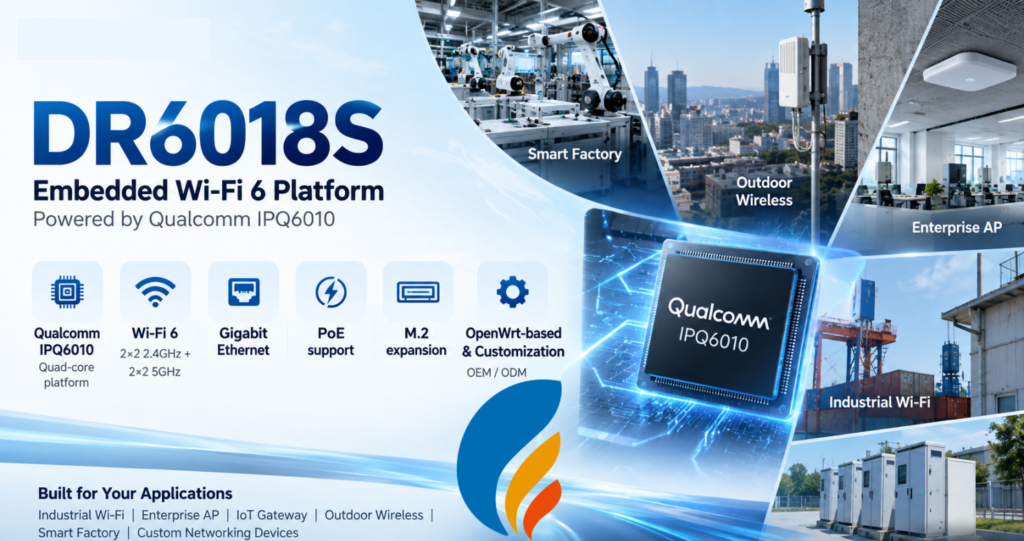
The DR6018S is built on Qualcomm’s IPQ6010 platform, supporting dual-band WiFi 6 with 2×2 at 2.4GHz and 2×2 at 5GHz, plus Gigabit Ethernet, PoE support, and M.2 expansion — making it a solid foundation for industrial WiFi, outdoor wireless, and custom networking equipment. Three example configurations:

Example 1 — Industrial PtP bridge: Two factories need a wireless link. A DR6018S + 5GHz directional antenna focuses energy toward the remote site, with 5GHz balancing capacity and propagation. Design priorities: high gain, narrow beam, good polarization isolation, and a clear line of sight.
Example 2 — Industrial PtMP network: One site needs to connect several remote buildings. Instead of a narrow directional antenna, a DR6018S + 5GHz sector antenna is usually the better fit. The key question shifts from “how many dBi?” to “how wide does the sector need to be, and how much capacity does each client require?”
Example 3 — Mixed-frequency network: Use 2.4GHz for wider-area, lower-bandwidth devices, and 5GHz for PtP/PtMP backhaul and higher-capacity clients. This division of labor is often more practical than trying to solve every connectivity requirement with a single band.
For projects that need true concurrent tri-band operation rather than a switched implementation, the DR5424 (built on Qualcomm’s IPQ5424 platform) runs 2.4GHz, 5GHz, and 6GHz as three independent, simultaneous radio chains, with up to 320MHz channel width on 6GHz — a step up from DR6018S for higher-capacity scenarios. This is a meaningfully different architecture from tri-band-switchable modules on the market, which operate on only one of the three bands at any given moment; the distinction is worth confirming during platform selection.
Six Things to Check Before Selecting an Antenna
- Frequency range — Don’t just check “5GHz compatible.” Verify the antenna’s actual operating range against the radio’s supported channels; this matters even more for 6GHz designs given the wider spectrum span.
- Antenna gain — Look at gain across the entire operating band, not just the peak advertised figure.
- Radiation pattern — Narrow beam and high front-to-back ratio for PtP; controlled sector coverage and low side lobes for PtMP.
- Polarization — Confirm the antenna supports the polarization configuration and isolation your MIMO system requires.
- Cable loss — Often overlooked. If the antenna sits several meters from the radio, coax loss eats directly into the link budget — and this effect grows at higher frequencies. The power delivered at the radio is not the same as the power that actually reaches the antenna.
- Connector and impedance — Check 50Ω system matching, connector type, cable type, adapter losses, and weatherproofing for outdoor installs. A good radio behind a poor RF chain still produces a poor wireless link.
The Antenna Is Part of the Radio System — Not an Accessory
For PtP and PtMP deployments, it helps to think of the entire RF chain as one system:
Radio → connector → cable → antenna → propagation environment → antenna → cable → connector → radio
— rather than the simpler “radio + antenna” mental model. As WiFi moves from 5GHz toward 6GHz and beyond, this system-level thinking only becomes more important.
The best antenna is never simply the one with the highest gain — it’s the one that delivers the right combination of frequency coverage, radiation pattern, polarization, efficiency, and link budget for the actual deployment. That’s why a platform like Wallys DR6018S is worth more than the sum of its WiFi module — it’s a starting point for a custom industrial AP, outdoor wireless bridge, or PtP/PtMP CPE.
If you’re evaluating antenna and RF platform selection for an industrial PtP/PtMP wireless project, reach out to info at 524wifi.net to discuss your application.