


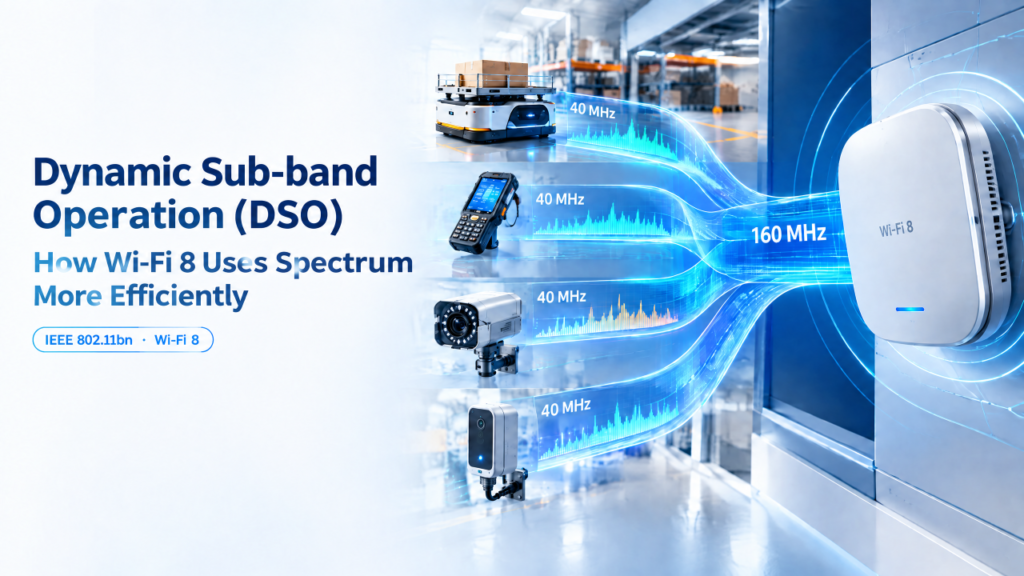
What is DSO, and why does it exist?
IEEE 802.11bn (Wi-Fi 8) introduces Dynamic Sub-band Operation (DSO) — sometimes called Dynamic Sub-Channel Operation — to solve a very concrete problem: the capability gap between access points and client devices. A modern AP chipset can run 160 MHz or even 320 MHz channels. Most connected stations — sensors, cameras, handheld scanners, mobile robots — only support 20 MHz or 40 MHz. Under Wi-Fi 6/7 rules, once an AP grants a TXOP (transmit opportunity) to a narrow-band station, the rest of that wide channel sits idle for the whole transmission window. A 160 MHz AP serving a 40 MHz station wastes 120 MHz on every single TXOP.
DSO fixes this at the MAC layer. Instead of allocating the full wide channel to one narrow-band station, the AP schedules multiple stations onto different sub-channels within the same TXOP, using an ICF/ICR (Intra-TXOP Control Frame / Response) exchange to coordinate who transmits where before data starts flowing. Four 40 MHz stations can now share a single 160 MHz TXOP concurrently instead of taking four separate turns.
How this changes AP/module design
For hardware teams building on Qualcomm Wi-Fi 7/8 platforms (IPQ9574, IPQ5424, QCN9274-class silicon), DSO isn’t just a MAC firmware feature — it changes how you think about channel width provisioning. Wide-channel APs stop being “wasted” on mixed-capability deployments; the same 320 MHz radio design that used to only pay off with all-320 MHz clients now scales efficiency gracefully down to 20 MHz legacy devices in the same BSS.
DSO vs. the Wi-Fi 7 alternative (static OFDMA/channel bonding only)
Wi-Fi 7 already gave us Multi-Link Operation and preamble puncturing, but scheduling flexibility within one TXOP for mixed-bandwidth clients wasn’t part of the toolkit. DSO is a Wi-Fi 8-specific MAC mechanism that works alongside Non-Primary Channel Access (NPCA) — where a station can move off a busy primary channel — to squeeze real throughput out of dense, mixed-device networks rather than relying purely on wider channels or more spectrum.
Applications this enables
- Dense AMR/AGV warehouse fleets where robots, handheld scanners, and fixed cameras all share one AP with very different bandwidth capabilities
- Multi-camera industrial vision networks mixing high-res inspection cameras with low-bandwidth trigger/status sensors
- Any industrial site consolidating mixed-generation devices onto one Wi-Fi 8 AP instead of running parallel 6/7/8 networks
Where we’re headed
We’re preparing our Wi-Fi 8 routerboard platform now, building on the same IPQ9574/IPQ5424-class hardware lineage we already ship in DR9574 and DR5424. If DSO-level MAC efficiency matters for your next-gen industrial AP or robot connectivity design, happy to compare notes.