


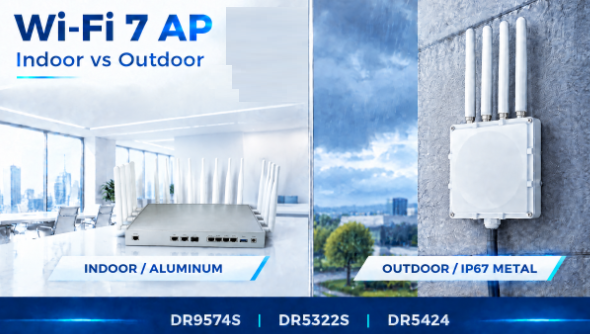
A Wi-Fi 7 AP is more than a Wi-Fi 7 chipset.
For a finished access point, the hardware platform, wireless configuration, Ethernet interfaces, enclosure, power design, and deployment environment all affect the final product.
Wallys provides several Wi-Fi 7 AP platforms that can be combined with indoor aluminum enclosures or outdoor IP67-rated metal enclosures.
Under the enclosure, customers can choose from three hardware platforms: DR9574S, DR5424, and DR5322S.
The three platforms are designed for different system requirements rather than being simple variations of the same AP.
What Do You Need to Consider When Building a Wi-Fi 7 AP?
There are three basic questions:
1. Where will the AP be deployed?
Indoor or outdoor?
2. What wireless and processing capacity does the application require?
2×2 or 4×4 radios? More CPU resources? More memory?
3. What wired interfaces does the product need?
2.5G, 10G, SFP, PoE, USB, or customized interfaces?
The answer to these questions determines which Wi-Fi 7 platform and enclosure combination makes sense.
Indoor or Outdoor Wi-Fi 7 AP?
The first decision is the enclosure.
Indoor Wi-Fi 7 AP
For indoor applications, 524WiFi offers an aluminum enclosure.
It is suitable for deployments such as:
- Enterprise networks
- Offices and commercial buildings
- High-density indoor wireless
- Industrial facilities
- Warehouses
- Smart buildings
The enclosure provides a practical platform for thermal management while keeping the AP suitable for indoor installation.
Outdoor Wi-Fi 7 AP
Outdoor deployments require a different mechanical design.
Wallys offers an IP67-rated metal enclosure for outdoor Wi-Fi 7 AP applications.
It is designed for environments where the equipment needs protection against dust and water, including:
- Outdoor wireless networks
- Industrial connectivity
- Warehouses and logistics yards
- Outdoor surveillance
- Campus and infrastructure networks
- Outdoor wireless backhaul
The enclosure is therefore not simply an external housing choice. It is part of the AP’s deployment architecture.
Which Wi-Fi 7 Platform Should You Choose?
524WiFi currently offers three Wi-Fi 7 hardware platforms for finished AP designs:
DR9574S, DR5424, and DR5322S.
They use different Qualcomm platforms and provide different combinations of CPU resources, wireless configuration, Ethernet connectivity, memory, and expansion interfaces.

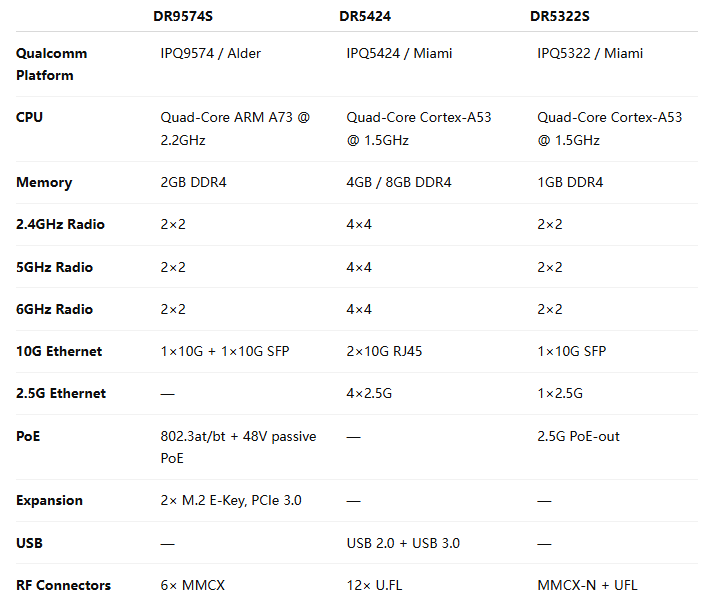
The important difference is not simply CPU speed.
Each platform gives you a different starting point for the final AP architecture.
DR9574S: When CPU and Expansion Matter
The DR9574S is based on the Qualcomm IPQ9574 platform, with a quad-core ARM A73 processor running at 2.2GHz.
It combines:
- 2GB DDR4
- 1× 10Gbps Ethernet
- 1× 10Gbps SFP
- 2× 1Gbps Ethernet
- Active PoE 802.3at/bt
- 48V passive PoE
- 2× M.2 E-Key interfaces with PCIe 3.0
- 2×2 radios on 2.4GHz, 5GHz, and 6GHz
- 6× MMCX connectors
The two M.2 E-Key interfaces provide additional expansion possibilities for projects that need more than the standard wireless configuration.
This makes DR9574S a suitable starting point for Wi-Fi 7 APs and gateways where CPU resources, 10G connectivity, PoE, or hardware expansion are important.
DR5424: When Wireless Capacity and Ethernet Density Matter
The DR5424 takes a different approach.
It combines 4×4 radios on 2.4GHz, 5GHz, and 6GHz with multiple multi-Gigabit Ethernet interfaces.
The platform provides:
- 4GB DDR4, with 8GB as the maximum option
- 4×4 2.4GHz radio
- 4×4 5GHz radio
- 4×4 6GHz radio
- 2× 10Gbps RJ45
- 4× 2.5Gbps RJ45
- USB 2.0
- USB 3.0
- 12× U.FL connectors
It supports up to 320MHz channel width on 6GHz and up to 240MHz on 5GHz according to the platform specification.
This makes DR5424 a platform for applications where wireless capacity and wired network density are both important.
For example, a high-density AP or gateway may need multiple 2.5G connections for local devices while using 10G Ethernet for aggregation or backhaul.
DR5322S: When the Design Needs to Stay Compact
The DR5322S uses the Qualcomm IPQ5322 platform with a quad-core Cortex-A53 processor at 1.5GHz and 1GB DDR4.
Its wireless configuration includes:
- 2×2 2.4GHz
- 2×2 5GHz
- 2×2 6GHz
- 2× MMCX-N connectors for 5GHz
- 2× MMCX-N connectors for 6GHz
- 2×2 2.4GHz antenna interfaces
For wired connectivity, it provides:
- 1× 2.5Gbps Ethernet
- 1× 2.5G PoE-out Ethernet
- 1× 10G SFP
- JTAG
- GPIO interfaces
- Reset button
The platform is therefore different from DR5424.
Instead of maximizing the number of Ethernet ports and using 4×4 radios, DR5322S provides a more compact 2×2 tri-band Wi-Fi 7 architecture with 2.5G, 10G SFP, and PoE-out connectivity.
This can be useful when the project does not require multiple 2.5G LAN ports but still needs multi-Gigabit connectivity.
How Do You Choose Between the Three Platforms?
A simple way to start is with the system requirement.
Need more CPU resources and expansion options?
→ DR9574S
Need 4×4 tri-band Wi-Fi 7 with multiple 10G and 2.5G Ethernet ports?
→ DR5424
Need a more compact 2×2 tri-band platform with 2.5G, 10G SFP, and PoE-out?
→ DR5322S
The platform can then be combined with the appropriate enclosure and interface configuration.
In other words:
Wi-Fi 7 platform → Wireless configuration → Ethernet interfaces → Enclosure → Power → Customization
Can the Wi-Fi 7 AP Interfaces Be Customized?
Yes.
For OEM/ODM projects, the AP does not have to remain a fixed off-the-shelf configuration.
524WiFi can work with customers to customize the hardware around specific project requirements, including:
- Ethernet interfaces
- Network port configuration
- Power interfaces
- PoE requirements
- RF and antenna connections
- Other project-specific hardware interfaces
- Mechanical and enclosure requirements
This is useful when a customer already has a product specification but cannot find an off-the-shelf Wi-Fi 7 AP that matches it.
Instead of changing the project around an existing product, the hardware can be adapted around the application.
From Wi-Fi 7 Platform to a Finished AP
A development board is only the starting point.
A production Wi-Fi 7 AP also needs:
Wireless platform + enclosure + antennas + interfaces + thermal design + power design + firmware + production configuration
This is why the same Wi-Fi 7 platform can be turned into different products depending on the target market.
For example:
Indoor Enterprise AP
→ DR9574S / DR5424 → Aluminum enclosure → Multi-Gigabit Ethernet → Customized antenna configuration
Outdoor Industrial AP
→ DR9574S / DR5322S → IP67 metal enclosure → PoE → Outdoor antenna configuration → Customized interfaces
Compact Wi-Fi 7 AP
→ DR5322S → Compact enclosure → 2.5G + 10G SFP → Customized mechanical design
The platform stays relatively consistent, while the final product can be adapted to the application.
Wi-Fi 7 APs for OEM/ODM Projects
524WiFi provides Wi-Fi 7 hardware platforms for customers developing their own AP, gateway, or wireless networking products.
The available approach includes:
- DR9574S / IPQ9574
- DR5424 / IPQ5424
- DR5322S / IPQ5322
- Indoor aluminum enclosure
- Outdoor IP67 metal enclosure
- Different wireless configurations
- Multi-Gigabit Ethernet options
- PoE options
- Interface customization
- OEM/ODM hardware customization
The goal is to shorten the path from a Wi-Fi 7 platform to a finished, application-specific wireless product.
Summary
Choosing a Wi-Fi 7 AP is not only about choosing a Wi-Fi 7 chipset.
The right configuration depends on where the AP will be deployed, how much wireless and CPU performance is required, what Ethernet interfaces are needed, and how much customization the project requires.
524WiFi and Wallys provide multiple Wi-Fi 7 platforms, enclosure options, and hardware customization possibilities so that customers can build a Wi-Fi 7 AP around their application instead of adapting their application to a fixed product.
Interested in Wi-Fi 7 samples or a customized AP configuration?