

How Wireless Mesh Networks Enable Autonomous Robots in Large and Dynamic Environments
The future of robotics is moving beyond controlled spaces.
Autonomous robots are no longer limited to laboratory demonstrations or small indoor environments.
Today, robots are being deployed in:
- Large warehouses
- Smart factories
- Outdoor farms
- Ports and logistics centers
- Mining sites
- Industrial inspection areas
- Hospitals and commercial buildings
As robot deployment expands, one challenge becomes increasingly important:
How do we maintain reliable connectivity when robots move beyond traditional Wi-Fi coverage?
The answer is not simply adding more access points.
The future of autonomous robotics requires a more flexible and intelligent wireless infrastructure.
This is where wireless mesh networking becomes increasingly important.

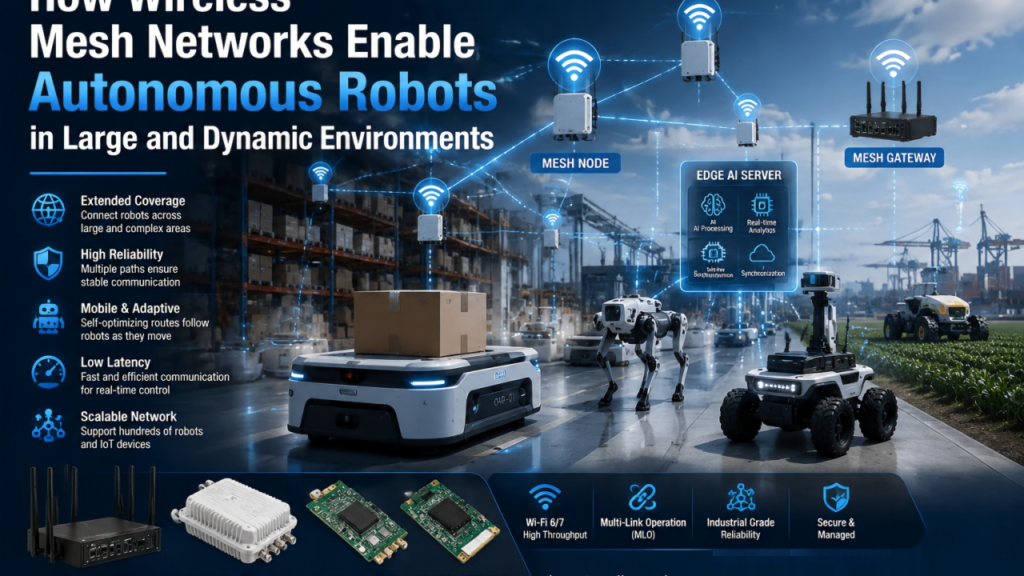
Autonomous Robots Need Connectivity Everywhere They Operate
A robot is only autonomous when it can continuously:
- Sense its environment
- Process information
- Communicate with other systems
- Receive updates
- Report status
Connectivity enables critical robot functions:
- Navigation assistance
- Remote monitoring
- Fleet management
- Mission updates
- Data synchronization
- Safety communication
For a fixed device, losing wireless connectivity may be inconvenient.
For an autonomous robot, connectivity loss can impact the entire operation.
A warehouse robot that loses connection may stop.
An inspection robot that disconnects may fail to complete a mission.
A farming robot operating in a large field may become unreachable.
Reliable wireless communication is not an optional feature.
It is operational infrastructure.
The Limitation of Traditional Wi-Fi Networks
Traditional Wi-Fi deployments are usually designed around fixed infrastructure:
Access Point → Client Device
This works well for:
- Offices
- Small factories
- Indoor environments
However, robotics introduces new challenges.
1. Large Operating Areas
Many robotic applications cover large spaces:
- Warehouses with thousands of square meters
- Outdoor industrial sites
- Agricultural fields
- Logistics yards
Installing wired access points everywhere may become:
- Expensive
- Difficult to maintain
- Limited by infrastructure availability
2. Dynamic Robot Movement
Robots are constantly moving.
Their communication environment changes every second.
A robot may travel:
- From one building to another
- Through different production areas
- Around obstacles and machinery
The wireless network must adapt dynamically.
3. Rapid Deployment Requirements
Many robotics deployments need flexibility.
For example:
A logistics company may expand warehouse operations.
A factory may redesign production lines.
An agricultural operation may deploy robots across changing areas.
A wireless solution should not require rebuilding the entire network every time the environment changes.
What Is Wireless Mesh Networking?
A traditional Wi-Fi network depends mainly on wired access points connected to a central network.
A wireless mesh network creates multiple communication paths.
Instead of:
Robot → Access Point → Network
A mesh environment can support:
Robot → Robot → Mesh Node → Network
or:
Robot → Mesh Node → Mesh Node → Gateway
Each node can help extend network coverage and improve flexibility.
Why Mesh Matters for Autonomous Robots
1. Extending Coverage Across Large Areas
Robots often operate in places where complete wired infrastructure is difficult.
Examples:
Smart Agriculture
Autonomous agricultural robots may operate across:
- Fields
- Orchards
- Greenhouses
Mesh networking can help extend connectivity across larger areas without requiring extensive cabling.
Industrial Sites
Factories and industrial facilities often include:
- Metal structures
- Moving equipment
- Complex layouts
Mesh networks can provide more flexible coverage.
Warehouses
Large warehouses may contain:
- High shelves
- Multiple zones
- Moving inventory systems
A flexible wireless architecture helps robots maintain communication while navigating different areas.
2. Improving Network Resilience
One of the biggest advantages of mesh networking is redundancy.
In traditional networks:
If one access point fails:
Connected devices may lose communication.
In a mesh network:
Multiple paths may exist.
If one route becomes unavailable, the network can potentially find another path.
For autonomous robots, this means:
- Higher availability
- Better reliability
- Reduced downtime
A robot fleet should not depend on a single communication point.
3. Supporting Mobile Robot Fleets
Robotics is moving toward multi-robot collaboration.
A warehouse may have:
- Hundreds of AMRs
- Multiple autonomous forklifts
- Robotic arms
- AI vision systems
These machines need continuous communication.
Mesh networking can provide a more adaptable communication layer for:
- Robot-to-network communication
- Robot-to-robot communication
- Edge computing connectivity
Mesh Networking and Edge AI Robotics
The growth of Edge AI makes connectivity even more important.
A modern autonomous robot may follow this architecture:
Sensors
↓
Camera / LiDAR / Vision Data
↓
Wireless Network
↓
Edge AI Server
↓
Decision Making
↓
Robot Control
If communication between these layers becomes unstable, the entire AI workflow is affected.
Mesh networking helps create a more flexible communication foundation for distributed AI systems.
The Role of Wi-Fi 6 and Wi-Fi 7 in Industrial Mesh
Modern robotics applications require more than coverage.
They need:
- High bandwidth
- Low latency
- High reliability
- Multiple device support
Wi-Fi 6 introduces important capabilities:
- OFDMA
- Improved efficiency in dense environments
- Better support for many connected devices
Wi-Fi 7 further expands possibilities with:
Multi-Link Operation (MLO)
Multiple frequency links can improve reliability and latency.
Higher Throughput
Supports demanding applications such as:
- Multi-camera robots
- AI vision systems
- Remote operation
Better Network Performance
Helps support increasingly complex robotic environments.
Challenges: Mesh Networks Must Be Designed for Robotics
Not all mesh networks are suitable for autonomous robots.
Robotics requires careful engineering.
Important considerations include:
Low Latency Routing
A robot cannot wait several seconds for network decisions.
Fast Path Optimization
The network should select efficient communication paths.
Mobility Support
Routes must adapt as robots move.
Network Management
Large fleets require visibility and control.
From Connected Robots to Connected Robot Ecosystems
The future factory will not contain isolated robots.
It will contain an ecosystem:
- Autonomous mobile robots
- AI cameras
- Edge servers
- Industrial sensors
- Cloud platforms
All these systems require reliable communication.
Mesh networking provides a path toward more flexible and scalable robot infrastructure.
Conclusion: Mesh Is Becoming Part of the Robot Infrastructure
Autonomous robots are moving into larger, more complex environments.
As deployment expands, traditional wireless coverage models become insufficient.
Robots need communication systems that can:
- Follow them as they move
- Adapt to changing environments
- Maintain reliable connections
- Support large-scale operations
Wireless mesh networking is becoming an important technology for building the connected infrastructure behind autonomous machines.
The future of robotics is not only about making robots smarter.
It is about creating the wireless systems that allow them to operate anywhere.
AI is the brain. Sensors are the eyes. Connectivity is the nervous system.
And mesh networking helps build that nervous system at scale.
How 524WiFi and Wallys Support Autonomous Robot Connectivity
At 524WiFi and Wallys, we focus on building reliable wireless infrastructure for the next generation of intelligent machines.
Our industrial Wi-Fi solutions support robotics applications that require:
- High-performance wireless communication
- Low-latency connectivity
- Flexible deployment
- Scalable mesh networking
By combining Wi-Fi 6/Wi-Fi 7 technology with industrial-grade hardware, Wallys helps robotics companies create reliable connectivity between:
Autonomous Robots → Edge AI Systems → Industrial Networks
Because smarter robots need more than intelligence.
They need a reliable wireless nervous system.