


Choppy security camera feeds. Hotel guests complaining about WiFi. Remote forest sensors dropping in and out. Large sites with stubborn dead zones. These issues show up in operations chats across industries almost every day. What’s strange is that many of these sites already run the “latest” WiFi gear — and the problems persist anyway. Is the hardware simply not good enough, or did we pick the wrong approach from the start?
The answer usually isn’t “how new is the equipment,” but “how clean is the spectrum, and how stable is the coverage.”
- 2.4GHz is congested almost everywhere — too many devices, too much interference, no way around it.
- 5GHz has limited penetration; thick walls, metal structures, and complex terrain all cause fast signal decay.
- Most deployments still run on a single band. When that band gets jammed or congested, there’s no fallback — the system just has to tough it out.
In other words, the core issue isn’t a lack of bandwidth. It’s the lack of a clean path to begin with.
Put this principle into concrete scenarios and the conflict becomes obvious:
Security surveillance: HD and AI-driven analytics keep pushing bandwidth requirements higher — a single 4K stream can demand several times the bandwidth of a typical scenario. Yet many installations still connect through consumer-grade routers. Once interference or multiple concurrent streams hit, packet loss and lag become almost inevitable — and unlike video streaming services, surveillance footage has no buffer to absorb the hit, so the stutter happens in real time.
Hotel wireless: This is one of the most complained-about scenarios in the past couple of years. Guests rarely say “your RF planning is weak” — they say the WiFi keeps dropping, or the room signal is worse than the lobby’s. The commonly cited root cause is insufficient AP density — one AP covering eight to a dozen-plus rooms, leaving marginal signal at the far end. Worse, simply adding bandwidth doesn’t always fix it; many performance problems actually trace back to network design and band management.
Forest fire monitoring and remote-area coverage: The conflict here is more extreme — it’s not a lack of bandwidth, it’s often no usable network at all. Mountainous and forested areas typically lack stable public network coverage. When a fire breaks out, communication has to be established within minutes, and any band congestion or coverage gap can mean a delayed warning.
Large-site and commercial coverage: Whether it’s a campus, an industrial park, or a large commercial venue, the bigger the footprint, the more a single band’s limitations get magnified — signal can be solid in one corner and drop off entirely around the next.
These scenarios look completely different on the surface, but they share the same underlying problem: once the band in use gets “jammed,” the device has no alternate route.
A genuinely stable solution isn’t about chasing a higher theoretical throughput number — it’s about giving the network a fallback. When 2.4GHz is congested and 5GHz can’t penetrate far enough, is there a clean, open band it can switch to instead?
That’s exactly the value of tri-band switchable design: a single card covering 2.4GHz, 5GHz, and 6GHz, switching to whichever band is cleanest for the current environment, instead of sticking with a band that’s already jammed. It’s worth being precise here: this is “switchable,” not three bands running concurrently on different traffic at once. It solves the deployment problem of “always having a clean path available,” not a throughput-stacking problem.
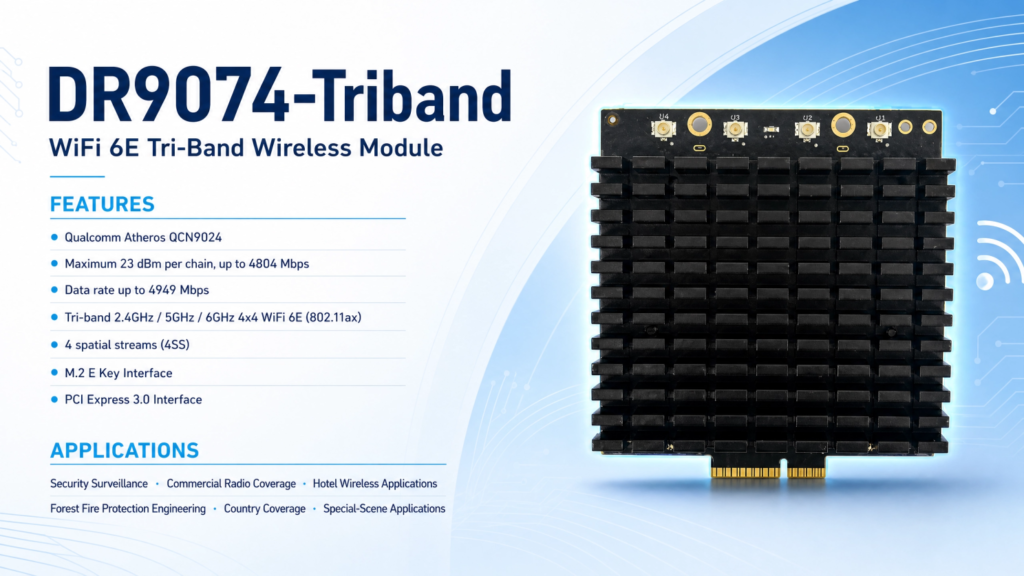
Take 524WiFi 6 DR9074-Triband as an example — a WiFi 6E (802.11ax) module built on the Qualcomm QCN9024 platform, using an M.2 E Key interface over PCIe 3.0, supporting switchable operation across 2.4GHz/5GHz/6GHz, with a 4T4R (4-spatial-stream) design, up to 23dBm per chain, and a theoretical rate of up to 4949Mbps.

Mapped back to the scenarios above, here’s where that matters in practice:
- Security surveillance: 6GHz is cleaner spectrum — in high-density camera deployments or environments with heavy WiFi interference, switching to it can cut packet loss and lag.
- Hotel wireless: For the classic pain point of dense rooms and congested bands, there’s no need to deploy different band-specific hardware per floor or interference profile — one card switches as needed to cover multiple conditions.
- Forest fire / remote areas: 23dBm transmit power combined with 4T4R spatial streams helps deliver a more stable coverage radius across open or complex terrain.
- Large-site coverage: The ability to switch flexibly across three bands lets deployers tune each area to its actual interference conditions, instead of applying one fixed configuration everywhere.
Wireless network stability was never really about the numbers on a spec sheet — it’s about whether the system can keep finding a usable path in a real, complex, interference-heavy environment. Band-switching capability, transmit power, and multi-stream design all ultimately serve the same goal: keeping the network from failing you when it matters most.
If you’re evaluating wireless solutions for surveillance, hospitality, remote monitoring, or large-site coverage, reach out to talk through the details.