


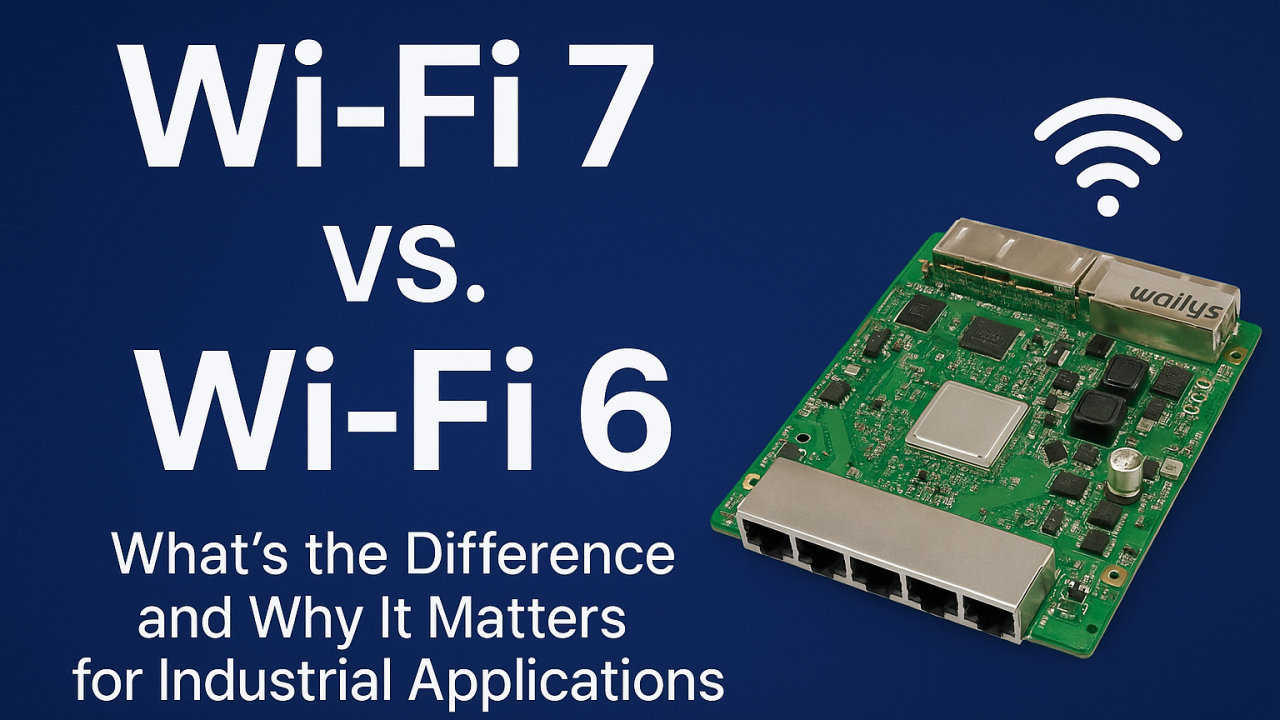
As industrial environments become more automated, connected, and data-driven, the demand for a faster, more reliable wireless network continues to grow. Wi-Fi 6 has served industries well in recent years, but Wi-Fi 7 introduces features that fundamentally reshape performance, latency, and reliability—especially in mission-critical industrial applications.
Many factories, warehouses, and outdoor industrial sites are now evaluating whether upgrading to Wi-Fi 7 is worth it. The answer becomes clear once you understand the major improvements Wi-Fi 7 brings compared to Wi-Fi 6.
What’s New in Wi-Fi 7 Compared to Wi-Fi 6?
Wi-Fi 7 introduces several breakthroughs that directly benefit industrial environments:
Faster Speeds and Higher Throughput Wi-Fi 7 supports up to 320 MHz channels and 4K QAM, providing significantly higher bandwidth. This is especially beneficial for AI vision systems, 4K/8K video streams, and large volumes of sensor data in industrial scenarios.
Multi-Link Operation (MLO) This is the most important upgrade for industrial automation. MLO allows devices to connect to multiple Wi-Fi bands at the same time, dramatically enhancing:
- Reliability
- Latency
- Roaming
- Interference resistance
When one link experiences congestion or interference, data continues flowing through the other link—ideal for AGVs, AMRs, and robotic control systems.
Lower Latency for Real-Time Control Wi-Fi 7 reduces latency to sub-millisecond levels, enabling smoother machine-to-machine communication, PLC data exchange, and industrial robot coordination.
Better Performance in Noisy Industrial Environments Factories, ports, and warehouses contain many devices that create interference. Wi-Fi 7 handles these challenges through:
- Intelligent multi-link scheduling
- Faster channel switching
- Improved OFDMA efficiency
This results in more stable wireless networks, even in heavily congested areas.
Why Wi-Fi 7 Matters for Industrial Applications
Enhanced Reliability for Smart Factories Real-time monitoring, predictive maintenance, and machine communication depend on uninterrupted connectivity. Wi-Fi 7 ensures stable links for sensors, controllers, and production lines.
Seamless Mobility for AGV and AMR Fleets Automated robots cannot afford Wi-Fi dead zones or packet loss. MLO supports smoother roaming, faster handovers, and high-precision navigation.
Better Edge Computing and AI Performance Industrial AI workloads often transmit large amounts of data for inference or analysis. Wi-Fi 7 accommodates high-throughput data without compromising stability.
Higher Density Support for IIoT Deployments Factories may have thousands of connected devices. Wi-Fi 7’s improved scheduling and wider channels support larger device ecosystems without congestion.
Strengthening Industrial Video Surveillance AI-enhanced cameras and real-time analytics benefit from Wi-Fi 7’s higher bitrate capacity and lower latency.
Real-World Industrial Use Cases for Wi-Fi 7
- AGV/AMR navigation and fleet management
- Smart logistics and warehouse management systems
- Industrial video surveillance with AI analytics
- Real-time sensor networks in smart factories
- Wireless backhaul bridging for ports and outdoor sites
- Edge computing devices with high data demands
- Autonomous machines and robotics
Wi-Fi 7 enables smoother, safer, and more efficient industrial operations.
Why Choose 524WiFi and Wallys Wi-Fi 7 Routerboards?
We provide industrial-grade Wi-Fi 7 routerboards such as DR5322S (IPQ5322) and next-generation DR9574 (IPQ9574) that support:
- Wi-Fi 7 + MLO
- POE/POE Out
- Long-distance transmission
- Industrial temperature rating
- Customizable hardware and firmware
- Mesh & roaming solutions
- OEM/ODM/JDM services for industry customers
Each board is optimized for harsh industrial deployment and supports custom configurations for automation, logistics, or edge computing projects.
Wi-Fi 7 is not just an incremental improvement over Wi-Fi 6—it’s a major leap designed for industries that require reliability, speed, and real-time responsiveness. For industrial automation companies planning future-proof networks, upgrading to Wi-Fi 7 can unlock significant performance and operational advantages.
For customized Wi-Fi 7 routerboards and industrial wireless solutions, contact us !