Key takeaways
- IEEE 802.11bn targets tail latency, packet loss and reliability under difficult real-world conditions.
- Multi-AP coordination and dynamic channel use reshape network architecture beyond single-link performance.
- Modular mainboards and radios provide flexibility while Wi-Fi 8 silicon and the draft continue to mature.
What Is Wi-Fi 8, and Why Does It Matter for Engineers?
Wi-Fi 8 is the market name for IEEE 802.11bn, the standard succeeding Wi-Fi 7 (802.11be). Unlike previous generations, which were sold primarily on peak throughput, 802.11bn’s official designation is Ultra High Reliability (UHR) — the standard is built to make wireless connections more consistent and predictable in difficult real-world RF conditions rather than simply chasing higher headline speeds.
For engineers, this reframing is the story. Industry research on 802.11bn targets at least 25% better throughput, 25% lower 95th-percentile latency, and 25% lower packet loss compared to Wi-Fi 7 under real conditions — the kind of tail-latency and drop-rate improvement that matters far more than peak Mbps when you’re running AMR fleets, machine vision links, or multi-robot warehouse networks.
As of mid-2026, the 802.11bn task group has draft work underway covering spectrum from 1 GHz to 7.25 GHz, with final IEEE ratification projected for 2028, though chipset vendors are moving early — Broadcom has announced Wi-Fi 8 silicon (BCM4918 APU, BCM6714/6719 radios) and MediaTek has previewed its Filogic 8000 chip series, with early hardware expected to run on draft specifications ahead of full ratification.
Key Technical Features Engineers Should Track
802.11bn introduces several mechanisms that directly reshape multi-AP network design:
- Multi-AP Coordination (MAPC): access points coordinate airtime, spatial reuse, and transmissions instead of behaving as independent, competing radios — a shift from Wi-Fi 7’s Multi-Link Operation, which optimizes a single AP-client link rather than the whole deployment.
- Coordinated Spatial Reuse and Coordinated Beamforming: neighboring APs share scheduling information to transmit on the same channel without stepping on each other, and align antenna patterns to cut interference.
- Dynamic Subchannel Operation and Non-Primary Channel Access: wide channels are used more flexibly, so a busy primary channel no longer blocks all traffic on that link.
- Single Mobility Domain behavior: 802.11bn is expected to allow a client to associate with multiple access points simultaneously (and vice versa), fundamentally changing roaming and airtime management compared to 802.11be.
Together these features are what actually deliver the reliability gains — not a new modulation scheme, but coordination logic across the AP layer.
How This Integrates With Wallys’ Wi-Fi 8 Platform
524WiFi™ and Wallys tech Wi-Fi 8 lineup is already moving from prototype to production, built around Qualcomm’s next-generation platforms:
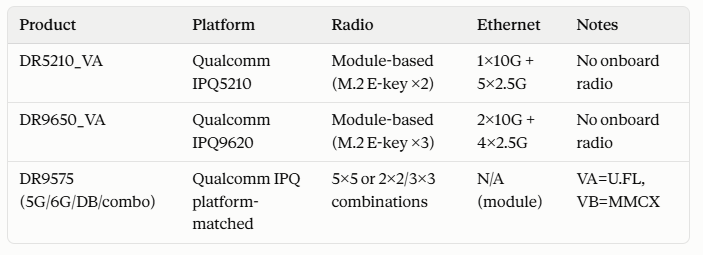
- DR5210_VA — IPQ5210-based mainboard, DDR4 + NOR/NAND flash, 2× M.2 E-key slots, 1× 10G copper + 5× 2.5G Ethernet, 12V input, no onboard radio (module-based design).
- DR9650_VA — IPQ9620-based mainboard, DDR4 + NOR/NAND flash, 3× M.2 E-key slots, 2× 10G copper + 4× 2.5G Ethernet, 12V input, also module-based.
- DR9575 module family — 5×5 5GHz, 5×5 6GHz, dual-band (2×2 2.4GHz + 3×3 5GHz), and a 5G/6G combo variant (3×3 5GHz + 2×2 6GHz, VB connector only). VA boards use U.FL connectors; VB variants use MMCX.
The modular mainboard-plus-radio-module architecture matters here specifically because of MAPC and coordinated spatial reuse: a fixed single-radio AP can’t easily be re-tuned as the 802.11bn draft evolves, but a mainboard that accepts interchangeable M.2 radio modules can be re-radioed as Wi-Fi 8 chipsets mature — relevant given the standard won’t be fully ratified until 2028.
Wi-Fi 8 vs. Wi-Fi 7: What Actually Changes


This is a distinct axis from the tri-band switchable vs. concurrent distinction that matters for current Wi-Fi 7 hardware selection — Wi-Fi 8’s coordination features operate at the network-topology level, above the radio-chain level.
Applications Enabled: Where UHR Actually Pays Off
- Multi-robot warehouse fleets: coordinated multi-AP scheduling and reduced tail latency directly address the roaming-drop and airtime-contention problems that show up once you have more than a handful of AMRs sharing a floor.
- Industrial vision networks: camera links tolerate throughput variance poorly; UHR’s packet-loss reduction target is more relevant here than raw peak bandwidth.
- Port, mining, and campus deployments: environments already using seamless-roaming Wi-Fi 6 APs (like our DR5018S-R series) are the natural upgrade path once Wi-Fi 8 silicon matures, since the underlying pain point — clean handoff between APs — is exactly what MAPC targets.
Hardware Summary – future products coming soon