Technical reference · 12 September 2026
| Specification | Configuration |
|---|---|
| Radio / platform | Wi-Fi 6 | 4x4 | 5 GHz |
| Theoretical PHY reference | 4804 Mb/s |
| Host / processor | QCN9074 / QCN9024 variant; PCIe 3.0 / M.2 E-Key |
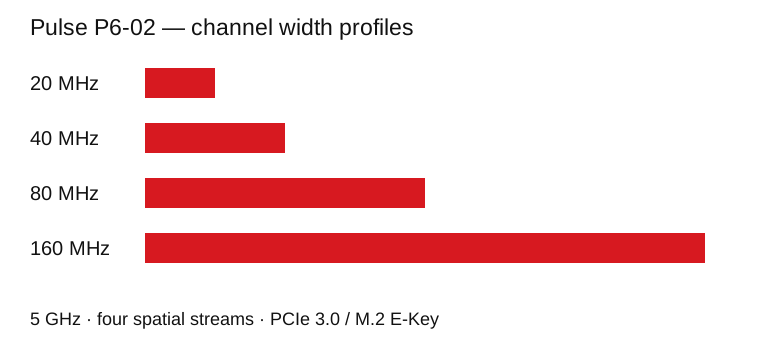
| Channel / network configuration | 20 / 40 / 80 / 160 MHz |
| RF / power | 4 x MMCX; 5 V carrier design |
| Mechanical / environment | 57 x 63 x 6 mm; -20 to +70 C |
| Parameter | Pulse P6-02 |
|---|---|
| Configuration storage | 2 Mbit serial I2C EEPROM |
| PCIe host | PCI Express 3.0 through M.2 E-Key |
| RF allocation | Four transmit / four receive paths; four MMCX connectors |
| Power integration | 5 V module supply; carrier pin assignment matched before power-on |
| Environmental design | -20 to +70 C operating; -40 to +90 C storage; 5-95% RH non-condensing |
| Band | Spatial streams | Channel widths (MHz) | RF connector system |
|---|---|---|---|
| 5 GHz | 4 | 20 / 40 / 80 / 160 | 4 x MMCX |
Pulse P6-02 uses the ath11k driver family for Linux integration. Prepare the PCIe host, driver, device firmware and calibration as one matched software set. For an OpenWrt host, choose packages built for that host release and kernel ABI, then verify the detected device and radio profiles.
| Integration item | Configuration |
|---|---|
| Radio platform | QCN9074 / QCN9024 variant; PCIe 3.0 / M.2 E-Key |
| Driver family | ath11k |
| Firmware lookup family | /lib/firmware/ath11k/QCN9074/hw1.0/ — confirm the path requested in the device boot log |
| Board data | Retain the unit calibration and revision-specific board data; match the PCI/subsystem and board identity. |
| Radio profile | Wi-Fi 6 | 4x4 | 5 GHz; 20 / 40 / 80 / 160 MHz |
| Read-only first checks | lspci -nnk; dmesg; iw phy; iw dev; iw reg get |
Use the following commissioning procedure for Pulse P6-02. This is a test method, separate from the theoretical PHY specifications and datasheet RF references above.
| Step | Record and verify |
|---|---|
| Baseline | Model/revision, firmware build, host CPU, uplink speed, channel width, country profile, antennas and client spatial streams. |
| Link verification | Capture negotiated PHY, RSSI per chain and noise/retry statistics before sustained traffic. |
| Wired reference | Measure the wired path first; select a server link appropriate to 4804 Mb/s. |
| Traffic test | Run TCP in each direction, then concurrent clients; record duration, CPU load, temperatures and retransmissions. |
| Site acceptance | Repeat at the intended mounting positions; save results with the exact configuration for comparison. |
524WiFi™ engineering support · Tomorrow Systems®