
Description
524WiFi Signal Plus™: Wideband four-path cellular performance from 617 to 6000 MHz
Engineered for receive and transmit. 524WiFi Signal Plus™ is our technical designation for an antenna whose frequency range, elements, MIMO ports, 50-ohm impedance, gain and matching are specified as one complete RF system. A passive antenna uses the same reciprocal RF path in both directions: it receives signals and radiates the transmitter power supplied by the connected radio.
Four matched passive paths support 4×4 MIMO across key sub-6 GHz cellular ranges. Documented gain rises from 2.5 dBi in the lowest band to 4 dBi in the highest supported band, with VSWR below 2.5. This gives installers a specification-led choice instead of a vague one-size-fits-all accessory. It is not an active amplifier and does not create additional transmitter power; the advantage comes from selecting the correct pattern, gain, ports, polarization and connectors for the real installation.
- 4×4 MIMO from 617 to 6000 MHz
- 2.5 / 3.5 / 4 dBi documented gain
- VSWR <2.5
- Four 3 m LMR100 leads with SMA male
Documented gain by frequency range
Bar lengths are normalized within this product for quick comparison; the printed dBi values are authoritative. End-to-end results also depend on radio power, cable loss, placement, alignment, interference and local network conditions.
524WiFi™ 4G LTE/5G External Omnidirectional Antenna, 4×4 MIMO, 617-6000 MHz, 4x SMA Male, 3 m
A wideband four-port outdoor antenna for cellular routers, gateways and modems that use 4×4 MIMO. Its omnidirectional pattern covers the major sub-6 GHz 4G LTE and 5G ranges from 617 to 6000 MHz, while four 3 m leads allow the radio to remain protected indoors or in an enclosure.
Key benefits
- Wide 617-6000 MHz coverage for sub-6 GHz cellular networks
- 4×4 MIMO with four independent antenna feeds
- Omnidirectional 360° horizontal radiation pattern
- Up to 4 dBi gain across the supported frequency groups
- Four SMA male connectors on 3 m white LMR100 cables
- Outdoor UV-resistant PVC radome and mast mounting kit
Recommended applications
- 4G LTE and sub-6 GHz 5G routers
- Industrial gateways, telemetry and failover links
- Remote sites, buildings and fixed wireless installations
- 4×4 MIMO cellular modems with four SMA female ports
Installation and compatibility
Connect all four SMA male leads to the cellular antenna ports of one 4×4 MIMO modem or router. Confirm that the device uses standard SMA female connectors; RP-SMA is not compatible. Band support alone does not guarantee service: the modem, SIM, operator bands, signal conditions and local network deployment must also be compatible.
Technical specifications
| Frequency range | 617-960 MHz; 1710-3800 MHz; 4900-6000 MHz |
|---|---|
| Gain | 2.5 dBi; 3.5 dBi; 4 dBi |
| MIMO / ports | 4×4 MIMO; 4 ports |
| Polarization | Vertical |
| Horizontal beamwidth | 360° |
| Vertical beamwidth | 60° |
| VSWR | <2.5 |
| Impedance | 50 ohms |
| Maximum input power | 50 W |
| Lightning protection | DC ground |
| Connectors and cable | 4x SMA male; 3 m white LMR100 |
| Dimensions / weight | Ø132 x 220 mm; 1.2 kg |
| Mounting | Mast Ø40-60 mm |
| Radome | UV-resistant PVC, white |
| Rated wind velocity | 210 km/h |
| Operating temperature | -40°C to +65°C |
Package contents
- 524WiFi™ wideband outdoor omnidirectional antenna
- Four integrated 3 m white LMR100 leads with SMA male connectors
- Mast-mounting kit
524WiFi™ model: 524WIFI-TOF-0660-4DV
Actual wireless performance depends on the connected equipment, cable losses, installation, radio environment and applicable local regulations.
Outdoor omnidirectional coverage built around documented RF values
The 524WIFI-TOF-0660-4DV is the cellular member of the outdoor omni range. Four antenna paths cover the documented 617–960, 1710–3800 and 4900–6000 MHz blocks for compatible 2G, 3G, 4G LTE and sub-6 GHz 5G equipment. Band-dependent gain is 2.5, 3.5 and 4 dBi, prioritising broad multi-band service around the mast instead of a narrow high-gain sector.
An omnidirectional antenna is selected when users or remote devices surround the mounting point. Its 360° horizontal pattern avoids the continuous realignment required by a directional antenna and makes the installation useful for yards, campuses, marinas, farms, industrial sites, temporary operations and other areas where clients can approach from several directions. It is not the best choice when every important device is located inside one narrow sector; in that case a directional panel can place more of the available energy toward the target.
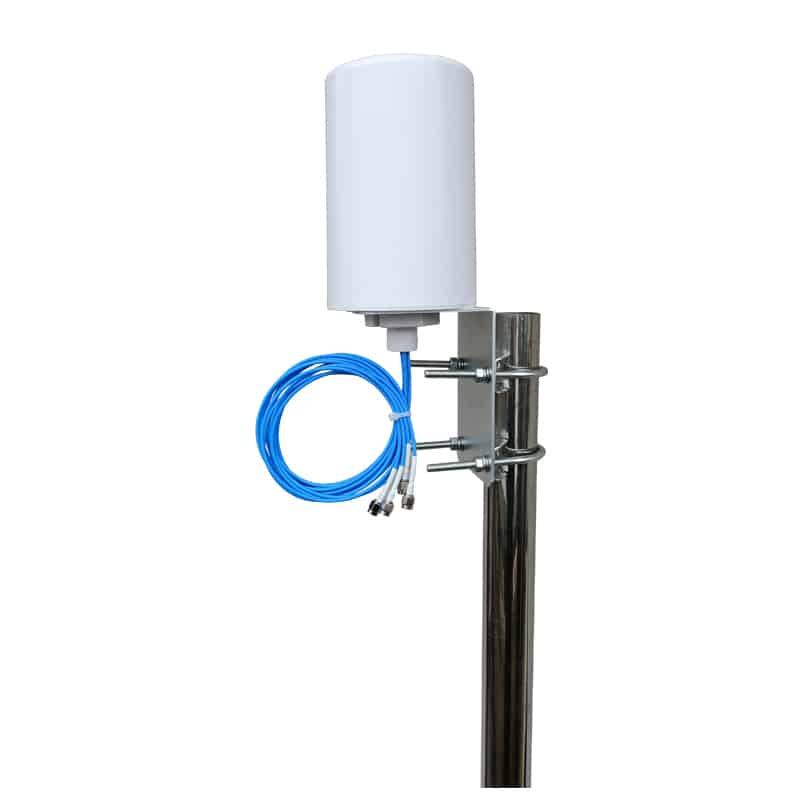
4×4 MIMO, four SMA male leads on 3 m LMR100
This purchased custom 524WiFi™ configuration uses four 3 m white LMR100 cables terminated in standard SMA male. It is designed for cellular routers and gateways that provide four compatible SMA female antenna ports. Do not confuse standard SMA with RP-SMA.
Four co-located paths support a compatible 4×4 cellular modem or router. The wide multi-band design is useful where operators, bands and aggregation combinations may change, but the modem must still support the required bands.
How the radiation pattern shapes real-world coverage
The horizontal beam width is 360°, which describes coverage around the mast. The vertical beam is 60° across the documented product pattern. Imagine a flattened volume of RF energy extending around the antenna rather than a perfect sphere. Mounting the antenna higher can improve line of sight, but excessive height or a poorly chosen vertical pattern can move the strongest energy above or beyond nearby users. Coverage must be planned in three dimensions.
2.5 / 3.5 / 4 dBi by frequency block · 360° azimuth · 60° vertical beam
Install with the antenna vertical and clear of large metal surfaces. Mounting directly beside a steel pole, wall edge, roof plant or solar-array frame can shadow part of the circle and change impedance. Use the supplied mast hardware within the documented diameter range, support every cable independently and create a weather-managed cable route. The outdoor radome and wind rating do not make an exposed connector joint automatically weatherproof; seal outdoor RF interfaces with a professional layered weatherproofing system.
What 4×4 contributes — and what it does not promise
Modern LTE and 5G routers may use several antenna ports for diversity, carrier combinations and MIMO. This antenna presents four outdoor paths in one housing so the modem can work with the propagation environment. The exact number of streams and bands in use is controlled by the modem, network and serving cell, not by the antenna alone.
MIMO performance is an end-to-end property. The radio must provide the corresponding number of external RF ports, the firmware must use them correctly and the remote device must support compatible spatial operation. The antenna cannot manufacture extra streams, bandwidth or transmitter power. Its job is to provide matched passive RF paths with a known pattern, gain, impedance and connector arrangement.
Connect all active radio paths and keep cable routing consistent. Long extensions, mixed cable types and unnecessary adapters can introduce unequal loss between paths, which reduces the value of a carefully selected MIMO antenna. Where an extension is unavoidable, choose 50-ohm low-loss coax rated for the highest operating frequency and include the complete connector-and-cable loss in the link budget.
524WiFi Signal Plus™ on receive and transmit
524WiFi Signal Plus™ is our specification-led designation for the complete passive RF path. The antenna works reciprocally: on receive it collects energy from remote radios; on transmit it radiates the energy delivered by the connected equipment. The same frequency coverage, pattern, gain, matching and feed system matter in both directions. Signal Plus is not a powered amplifier and does not override the radio’s limits.
The model’s Signal Plus basis is its multi-band four-path design, 360° pattern, band-dependent 2.5/3.5/4 dBi gain, VSWR below 2.5, 50-ohm impedance and custom four-lead feed system. It supports the uplink from the router as well as the downlink from the network.
Recommended deployments
Four-port gateways serving sites where towers may lie in different directions.
Remote cabinets, automation and monitoring systems needing broad operator coverage.
Installations where orientation to one fixed base station cannot be guaranteed.
Use this omni model where several base stations or operators may serve the location from different azimuths, or where the equipment is mobile within a site. If one known distant cell is the only useful target, the directional 4×4 panel can deliver more gain and reject more energy from behind.
Site-planning checklist
- Map the clients. Confirm that important devices genuinely surround the antenna. If they occupy one direction only, compare a directional panel before committing to omni coverage.
- Confirm bands and ports. Match the radio’s operating bands, number of external antenna ports, 50-ohm impedance and exact connector gender to this purchased configuration.
- Choose useful height. Seek line of sight over local obstructions without placing the vertical pattern above nearby clients. Analyse both the closest and farthest service points.
- Control feed-line loss. Account for all four integrated 3 m LMR100 runs and any adapters. Cellular low bands tolerate cable loss better than the upper bands, so calculate the worst case at the highest band you intend to use.
- Protect the outdoor interfaces. Provide strain relief, a drip loop, connector weatherproofing, grounding and surge protection appropriate to the structure and local electrical rules.
- Measure both directions. Check receive metrics, throughput and stability from representative low-power clients as well as signal strength reported by the client. A strong downlink alone is not a complete wireless link.
Understanding the specification instead of chasing one headline number
- Frequency coverage
- The documented blocks are 617–960, 1710–3800 and 4900–6000 MHz. Coverage is not a claim that every frequency between 617 and 6000 MHz has identical performance. Verify the modem and operator bands used at the site.
- Documented gain
- 2.5, 3.5 and 4 dBi across the specified frequency blocks. This moderate gain supports broad azimuth coverage rather than concentrating energy toward one tower.
- VSWR
- Specified below 2.5. Installed return loss can be worsened by poor connectors, damaged cable, water ingress or mounting too close to conductive structures.
- 50-ohm impedance
- Matches the standard RF system impedance expected by compatible radios, connectors and coaxial feed lines.
- DC ground
- Describes the antenna’s specified static/lightning-protection topology. It does not replace building bonding, surge arrestors or a code-compliant lightning-protection design.
- Wind and temperature
- The specified radome assembly is rated for 210 km/h wind and operation from −40°C to +65°C. Correct mast hardware, cable support and connector sealing remain the installer’s responsibility.
Omnidirectional or directional?
Choose this omni model when coverage must extend around the installation point and a single azimuth direction would leave important clients behind the antenna. Choose a directional panel when the remote site, base station or service sector is known and concentrated. A directional antenna can offer more gain and interference rejection toward one target, while an omni antenna offers broader azimuth coverage and easier support for moving or distributed clients.
Choose the omni version when tower direction is unknown, multiple networks matter or clients move around the site. Choose the 617–4200 MHz directional panel when a survey identifies one useful serving sector and additional directional gain is worth the alignment work.
Frequently asked technical questions
Does higher mounting always improve the result?
No. Height can improve line of sight, but the vertical beam must still intersect the client area and longer cable may consume the gain advantage. Select height together with pattern, distance and feed loss.
Can this passive antenna boost transmitter power?
No. It has no active amplifier. Antenna gain describes how the radiation pattern concentrates energy relative to a reference. Legal transmitter power and EIRP remain controlled by the radio configuration and local regulation.
Can unused MIMO leads be left disconnected?
Only if the radio manufacturer explicitly permits that operating mode and the unused radio ports are handled as specified. Never transmit into an active unterminated port. Select the antenna port count that matches the equipment.
Is the antenna automatically compatible with every router?
No. Compatibility requires matching frequency bands, number of external ports, 50-ohm impedance, connector series and gender, and support for external antennas in the device documentation. This purchased version uses four standard SMA male connectors and 3 m LMR100 cables. Confirm four SMA female modem ports and the operator bands before installation.
Will the antenna provide the same distance in every direction?
The nominal azimuth pattern is omnidirectional, but the installed environment is not. Buildings, trees, vehicles, terrain, metalwork, cable loss, interference and remote-device capability can create substantial directional differences. A site survey is the correct way to validate coverage.
Engineering note from 524WiFi™
Plan the complete bidirectional link, not only the access-point signal bar. Match the radio ports, account for every metre of feed line, keep the antenna clear of metal, protect the outdoor interfaces and verify uplink from the weakest client. The 524WIFI-TOF-0660-4DV then provides a documented 4×4 omnidirectional foundation rather than an unknown generic aerial.

Reviews
There are no reviews yet.