
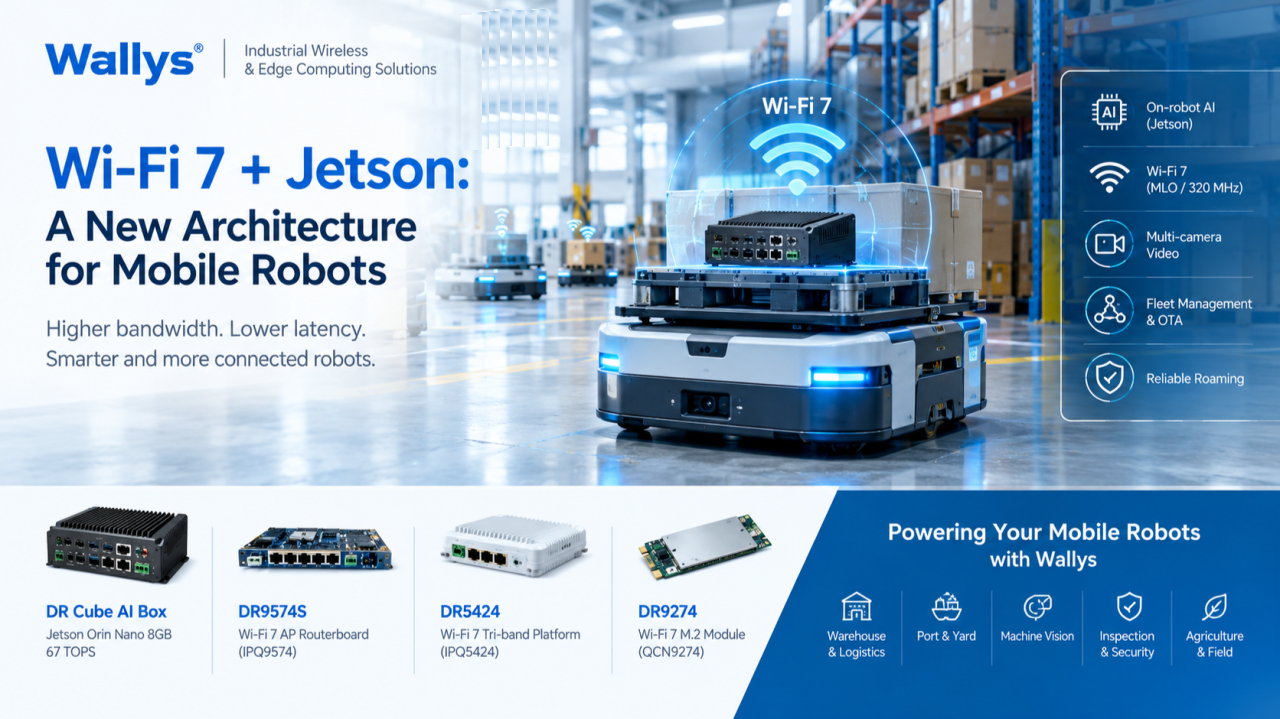
Mobile robots used to be limited mainly by batteries and mechanics. Increasingly, the limit is data movement. A modern AMR or UGV carries multiple cameras, LiDAR, and depth sensors. It runs perception models on board, and it has to stay connected while roaming across a warehouse, port, or factory floor. Compute has advanced quickly with NVIDIA Jetson. The wireless link has often stayed one generation behind.
Pairing Jetson-class edge compute with a Wi-Fi 7 network is one practical way to close that gap.
Why Jetson and Wi-Fi 7 belong in the same architecture
Jetson runs perception, localization, and navigation on the robot itself, so the robot does not depend on the network for real-time decisions. But the network still carries the data that matters at fleet level:
- Compressed multi-camera streams for remote monitoring and teleoperation
- Map and model updates pushed to many robots at once
- Fleet telemetry, task dispatch, and OTA firmware
- Handover of the robot’s connection between access points while moving
Wi-Fi 7 (IEEE 802.11be) addresses these directly. Channels of up to 320 MHz in the 6 GHz band raise per-link capacity. 4K-QAM raises spectral efficiency. Multi-Link Operation (MLO) lets a client use more than one band to improve reliability and reduce latency variation. Multi-RU scheduling helps when many small clients share a channel, which is the typical multi-robot case.
How the pieces fit together: 524WiFi and Wallys edge platform
At 524WiFi and Wallys, we treat the robot’s compute and its radio as one design problem rather than two separate purchases.
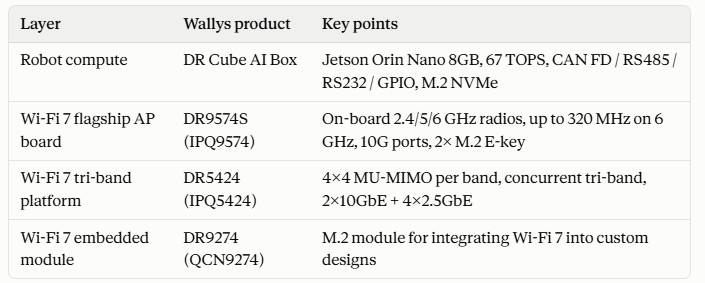
On the robot: the DR Cube AI Box is built on the NVIDIA Jetson Orin Nano 8GB module with our custom carrier board. It offers 67 TOPS of AI performance. Connectivity includes Gigabit Ethernet (one port with 48V PoE), optional Wi-Fi, and optional 4G/5G. Robot-side I/O includes CAN FD, RS485, RS232, GPIO, USB 3.0, and an M.2 NVMe slot. Because we design custom carrier boards, the same architecture can also be built around a different Jetson module or a different I/O layout.
On the infrastructure side: Wi-Fi 7 platforms based on Qualcomm silicon serve as the access point layer. Examples are the DR9574S (IPQ9574), the DR5424 (IPQ5424), and the DR9274 M.2 module (QCN9274) for embedding Wi-Fi 7 into your own hardware.
One point worth stating clearly: tri-band does not always mean the same thing. On the DR5424 and DR9574S, the 2.4 GHz, 5 GHz, and 6 GHz radios are three independent chains running concurrently. Some tri-band cards are tri-band switchable, meaning one radio moves between bands to avoid interference. Both approaches are useful, but they suit different designs, so check which one a product actually is before planning around it.
Compared with the usual approach
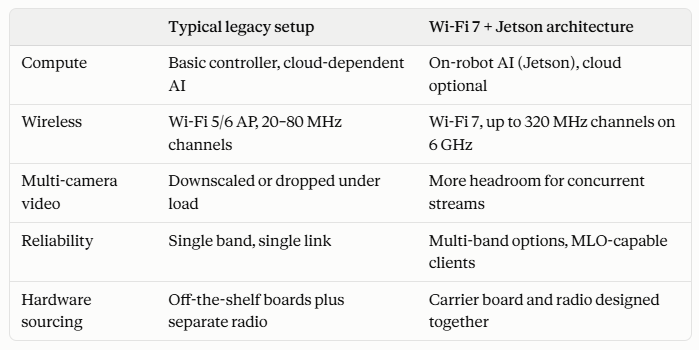
Wi-Fi 7 is not a magic fix. Real roaming performance still depends on AP placement, channel planning, and client support. But the higher-capacity link and the multi-band tools give the network more room to work with.
Where this architecture applies
- Warehouse and logistics AMRs: dense multi-robot fleets with steady roaming and continuous telemetry
- Port and yard vehicles: long-range coverage with camera-based monitoring
- Machine vision on the move: multi-camera, high-resolution image transfer to inspection systems
- Inspection and security robots: live video plus on-board detection
- Agricultural and field robotics: long-range control and video links, with custom transmission software where needed
Hardware summary
Talk to us
If you are building mobile robots on Jetson and would rather not develop the wireless hardware yourself, we can supply the modules, routerboards, and custom carrier boards, plus long-range transmission software customization.