Posted on

VLAN Applications in the Logistics Industry – Smart Warehouse & Automation Systems

As the logistics industry continues to evolve, there is a growing need for efficient, stable, and flexible networking solutions. Virtual Local Area Networks (VLANs) provide a powerful tool for managing network traffic, optimizing resources, and improving both efficiency and security within logistics operations. Below are several key VLAN application scenarios within the logistics industry.


1. Smart Warehouse & Automation Systems

Smart warehouses, equipped with automated systems like robotic arms, conveyor belts, sensors, and RFID systems, rely on a robust network for seamless data exchange. VLANs can improve network performance by segmenting traffic based on device type.

  • VLAN Segmentation:
  • VLAN 10 (Automated Guided Vehicle Network): Ensures low-latency, high-priority communication for automated guided vehicles (AGVs).
  • VLAN 20 (RFID & Scanners): Provides dedicated bandwidth for RFID systems and scanners, ensuring real-time tracking.
  • VLAN 30 (Surveillance Network): Segregates video surveillance data from other traffic to prevent congestion.

VLAN helps ensure that critical devices such as AGVs and RFID scanners can communicate without interference, enhancing warehouse efficiency.


2. Sorting Systems in Distribution Centers

Sorting systems in distribution centers often involve complex automation machinery that requires real-time communication to optimize the sorting of parcels. VLANs help ensure smooth operation by prioritizing the traffic of sorting equipment.

  • VLAN Segmentation:
  • VLAN 100 (Sorting Equipment Network): Dedicated VLAN for the machinery that handles sorting, minimizing delays caused by high data traffic.
  • VLAN 200 (Office Management Network): Separates office traffic from operational machinery, avoiding disruptions to real-time sorting tasks.
  • VLAN 300 (Customer Service Interface): Isolates customer-facing systems, ensuring customer data remains secure while other operational processes run smoothly.

VLANs optimize data flow within the sorting systems and prevent network congestion, increasing overall throughput.


3. IoT Devices and Wireless Networks

In the logistics industry, IoT devices such as temperature sensors, GPS trackers, and smart locks play an integral role in monitoring and managing goods during transit and storage. VLANs are essential for managing and securing wireless network traffic.

  • VLAN Segmentation:
  • VLAN 50 (IoT Device Network): Creates a dedicated VLAN for all IoT devices, ensuring reliable data transfer while isolating traffic from other networks.
  • VLAN 60 (Customer Wi-Fi Network): Segregates visitor and employee Wi-Fi access from critical business systems to ensure security.

Using VLANs ensures that sensitive logistics data from IoT devices is protected and prioritized, enabling real-time monitoring and secure communications.


4. Security and Data Isolation

The logistics industry handles sensitive customer data, inventory management information, and delivery details. VLANs are used to isolate these critical data streams from other less sensitive traffic, adding an additional layer of security.

  • VLAN Segmentation:
  • VLAN 10 (Management and Control Network): Isolates administrative systems and critical control networks to prevent unauthorized access.
  • VLAN 20 (Customer Data Network): Protects customer and order information by creating a separate VLAN for processing sensitive data.
  • VLAN 30 (Surveillance Network): Ensures video feeds from surveillance cameras are kept within a dedicated network, preventing bandwidth overload.

VLANs improve data security by isolating sensitive systems from regular traffic, reducing the risk of data breaches or unauthorized access.


5. Integration with 5G Networks

As logistics operations increasingly incorporate 5G technology, VLANs help ensure that high-priority devices, such as autonomous delivery vehicles and drones, have dedicated network resources for efficient communication.

  • VLAN Segmentation:
  • VLAN 70 (Autonomous Vehicle Network): Dedicated VLAN for vehicles and drones that require low-latency and high-bandwidth communication.
  • VLAN 80 (Public-facing Network): Provides separate VLANs for external systems, ensuring no interference with mission-critical logistics systems.

Integrating VLANs with 5G allows logistics companies to optimize network performance for high-demand devices, ensuring smooth and efficient operations.

Router board DR4019 Vlan Solution

✅ Industrial-Grade Performance

  • Qualcomm IPQ4019/IPQ4029 chipset for stable, 24/7 operation.

✅ High-Power Wireless Connectivity

  • Dual-band radios: 2×2 5GHz & 2×2 2.4GHz high-power modules.
  • Frequency range: 4.940GHz–5.825GHz & 2.400GHz–2.482GHz.
  • MMCX connectors for flexible antenna deployment.
  • Supports 5MHz/10MHz/20MHz/40MHz/80MHz bandwidth.

✅ VLAN & Network Optimization

  • VLAN-ready for secure network segmentation in logistics hubs.
  • 802.11s Mesh support for seamless warehouse connectivity.
  • Fixed data rate for AGVs, RFID, and IoT tracking.

✅ Flexible Firmware & Integration

  • Supports OpenWRT, QSDK, OpenWiFi.
  • Compatible with Quectel modules for LTE/5G expansion.

✅ Environmentally Safe

  • RoHS compliant, ensuring safety and sustainability.
DR4019 mainboard ipq4019

Conclusion

VLAN technology plays a crucial role in optimizing network performance, improving security, and supporting the growth of smart logistics systems. By segmenting traffic based on device type and use case, logistics companies can improve data flow, reduce congestion, and ensure secure communication across their networks. As the logistics industry continues to evolve with IoT, automation, and 5G, VLANs will remain a key component in driving efficiency, security, and innovation.

The Router board DR4019 Vlan Mesh Solution
Posted on

AIoT & Robotics Boom: How WiFi 6/7 Enables Seamless Wireless Networks

The rapid rise of AIoT (Artificial Intelligence of Things) and robotics is transforming industries, from smart manufacturing and autonomous logistics to healthcare and consumer robotics. As robots become more intelligent and interconnected, the need for high-speed, low-latency, and reliable wireless communication is greater than ever. WiFi 6 and WiFi 7 are emerging as key enablers of seamless connectivity in the AIoT-driven robotics revolution.

Challenges in Wireless Communication for AIoT and Robotics

AI-powered robots rely heavily on real-time data exchange, cloud processing, and collaborative operations. However, traditional wireless networks face several challenges in meeting these demands:

  • High Latency: Robotics applications, such as autonomous mobile robots (AMRs) and industrial automation, require ultra-low latency to ensure precise control and real-time decision-making.
  • Interference & Congestion: Dense industrial environments often experience significant wireless interference, affecting communication reliability.
  • Bandwidth Limitations: High-resolution sensors, AI-driven vision systems, and cloud-based data processing generate massive data streams that require high-throughput connectivity.
  • Seamless Roaming: Robots moving within factories, warehouses, or hospitals need smooth network transitions without disruptions.

How WiFi 6 and WiFi 7 Solve These Challenges

WiFi 6 and WiFi 7 introduce groundbreaking advancements that make them ideal for AIoT and robotic applications:

1. Ultra-Low Latency for Real-Time Control

  • WiFi 6: Features OFDMA (Orthogonal Frequency Division Multiple Access) and MU-MIMO, allowing multiple devices to communicate simultaneously, reducing latency.
  • WiFi 7: Introduces Multi-Link Operation (MLO), enabling robots to use multiple frequency bands simultaneously, further reducing latency and ensuring stable connectivity.

2. Enhanced Interference Resistance in Industrial Environments

  • WiFi 6: Uses BSS (Basic Service Set) Coloring to minimize co-channel interference, improving efficiency in dense environments.
  • WiFi 7: Supports Adaptive Preamble Puncturing, allowing devices to avoid interference dynamically and maintain high-speed connections.

3. High Bandwidth for AI-Driven Applications

  • WiFi 6: Expands channel width up to 160 MHz, supporting high-throughput applications like AI-powered vision systems.
  • WiFi 7: Doubles the bandwidth with 320 MHz channels, significantly boosting data rates for real-time AI processing and high-resolution sensor data transmission.

4. Seamless Roaming for Mobile Robots

  • WiFi 6 & 7: Both support enhanced roaming protocols, ensuring robots moving within large-scale environments (factories, warehouses, hospitals) maintain uninterrupted connectivity.

524WiFi’ WiFi 6/7 Solutions for Robotics & AIoT

524WiFi and Wallys, a leading providers of industrial wireless solutions, offers a range of high-performance WiFi 6 and WiFi 7 modules and router boards designed for AIoT and robotic applications. Key products include:

  • DR5018S (WiFi 6) – A robust router board featuring Qualcomm IPQ5018, optimized for low-latency and high-speed industrial connectivity.
  • DR9574 (WiFi 7) – A next-gen WiFi 7 router board powered by IPQ9574, delivering exceptional performance with Multi-Link Operation and 320MHz bandwidth.
  • DR9074 Network Card – A high-speed WiFi 6E module for seamless AIoT data transmission in robotic applications.

Conclusion: WiFi 6 & 7—The Future of AIoT and Robotics Connectivity

As AIoT and robotics continue to evolve, reliable and high-performance wireless networks will be the backbone of their success. WiFi 6 and WiFi 7 provide the speed, low latency, and seamless connectivity required for next-generation robotic applications. By integrating cutting-edge WiFi solutions, businesses can unlock the full potential of AI-powered automation and create truly intelligent, interconnected environments.

Posted on

Robotics + Edge Computing: How WiFi 7 Enhances Data Transmission Efficiency

Introduction

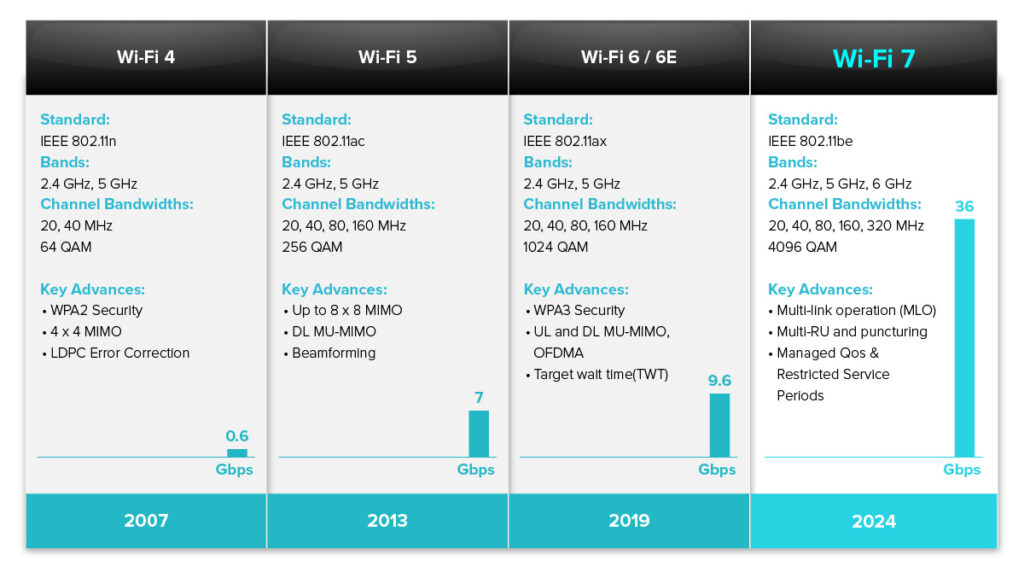
The rapid advancements in robotics and edge computing have revolutionized industries such as manufacturing, healthcare, logistics, and smart cities. However, these innovations require ultra-fast, low-latency, and highly reliable wireless communication to function effectively. Enter WiFi 7 (802.11be)—the next-generation wireless standard that significantly improves data transmission efficiency, making it an ideal solution for robotics and edge computing applications.

Challenges in Robotics and Edge Computing Connectivity

Robotic systems and edge devices process vast amounts of data in real time, often in environments with high device density, dynamic movement, and complex networking needs. Some of the key connectivity challenges include:

  • High Bandwidth Demand – Robots generate and transmit high-resolution sensor data, video feeds, and AI computations, requiring ultra-fast wireless speeds.
  • Low Latency Requirement – Real-time control, decision-making, and autonomous navigation depend on millisecond-level latency.
  • Interference & Network Congestion – Industrial and urban environments are packed with multiple wireless devices, leading to potential signal interference and congestion.
  • Seamless Handover & Reliability – Mobile robots, drones, and AGVs (Automated Guided Vehicles) need consistent connectivity without dropouts when moving across different network zones.

How WiFi 7 Enhances Data Transmission Efficiency for Robotics & Edge Computing

1. Multi-Link Operation (MLO) for Lower Latency & Higher Reliability

WiFi 7 introduces Multi-Link Operation (MLO), allowing devices to simultaneously transmit and receive data over multiple frequency bands (2.4 GHz, 5 GHz, and 6 GHz). This enhances:

  • Lower latency by dynamically selecting the best path with minimal interference.
  • Increased reliability by enabling seamless switching between channels, preventing disruptions in robotic control systems.

2. Wider Channel Bandwidth (Up to 320 MHz) for Faster Data Transmission

WiFi 7 supports 320 MHz channel bandwidth (double that of WiFi 6), offering significantly higher data transfer speeds. For edge AI applications and real-time video analytics, this means:

  • Faster data exchange between robotic sensors and edge servers.
  • Reduced congestion in high-density environments such as smart factories or hospitals.

3. 4K QAM Modulation for Increased Data Throughput

WiFi 7 introduces 4096-QAM (4K QAM), compared to 1024-QAM in WiFi 6, boosting the amount of data transmitted per signal. This results in:

  • Up to 20% higher throughput, making it ideal for transmitting high-resolution images, LIDAR data, and AI-driven commands in real-time.
  • Improved efficiency for multi-robot coordination and cloud-edge communication.

4. Better Performance in Congested Environments

With features like Preamble Puncturing, WiFi 7 can efficiently utilize spectrum even in noisy environments, preventing bandwidth wastage. This is especially useful in:

  • Industrial automation, where multiple machines operate wirelessly.
  • Smart cities, where multiple sensors, cameras, and edge devices coexist.

5. Deterministic Latency for Time-Sensitive Operations

WiFi 7 introduces deterministic latency mechanisms, ensuring that time-sensitive robotic tasks are completed with predictable timing. This is crucial for:

  • Robotic surgery and medical robotics, where even slight delays can impact outcomes.
  • Autonomous vehicles and drone networks, where real-time decision-making is critical.

Real-World Applications of WiFi 7 in Robotics & Edge Computing

🔹 Smart Manufacturing

  • WiFi 7 enables real-time monitoring and control of robotic arms and AGVs in factories.
  • High-speed connectivity ensures seamless data exchange between sensors, AI models, and cloud platforms.

🔹 Healthcare & Medical Robotics

  • Enhances low-latency video streaming for remote robotic surgeries and AI-driven diagnostics.
  • Supports real-time data analytics in hospitals with multiple edge AI applications.

🔹 Autonomous Vehicles & Drones

  • WiFi 7’s high throughput and MLO allow faster V2X (Vehicle-to-Everything) communication for autonomous driving.
  • Drones used in agriculture, surveillance, and delivery services benefit from more reliable long-range communication.

Conclusion

WiFi 7 is a game-changer for robotics and edge computing, providing the necessary speed, reliability, and efficiency to support next-generation AI-driven applications. As industries adopt autonomous systems, real-time AI processing, and IoT, WiFi 7 will be at the core of ensuring seamless and intelligent connectivity.

Looking for a WiFi 7 hardware solution for your robotics or edge computing project? Contact us for industrial-grade WiFi 7 router boards, network cards, and custom solutions.

Posted on

Industrial Wi-Fi with AI: Opportunities and Challenges Brought by DeepSeek

The integration of AI into industrial Wi-Fi networks is revolutionizing how industries operate, creating smarter, more efficient systems that can process data in real-time, automate processes, and enhance security. One notable advancement in AI technology is DeepSeek, an AI-powered solution leveraging deep learning models to accelerate data processing. As these technologies make their way into industrial networks, they present both exciting opportunities and unique challenges. In this article, we explore how DeepSeek can benefit industrial Wi-Fi networks, the advantages it offers, and the hurdles businesses must overcome to successfully implement these systems.

1. Opportunities: Enhancing Industrial Wi-Fi with AI

AI technologies, such as DeepSeek, are significantly improving how industrial systems handle and analyze data. Here’s a look at how DeepSeek can unlock new possibilities in industrial Wi-Fi networks:

1.1. Improved Network Efficiency and Real-Time Data Processing

With DeepSeek AI models, industrial Wi-Fi networks can process massive amounts of data generated by IoT devices, sensors, and cameras in real-time. Platforms like the Rockchip RK3588, which integrates a 6 TOPS NPU, offer the perfect environment for running these AI models. According to a recent post on CNX Software, DeepSeek running on the RK3588 achieves up to 15 tokens per second, which significantly accelerates real-time data analysis and decision-making. This performance boost is especially important in industries like smart manufacturing and security, where low latency and rapid data processing are essential.

AI-powered networks can reduce delays, boost decision-making speed, and improve operational efficiency by quickly analyzing large data sets. For industries that rely on real-time decision-making, this can translate into faster responses to changing conditions.

1.2. Predictive Maintenance and Automation

Predicting machine malfunctions before they occur is another advantage of integrating AI into industrial Wi-Fi systems. By analyzing data from machines, sensors, and connected devices, DeepSeek can detect patterns and predict potential failures. This is known as predictive maintenance—a key element of Industry 4.0.

The ability to identify early warning signs of equipment issues reduces the risk of costly downtime and improves overall equipment efficiency. Moreover, AI automation powered by DeepSeek can enhance processes like inventory management, quality control, and production scheduling, all while reducing human error.

1.3. Enhanced Security and Surveillance

Security is a major concern for industries that rely on connected systems and devices. AI enables smarter surveillance systems that are capable of face recognition, license plate detection, and anomaly detection in real time. When integrated into industrial Wi-Fi networks, DeepSeek models can significantly enhance security systems by processing video feeds and sensor data quickly and accurately.

AI-powered surveillance is especially useful in smart cities and sensitive industrial environments, where constant monitoring is crucial to prevent unauthorized access or security breaches.

2. Challenges: Barriers to AI Integration in Industrial Wi-Fi

While the advantages of integrating AI into industrial Wi-Fi systems are clear, there are several challenges that organizations must address to make the most of these technologies.

2.1. Hardware Compatibility and Performance

To run AI models like DeepSeek effectively, industrial systems need powerful hardware. In many cases, this means upgrading legacy infrastructure to include AI-capable hardware and ensuring compatibility between existing Wi-Fi equipment and AI acceleration platforms like Rockchip RK3588. These advanced NPU systems, capable of handling complex computations, are crucial for enabling real-time AI workloads.

As mentioned in the CNX Software article, the RK3588 platform’s AI acceleration allows for high-speed data processing, achieving up to 15 tokens per second, an impressive feat for industrial applications. However, organizations need to ensure that their systems can support these platforms and leverage their full potential.

2.2. Power Consumption and Thermal Management

AI workloads are energy-intensive, and the increased power consumption of AI systems can be a concern in industrial environments. High-performance AI accelerators, such as those using NPUs, generate substantial heat, which requires efficient thermal management systems to prevent overheating.

In industries where equipment runs continuously, managing the power consumption and heat generated by AI-enabled devices is critical. Companies must factor in these needs when implementing AI solutions like DeepSeek.

2.3. Data Security and Privacy

As AI systems process vast amounts of data, especially sensitive operational or security data, data security becomes a significant concern. Industrial Wi-Fi networks must ensure that AI models like DeepSeek are deployed with strong security frameworks in place.

Ensuring data privacy and compliance with regulatory standards is essential to avoid breaches or misuse of sensitive information. As AI models become more integrated into industrial systems, companies must adopt robust encryption and data protection protocols.

2.4. High Initial Costs and Complexity

The cost of upgrading infrastructure to support AI models can be prohibitively high for some businesses, especially small and medium-sized enterprises. Integrating advanced hardware, such as Rockchip RK3588 with NPU support, along with AI software like DeepSeek, requires a significant financial and resource investment. Additionally, these systems often require specialized personnel to implement and manage them.

The complexity of deploying and maintaining AI-powered industrial networks, combined with the need for specialized skills and hardware, can be a barrier to entry for many organizations.

3. 524WiFi’ Solutions for Optimizing Industrial Wi-Fi with AI

To address these challenges, 524WiFi and Wallys provide tailored solutions that integrate AI acceleration into industrial Wi-Fi networks. Products such as the DR9574 Router Board and the DR9074-triband module are designed to support high-performance AI applications, ensuring that companies can leverage AI-powered networks without sacrificing security, performance, or energy efficiency.

Wallys’ customized hardware and software support make it easier for industries to adopt AI technologies like DeepSeek, enabling seamless integration and efficient operation.

4. Conclusion

The integration of AI into industrial Wi-Fi networks brings remarkable opportunities for industries such as smart manufacturing, surveillance, and smart cities. With solutions like DeepSeek, powered by platforms like Rockchip RK3588, businesses can enhance network efficiency, enable predictive maintenance, and improve security.

However, the implementation of these technologies comes with its own set of challenges, such as hardware compatibility, energy consumption, data security, and cost. By addressing these issues with customized solutions from companies like 524WiFi or Wallys, industries can unlock the full potential of AI in their Wi-Fi networks, driving innovation and operational efficiency.

Posted on

The New Era of Wi-Fi 7: Elevating the Network to the Next Level – MediaTek MT7996

In the ever-evolving landscape of wireless communication, 524WiFi has once again asserted its commitment to innovation by diving headfirst into the realm of Wi-Fi 7 technology. As the demand for faster and more reliable connectivity continues to surge, 524WiFi’s strategic move positions the company at the forefront of the next generation of wireless networking.

524WiFi’s Wi-Fi 7 technology, utilizing MediaTek MT7996, leverages MediaTek’s distinctive 4T5R technology platform with advanced receiver diversity techniques and MRC (Multiple Receive Chains). This boosts throughput in the 6GHz frequency for indoor use, delivering wider coverage, top-notch performance, and a stable, efficient 6GHz mesh backhaul. As a manufacturer committed to maximizing MediaTek’s capabilities, AsiaRF strives to collaboratively craft an enhanced connectivity experience for Wi-Fi 7.

What is Wi-Fi 7

WiFi 7, based on the new IEEE 802.11be standard, operates in three frequency bands: 2.4 GHz, 5 GHz, and 6 GHz. With a maximum bandwidth of 320 MHz in the 6 GHz band, it significantly boosts data transfer rates, addressing the need for faster and more efficient wireless communication in modern networks.

Advantages of Wi-Fi 7 Technology

  • Ultra-High Speed:

Wi-Fi 7 operates on the 6GHz spectrum, enabling the use of channels as wide as 320Hz, further enhancing transmission speeds and achieving a threefold increase compared to the previous generation.

  • Low Latency:

Wi-Fi 7 technology reduces latency, offering more real-time connectivity suitable for applications with stringent low-latency requirements, such as video conferencing.

  • Multi-Link Operation (MLO):

Using Multiple Link Operation (MLO), Wi-Fi 7 enables devices to transmit and receive data across different frequency bands and channels simultaneously, enhancing throughput and reducing latency.

  • Reliable Connectivity:

The use of advanced modulation techniques and signal processing in Wi-Fi 7 enhances the reliability of wireless connections, reducing the likelihood of signal interference and disruptions in enterprise environments.

In summary, Wi-Fi 7, as the next-generation wireless technology, with its enhanced speed and performance, is set to redefine our online experience. 524WiFi is at the forefront of innovation, gearing up to launch high-performance Wi-Fi 7 products, including system platforms and modules. These products will elevate our connectivity experience to higher levels. Anticipate the exciting advancements that Wi-Fi 7 and 524WiFi´s upcoming products promise to bring, leading us into a new era of seamless and superior wireless connectivity.

Posted on

5M / 10M | Want faster, more reliable Wi-Fi with QCN 9074 ?

Unlocking New Frontiers in Wireless Communication with 524WiFi’ DR9074 WiFi Modules 🚀

We’re excited to share a game-changing update that takes connectivity to a whole new level! Our DR9074 series WiFi modules have just received a significant upgrade—now supporting 5M/10M bandwidth, opening the door to faster, more reliable wireless communication than ever before.

What Does This Mean for You?

Let’s break down the key benefits you can expect:

  • Enhanced Performance: Say goodbye to slow speeds and high latency. With these modules, you’ll experience faster data transmission and reduced lag, making them perfect for applications that need a bandwidth boost.
  • Future-Ready: As industries and technologies evolve, our DR9074 modules are built to stay ahead of the curve, ensuring your network stays top-notch for years to come.

Where Can You Use It?

From urban infrastructure to high-flying adventures, the DR9074 modules can be applied in a variety of exciting scenarios:

  • Smart Cities: The future of urban living is here. With our DR9074 modules, you can power next-gen IoT networks for smart lighting, traffic management, and real-time environmental monitoring—making cities smarter and more sustainable.
  • Enterprise Solutions: Whether in a tech startup or a global enterprise, high-speed internet is critical. These modules support blazing-fast connections in office buildings, commercial spaces, and remote work environments, enhancing productivity and collaboration.
  • Inflight Connectivity: Who said you can’t have seamless internet at 35,000 feet? With the DR9074 series, passengers can enjoy smooth and reliable internet access, elevating the inflight experience to new heights.

Why Choose 524WiFi?

We are passionate about pushing the limits of wireless technology. Our commitment to innovation means that we’re not just meeting the connectivity demands of today—we’re ready for the challenges of tomorrow.

So, whether you’re building the city of the future, improving business connectivity, or keeping travelers connected in the sky, the DR9074 series is the solution you’ve been waiting for.

Ready to take your network to the next level? Let’s connect! Reach out to us today and explore how we can help you achieve unparalleled wireless performance.

Posted on

IPQ4019 / IPQ4029 powered DR40X9 router board: Unlocking the Power of Mesh Networking with BATMAN

The DR40X9 WiFi 5 router, powered by Qualcomm’s IPQ4019 and IPQ4029 chipsets, delivers reliable and efficient connectivity for various environments. When integrated with BATMAN Mesh networking protocol, the DR40X9 offers seamless coverage, dynamic routing optimization, and fault tolerance, making it the perfect choice for large-scale, high-demand networks.

1. Core Features of DR40X9: Advantages of IPQ4019 and IPQ4029 Chipsets

The IPQ4019 and IPQ4029 chipsets are the backbone of the DR40X9, offering WiFi 5 (802.11ac) technology and the following capabilities:

  • Hardware Design: Equipped with powerful hardware and high-power amplifiers, the DR40X9 ensures excellent wireless coverage and performance, even in demanding environments.
  • WiFi 5 Technology: Delivers high throughput for stable wireless connectivity, ideal for industrial, commercial, and residential applications.

2. Benefits of Mesh Networking with DR40X9

(1) Enhanced Coverage with Multi-Hop Support

The DR40X9, powered by IPQ4019 or IPQ4029, can act as multiple interconnected nodes in a Mesh network, providing seamless wireless coverage over large areas. This is particularly useful for:

  • Large homes or offices
  • Multi-building campuses
  • Rural or suburban deployments

Each node extends the network, ensuring consistent connectivity without dead zones.

(2) Dynamic Route Optimization

When paired with BATMAN, the DR40X9’s Mesh network can dynamically optimize routing paths based on real-time link quality.

  • Result: Lower latency, faster data transmission, and automatic rerouting in case of node or link failures to enhance network reliability.

(3) Decentralized Architecture for Fault Tolerance

With BATMAN and the Mesh topology, each DR40X9 router independently makes routing decisions.

  • Impact: Eliminates single points of failure and ensures the network stays operational even if individual nodes disconnect or fail.

(4) Scalability for Large Networks

Thanks to the distributed nature of Mesh networks, adding more DR40X9 routers to expand the network is seamless, without significant performance degradation.

  • Performance: Scalable network expansion that maintains throughput and low latency, ideal for growing businesses or high-density areas.

(5) Low Maintenance with Automatic Node Discovery

BATMAN simplifies network setup by automatically discovering and integrating new nodes.

  • Efficiency: Reduces manual configuration efforts and adapts quickly to changes in network structure.

3. Performance Evaluation in Real-World Scenarios

(1) Home Use

  • Scenario: Multi-story homes with high device density
  • Benefits: Seamless streaming, gaming, and browsing across all rooms. Efficient multi-hop coverage eliminates dead zones.

(2) Small to Medium Enterprises (SMEs)

  • Scenario: Office spaces with multiple users and connected devices
  • Benefits: Reliable connectivity for video conferencing and file sharing. Fault tolerance ensures no disruption during critical operations.

(3) Outdoor and Industrial Deployments

  • Scenario: Farms, warehouses, or temporary outdoor setups
  • Benefits: Wide-area coverage with scalable Mesh configurations. Resilient to environmental challenges and node failures.

4. Potential Limitations

While WiFi 5 may not offer the same peak speeds and efficiency as WiFi 6/6E or WiFi 7, the DR40X9 performs exceptionally well in Mesh deployments. Combining it with BATMAN significantly mitigates these limitations, providing robust performance in real-world applications.


Conclusion

With the powerful IPQ4019 and IPQ4029 chipsets, the WallysTech DR40X9 WiFi 5 router excels in Mesh network setups. Its enhanced coverage, dynamic routing, fault tolerance, and scalability make it an excellent solution for residential, commercial, and industrial applications, where reliability and cost-effectiveness are prioritized.

Posted on

DR5018S 524 WiFi 6 Tri Band Routerboard with Qualcomm IPQ 5018 – High Performance, Industrial Grade Network Solution

Next-Generation Network Solution: WiFi 6 Routerboard DR5018S

In today’s rapidly evolving wireless communication landscape, both businesses and households demand faster, more stable, and more efficient networks. Leveraging years of technical expertise and innovative design, 524WiFi and Wallystech introduce the WiFi 6 Routerboard DR5018S, a cutting-edge solution tailored for those pursuing exceptional network performance.


Key Features

High-Performance Hardware Design

  • Powerful Processor: The DR5018S is equipped with the Qualcomm IPQ5018 processor, featuring a quad-core ARM Cortex-A7 architecture with a clock speed of up to 1.8GHz, delivering robust computing and processing power.
  • Tri-Band Support: Supports 2.4GHz, 5GHz, and 6GHz bands simultaneously, utilizing the WiFi 6 standard (802.11ax) to achieve ultra-low latency and high-speed transmission, ensuring smooth connections for multiple devices.
  • Efficient RF Design: 5GHz band powered by QCN6102 chipset with 2×2 MIMO support. 6GHz band powered by QCN6122 chipset with 2×2 MIMO support.
  • Outstanding Network Performance
  • High Throughput: Maximum throughput of up to 3.6Gbps, meeting the demands of home theaters, online gaming, and large-scale file transfers effortlessly.
  • Enhanced Connection Density: Supports OFDMA and MU-MIMO technologies, significantly improving network capacity and efficiency, enabling smooth connections for multiple devices simultaneously.
  • Low Latency and High Reliability: Equipped with BSS Coloring technology to reduce signal interference, ensuring high-quality wireless connectivity.

Industrial-Grade Reliability

  • IP68 Protection: Fully enclosed waterproof casing allows the DR5018S to operate reliably in harsh outdoor environments, making it ideal for industrial IoT and outdoor surveillance applications.
  • Wide Temperature Support: Operates stably within a temperature range of -40°C to 70°C, meeting the demands of extreme environments.

Flexible System and Functional Support

  • Open Source Compatibility: Compatible with OpenWRT and OpenWiFi systems, offering a highly customizable development environment that allows developers to adapt functionalities to specific requirements.
  • Built-in GPS Functionality: Enables precise positioning, catering to applications in vehicle networks and outdoor mobile devices.

Why Choose 524WiFi Wallystech DR5018S?

  1. Comprehensive Band Support for Future-Proof Networks The DR5018S is one of the few high-performance router boards supporting WiFi 6 tri-band functionality, offering unparalleled bandwidth and low-latency advantages to meet both current and future network demands.
  2. Stable and Reliable for Complex Environments With its industrial-grade design, the DR5018S delivers consistent performance in extreme conditions, whether in freezing cold or scorching heat. Its IP68-rated protection ensures long-term outdoor operation, reducing maintenance costs.
  3. Open Ecosystem for Development and Expansion For businesses and developers, the open software and hardware ecosystem allows for flexible customization based on project needs, ensuring a higher return on investment (ROI).
  4. Broad Applicability for Various Scenarios
  • Enterprise Environments: Supports high-density user access and data transmission, making it ideal for offices, hotels, and commercial spaces.
  • Outdoor Deployment: Perfect for smart city projects, remote surveillance, and public WiFi coverage.
  • Industrial Applications: Tailored for industrial IoT environments, enabling real-time data transmission and efficient management.

Conclusion

The 524 WiFi 6 Routerboard DR5018S combines powerful performance, tri-band support, an open development environment, and industrial-grade reliability to provide a one-stop, high-efficiency network solution. Whether for home users, enterprise clients, or industrial applications, the DR5018S excels in delivering fast, stable, and reliable network experiences.

Choose the DR5018S today and unlock an unparalleled wireless networking experience!

Posted on

Qualcomm IPQ5312 WiFi 7 SoC for Industrial Use Cases

Qualcomm IPQ5312 WiFi 7 SoC for Industrial Use Cases

The rapid evolution of wireless communication technologies has paved the way for groundbreaking solutions in industrial applications. Qualcomm’s IPQ5312 WiFi 7 SoC is one such innovation, offering unparalleled performance and versatility tailored to meet the unique demands of industrial use cases. In this article, we explore the key features of the IPQ5312 SoC and its potential impact on industrial sectors.

Key Features of Qualcomm IPQ5312

1. WiFi 7 Technology

The IPQ5312 leverages the latest WiFi 7 advancements, including Multi-Link Operation (MLO), 320 MHz channel support, and enhanced modulation schemes like 4K-QAM. These features deliver ultra-high throughput, low latency, and robust connectivity, even in challenging environments.

2. High Integration for Industrial Applications

Designed with industrial-grade reliability, the IPQ5312 integrates powerful CPU cores and network accelerators, making it suitable for applications like smart factories, automated logistics, and industrial IoT. The integration of multiple interfaces ensures seamless connectivity across diverse systems.

3. Enhanced Security

Industrial deployments demand high levels of security. The IPQ5312 includes advanced encryption and secure boot features to protect against cyber threats, ensuring reliable and safe operations.

4. Energy Efficiency

Energy efficiency is critical in industrial settings to reduce operational costs. The IPQ5312 is optimized for low power consumption without compromising performance, making it ideal for applications requiring 24/7 operation.

Industrial Use Cases

1. Smart Manufacturing

With its ability to handle high device density and provide low-latency communication, the IPQ5312 is ideal for smart manufacturing setups. It can connect sensors, machinery, and control systems in real-time, enabling predictive maintenance and operational efficiency.

2. Warehouse Automation

Automated guided vehicles (AGVs) and robotic systems rely on uninterrupted connectivity to perform their tasks efficiently. The IPQ5312’s robust WiFi 7 capabilities ensure smooth data transmission, even in environments with heavy interference.

3. Smart Ports

Ports require seamless communication between cranes, vehicles, and control centers. The IPQ5312 supports long-range, high-speed communication, streamlining operations and improving safety in port logistics.

4. Industrial IoT (IIoT)

The IPQ5312’s high throughput and low latency make it an excellent choice for IIoT applications, where real-time data collection and processing are critical.

Why Choose Qualcomm IPQ5312?

Qualcomm’s legacy in wireless technology innovation ensures that the IPQ5312 offers the reliability, performance, and scalability required for industrial applications. Its comprehensive feature set and focus on security, efficiency, and connectivity make it a standout choice for industries aiming to adopt next-generation wireless solutions.

Conclusion

The Qualcomm IPQ5312 WiFi 7 SoC represents a significant leap forward for industrial wireless communication. Its advanced capabilities align perfectly with the evolving needs of industries seeking to enhance productivity, security, and connectivity. As the industrial landscape becomes increasingly digital, solutions like the IPQ5312 will play a pivotal role in shaping the future.

For more information about industrial-grade WiFi solutions, visit 524WiFi 7 DR5322 Router Board

Posted on

The incredibly powerful AP Controller has evolved again! It’s even better than before!

For those serious about industrial network management, the 524WiFi Wallys AP Controller has always been a reliable tool. However, as with any great software, there are constant improvements and updates, and this latest version is no exception. After facing some common issues that are often seen with less durable solutions, 524WiFi Wallys AP Controller has evolved, and it’s now better than ever!

Let’s take a deeper look at what’s new, and why this tool should be your go-to for seamless network management.

What’s New in This Version of 524WiFi Wallys AP Controller?

524WiFi Wallys AP Controller has evolved to include essential features that will transform how you manage your network, especially in large environments like factories or campuses.

  • Group Management Functionality: The new version introduces group management features, allowing you to organize and manage AP devices across different network segments. Imagine you’re managing a large factory where the warehouse and office building are on separate subnets. Previously, the AP controller could only manage one subnet per instance, but now, you can seamlessly handle devices across multiple network segments from a single interface.
Group Management Functionality
  • Batch Settings and Categorization: With the group management feature, you can now batch set notes for your AP devices. These notes help you categorize devices based on their location or function, making it easy to filter and manage them accordingly. This means you can quickly find and apply settings to a specific group of devices, whether it’s for firmware upgrades, Wi-Fi configurations, or other tasks.
Batch Configure Equipment Notes
Building A
Building B
Warehouse
  • Batch Firmware Upgrades: The batch firmware upgrade feature has been enhanced, enabling you to upgrade the firmware of multiple devices at once, saving you time and ensuring consistency across your network.
Batch Firmware Upgrades
  • Wi-Fi Configuration: Now, you can batch configure Wi-Fi settings, including SSIDs and security protocols, across different groups of devices, making network setup and management even more efficient.
Wi-Fi Configuration
  • Bulk Command Execution: A standout feature of this update is the bulk command execution capability. This new feature is incredibly useful when troubleshooting or debugging. For example, you can select multiple devices and issue commands to make their LEDs flash, helping you quickly identify and isolate devices that might not be functioning properly. This makes network issues much more visual and easier to diagnose.
Bulk Command Execution

What Can You Manage with 524WiFi Wallys AP Controller?

With the 524WiFi Wallys AP Controller, you can manage a variety of tasks to keep your network running smoothly:

  • Upgrading Device Firmware: Keep all your devices up to date with the latest firmware, ensuring optimal performance and security across your entire network.
  • Configure Wi-Fi: Easily configure Wi-Fi settings across all connected devices, including SSID, security protocols, and bandwidth management for optimal performance.
  • Deleting Offline Devices: Remove offline or inactive devices from your network to maintain efficiency and ensure only active devices are consuming resources.
  • Update Equipment Notes: Add or update equipment notes for each device to track changes, configurations, or any specific requirements for your network management.
  • Importing Whitelist: Import a whitelist of authorized devices to prevent unauthorized access and keep your network secure.
  • Execute Commands: Execute custom commands across multiple devices simultaneously to streamline tasks like troubleshooting, configuration changes, or system resets.

Why Choose AP Controller from 524WiFi and Wallys?

The 524WiFi Wallys AP Controller has become a truly powerful tool for managing large-scale, multi-segment networks. With new features like group management, batch firmware upgrades, Wi-Fi configuration, and bulk command execution, it’s never been easier to keep your network in check.

If you’re managing a large facility or complex network, this upgraded 524WiFi Wallys AP Controller is the ideal solution to streamline your tasks and make troubleshooting easier.

For project inquiries or to schedule a sample test, contact our sales team. We’re here to help you tailor the perfect solution for your needs.

Two Version for Option

WL-AC1000-E
WL-AC1000-1U