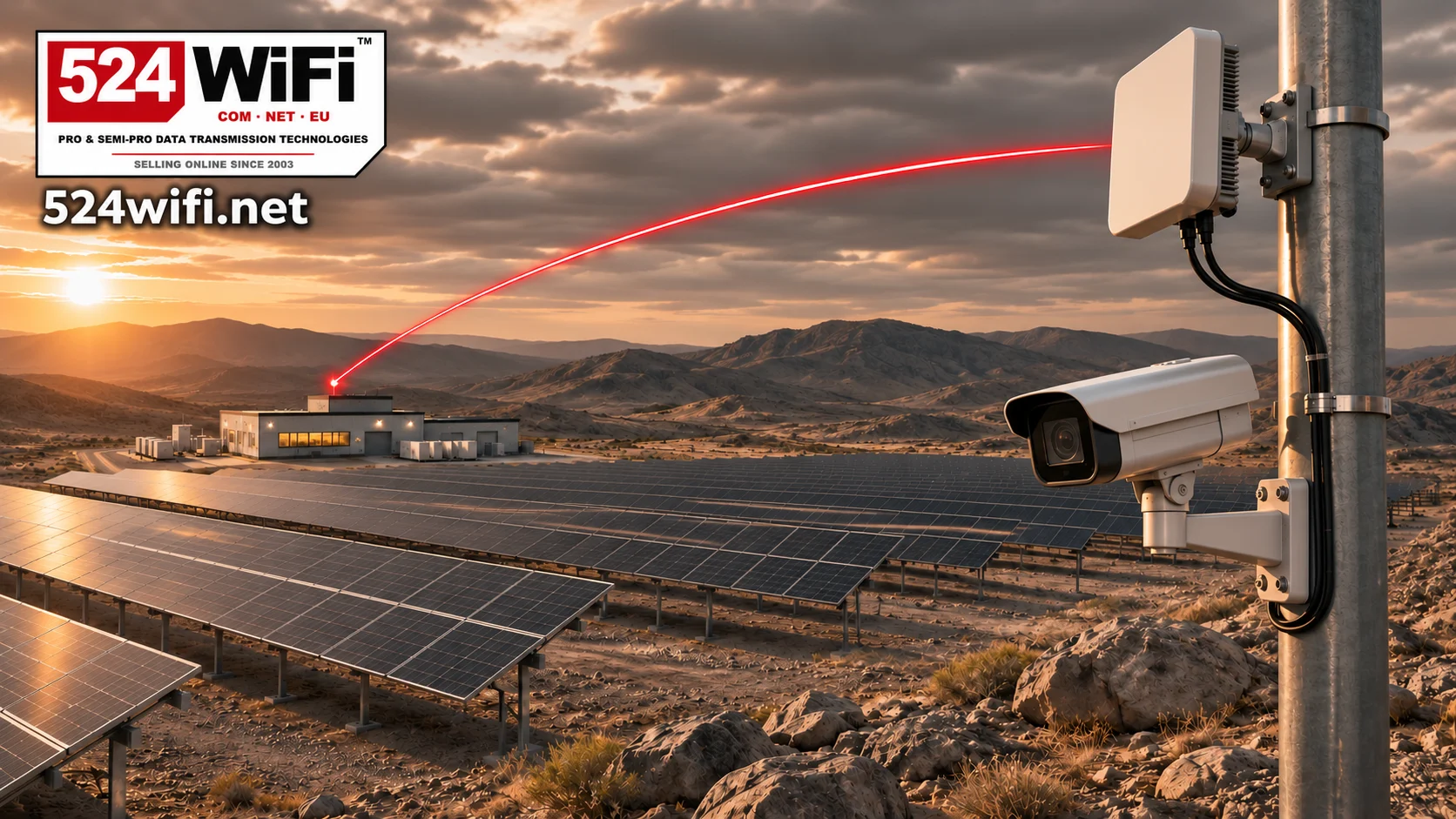
Long-range Wi-Fi 6 point-to-point links for ports, solar farms and fish farms, with PoE single-cable deployment.
A camera on a pole 500 meters from your control room should not need a trench, a permit and a six-week construction schedule. Yet at ports, solar plants, farms and aquaculture sites, that is still how many remote video and sensor links get built.
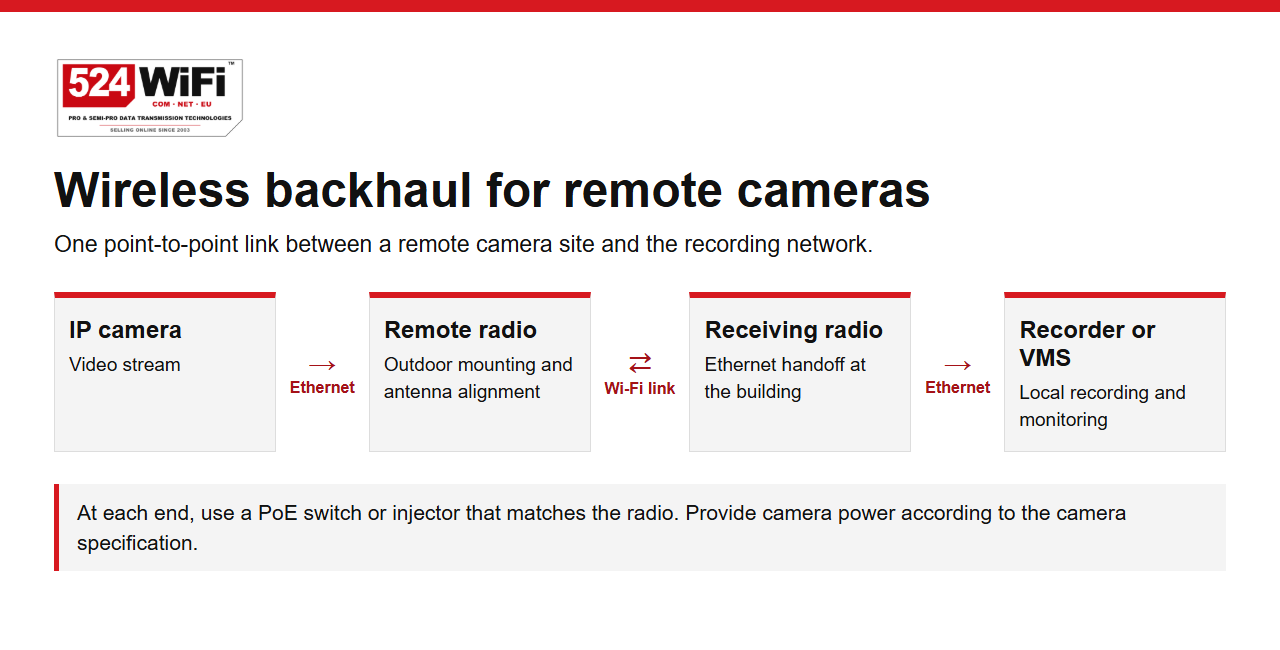
Why remote backhaul is harder than it looks
Remote cameras and sensors are rarely where the cable is. The usual options each carry a cost:
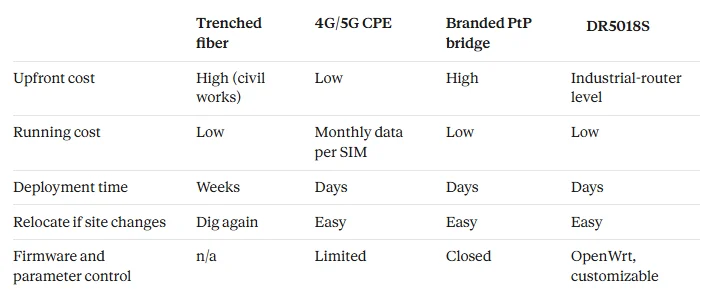
- Trenched fiber: it needs approvals and civil works, and the schedule is long. If the site layout changes, you dig again. When a cable is cut, repair is slow.
- 4G/5G CPE at every point: it brings monthly data fees, limited uplink bandwidth and variable signal. Every point also has its own SIM card to manage.
- Branded point-to-point bridges: they work, but the unit price is high, and firmware is closed. Changing parameters or connecting to your own management platform is difficult.
- Consumer-grade outdoor APs: once distance grows, an ACK timeout that is not tuned causes throughput drops and stream interruptions.
How 524WiFi™ Pulse fits long-range Wi-Fi 6 backhaul
The Qualcomm IPQ5018 platform supports OpenWrt-based configurations, so the parameters that matter at distance can be adjusted for each site:
- Distance and ACK timeout tuning per link, instead of fixed defaults.
- PoE single-cable deployment: power and data on one cable to the pole. Choose the PoE configuration specified for the 524WiFi™ Pulse outdoor mesh node.
- Open software: you can connect it to your own management platform. Long-range transmission software customization is available.
- OEM/ODM options: interfaces and enclosure can be adapted to your project.
- Certification: CE, UKCA and FCC.
Field data: what has actually been tested
In an outdoor test, the platform supplier ran a three-hop IPQ5018 mesh over about 730 m end to end. With iperf3 running multiple concurrent streams, aggregate throughput measured 621–631 Mbps. These are aggregate multi-stream path figures, not single-client or per-hop speeds. Real results depend on line of sight, antennas, channel conditions and configuration, which is why we tune per site.
Comparison: four ways to connect a remote camera
Where this works
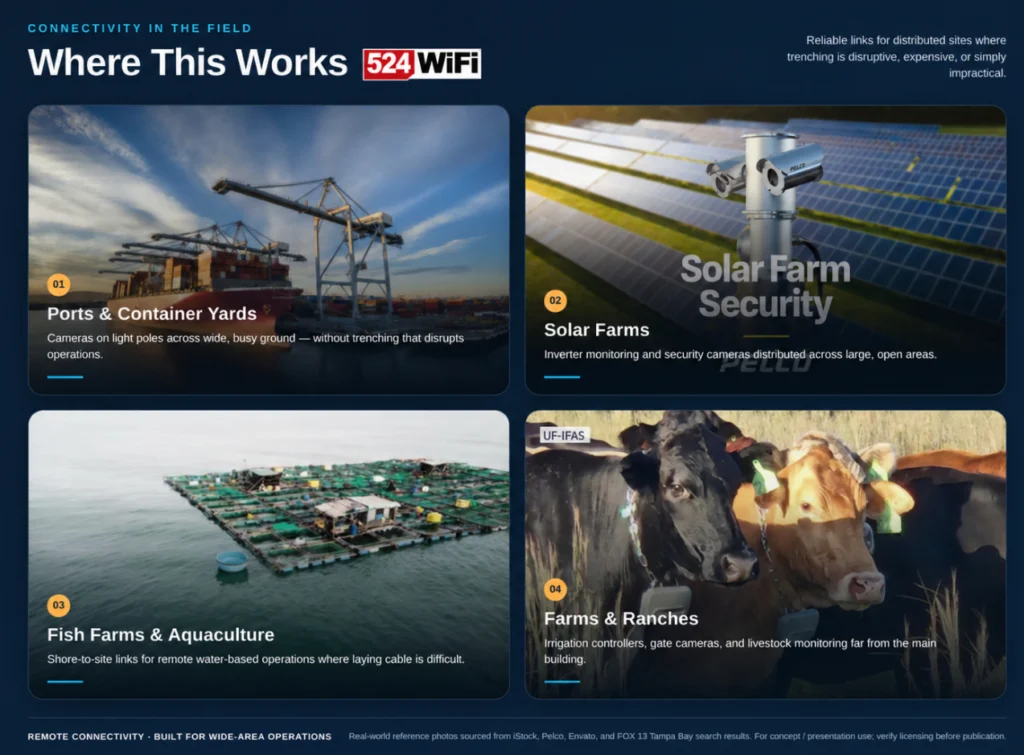
- Ports and container yards: cameras on light poles across wide, busy ground where trenching disrupts operations.
- Solar farms: inverter monitoring and security cameras spread across large areas.
- Fish farms and aquaculture: shore-to-site links where laying cable is difficult.
- Farms and ranches: irrigation controllers, gate cameras and livestock monitoring far from the main building.
What you save
- Money: no trenching and no monthly data fees.
- Time: mount, power over one cable, align and configure. Typical links can be commissioned in days.
- Effort: one platform, tuned per site, with software customization if your project needs it.
Talk to 524WiFi™
If you are planning a remote camera or sensor backhaul, send us the distance, the number of points and the data you need to carry. We will suggest a link design based on your site.
Mail to: [email protected]