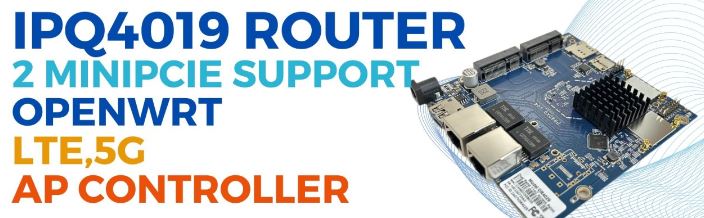
Posted on

IPQ4019 IPQ4029 Mesh Networking Setup: DR4019 Router Boards in Action

Learn how to set up and test a robust mesh network using three Wallystech DR4019 router boards. Watch as we:

Upgrade firmware with Wallys OpenWrt Mesh. Configure unique IPs for seamless communication.

Test network resilience, proving reliable data transmission even during power disruptions.

Perfect for smart cities, IoT, and industrial applications!

You can also read previous article How to Upgrade DR4019 with OpenWrt 23.05 – Simple Steps! Enjoy.

Posted on

Why OpenWrt + WiFi 6 = Future-Proof Networking? Unlock Next-Gen Networking with 524WiFi’ OpenWrt-Supported WiFi 6 Solutions

The demand for high-performance, customizable wireless solutions is surging across industries – from enterprise networks to industrial IoT and smart city deployments. At Wallys Communications, we bridge cutting-edge hardware with open-source flexibility through our OpenWrt-compatible WiFi 6 modules, engineered for reliability and scalability.

Why OpenWrt + WiFi 6 = Future-Proof Networking

OpenWrt Advantages: Full network stack control, lightweight operation (ideal for embedded systems), and 3,000+ software packages

WiFi 6 Benefits:

▶ 4× device capacity vs. WiFi 5

▶ 75% lower latency

▶ 1.8Gbps aggregate throughput (DR7915)

▶ BSS Coloring for dense deployments

Mediatek DR7915 MT7915

Featured Solutions: Enterprise-Grade WiFi 6 Modules

1. DR7915 Mini PCIe Module

✅ Chipset: MediaTek MT7915 + MT7975 (2×2 dual-band)

✅ Performance:

2.4GHz: 23dBm max power, 574Mbps

5GHz: 20dBm max power, 1201Mbps

-40°C to 70°C operating range

✅ Key Features:

DFS radar detection

MU-MIMO & OFDMA

LDPC/STBC encoding

Full OpenWrt 21.02+ support

2. DR4019 – The Robust Foundation for DR7915 WiFi 6 Solutions

DR4019 – The Robust Foundation for DR7915 WiFi 6 Solutions

Why Engineers Choose 524WiFi and Wallys?

🔧 Open-Source First:

Full driver source code access

Community-supported builds

🛠️ Design-to-Deployment Support:

RF layout optimization guidance

Thermal management consulting

FCC/CE pre-certification testing

🌐 Proven in Production:

Batch-to-batch consistency

Implementation Scenarios

• Industrial IoT gateways (5G + WiFi 6 edge computing)

• High-density office APs (200+ concurrent users)

• Outdoor mesh networks (-40°C hardened)

Posted on

Wallys WiFi5 Devices Now Support WL-AC1000 AP Controller – A Secure Solution for Your Connectivity Needs

Wallys WiFi5 Devices Now Support WL-AC1000 AP Controller – A Secure Solution for Your Connectivity Needs

At Wallys, we’re constantly evolving to meet the demands of our customers and provide the most reliable and secure solutions. We’re excited to announce that our WiFi5 devices now support the WL-AC1000 AP Controller. This is a local AP controller designed for centralized management of access points (AP), which offers significant advantages in specific use cases where security is of utmost importance.

Unlike cloud-based controllers, the WL-AC1000 ensures that your network management remains secure within your local environment, providing you with a more robust control solution. It is powered by Wallys’ hardware-based manager, enhancing safety and stability.

About the DR40x9 Router Board

Incorporating Qualcomm’s IPQ 4019 / 4029 chipset, the DR4019 / DR4029 is a rugged router board that operates seamlessly within extreme environmental temperatures ranging from -40°C to 70°C. This makes it ideal for long-distance, stable data transmission in various industrial applications. With OpenWrt custom firmware support, it can be tailored to meet the unique needs of your network.

Key features include:

  • Stable Performance in harsh environments
  • OpenWrt Custom Firmware for flexible configuration
  • Wide Application across industrial use cases

For more details on the DR4029 and its hardware specifications –

https://www.524wifi.com/index.php/catalogsearch/result/?q=4029

Posted on

VLAN Applications in the Logistics Industry – Smart Warehouse & Automation Systems

As the logistics industry continues to evolve, there is a growing need for efficient, stable, and flexible networking solutions. Virtual Local Area Networks (VLANs) provide a powerful tool for managing network traffic, optimizing resources, and improving both efficiency and security within logistics operations. Below are several key VLAN application scenarios within the logistics industry.


1. Smart Warehouse & Automation Systems

Smart warehouses, equipped with automated systems like robotic arms, conveyor belts, sensors, and RFID systems, rely on a robust network for seamless data exchange. VLANs can improve network performance by segmenting traffic based on device type.

  • VLAN Segmentation:
  • VLAN 10 (Automated Guided Vehicle Network): Ensures low-latency, high-priority communication for automated guided vehicles (AGVs).
  • VLAN 20 (RFID & Scanners): Provides dedicated bandwidth for RFID systems and scanners, ensuring real-time tracking.
  • VLAN 30 (Surveillance Network): Segregates video surveillance data from other traffic to prevent congestion.

VLAN helps ensure that critical devices such as AGVs and RFID scanners can communicate without interference, enhancing warehouse efficiency.


2. Sorting Systems in Distribution Centers

Sorting systems in distribution centers often involve complex automation machinery that requires real-time communication to optimize the sorting of parcels. VLANs help ensure smooth operation by prioritizing the traffic of sorting equipment.

  • VLAN Segmentation:
  • VLAN 100 (Sorting Equipment Network): Dedicated VLAN for the machinery that handles sorting, minimizing delays caused by high data traffic.
  • VLAN 200 (Office Management Network): Separates office traffic from operational machinery, avoiding disruptions to real-time sorting tasks.
  • VLAN 300 (Customer Service Interface): Isolates customer-facing systems, ensuring customer data remains secure while other operational processes run smoothly.

VLANs optimize data flow within the sorting systems and prevent network congestion, increasing overall throughput.


3. IoT Devices and Wireless Networks

In the logistics industry, IoT devices such as temperature sensors, GPS trackers, and smart locks play an integral role in monitoring and managing goods during transit and storage. VLANs are essential for managing and securing wireless network traffic.

  • VLAN Segmentation:
  • VLAN 50 (IoT Device Network): Creates a dedicated VLAN for all IoT devices, ensuring reliable data transfer while isolating traffic from other networks.
  • VLAN 60 (Customer Wi-Fi Network): Segregates visitor and employee Wi-Fi access from critical business systems to ensure security.

Using VLANs ensures that sensitive logistics data from IoT devices is protected and prioritized, enabling real-time monitoring and secure communications.


4. Security and Data Isolation

The logistics industry handles sensitive customer data, inventory management information, and delivery details. VLANs are used to isolate these critical data streams from other less sensitive traffic, adding an additional layer of security.

  • VLAN Segmentation:
  • VLAN 10 (Management and Control Network): Isolates administrative systems and critical control networks to prevent unauthorized access.
  • VLAN 20 (Customer Data Network): Protects customer and order information by creating a separate VLAN for processing sensitive data.
  • VLAN 30 (Surveillance Network): Ensures video feeds from surveillance cameras are kept within a dedicated network, preventing bandwidth overload.

VLANs improve data security by isolating sensitive systems from regular traffic, reducing the risk of data breaches or unauthorized access.


5. Integration with 5G Networks

As logistics operations increasingly incorporate 5G technology, VLANs help ensure that high-priority devices, such as autonomous delivery vehicles and drones, have dedicated network resources for efficient communication.

  • VLAN Segmentation:
  • VLAN 70 (Autonomous Vehicle Network): Dedicated VLAN for vehicles and drones that require low-latency and high-bandwidth communication.
  • VLAN 80 (Public-facing Network): Provides separate VLANs for external systems, ensuring no interference with mission-critical logistics systems.

Integrating VLANs with 5G allows logistics companies to optimize network performance for high-demand devices, ensuring smooth and efficient operations.

Router board DR4019 Vlan Solution

✅ Industrial-Grade Performance

  • Qualcomm IPQ4019/IPQ4029 chipset for stable, 24/7 operation.

✅ High-Power Wireless Connectivity

  • Dual-band radios: 2×2 5GHz & 2×2 2.4GHz high-power modules.
  • Frequency range: 4.940GHz–5.825GHz & 2.400GHz–2.482GHz.
  • MMCX connectors for flexible antenna deployment.
  • Supports 5MHz/10MHz/20MHz/40MHz/80MHz bandwidth.

✅ VLAN & Network Optimization

  • VLAN-ready for secure network segmentation in logistics hubs.
  • 802.11s Mesh support for seamless warehouse connectivity.
  • Fixed data rate for AGVs, RFID, and IoT tracking.

✅ Flexible Firmware & Integration

  • Supports OpenWRT, QSDK, OpenWiFi.
  • Compatible with Quectel modules for LTE/5G expansion.

✅ Environmentally Safe

  • RoHS compliant, ensuring safety and sustainability.
DR4019 mainboard ipq4019

Conclusion

VLAN technology plays a crucial role in optimizing network performance, improving security, and supporting the growth of smart logistics systems. By segmenting traffic based on device type and use case, logistics companies can improve data flow, reduce congestion, and ensure secure communication across their networks. As the logistics industry continues to evolve with IoT, automation, and 5G, VLANs will remain a key component in driving efficiency, security, and innovation.

The Router board DR4019 Vlan Mesh Solution
Posted on

IPQ6000 vs IPQ4019: A Comprehensive Comparison

IPQ6000 vs IPQ4019: A Comprehensive Comparison

When it comes to selecting the right SoC (System on Chip) for wireless networking, Qualcomm’s IPQ6000 and IPQ4019 are two of the most popular choices. Both chips cater to a wide range of applications, but understanding their differences and strengths is essential to making an informed decision. In this article, we’ll explore their key features and dive into why the IPQ4019, and specifically Wallystech’s DR4019, stands out as a reliable and efficient solution for industrial and commercial wireless applications.

Performance and Processing Power

IPQ6000: The IPQ6000 is a newer SoC designed for mid-tier networking applications. It offers quad-core ARM Cortex-A53 processors running at up to 1.2 GHz. While it provides sufficient power for home and small enterprise use, its capabilities can be overkill for applications that prioritize cost-efficiency and stability over raw power.

IPQ4019: On the other hand, the IPQ4019 features quad-core ARM Cortex-A7 processors clocked at up to 717 MHz. While slightly less powerful than the IPQ6000, its processing power is optimized for efficiency, making it a preferred choice for cost-sensitive industrial applications that require stable and long-term operation without unnecessary overhead.

Wi-Fi Capabilities

IPQ6000: The IPQ6000 supports Wi-Fi 6 (802.11ax), offering higher throughput and better performance in high-density environments. However, it is primarily suited for scenarios where Wi-Fi 6’s capabilities are essential, such as advanced enterprise networks or consumer-grade devices.

IPQ4019: The IPQ4019 supports Wi-Fi 5 (802.11ac) with dual-band capabilities (2.4GHz and 5GHz) and MU-MIMO technology. While it doesn’t offer Wi-Fi 6, it provides robust and reliable performance for most industrial and commercial wireless applications. The simplicity of Wi-Fi 5 makes it easier to deploy and maintain, especially in environments where ultra-high-speed connectivity isn’t critical.

Power Consumption

Power efficiency is a critical factor in industrial and embedded applications. The IPQ4019’s Cortex-A7 cores consume significantly less power compared to the Cortex-A53 cores in the IPQ6000. This makes the IPQ4019 an excellent choice for devices that need to operate continuously in challenging environments with limited power resources.

Cost-Effectiveness

The IPQ4019 outshines the IPQ6000 in terms of cost-efficiency. Its balance of performance and affordability makes it a go-to solution for projects that demand reliability without inflating costs. For industrial-grade applications, the IPQ4019’s price-to-performance ratio is hard to beat.

Why Choose DR4019 ?

Wallystech’s DR4019 router board harnesses the full potential of the IPQ4019 chipset. Here are some key advantages:

  1. Industrial-Grade Design: The DR4019 is designed for demanding industrial environments, ensuring long-term reliability and stability.
  2. Dual-Band Capability: It supports simultaneous 2.4GHz and 5GHz bands, enabling versatile wireless applications.
  3. Customizable Hardware and Software: Wallystech offers unparalleled customization options, including tailored firmware, drivers, and interfaces.
  4. Support for MU-MIMO: Enhanced connectivity for multiple users, making it ideal for high-demand applications.
  5. Wide Application Range: From smart cities to secure networks, the DR4019 is versatile enough to meet the needs of various industrial use cases.

The choice between IPQ6000 and IPQ4019 ultimately depends on your specific application. For cost-effective, reliable, and industrial-grade performance, the IPQ4019 and Wallystech’s DR4019 offer a winning combination.

Posted on

Fast Roaming Test: Seamless Video Camera Transmission During AP Switch!

Exciting Updates on Fast Roaming Testing!

Today, we’re thrilled to share the results of our latest fast roaming test, demonstrating how STA (client devices) can seamlessly switch between access points (APs) while on the move! DR4029 routers used for all devices.

Testing Setup Overview

The theory behind our testing is straightforward: as the STA moves, it should automatically disconnect from weaker APs and connect to the strongest ones, ensuring uninterrupted data flow between PC1 and PC2. We verified this by using PC1 to ping PC2.

Testing Setup Overview

Testing Topology

In our simplified validation, we used SSH to lower the transmission power of AP1 while increasing that of AP2, simulating the STA moving away from AP1 and closer to AP2. Throughout the test, PC1 continuously displayed footage from the camera connected to the STA, with data flowing smoothly from PC2 to PC1—flawless and seamless!

Testing Topology

Next, we’ll delve deeper into real-world scenarios involving fast roaming, including the STA switching between multiple APs. Stay tuned for the latest updates and exciting content!

Complete Testing Video:

Posted on

IPQ5332 vs. IPQ4019 : The Best WiFi for Oil and Gas Industries

In the oil and gas industry, selecting the right WiFi solution is crucial for ensuring operational stability and efficiency. Recently, the IPQ5332 and IPQ4019 chips have emerged as prominent choices. This article will compare these two chips to help you determine which WiFi solution best meets the needs of the oil and gas sector.

Performance Comparison

IPQ5332:

Core: The IPQ5332 is a high-performance quad-core processor from Qualcomm, featuring the latest WiFi 6E technology and supporting the 6GHz frequency band. It offers higher bandwidth and lower latency.

Data Transfer Speed: It supports data transfer speeds of up to 10 Gbps, suitable for applications requiring high-speed data transfer, such as real-time monitoring and large-scale data processing.

Applications: Ideal for scenarios demanding extreme stability and data transfer speed, such as real-time monitoring systems and intelligent sensor networks in the oil and gas industry.

IPQ4019:

Core: The IPQ4019 is a mid-to-high-end processor from Qualcomm, supporting WiFi 5 (802.11ac) technology with a quad-core processor.

Data Transfer Speed: It supports data transfer speeds of up to 1.7 Gbps, which is sufficient for most applications but lower compared to the IPQ5332.

Applications: Suitable for applications with less extreme data transfer requirements, such as general wireless communication and less data-intensive tasks.

Interference Resistance

IPQ5332: With support for WiFi 6E technology, the IPQ5332 offers better interference resistance in multi-user and high-density network environments. This is particularly important in the oil and gas industry, where there may be various electronic devices and signal interference sources.

IPQ4019: The IPQ4019 provides good interference resistance but is not as advanced as the IPQ5332. It performs well in environments with fewer interference sources.

Power Consumption and Heat Management

IPQ5332: While delivering high performance, the IPQ5332 may require more power and heat management. In the oil and gas industry, equipment needs to operate reliably in harsh environments, so effective heat dissipation solutions are necessary.

IPQ4019: The lower power consumption of the IPQ4019 means it has less stringent heat management requirements, making it suitable for applications where power consumption is a concern.

Cost-Effectiveness

IPQ5332: Higher performance comes with a higher cost. For applications needing extreme data transfer speeds and low latency, the IPQ5332 offers exceptional performance, though it may be more expensive.

IPQ4019: The IPQ4019 provides a more cost-effective option, making it suitable for scenarios with budget constraints while still requiring efficient wireless solutions.

Conclusion

When choosing a WiFi solution, the IPQ5332 and IPQ4019 each have their advantages. For applications in the oil and gas industry requiring high performance, high bandwidth, and strong interference resistance, the IPQ5332 is undoubtedly the better choice. It provides exceptional data transfer speeds and stability, making it suitable for complex environments. On the other hand, the IPQ4019 is a high-value option for scenarios with less extreme performance requirements or tighter budgets.

Posted on

IPQ9574 vs. IPQ4019 in Real-World Applications

Interconnectivity of Industrial Equipment: IPQ9574 vs. IPQ4019 in Real-World Applications

In the rapidly evolving landscape of industrial automation and the Industrial Internet of Things (IIoT), robust and reliable network connectivity is crucial. The choice of a network chipset can significantly impact the performance, scalability, and reliability of industrial equipment. This article compares two popular Qualcomm chipsets, the IPQ9574 and IPQ4019, examining their suitability for various industrial applications.

Overview of IPQ9574 and IPQ4019

IPQ9574: The Qualcomm IPQ9574 is a high-performance chipset designed for advanced networking applications, particularly Wi-Fi 7. It features a quad-core Cortex-A53 processor clocked at 2.2 GHz, supporting Wi-Fi 7 (802.11be) with tri-band capabilities, including the new 6 GHz band. It offers enhanced throughput, low latency, and high capacity, making it ideal for dense environments with numerous connected devices.

IPQ4019: The Qualcomm IPQ4019 is a more mature chipset, featuring a quad-core ARM Cortex-A7 processor clocked at 717 MHz. It supports dual-band Wi-Fi 5 (802.11ac) and is widely used in various networking applications due to its balance of performance and cost-effectiveness.

Application 1: High-Performance Industrial Gateways

Industrial gateways act as the central hub for communication between field devices and cloud services. The IPQ9574, with its powerful processing capabilities and tri-band Wi-Fi 7 support, excels in environments requiring high throughput and low latency. It can handle multiple simultaneous connections and data-intensive applications more efficiently than the IPQ4019, which, while reliable, may struggle with high data loads due to its lower processing power and Wi-Fi 5 limitations.

Application 2: Smart Manufacturing

In smart manufacturing, real-time data processing and communication are vital. The IPQ9574’s advanced features enable seamless connectivity and faster data exchange between machines, sensors, and control systems. Its support for Wi-Fi 7 reduces congestion and interference, ensuring reliable performance in a crowded industrial environment. The IPQ4019, while adequate for less demanding applications, may not provide the same level of performance in high-density settings.

Application 3: Factory Automation

Factory automation relies heavily on reliable network connectivity to synchronize operations and improve efficiency. The IPQ9574’s superior processing power and advanced Wi-Fi capabilities offer a significant advantage in these scenarios, ensuring smooth and uninterrupted communication between automated systems. The IPQ4019, though capable, may face challenges in handling the increased data traffic and connectivity demands of a fully automated factory.

Application 4: Warehouse Management

In warehouse management, robust and scalable network solutions are essential to support inventory tracking, automated guided vehicles (AGVs), and other smart systems. The IPQ9574’s high throughput and low latency are beneficial for real-time inventory management and AGV navigation. The IPQ4019 can support basic warehouse operations but may not deliver the same performance in a high-traffic, dynamic environment.

Application 5: Industrial Robotics

Industrial robots require reliable and low-latency connectivity to perform precise operations. The IPQ9574, with its enhanced Wi-Fi 7 support, ensures stable and fast communication, reducing downtime and improving productivity. The IPQ4019, while suitable for less complex robotic applications, may not provide the same level of performance in environments with multiple robots and high data exchange requirements.

Application 6: Smart City Infrastructure

Smart city infrastructure demands robust and scalable network solutions to support various applications, from traffic management to public safety. The IPQ9574’s advanced capabilities make it ideal for handling the high data loads and numerous connections required in smart city deployments. The IPQ4019 can support smaller-scale applications but may struggle with the extensive connectivity and performance demands of a fully developed smart city infrastructure.

Application 7: Remote Industrial Monitoring

Remote monitoring of industrial sites requires reliable and secure network connectivity to ensure continuous data transmission. The IPQ9574’s enhanced processing power and tri-band support provide robust performance for remote monitoring applications, even in harsh environments. The IPQ4019, while reliable, may not offer the same level of performance and scalability for remote monitoring over large areas or multiple sites.

Application 8: High-Density Client Environments

In high-density client environments, such as industrial plants with numerous connected devices, the IPQ9574’s advanced Wi-Fi 7 capabilities and high processing power provide a significant advantage. It can manage more connections simultaneously with lower latency compared to the IPQ4019, which may experience performance bottlenecks in such demanding settings.

Application 9: Interconnectivity of Industrial Equipment

Interconnecting various industrial equipment requires a network solution that can handle diverse communication protocols and high data volumes. The IPQ9574’s superior performance and advanced features make it well-suited for this task, ensuring seamless communication between different types of equipment. The IPQ4019, while capable of supporting basic interconnectivity, may not deliver the same level of performance in more complex and data-intensive environments.

Application 10: Real-World Performance and Scalability

In real-world applications, the scalability and performance of the network solution are critical. The IPQ9574, with its high processing power and advanced Wi-Fi capabilities, offers better scalability and performance for growing industrial networks. The IPQ4019, though cost-effective, may require more frequent upgrades and optimizations to meet the evolving demands of industrial applications.

Wallys Solutions: IPQ9574 and IPQ4029

Wallys offers advanced solutions based on both IPQ9574 and IPQ4029 chipsets, catering to various industrial needs. The DR9574 board leverages the power of the IPQ9574 chipset, providing unparalleled performance and scalability for high-demand environments. It features 4×4 2.4G, 4xM.2 slots, and multiple Ethernet ports, making it a versatile choice for industrial applications. More details can be found here.

For those seeking a cost-effective solution without compromising on reliability, the DR40X9 board based on the IPQ4029 chipset is an excellent choice. It supports dual-band 802.11AC Wave2 MU-MIMO and onboard WiFi radio, and can be embedded with LTE. This makes it a suitable option for industrial parks with moderate network demands. More information is available here.

For inquiries and custom solutions, contact the Wallys sales team at [email protected].

Conclusion

Both the IPQ9574 and IPQ4019 have their strengths and are suited for different types of industrial applications. The IPQ9574, with its advanced features and higher performance, is ideal for demanding environments requiring robust and scalable network solutions. The IPQ4019, on the other hand, provides a reliable and cost-effective solution for less demanding applications. When choosing between the two, it’s essential to consider the specific requirements and constraints of your industrial environment to ensure optimal performance and connectivity.

Posted on

IPQ9574 vs. IPQ4019 in Real-World Applications

Interconnectivity of Industrial Equipment: IPQ9574 vs. IPQ4019 in Real-World Applications

In the rapidly evolving landscape of industrial automation and the Industrial Internet of Things (IIoT), robust and reliable network connectivity is crucial. The choice of a network chipset can significantly impact the performance, scalability, and reliability of industrial equipment. This article compares two popular Qualcomm chipsets, the IPQ9574 and IPQ4019, examining their suitability for various industrial applications.

Overview of IPQ9574 and IPQ4019

IPQ9574: The Qualcomm IPQ9574 is a high-performance chipset designed for advanced networking applications, particularly Wi-Fi 7. It features a quad-core Cortex-A53 processor clocked at 2.2 GHz, supporting Wi-Fi 7 (802.11be) with tri-band capabilities, including the new 6 GHz band. It offers enhanced throughput, low latency, and high capacity, making it ideal for dense environments with numerous connected devices.

IPQ4019: The Qualcomm IPQ4019 is a more mature chipset, featuring a quad-core ARM Cortex-A7 processor clocked at 717 MHz. It supports dual-band Wi-Fi 5 (802.11ac) and is widely used in various networking applications due to its balance of performance and cost-effectiveness.

Application 1: High-Performance Industrial Gateways

Industrial gateways act as the central hub for communication between field devices and cloud services. The IPQ9574, with its powerful processing capabilities and tri-band Wi-Fi 7 support, excels in environments requiring high throughput and low latency. It can handle multiple simultaneous connections and data-intensive applications more efficiently than the IPQ4019, which, while reliable, may struggle with high data loads due to its lower processing power and Wi-Fi 5 limitations.

Application 2: Smart Manufacturing

In smart manufacturing, real-time data processing and communication are vital. The IPQ9574’s advanced features enable seamless connectivity and faster data exchange between machines, sensors, and control systems. Its support for Wi-Fi 7 reduces congestion and interference, ensuring reliable performance in a crowded industrial environment. The IPQ4019, while adequate for less demanding applications, may not provide the same level of performance in high-density settings.

Application 3: Factory Automation

Factory automation relies heavily on reliable network connectivity to synchronize operations and improve efficiency. The IPQ9574’s superior processing power and advanced Wi-Fi capabilities offer a significant advantage in these scenarios, ensuring smooth and uninterrupted communication between automated systems. The IPQ4019, though capable, may face challenges in handling the increased data traffic and connectivity demands of a fully automated factory.

Application 4: Warehouse Management

In warehouse management, robust and scalable network solutions are essential to support inventory tracking, automated guided vehicles (AGVs), and other smart systems. The IPQ9574’s high throughput and low latency are beneficial for real-time inventory management and AGV navigation. The IPQ4019 can support basic warehouse operations but may not deliver the same performance in a high-traffic, dynamic environment.

Application 5: Industrial Robotics

Industrial robots require reliable and low-latency connectivity to perform precise operations. The IPQ9574, with its enhanced Wi-Fi 7 support, ensures stable and fast communication, reducing downtime and improving productivity. The IPQ4019, while suitable for less complex robotic applications, may not provide the same level of performance in environments with multiple robots and high data exchange requirements.

Application 6: Smart City Infrastructure

Smart city infrastructure demands robust and scalable network solutions to support various applications, from traffic management to public safety. The IPQ9574’s advanced capabilities make it ideal for handling the high data loads and numerous connections required in smart city deployments. The IPQ4019 can support smaller-scale applications but may struggle with the extensive connectivity and performance demands of a fully developed smart city infrastructure.

Application 7: Remote Industrial Monitoring

Remote monitoring of industrial sites requires reliable and secure network connectivity to ensure continuous data transmission. The IPQ9574’s enhanced processing power and tri-band support provide robust performance for remote monitoring applications, even in harsh environments. The IPQ4019, while reliable, may not offer the same level of performance and scalability for remote monitoring over large areas or multiple sites.

Application 8: High-Density Client Environments

In high-density client environments, such as industrial plants with numerous connected devices, the IPQ9574’s advanced Wi-Fi 7 capabilities and high processing power provide a significant advantage. It can manage more connections simultaneously with lower latency compared to the IPQ4019, which may experience performance bottlenecks in such demanding settings.

Application 9: Interconnectivity of Industrial Equipment

Interconnecting various industrial equipment requires a network solution that can handle diverse communication protocols and high data volumes. The IPQ9574’s superior performance and advanced features make it well-suited for this task, ensuring seamless communication between different types of equipment. The IPQ4019, while capable of supporting basic interconnectivity, may not deliver the same level of performance in more complex and data-intensive environments.

Application 10: Real-World Performance and Scalability

In real-world applications, the scalability and performance of the network solution are critical. The IPQ9574, with its high processing power and advanced Wi-Fi capabilities, offers better scalability and performance for growing industrial networks. The IPQ4019, though cost-effective, may require more frequent upgrades and optimizations to meet the evolving demands of industrial applications.

524WiFi and Wallys Solutions: IPQ9574 and IPQ4029

524WiFi offers advanced solutions based on both IPQ9574 and IPQ4029 chipsets, catering to various industrial needs. The DR9574 board leverages the power of the IPQ9574 chipset, providing unparalleled performance and scalability for high-demand environments. It features 4×4 2.4G, 4xM.2 slots, and multiple Ethernet ports, making it a versatile choice for industrial applications. More details can be found here.

For those seeking a cost-effective solution without compromising on reliability, the DR40X9 board based on the IPQ4029 chipset is an excellent choice. It supports dual-band 802.11AC Wave2 MU-MIMO and onboard WiFi radio, and can be embedded with LTE. This makes it a suitable option for industrial parks with moderate network demands. More information is available here.

Conclusion

Both the IPQ9574 and IPQ4019 have their strengths and are suited for different types of industrial applications. The IPQ9574, with its advanced features and higher performance, is ideal for demanding environments requiring robust and scalable network solutions. The IPQ4019, on the other hand, provides a reliable and cost-effective solution for less demanding applications. When choosing between the two, it’s essential to consider the specific requirements and constraints of your industrial environment to ensure optimal performance and connectivity.