
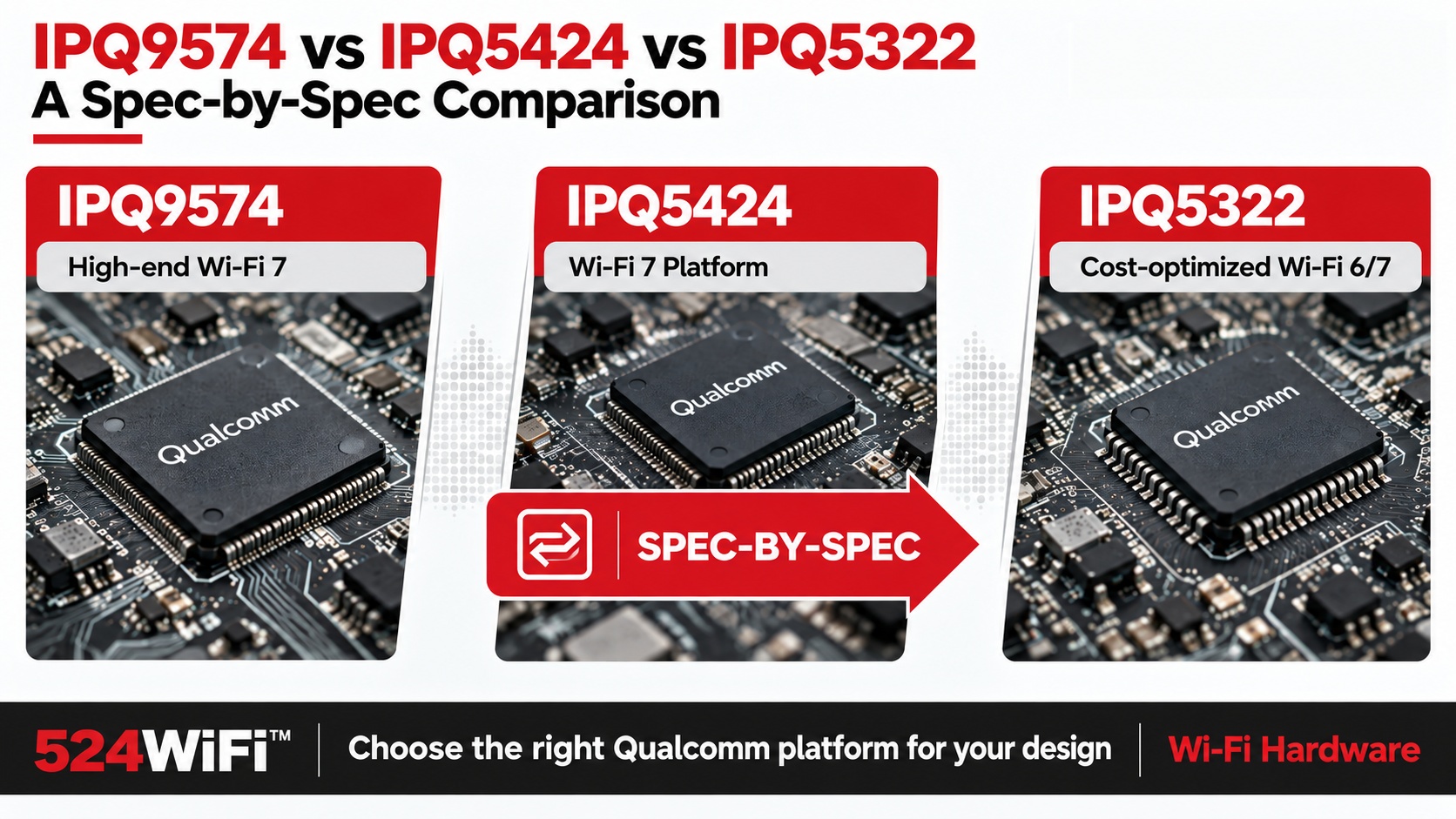
Key takeaways
- Platform choice depends on radio topology and I/O as much as CPU performance.
- 524WiFi™ Pulse B9574-2×2-SFP Pro Plus emphasizes CPU headroom and expansion; 524WiFi™ Pulse B5424-4×4 Pro Plus emphasizes 4×4 tri-band capacity and Ethernet density.
- 524WiFi™ Pulse B7-04 uses a different upper-band module architecture that must be included in BOM and RF planning.
Most comparisons of these three chips treat them as a simple good/better/best tri-band lineup. The datasheets say otherwise. CPU architecture, radio topology and wired interfaces distinguish the selected board configurations. And IPQ5322 isn’t actually a tri-band SoC on its own: 5GHz/6GHz only exist on a 524WiFi™ Pulse B7-04 board because of an added QCN9274/QCN6274 module, not because the chip integrates them. This breakdown goes through the datasheet numbers for 524WiFi™ Pulse B9574-2×2-SFP Pro Plus (IPQ9574), 524WiFi™ Pulse B5424-4×4 Pro Plus (IPQ5424), and 524WiFi™ Pulse B7-04 (IPQ5322) — CPU, radio chains, channel width, and I/O — so the platform choice is based on what’s actually on the silicon.
CPU and Reference Design
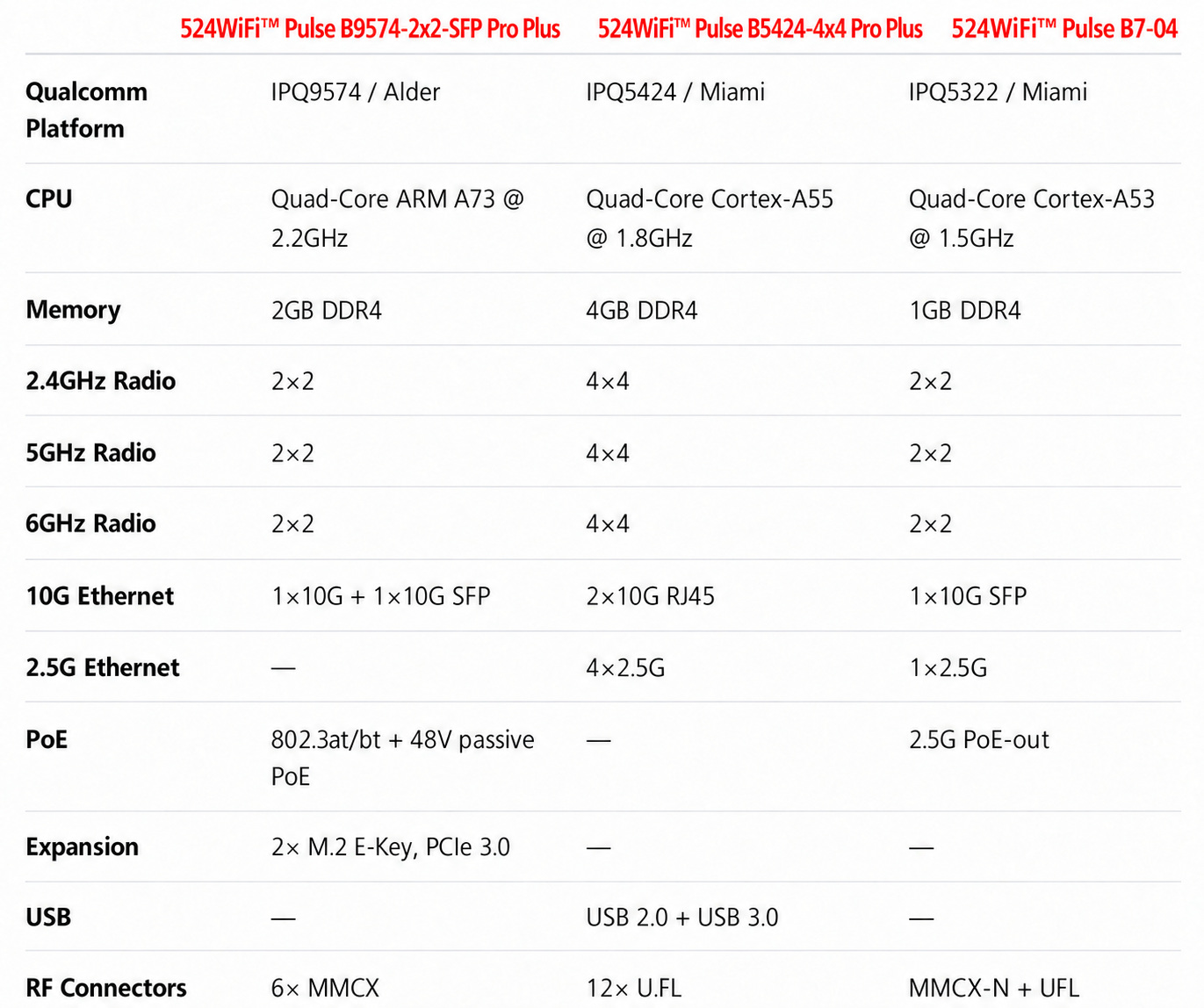
Pulse B9574-2×2-SFP Pro Plus uses a quad-core ARM Cortex-A73 at 2.2 GHz. The current Pulse B5424-4×4 Pro Plus configuration uses a quad-core ARM Cortex-A55 at 1.8 GHz with 4 GB DDR4. The IPQ5322 platform described for Pulse B7-04 uses a quad-core Cortex-A53 at 1.5 GHz with 1 GB DDR4. Select the board around its complete compute, radio and I/O architecture.
Radio Topology — the Part That Determines System Design
This is where the three platforms actually diverge, and it’s not just “more bands = better”:
524WiFi™ Pulse B9574-2×2-SFP Pro Plus (IPQ9574): three independent on-board radios, 2×2 each — 2.4GHz (up to 573.6Mbps PHY), 5GHz (up to 2882Mbps PHY), 6GHz (up to 5765Mbps PHY). All three run concurrently.
524WiFi™ Pulse B5424-4×4 Pro Plus (IPQ5424): three independent on-board radios, but 4×4 MU-MIMO on each band — 2.4GHz (802.11b/g/n/ax/be, 23dBm/chain max), 5GHz (802.11a/n/ac/ax/be, 21dBm/chain max), 6GHz (802.11ax/be, 19dBm/chain max), all concurrent. 12× U.FL antenna connectors reflect the 4×4-per-band chain count.
524WiFi™ Pulse B7-04 (IPQ5322): only 2×2 2.4GHz is on-board. There is no native 5GHz or 6GHz radio on the IPQ5322 SoC itself — 5/6GHz coverage requires adding a separate QCN9274 or QCN6274 WiFi 7 module. This is a structurally different platform from the other two: 524WiFi™ Pulse B9574-2×2-SFP Pro Plus and 524WiFi™ Pulse B5424-4×4 Pro Plus are integrated tri-band SoCs; 524WiFi™ Pulse B7-04 is a 2.4GHz baseband platform designed to pair with an external WiFi 7 radio module for the upper bands.
If your BOM assumption was “IPQ5322 = cheaper tri-band chip,” that’s incorrect at the silicon level — the tri-band capability on a 524WiFi™ Pulse B7-04 design is a module-add, not an on-die feature. Budget and BOM planning should treat it accordingly.
Channel Width and Modulation
524WiFi™ Pulse B5424-4×4 Pro Plus supports 240MHz on 5GHz, a step beyond 524WiFi™ Pulse B9574-2×2-SFP Pro Plus’s 160MHz ceiling on that band — relevant if you’re doing 5GHz-heavy backhaul rather than leaning on 6GHz for the wide channels.
I/O and Interfaces
524WiFi™ Pulse B9574-2×2-SFP Pro Plus is the only one of the three with M.2 E-key PCIe 3.0 expansion slots — relevant if your design needs an add-in card (cellular, additional radio) beyond what’s on-board. 524WiFi™ Pulse B5424-4×4 Pro Plus carries the heaviest native Ethernet backhaul (2×10GbE + 4×2.5GbE), which lines up with its role as a high-density AP/gateway aggregation point rather than an edge client device.
Selection Guidance
- Need three genuinely concurrent radios with maximum per-band throughput and PCIe expansion: 524WiFi™ Pulse B9574-2×2-SFP Pro Plus. The 2.2GHz A73 CPU and M.2 slots also make it the better fit if you’re layering additional compute or a cellular module onto the same board.
- Need three concurrent radios with more antenna chains (4×4) and heavier Ethernet backhaul, at a lower CPU clock: 524WiFi™ Pulse B5424-4×4 Pro Plus. This is the platform for high-density AP deployments where per-band MIMO order matters more than raw CPU headroom.
- Building a cost-optimized 2.4GHz-anchor design and adding WiFi 7 upper-band coverage via an external QCN9274/QCN6274 module: 524WiFi™ Pulse B7-04. Don’t spec this as a drop-in tri-band replacement for 524WiFi™ Pulse B5424-4×4 Pro Plus — the radio architecture is fundamentally different, and your BOM needs to account for the module separately.
Platform references: DR9574S, DR5424 and DR5322S.