
Key takeaways
- Start OpenWrt planning with chipset, kernel and upstream-support direction rather than a feature checklist.
- 524WiFi™ Pulse B5018-2×2 Pro Plus provides an IPQ5018-based Wi-Fi 6/6E path with a public OpenWrt contribution.
- 524WiFi™ Pulse B9574-2×2-SFP Pro Plus provides a separate IPQ9574-based Wi-Fi 7 path for next-generation product planning.
When an industrial wireless project is evaluating OpenWrt, the most useful starting point is not a feature checklist. It is the direction of the platform path itself.
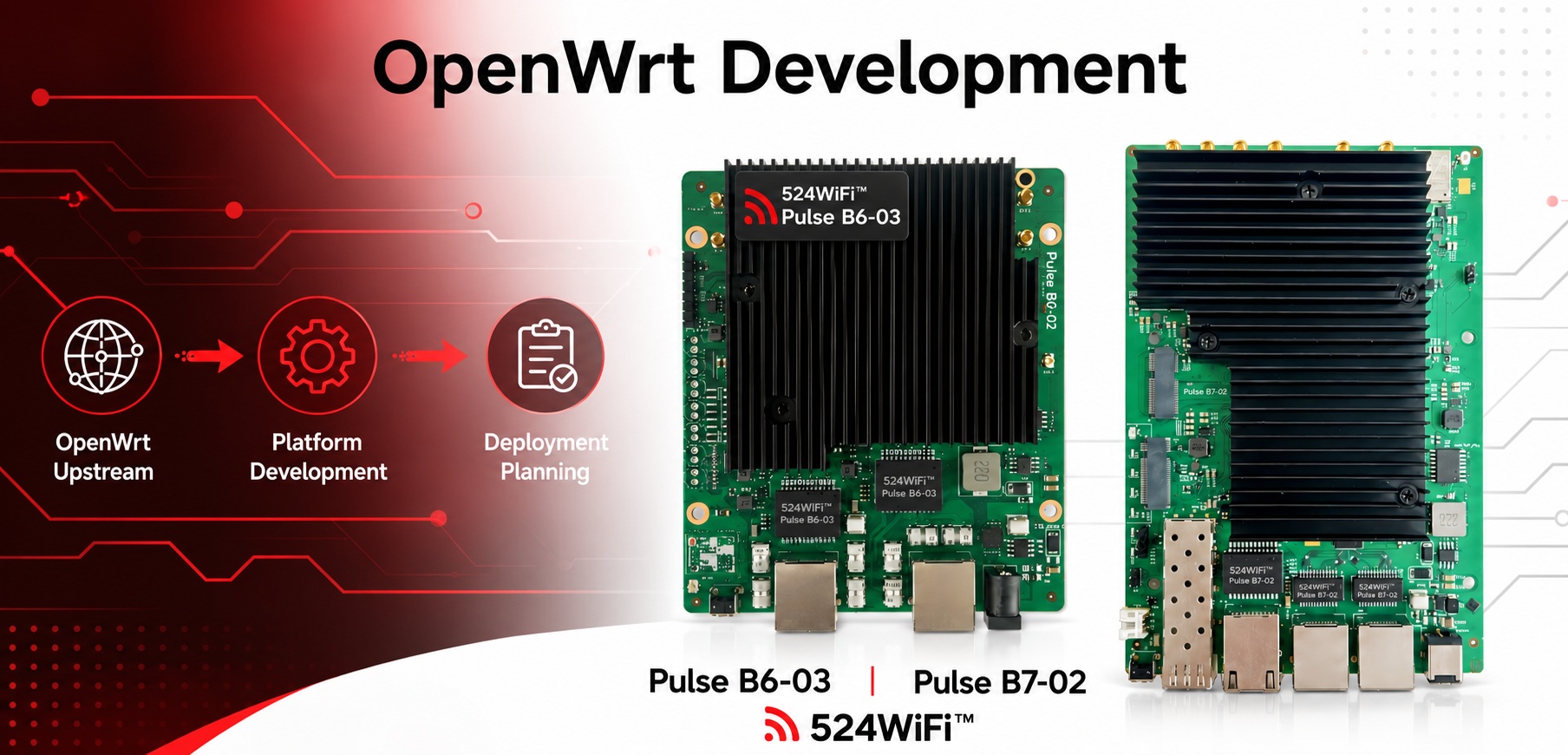
For 524WiFi™ Pulse B5018-2×2 Pro Plus, the platform-specific OpenWrt contribution is here: https://github.com/openwrt/openwrt/pull/24910
This contribution adds 524WiFi™ Pulse B5018-2×2 Pro Plus support to the qualcommax/ipq50xx target and gives engineering teams a useful reference point for platform planning.
For 524WiFi™ Pulse B9574-2×2-SFP Pro Plus, the current OpenWrt development line uses Linux 6.18. This gives Wi-Fi 7-oriented projects a separate planning track when teams are considering architecture, integration scope, and future software maintenance.
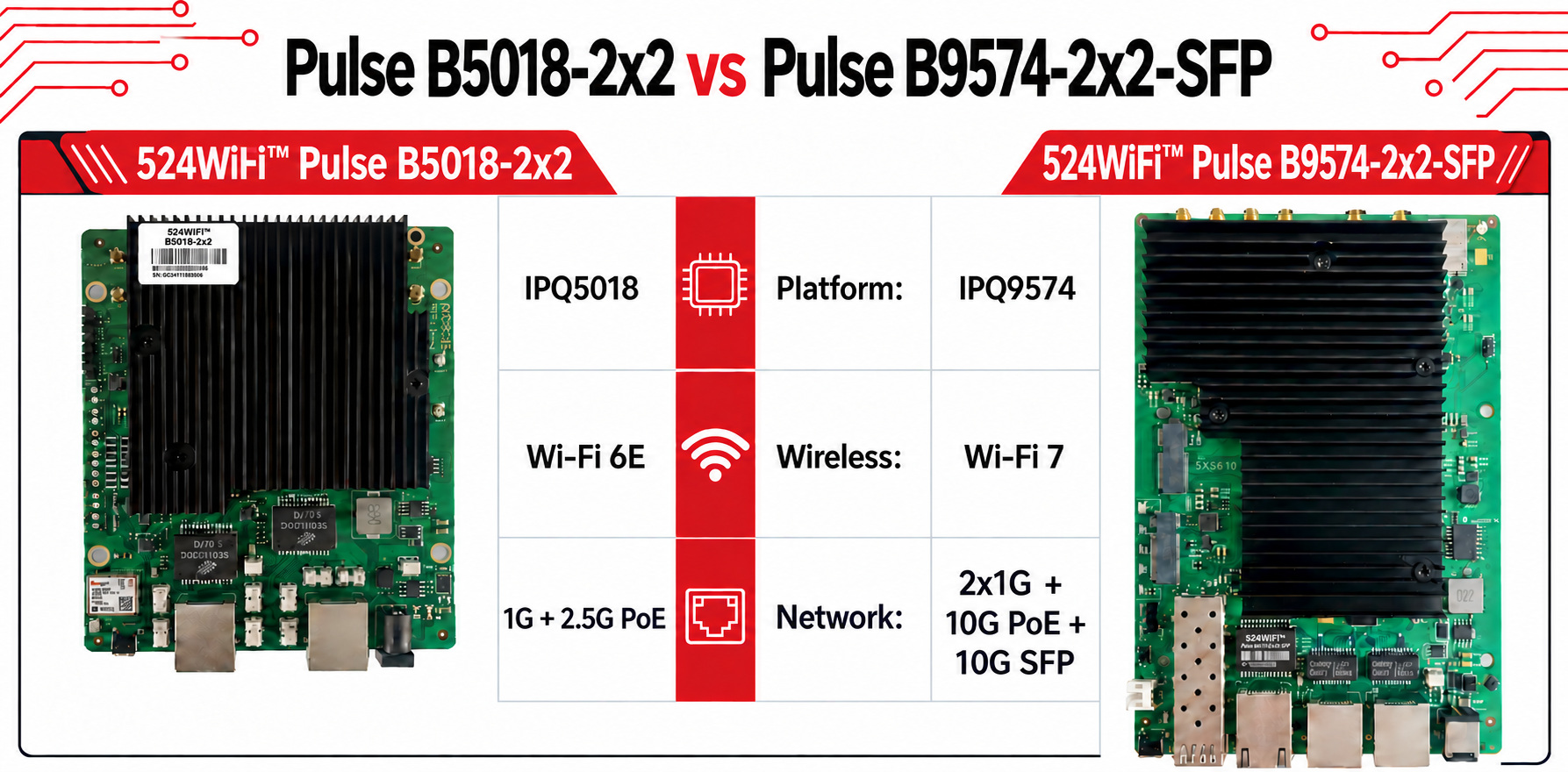
Hardware snapshot: 524WiFi™ Pulse B5018-2×2 Pro Plus is built on Qualcomm IPQ5018 with tri-band Wi-Fi 6/6E. 524WiFi™ Pulse B9574-2×2-SFP Pro Plus (2.4 + 5 + 6 GHz) uses Qualcomm IPQ9574 with tri-band Wi-Fi 7 and 10G network interfaces. See the comparison above for the exact public datasheet fields.
The practical comparison is less about declaring a winner. A Wi-Fi 6E-oriented 524WiFi™ Pulse B5018-2×2 Pro Plus path may suit a project that values an upstream review path today; a Wi-Fi 7-oriented 524WiFi™ Pulse B9574-2×2-SFP Pro Plus path may fit teams planning their next platform generation. In both cases, define radio requirements, lifecycle expectations, and validation
Platform references: DR5018S, DR9574S.