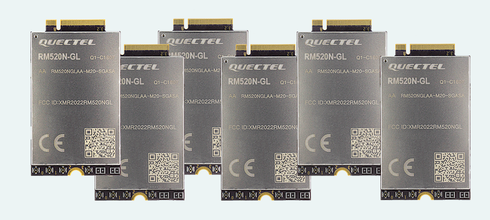
With downlink speeds up to 4.7 Gbps and uplink speeds up to 1.25 Gbps, the RM520N-GL is ideal for applications requiring ultra-low latency and high throughput, such as industrial automation, CPE routers, telematics, video surveillance, and AR/VR platforms.
Among the most sold 5G NR modules out there, the Quectel RM520N-GL is engineered to deliver blazing-fast connectivity for next-generation broadband applications. Supporting both 5G NR (SA/NSA) and fallback to high-speed LTE and 3G, this module ensures reliable coverage and seamless global deployment.
Your device will connect to 5G. But will it be Standalone or Non-Standalone? The answer depends on the network, and the Quectel RM520N-GL handles both. With fallback to LTE and 3G, it keeps devices connected wherever they are deployed.
That flexibility is one reason it’s among the best-selling 5G NR modules available. Add up to 4.7 Gbps downlink and 1.25 Gbps uplink, and it’s a proven choice for CPE routers, industrial automation, telematics and video surveillance.
5One common assumption we encounter is that moving from 4G LTE to 5G will automatically improve network coverage. After all, newer technology should be better… right? The reality is a bit more complicated – again and again.
For many IoT applications, coverage is determined far more by frequency than by the generation of cellular technology itself. An LTE device operating on low-band can often outperform a 5G device using mid-band when it comes to indoor penetration and reach into challenging environments such as basements and utility cabinets.
Part of the early promise of 5G was that technologies such as Dynamic Spectrum Sharing (DSS) would allow operators to introduce 5G while leveraging the coverage footprint already established by LTE. While DSS certainly accelerated early deployments, many operators are now evolving their strategies as networks mature, balancing capacity, efficiency, and spectrum utilization to meet growing demand (https://www.lightreading.com/5g/the-quiet-sunset-of-5g-dynamic-spectrum-sharing).
Then there’s another point: 5G Standalone (SA) vs Non-Standalone (NSA). Most of today’s 5G deployments are still NSA, meaning they continue to rely on the existing LTE core network for signalling and control. True 5G SA deployments offer the full promise of 5G with network slicing and super low latency being key factors, but they remain relatively uncommon. Or, to put it another way: 5G Standalone deployments are quite (stand)alonely!
You also have the “LPWA is 5G” proponents but we’re talking real 5G here. So what’s the takeaway? The “best” cellular technology isn’t necessarily the newest one; the right choice depends on what you’re trying to achieve.
If your application requires high throughput, low latency, or is designed with future 5G capabilities in mind, then 5G may well be the obvious choice for you. On the other hand, if your priorities are coverage in difficult environments, low power consumption and/or cost control, LTE technologies still make a very compelling case. The good news? We really love this stuff.
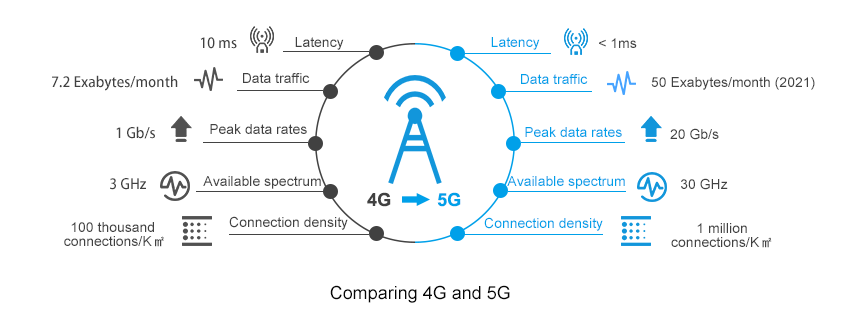
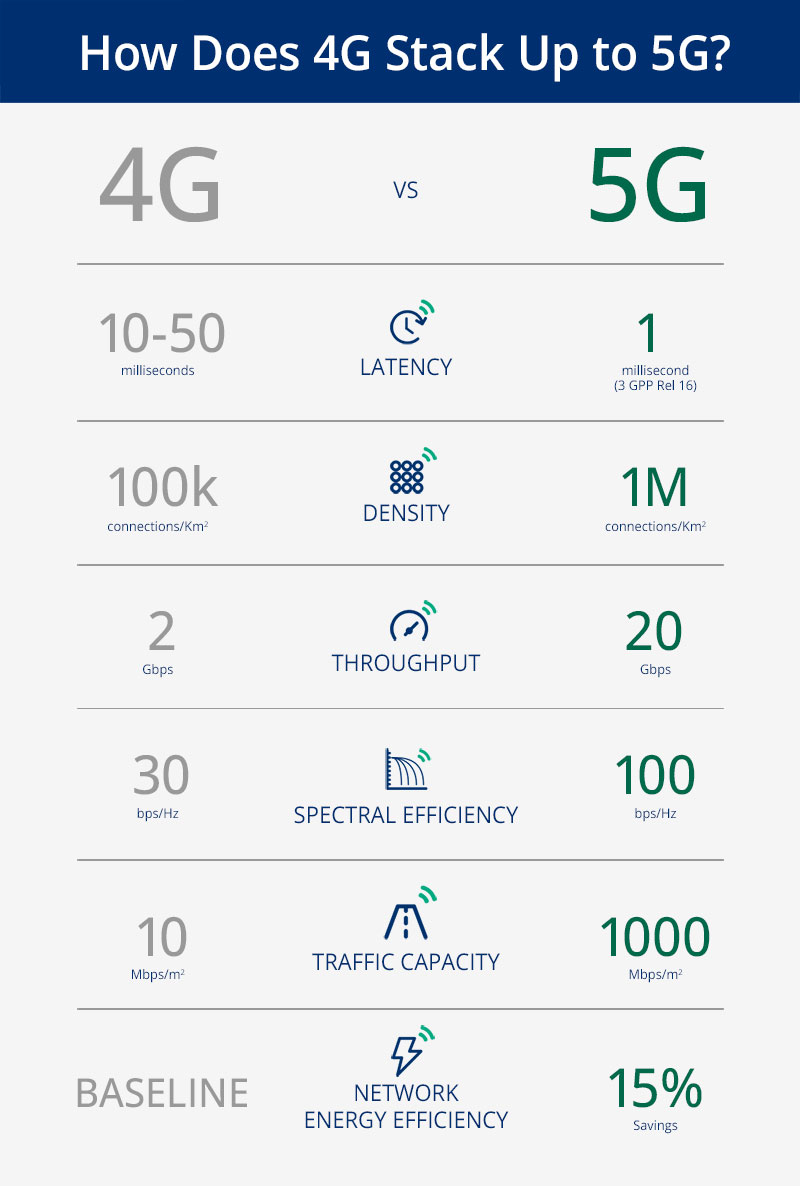
4G Vs. 5G Key Technology Differences
Choosing the right cellular technology isn’t always straightforward, but that’s where we can help. Whether you’re evaluating LPWA, LTE, or NR, we’d be happy to discuss your application, and help you navigate the intricacies of module selection to find the best fit for your project.
In this article, I will address and review the Key technology differences between 4G and 5G; reading this topic is crucial, especially if you have a good background in 4G and have just started your 5G Career.
This article will cover the differences between 4G & 5G for the following
Content
RAN Structure: 4G, 5G NSA & 5G SA
From the Radio Access Network side, The overall structure looks very similar, for example;
X2 interface connecting different 4G Nodes was replaced by the Xn interface
S1 interface connecting BTS Side to the Core network replaced by Ng interface
MME replaced by AMF and SGW replaced by UPF
From a superficial view, it is a matter of naming change; however, there are subtle changes implemented that leads to huge improvement; we will be addressing one of the points which can lead to improving latency in 5G SA.
RAN Structure
One of the main differences provided in 5G SA Architecture is that the User plane and Control function has separated; see below comments and the 4G & 5G Full Architecture for more details.
An important Characteristic of the 5G System is separating the user plane and control plane functions, which differs from the original 4G System architecture in the following:
In 4G: P-GW provides both control plane and user plane functions(IP Address allocation & Packet Forwarding)
In 5G: SMF Provides IP Allocation, and UPF provides packet forwarding
2. User and Control plane separation allows independent scaling of the two functions
Operators can add more user plane capabilities without having to add more control plane
Minimize latency by distributing User plane and keeping it geographically close to the AN
Packet Gateway provides both User plane and Control Plane function in 4G
4G Architecture
While in 5G, Only UPF provides User plane function.
5G Architecture: Pictures captured from 5G NR in Bullets
Quality of Service: 4G & 5G
For the QoS Part, there is an essential change in the way of how the QoS is being allocated.
In 4G, EPS Bearer is responsible for providing E2E User Plane connectivity between the UE and Access Point Name “APN” within the Packet Gateway
*APN defines the interface to the external data network
The point here is that EPS Bearer has a one-to-one mapping to the QoS, This means that the User needs to establish a new EPS bearer every time there is a new QCI assignment, Only One QoS(Example QCI 9 can be assigned to one DRB) with no flexibility.
4G QoS
In 5G, PDU Sessions is responsible for providing E2E User Plane connectivity between the UE and Data Network Name “DNN” within the User Plane Function ( UPF)
*DNN defines the interface to the external data network
However, Unlike 4G EPS Bearer, PDU Session supports one or more QoS Flows, Which means that QoS Flow to radio bearer mapping is not necessarily one-to-one mapping and multiple QoS can be mapped to the same Radio Bearer.
5G QoS
Note: QoS Flows belonging to different PDU Sessions are mapped onto different DRBs.
Radio Protocol Stack: 4G & 5G
SDAP Primary Task:
Service Data Application Protocol (SDAP) is responsible for mapping QoS bearers to radio bearers according to their quality-of-service requirements. This protocol layer is not present in LTE but introduced in NR when connecting to the 5G core network due to the new quality-of-service handling
The new SDAP (Service Data Adaptation Protocol) primary function maps each QoS Flow onto a specific Data Radio Bearer
•Multiple QoS Flows can be mapped onto a single DRB or,
•Single QoS Flow can be mapped onto a single DRB.
Radio Protocol Stack: SDAP Layer added in User-PlaneSDAP Layer
Overall Technology Comparison
4G Vs. 5G Bandwidth
4G Supports a maximum up to 20Mhz BW, While 5G is up to 400Mhz
5G offers less Guard Band(2~5) and Higher Spectrum Utilization(Utilizing up to 95% of the Channel BW, While 4G Utilize 90%)
Up to 20x Higher Bandwidth and New Spectrum Definition. (ex. mmwave)
NR Offers Less Guard-band and Higher spectrum utilization
*Source: 3GPP TS 38.101 & TS38.104
Frame Structure Comparison: 4G & 5G
The following summarized the main differences between 4G & 5G Frame Structure
Frame and Subframe duration remained the Same for 5G
Number of Symbols in a slot is now fixed to 14 in 5G (4G is fixed to 7)
5G has a flexible numerology, which allows different configurations as the Slot Duration relies on SCS(Sduration = 1 /SCS)
5G is now using a Slot as a scheduling Unit instead of Sub-frame compared to 4G
NR RB Resource Grid is double 4G(14 vs. 7 OFDM symbols in one RB )
Physical Channel & Signals Comparison : 4G & 5G
The below table summarizes the main differences in Physical Channel and Signals
Downlink Comparison: Physical Downlink Control Channel(PDCCH)
In LTE, PDCCH control channels are always distributed across the entire system bandwidth.
NR PDCCHs are designed to transmit in a configurable control resource set (Called CORESET).
Uplink Comparison: Physical Uplink Control Channel(PUCCH)
In 4G, PUCCH is transmitted in one or more Physical Resource Blocks (PRB) at the edges of the system bandwidth and is only supporting Long-Format(duration 1 ms)
While 5G supports both Long and short format, Where short format provides the following:
1~2 Symbols over the complete
Provides Better Latency
PBCH & Synchronization Signals: 4G & 5G
There are 2 main changes in PBCH and SS compared to 4G:
PBCH and SS are now being combined into SSB
SSB Frequency domain location is flexible and can be configured at different locations based on the network requirements(4G PBCH & SS are fixed at the center of Channel BW)
Broadcast Channel Comparison: 4G & 5G
4G Provide Wide Beam coverage, while 5G provides narrow beam coverage for broadcast channels, which can improve the Coverage and Quality
Reference Signal Overhead comparison: 4G & 5G
5G Overhead is almost half 4G, and the mean reason behind that 5G has no Cell Specific Reference Signal as 4G
As you know that CRS was all the time transmitted “Always on” over the entire BW and consume a large number of resource elements within the Resource block
While 5G uses DMRS for channel demodulation instead of CRS.
PDSCH DMRS offers much less overhead compared to CRS due to the following:
DMRS is transmitted within the set of RBs allocated to PDSCH. i.e, if a UE is allocated 10RBs for PDSCH, then both PDSCH and DMRS will be transmitted across those BW
DMRS Configuration type 1 uses 6 RS within one or two symbols, which add around 3.6% up to 7% overhead to 5G, while 4G offers from 9% to 17% overhead. Please see the below picture for more details and refer to the below-attached video for more information.
Key differences in Link Budgets: 4G & 5G
4G & 5G almost have the same Link Budget Basic Methodology
Link Budget is counting all of the gains and losses from the TX through the medium(Free Space, Cables, etc.) to the receiver
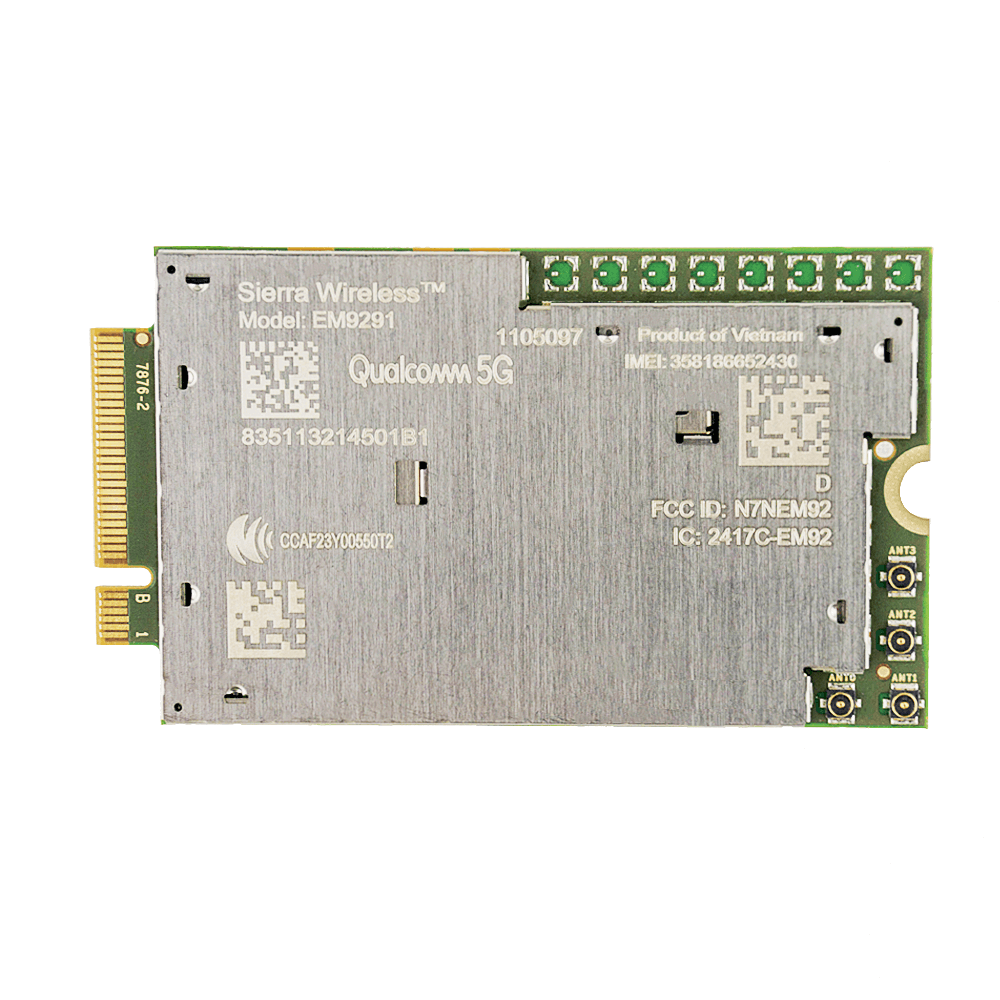
Powered by the Qualcomm X61 modem, the Semtech EM9295 brings cost-optimized 5G connectivity in the well known M.2 30x52mm form factor. It supports 3GPP Release 16 and downlink speeds reaching up to 2.5 Gbps. This latest addition to Semtech’s portfolio hits a sweetspot between capability and affordability.
Whether you’re deploying routers, industrial gateways, or edge computing platforms, the EM9295 delivers the right balance of speed, functionality, and cost – making 5G a practical choice for value-driven projects where every design decision matters. Get your sample today, or reach out to our experts to discuss your project needs.
5G NR Sub-6 GHz embedded module delivers up to 4.9Gbps downlink speed and 660Mbps uplink speed. With automatic 4G and 3G fallback networks and integrated GNSS receiver (GPS, GLONASS, BeiDou, and Galileo satellite systems supported), the EM9295 is applicable to a wide range of IoT applications such as industrial routers, home gateways, industrial and consumer laptops, rugged tablet PCs, video surveillance and digital signage.
Key Benefits
Worldwide coverage on a single module
Dual Sim Single Standby (DSSS)
Industrial grade
Optional Embedded Consumer eUICC to simplify and add flexibility to IoT deployment
Among the best-selling 5G NR modules on the market, the Quectel RM520N-GL is engineered to deliver blazing-fast connectivity for next-generation broadband applications. Supporting both 5G NR (SA/NSA) and fallback to high-speed LTE and 3G, this module ensures reliable coverage and seamless global deployment. With downlink speeds up to 4.7 Gbps and uplink speeds up to 1.25 Gbps, the RM520N-GL is ideal for applications requiring ultra-low latency and high throughput, such as industrial automation, CPE routers, telematics, video surveillance, and AR/VR platforms.
We also offer many suitable accessory for this modem.
Your device will connect to 5G. But will it be Standalone or Non-Standalone? The answer depends on the network, and the Quectel RM520N-GL handles both. With fallback to LTE and 3G, it keeps devices connected wherever they are deployed.
That flexibility is one reason it’s among the best-selling 5G NR modules available. Add up to 4.7 Gbps downlink and 1.25 Gbps uplink, and it’s a proven choice for CPE routers, industrial automation, telematics and video surveillance.