Posted on

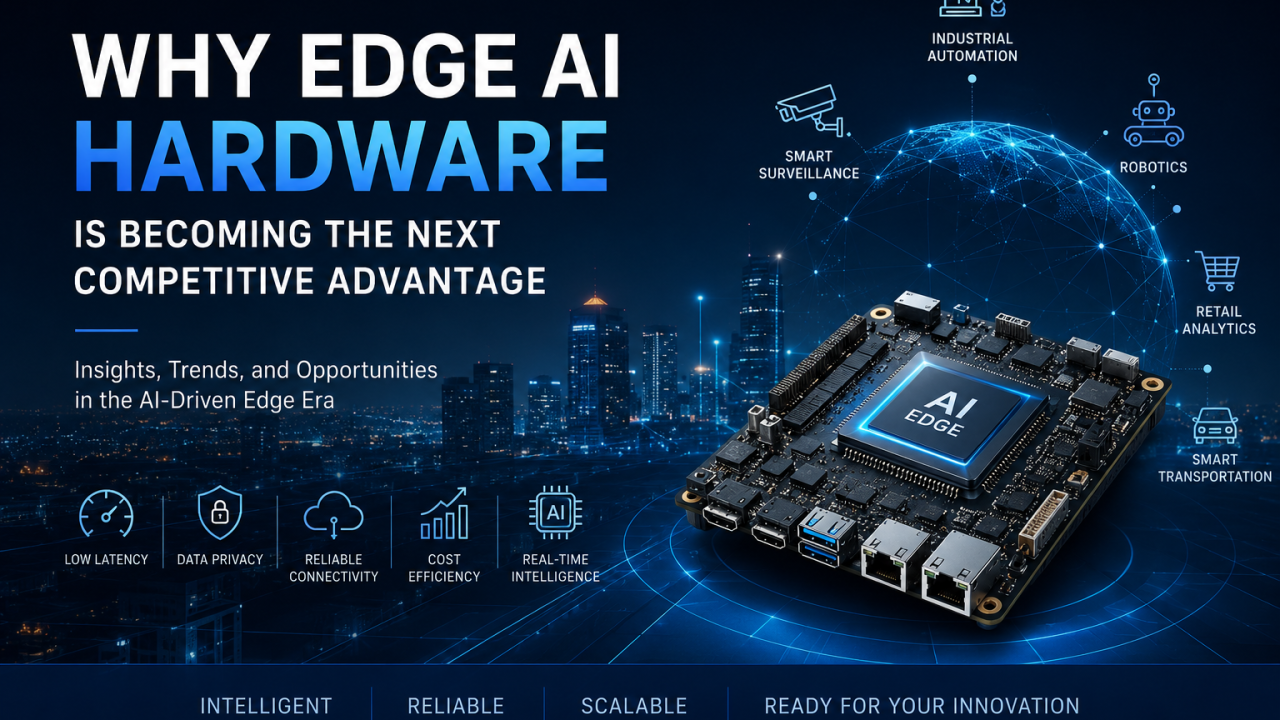
Why Edge AI Hardware Is Becoming the Next Competitive Advantage

Artificial Intelligence has evolved at an incredible pace over the past few years. From large language models to computer vision and predictive analytics, AI software has become increasingly powerful and accessible.

But as AI adoption accelerates, I’ve noticed a shift in conversations with customers and partners.

The discussion is no longer just about models.

It’s about deployment.

AI Doesn’t Create Value Until It Reaches the Edge

Training an AI model is only part of the journey. Real business value is created when AI runs where decisions need to be made—inside factories, warehouses, vehicles, retail stores, hospitals, and smart cities.

For many applications, relying entirely on cloud computing creates several challenges:

  • High latency
  • Expensive bandwidth
  • Privacy concerns
  • Unstable network connectivity
  • Ongoing cloud operating costs

This is why Edge AI has become one of the fastest-growing segments of the AI industry.

Processing data locally enables faster responses, better reliability, and greater control over sensitive information.

The New Bottleneck Isn’t Software

Five years ago, companies asked:

“Which AI framework should we use?”

Today they ask:

“Which hardware platform should we build on?”

Many AI startups have exceptional software teams, yet hardware development often delays commercialization.

Designing an embedded AI system involves far more than selecting a processor. Teams must address thermal management, power optimization, connectivity, storage, operating system support, long-term component availability, manufacturing, and certification.

For companies whose core strength lies in AI algorithms or industry expertise, developing custom hardware from scratch may not be the best use of resources.

Why OEM and ODM Partnerships Matter More Than Ever

Instead of reinventing the hardware platform, many companies are choosing to collaborate with experienced OEM and ODM manufacturers.

This approach allows engineering teams to focus on what truly differentiates their products:

  • AI applications
  • Software platforms
  • User experience
  • Industry-specific solutions

Meanwhile, hardware partners provide mature platforms that reduce development risk and shorten time-to-market.

In today’s competitive environment, launching six months earlier can be more valuable than achieving marginal improvements in hardware performance.

Flexibility Is Becoming More Important Than Raw Performance

The AI industry often focuses on TOPS, GPU cores, and benchmark scores.

While computing power certainly matters, customers increasingly ask different questions:

  • Can this platform be customized?
  • Does it support industrial environments?
  • Can wireless connectivity be added?
  • Is storage expandable?
  • Will the platform still be available in three years?
  • Can it scale from prototype to mass production?

These practical considerations often determine whether a product succeeds in the market.

Performance attracts attention.

Flexibility wins projects.

Looking Ahead

Edge AI is no longer an emerging trend—it is becoming the standard architecture for many intelligent devices.

Whether it’s machine vision, robotics, industrial automation, transportation, or smart retail, demand for reliable, customizable AI hardware continues to grow.

I believe the next wave of innovation won’t come solely from more powerful AI models.

It will come from making AI easier to deploy in real-world environments.

Companies that can combine intelligent software with reliable, scalable hardware will be best positioned to deliver practical AI solutions.

As someone working closely with Edge AI platforms, it’s exciting to see how quickly the industry is evolving.

I’m curious to hear your perspective.

What do you think will become the biggest challenge for Edge AI over the next five years—computing power, deployment, cost, or something else?

Let’s discuss.
Posted on

Wi-Fi 7 for AIoT: How IPQ9574 and QCN9274 Enable Real-Time Edge AI

When we talk about Wi-Fi 7 (802.11be), most discussions focus on its impressive speed upgrades — and rightly so. But beneath the surface, Wi-Fi 7 is quietly becoming a critical enabler for Artificial Intelligence (AI) and AIoT (Artificial Intelligence of Things). It’s not just about faster wireless — it’s about making intelligent devices truly efficient, real-time, and scalable.

🚀 What Makes Wi-Fi 7 Different?

Wi-Fi 7 introduces groundbreaking features like:

  • Multi-Link Operation (MLO) — enabling devices to connect across multiple bands simultaneously, improving reliability and reducing latency.
  • Higher throughput — supporting up to 46 Gbps, ideal for high-data AI workloads.
  • Lower latency — essential for real-time AI inference.
  • Improved concurrency — allowing more smart devices to communicate simultaneously without congestion.

These capabilities make Wi-Fi 7 a natural fit for the AI revolution — both in the cloud and at the edge.


🧠 AI + Wi-Fi 7: A Perfect Match

1. Faster Real-Time Inference at the Edge

Edge AI devices like smart cameras, traffic sensors, or inspection drones require:

  • Constant data streams
  • Real-time decision-making
  • High connection reliability

Wi-Fi 7 ensures ultra-low latency and high bandwidth — perfect for AI models processing data in real time, directly on edge devices.

📍 Example: In smart manufacturing, a defect detection system running AI vision models can send high-resolution images instantly over Wi-Fi 7 for sub-second inference.


2. Scalable AIoT Networks

AIoT means connecting and managing hundreds or thousands of smart devices, often with edge AI capabilities.

Wi-Fi 7 supports:

  • Massive device concurrency
  • Dynamic bandwidth allocation
  • Superior QoS (Quality of Service)

This allows factories, campuses, or smart buildings to scale up their AIoT systems without overloading the network.

📍 Example: A smart office can deploy hundreds of AI-enabled occupancy sensors and environmental monitors — all reporting in real time — without lag.


3. Wireless Edge AI Gateways

Many AIoT systems use a local AI gateway that:

  • Aggregates data from various sensors
  • Runs local AI models
  • Connects wirelessly to the cloud or central system

Wi-Fi 7’s multi-band capabilities ensure that these gateways maintain stable, high-speed connections — even in noisy RF environments.

📍 Example: In a hospital, an AI-powered patient monitoring system can use a Wi-Fi 7-enabled gateway to transmit continuous multi-sensor data with minimal delay or risk of interruption.


🌐 AI-Powered Devices Need a Smarter Network — That’s Wi-Fi 7

As AI models become more complex and real-time applications more common, the network needs to evolve as well. Wi-Fi 7 is not just keeping up — it’s paving the way forward.

Whether it’s in:

  • Retail analytics
  • Autonomous vehicles
  • Healthcare monitoring
  • Smart agriculture
  • or Industrial robotics…

AI + Wi-Fi 7 is the new power couple for connected intelligence.


🔧 524WiFi and Wallys Wi-Fi 7 Hardware: Designed for AI and AIoT Deployments

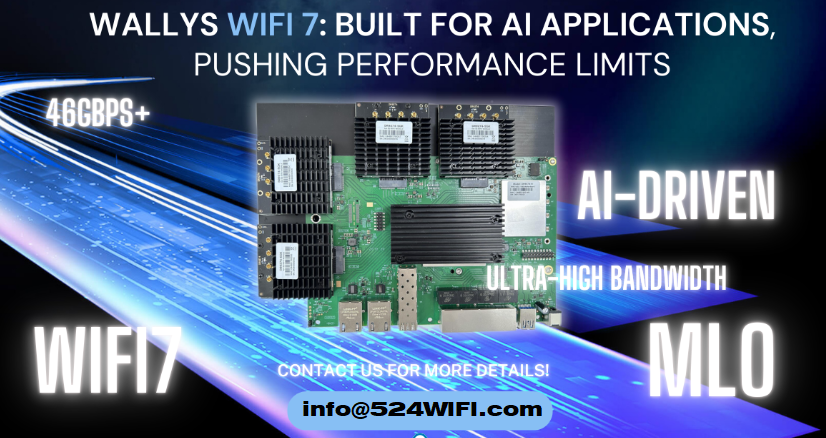
At 524WiFi and Wallys, we offer industrial-grade Wi-Fi 7 solutions based on Qualcomm platforms such as IPQ9574 and QCN9274. Our high-performance router boards and wireless modules are ideal for:

  • AI-enabled edge computing devices
  • Custom AIoT gateways
  • High-bandwidth data streaming systems

🔹 DR9574 Router Board – (CPU:Qualcomm IPQ9574) Perfect for AI gateways with multiple high-speed interfaces

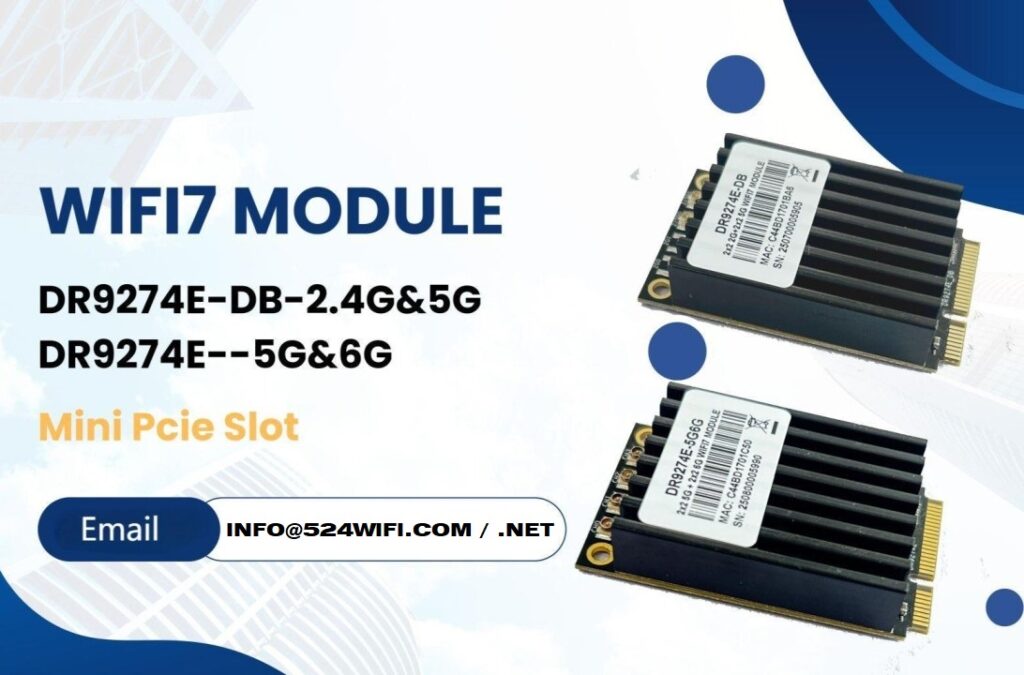
🔹 DR9274 Mini PCIe Module – (CPU:Qualcomm QCN9274/QCN6274) Compact and powerful Wi-Fi 7 module for embedded AI system

🔹 Custom ODM/OEM support – Tailor-made solutions for your AI product roadmap

👉 Contact our team at info@524wifi dor net or com to discuss your AI project and how Wi-Fi 7 can help you scale it smarter and faster.