Posted on

Mediatek MT7915 : A Comprehensive Review of Its Features and Benefits

In the rapidly evolving world of wireless networking, the MT7915 stands out as a powerful and versatile solution for modern connectivity needs. Designed to deliver high performance, reliability, and flexibility, this WiFi 6 chip is ideal for a wide range of applications, from industrial IoT to enterprise networking. In this article, we’ll take a deep dive into the features and benefits of the MT7915, and explore why it’s a top choice for next-gen wireless solutions.

Key Features of the MT7915

1. WiFi 6 Technology

The MT7915 supports 802.11ax (WiFi 6), the latest wireless standard that offers significant improvements over previous generations. With features like OFDMA (Orthogonal Frequency Division Multiple Access) and MU-MIMO (Multi-User Multiple Input Multiple Output), it enables faster speeds, lower latency, and better performance in high-density environments.

2. Dual-Band Support

The MT7915 operates on both 2.4GHz and 5GHz bands, providing flexibility for various networking scenarios. Whether you need broader coverage or higher throughput, this chip delivers optimal performance.

3. High Throughput

With support for 2T2R (2 Transmit, 2 Receive) streams, the MT7915 offers impressive data rates, making it suitable for bandwidth-intensive applications like video streaming, online gaming, and industrial automation.

4. OpenWRT Compatibility

The MT7915 is compatible with OpenWRT, a popular open-source operating system for routers and networking devices. This allows for greater customization and flexibility, enabling developers to tailor the solution to their specific needs.

5. Mini PCIe and M.2 keay A+E or B+M Form Factor

The MT7915 comes in a Mini PCIe or m.2 module, making it easy to integrate into a wide range of devices, from routers and access points to industrial equipment and IoT devices.

6. Industrial-Grade Reliability

Designed for harsh environments, the MT7915 operates reliably in extreme temperatures and conditions, making it ideal for industrial applications.

Benefits of the MT7915

1. Enhanced Performance

The MT7915 delivers faster speeds and lower latency compared to previous-generation WiFi chips, ensuring a seamless user experience even in high-density environments.

2. Cost-Effective Solution

With its high performance and flexibility, the MT7915 offers excellent value for money, making it a cost-effective choice for businesses and developers.

3. Future-Proof Technology

By supporting WiFi 6, the MT7915 ensures that your network is ready for the future, with the ability to handle increasing data demands and new applications.

4. Easy Integration

The Mini PCIe form factor and OpenWRT compatibility make the MT7915 easy to integrate into existing systems, reducing development time and costs.

5. Versatility

From smart homes and offices to industrial IoT and smart cities, the MT7915 is suitable for a wide range of applications, providing reliable connectivity wherever it’s needed.

Applications of the MT7915

1. Industrial IoT

The MT7915’s industrial-grade reliability and high throughput make it ideal for industrial IoT applications, such as factory automation, remote monitoring, and smart logistics.

2. Enterprise Networking

With its support for WiFi 6 and high-density environments, the MT7915 is perfect for enterprise networks, providing fast and reliable connectivity for offices, campuses, and data centers.

3. Smart Homes

The MT7915’s dual-band support and high performance make it a great choice for smart home devices, ensuring seamless connectivity for streaming, gaming, and smart appliances.

4. Public WiFi

The MT7915’s ability to handle high-density environments makes it suitable for public WiFi hotspots, such as airports, malls, and stadiums.

Why Choose Mediatek MT7915 Solution?

At 524WiFi, we offer various MT7915 and MT7916 WiFi 6 / 6E module based on the Mediatek chip, designed to meet the needs of modern wireless networks. Our solution includes:

  • High-quality hardware: Built for durability and performance.
  • OpenWRT support: Enabling customization and flexibility.
  • Expert support: Our team is available to assist with integration and optimization.

To learn more about our MT7915-based solution, please read more : https://524wifi.net/?s=7915

Conclusion

The MT7915 is a powerful and versatile WiFi 6 chip that offers high performance, reliability, and flexibility for a wide range of applications. Whether you’re building an industrial IoT system, an enterprise network, or a smart home solution, the MT7915 is a future-proof choice that delivers exceptional value.

Posted on

Top QCA IPQ 9574 Chip Features for Next-Gen Wi-Fi 7 Connectivity

op IPQ9574 Chip Features for Next-Gen Wi-Fi 7 Connectivity

As the demand for faster, more reliable wireless networks continues to grow, the introduction of Wi-Fi 7 has become a game-changer in the world of wireless technology. At the heart of this new generation of Wi-Fi is the IPQ9574 chip, designed by Qualcomm, which is quickly emerging as one of the leading chips for Wi-Fi 7 connectivity. With its advanced features, the IPQ9574 is set to unlock unprecedented speeds, capacity, and reliability, paving the way for cutting-edge applications across industries. In this article, we’ll take a closer look at the top features of the IPQ9574 chip and how it is revolutionizing the way we connect.

1. Multi-Link Operation (MLO) for Ultra-Fast Speeds

One of the standout features of the IPQ9574 chip is its support for Multi-Link Operation (MLO), a critical component of Wi-Fi 7. MLO allows devices to simultaneously connect to multiple frequency bands (e.g., 2.4 GHz, 5 GHz, and 6 GHz) instead of relying on a single band. This results in faster data transfer speeds and improved network efficiency.

With MLO, the IPQ9574 can combine multiple data streams from different channels, enhancing throughput and reducing latency. This makes it ideal for demanding applications such as 4K/8K video streaming, virtual reality (VR), and high-speed gaming, where a seamless and ultra-fast connection is essential.

2. Increased Capacity for Dense Environments

The IPQ9574 chip is built with the capacity to handle a large number of devices simultaneously, which is critical in today’s increasingly connected world. Whether it’s a smart home, a busy office, or a large public venue, the chip ensures that network congestion is minimized, allowing for smooth communication even in dense environments.

With the Wi-Fi 7 technology powered by the IPQ9574, your network will be able to efficiently handle more devices without sacrificing performance. This is especially important as the Internet of Things (IoT) continues to expand and more smart devices are added to networks every day.

3. Better Spectrum Utilization with 320 MHz Channel Width

The IPQ9574 chip supports 320 MHz channel width, which significantly increases the amount of data that can be transmitted over the network. This feature is crucial for taking full advantage of the newly available 6 GHz spectrum offered by Wi-Fi 7, allowing for less interference and more bandwidth.

With wider channels, users can expect higher throughput and faster data speeds. For example, large file transfers, high-definition video streaming, and bandwidth-intensive tasks will see massive improvements in speed and efficiency.

4. Enhanced Reliability and Reduced Latency

One of the most important factors in ensuring a reliable network is minimizing latency—the delay between sending and receiving data. The IPQ9574 chip addresses this with advanced features that optimize network reliability and ensure a low-latency experience.

In applications such as live streaming, online gaming, and real-time video conferencing, low latency is essential for smooth, uninterrupted experiences. The IPQ9574 chip’s ability to provide consistent, stable connections is what sets it apart, ensuring high performance even during heavy traffic periods.

5. Seamless Connectivity with Enhanced Roaming

The IPQ9574 chip supports seamless roaming, which allows devices to smoothly transition between access points without interruption. Whether you’re walking around your home or office, the network will automatically hand off your connection to the nearest access point, ensuring a continuous, reliable experience.

This is especially beneficial in larger spaces or environments with many users, such as hotels, hospitals, or large campuses, where maintaining an uninterrupted connection is crucial.

6. Backward Compatibility with Wi-Fi 5 and Wi-Fi 6

Although the IPQ9574 chip is built for the future with Wi-Fi 7, it also maintains backward compatibility with older Wi-Fi standards, such as Wi-Fi 5 and Wi-Fi 6. This means that users with older devices can still enjoy fast and reliable connections on Wi-Fi 7 networks, without the need to upgrade all their devices at once.

Conclusion: The Future of Wireless Connectivity

The IPQ9574 chip is a powerhouse for Wi-Fi 7 technology, offering game-changing features like Multi-Link Operation (MLO), higher capacity, wider channels, and seamless roaming. These features make it the perfect choice for applications demanding high-speed, reliable, and efficient wireless connections—whether it’s for streaming, gaming, smart cities, or enterprise networks.

At Wallys Communications, we leverage the IPQ9574 chip to deliver cutting-edge solutions that meet the needs of modern wireless networks. Additionally, we have developed AI-driven solutions, such as human recognition and vehicle detection, powered by QCN9074 chips, offering innovative applications in security and automation.

Contact us today to learn more about how our Wi-Fi 7 solutions powered by IPQ9574 can elevate your wireless network and unlock the full potential of next-gen connectivity.

Posted on

What industries are likely to benefit the most from WiFi 7 advancements?

WiFi 7 advancements are set to benefit several industries, particularly those that rely heavily on connectivity, data transfer, and real-time communication. Here are some of the key industries likely to gain the most:

1. Manufacturing

  • Smart Factories: Enhanced connectivity supports IoT devices, automation, and robotics, improving efficiency and productivity on the factory floor.
Smart Factories

2. Healthcare

  • Telemedicine and Remote Monitoring: High-speed, low-latency connections enable real-time patient monitoring and telehealth services, enhancing care delivery.
Healthcare

3. Transportation and Logistics

  • Fleet Management: IoT sensors and real-time tracking systems can operate more effectively, improving logistics, inventory management, and route optimization.
Transportation and Logistics

4. Retail

  • Smart Retail Solutions: WiFi 7 can support advanced point-of-sale systems, inventory tracking, and customer engagement technologies like AR applications.

5. Education

  • Online Learning and Collaboration: Schools and universities can leverage high-speed connectivity for blended learning, virtual classrooms, and enhanced collaboration tools.

6. Energy and Utilities

  • Smart Grids: Enhanced data transmission allows for better monitoring and management of energy consumption and distribution, facilitating the growth of renewable energy sources.

7. Construction

  • Site Connectivity: Real-time data sharing between devices and personnel can improve project management, safety monitoring, and equipment tracking.

8. Agriculture

  • Precision Farming: IoT devices can collect and transmit data on soil conditions, crop health, and weather, optimizing agricultural practices and yields.

9. Hospitality

  • Guest Experience: Hotels can provide seamless connectivity for guests and improve operational efficiency through integrated management systems.

Conclusion

WiFi 7’s capabilities are set to transform industries by enhancing connectivity, supporting advanced technologies, and improving efficiency. As businesses adopt these advancements, the impact on operations, customer experience, and overall productivity will be significant.

Wallys WiFi 7 Solutions

With over 16 years of expertise, Wallys is a leader in OEM/ODM services for WiFi products, including router boards, WiFi cards, antennas, and access points spanning WiFi 5, 6, and 7 standards. We excel in both software development and hardware customization, leveraging Qualcomm chipsets like IPQ9574 and IPQ6010 to deliver superior performance. Many of our products support open-source platforms such as OpenWrt and OpenWiFi, allowing for highly customizable solutions tailored to meet specific client needs.

At Wallys, we offer two robust WiFi 7 solutions designed to meet diverse needs:

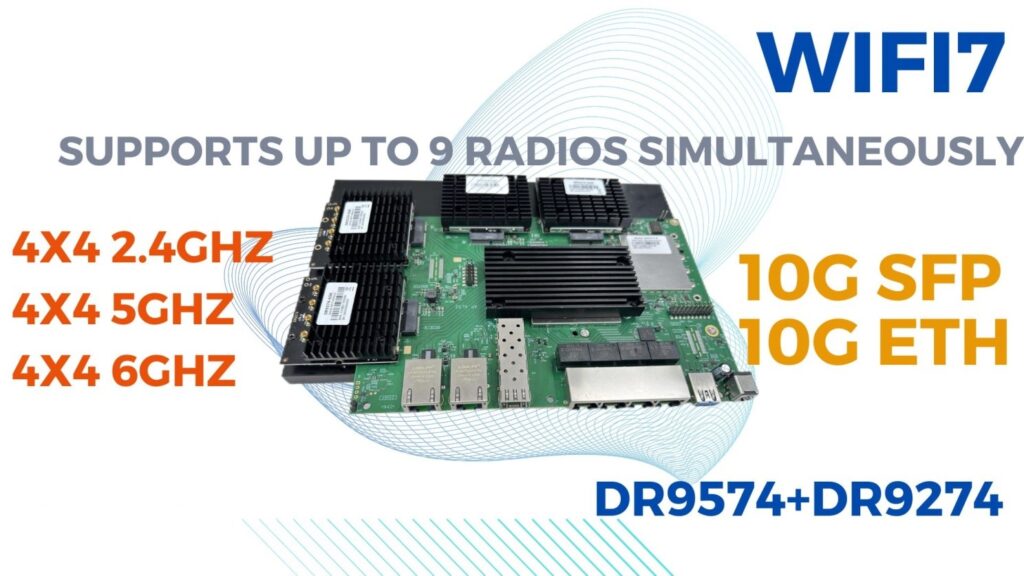
1.DR9574 IPQ9574 Solution (Industrial Grade)

Features: Qualcomm IPQ9574 chipset, QCN9247 4×4 2.4GHz, 4x M.2 slots, QCN6274/QCN9274, 2x 10G Ethernet ports, 4x 1G Ethernet ports.

Performance: Achieves impressive throughput with a 6GHz indoor test reaching 9.9Gbps when tested with a 10G port PC.

More Info: DR9574 IPQ9574 Solution

2.DR5332 IPQ5332 Solution (Commercial Grade)

Features: Qualcomm IPQ5332 chipset, 10G SFP, 1GB DDR4 16-bit.

More Info: DR5332 IPQ5332 Solution

Posted on

The Essence of OFDMA

At the heart of OFDMA lies the concept of dividing the available wireless spectrum into smaller, more manageable resource units. These resource units, or subcarriers, are then dynamically allocated to multiple users based on their individual data transmission needs. This approach contrasts with traditional OFDM, where the entire spectrum is allocated to a single user at a time, leading to inefficient utilisation of network resources, especially when dealing with a large number of users with varying data requirements.

Benefits of OFDMA

The implementation of OFDMA has brought about a multitude of benefits to wireless networks, including:

  • Increased Efficiency: By allocating resource units based on user needs, OFDMA minimises the amount of unused spectrum, leading to more efficient utilisation of network resources.
  • Enhanced Capacity: The ability to serve multiple users simultaneously significantly increases the overall capacity of the network, enabling more devices to connect and access data without experiencing congestion or slowdowns.
  • Improved Fairness: OFDMA ensures that users with different data requirements are treated fairly, preventing users with high data needs from dominating the network and depriving others of adequate bandwidth.
  • Reduced Latency: By efficiently distributing data across multiple subcarriers, OFDMA minimises the time it takes for data to travel from a device to the network and back, resulting in lower latency and a more responsive user experience.

Real-World Applications

The benefits of OFDMA extend beyond theoretical advantages, positively impacting various real-world applications:

  • Dense Wireless Environments: In crowded environments like stadiums, offices, or public transportation hubs, OFDMA plays a crucial role in ensuring that all users can access the network without experiencing significant performance degradation.
  • Real-Time Applications: For applications that demand low latency, such as video conferencing, cloud gaming, and remote surgery, OFDMA’s ability to minimise delays is essential for providing a seamless and uninterrupted user experience.
  • Internet of Things (IoT): With the growing proliferation of IoT devices, OFDMA enables efficient management of data traffic from a vast number of connected devices, ensuring that critical data is transmitted reliably and without congestion.

The Future of OFDMA

As wireless technologies continue to evolve, OFDMA will undoubtedly play an even more prominent role in shaping the future of wireless communication. With its ability to address the challenges of increasing user demands, diverse data requirements, and the growing density of connected devices, OFDMA is poised to enable a new era of seamless, efficient, and high-performance wireless connectivity.