
Posted on

Long-Range Drone Video & Control Links: Choosing Between DR5322, DR9574S, and DR5424

For agricultural, inspection, and mapping drones, the weakest link in the field is rarely the flight controller — it’s the wireless link. Video dropouts, control-command latency, and interference between multiple concurrent aircraft all directly affect operational efficiency and, in some cases, flight safety. Picking the right wireless hardware platform ultimately comes down to trade-offs between throughput, range, integration approach, and deployment environment.

524WiFi and Wallys currently offer three Qualcomm WiFi 7-based platforms that map to different drone video/control link scenarios: DR5322, DR9574S, and DR5424. Here’s how they differ, and which one fits which use case.

DR5322: Lightweight and modular, built for cost-sensitive edge nodes

The DR5322 is built on Qualcomm’s IPQ5322 (quad-core Cortex-A53 @1.5GHz) and is essentially a compact routerboard: onboard 2×2 2.4GHz radio, with 5GHz/6GHz handled through an add-on QCN9274/QCN6274 WiFi 7 module, reaching up to roughly 5764Mbps physical data rate. It offers 4x 2.5G Ethernet ports plus 1x 10G SFP, with 802.3bt PoE support.

This “onboard 2.4G + pluggable high-band module” architecture makes the DR5322 well suited as a relay node or video-transmission hub for a single small multirotor — where the priority is small footprint, low power, and controlled cost rather than maximum throughput. Think field-deployable relay boxes or vehicle-mounted repeaters.

DR9574S: The modular flagship, built for relay towers and multi-drone coordination

The DR9574S runs on Qualcomm’s IPQ9574 (quad-core ARM-A73 @2.2GHz) and is the most configurable of the three — six version options (2×2/4×4, 5G/6G/5-7G) let you tailor the band mix to the project. It supports OFDMA, MU-MIMO, and multi-link operation (MLO), with 10G SFP, 10G Ethernet with PoE, and 2 Gigabit ports, plus optional GPS. Industrial-grade design supports operation from -20°C to 70°C.

This configuration is a better fit for fixed base stations, relay towers, or scenarios that need to manage video/control links for multiple drones at once — for example, a large-scale agricultural operation running several spraying drones simultaneously, where the ground station needs to reliably carry multiple concurrent video and control streams.

DR5424: High-throughput tri-band, built for aggregating high-definition multi-stream video

The DR5424 is the most integrated of the three: Qualcomm IPQ5424 (quad-core Cortex-A55 @1.8GHz), full onboard tri-band WiFi 7 (4×4 MU-MIMO), 320MHz channel width, with theoretical physical data rates up to 1376Mbps on 2.4GHz, 8647Mbps on 5GHz, and 11530Mbps on 6GHz. It also carries the strongest port configuration of the three: 4x 2.5G plus 2x 10G Ethernet.

One important clarification: DR5424’s tri-band design is switchable, not concurrent — the three bands are there to be switched between as needed to avoid interference, not to simultaneously carry separate traffic types (e.g., control on one band, video on another, backhaul on a third). This distinction matters when evaluating a project’s actual concurrent multi-video-stream capacity.

With onboard tri-band radios and multiple high-speed Ethernet ports, the DR5424 is well suited as an aggregation gateway for high-definition, multi-channel video feeds — for example, when several aerial video streams need to be backhauled simultaneously to a ground station for real-time stitching or AI-based analysis.

Side-by-side comparison

DR5322 DR9574S DR5424 Chipset IPQ5322 (A53 @1.5GHz) IPQ9574 (A73 @2.2GHz) IPQ5424 (A55 @1.8GHz) Radio architecture Onboard 2.4G + pluggable 5/6G module Modular, 6 version options (2×2/4×4) Full onboard tri-band, 4×4 Max theoretical rate ~5764Mbps ~5765Mbps (per radio) ~11530Mbps (6GHz) Channel width — Up to 160MHz Up to 320MHz Ethernet 4x 2.5G + 1x 10G SFP 2x 1G + 1x 10G+PoE + 1x 10G SFP 4x 2.5G + 2x 10G GPS No Optional No Typical use case Lightweight relay node / cost-sensitive projects Fixed base station / multi-drone relay tower High-definition multi-stream aggregation gateway

Which one should you choose?

  • Budget-constrained projects that only need to support a single drone or a small number of video links — a lightweight relay node: go with DR5322.
  • Larger operational radius, managing multiple drones online at once, needing a fixed base station or relay tower: go with DR9574S, selecting the version that matches your band requirements.
  • Concurrent high-definition multi-stream video backhaul with high Ethernet aggregation bandwidth requirements, needing an edge gateway: go with DR5424.

All three platforms support OEM/ODM customization, including long-range transmission software tuning, antenna selection, and enclosure design. If you’re evaluating wireless hardware for a drone video/control link project, reach out to info at 524wifi.net or 524wifi.com for selection guidance or to request samples.
Posted on

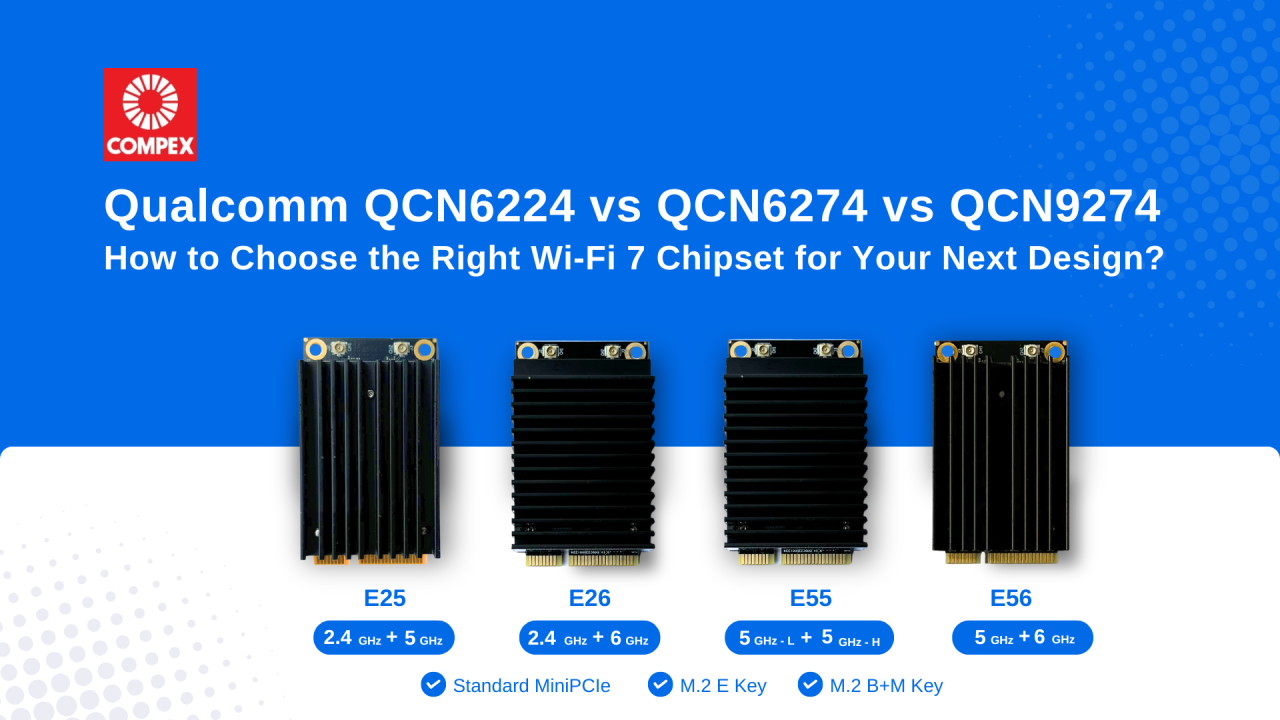
Qualcomm QCN6224 vs QCN6274 vs QCN9274: Which Wi-Fi 7 Chipset Should You Design With?

Wi-Fi 7 is rapidly becoming the standard for enterprise networking, industrial IoT, Edge AI and next-generation wireless infrastructure. When choosing between Qualcomm’s QCN6224, QCN6274, and QCN9274, engineering teams often ask us which one is “best.” The real question is: Which one fits your application’s capacity, thermal and cost?

Here is a quick breakdown to guide your next design:

Qualcomm QCN6224

It is designed for applications where cost efficiency and reliable Wi-Fi 7 performance are priorities, well suited for embedded systems and entry-level enterprise networking products. Supporting up to 128 concurrent clients, it offers reliable wireless performance for applications that do not require extremely high connection density. For many OEMs/ ODMs, QCN6224 offers an excellent balance between performance and affordability.

Qualcomm QCN6274

The Qualcomm QCN6274 targets enterprise-class networking. With support for the 6 GHz spectrum, wider channel bandwidth and up to 256 clients, it is well suited for enterprise access points, smart manufacturing, healthcare and campus networks where higher capacity is required.

Qualcomm QCN9274

The Qualcomm QCN9274 is Qualcomm’s flagship Wi-Fi 7 networking chipset for demanding enterprise and industrial applications. Supporting up to 512 concurrent clients, it is ideal for high-density enterprise deployments, mission-critical wireless infrastructure and industrial applications that demand maximum wireless capacity and low latency.

Article content
ChipsetNo of ClientsBest ForKey Advantages
QCN6224Up to 128 clientsSmall-Medium Business NetworkingCost-effective Wi-Fi 7 performance
QCN6274Up to 256 clientsEnterprise Access PointsHigher throughput, 6 GHz support, enterprise scalability
QCN9274Up to 512 clientsHigh-density Enterprise, Mission-critical NetworksMaximum capacity, advanced RF performance, premium enterprise features

Rather than asking which chipset is “better,” a more important question is: Which chipset is the right fit for your application requirements?

Choose Qualcomm QCN6224 when cost efficiency and dependable Wi-Fi 7 performance are your priorities.

Choose Qualcomm QCN6274 when your product needs higher throughput, 6 GHz support and greater client capacity.

Choose Qualcomm QCN9274 when you are designing high-density wireless infrastructure where scalability, low latency and high concurrent client capacity are critical.

Looking Beyond the Chipset

Selecting the right chipset is only one part of developing a successful Wi-Fi 7 product. RF front-end design, thermal dissipation and host platform integration can add months to your development cycle.

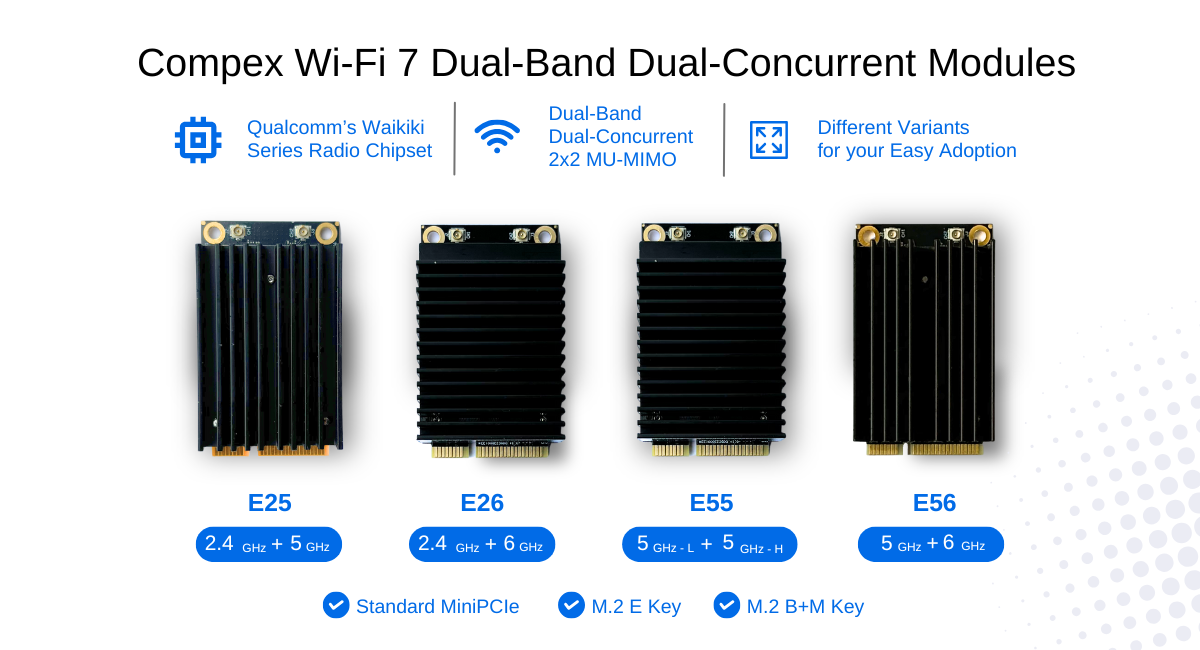
At 524WiFi and Compex, our Wi-Fi 7 Module Family supports single and dual-band configuration with both commercial grade and industrial grade chipset. Available in standard MiniPCIe form factor and M.2 variants, the module family are compatible with Qualcomm platforms as well as various third-party industrial CPU platforms, including Intel x86, NVIDIA and ARM-based processors such as NXP and Marvell, helping OEMs/ ODMs reduce integration risk and accelerate product development.

To learn more about Compex Wi-Fi 7 Standard MiniPCIe and M.2 Qualcomm-based Wi-Fi 7 module, contact us directly !

Posted on

QCN9024-Powered DR9074-TRIBAND: Advanced WiFi 6 Tri-Band Solution

DR9074-TRIBAND: High-Performance WiFi 6 Tri-Band Network Card for Next-Gen Wireless Solutions

Introduction

With the increasing demand for high-speed wireless networks, WiFi 6 technology has become the preferred choice for upgrading enterprise and industrial wireless solutions. Offering higher throughput, lower latency, and superior interference resistance, WiFi 6 enables seamless connectivity across multiple applications.

524WiFi introduces the DR9074-TRIBAND, a high-performance WiFi 6 tri-band network card powered by the Qualcomm QCN9024 chipset. Supporting 2.4GHz, 5GHz, and 6GHz frequency bands, this card is designed for high-density environments, multi-device connectivity, and low-latency applications. This article will explore the technical features, application scenarios, and benefits of the DR9074-TRIABND in upgrading wireless network solutions.


DR9074-TRIABND Specifications

524WIFi DREAM DR9074-TRIBAND is built on the Qualcomm QCN9024 chipset and boasts the following core specifications:

Parameter Specification Chipset Qualcomm QCN9024 WiFi Standard 802.11ax (WiFi 6) Frequency Bands 2.4GHz / 5GHz / 6GHz Antenna Interface 4×4 MU-MIMO Throughput 2.4GHz: 1148 Mbps ;5GHz: 2402 Mbps ;6GHz: 2402 Mbps Interface PCIe 3.0 Transmit Power Up to 23dBm Security WPA3 Encryption Compatibility Supports OpenWRT / Linux / Custom Firmware


Advantages of a Tri-Band WiFi Design

One of the standout features of the DR9074-TRIABDN is its tri-band support (2.4GHz, 5GHz, 6GHz). Compared to traditional single-band or dual-band network cards, it provides higher throughput, reduced interference, and more flexible networking options.

1. 2.4GHz Band: Wide Coverage, Ideal for IoT Devices

  • Advantages: Strong penetration capability, suitable for long-distance connections.
  • Applications: Smart home devices, industrial sensors, low-power IoT devices.

2. 5GHz Band: High Throughput for Mainstream Wireless Applications

  • Advantages: Supports higher bandwidth while avoiding congestion in the 2.4GHz band.
  • Applications: Enterprise WiFi networks, HD video streaming, cloud computing offices.

3. 6GHz Band: Low-Interference, High-Speed Wireless Connectivity

  • Advantages: Offers higher bandwidth and less interference, meeting the needs of WiFi 6E devices.
  • Applications: VR/AR, low-latency cloud gaming, high-speed wireless backhaul.

With tri-band operation, the DR9074-TRIBAND can support multiple use cases simultaneously, optimizing network performance and reducing interference.


Qualcomm QCN9024: The Power Behind WiFi 6

As the core of the DR9074-TRIBAND, the QCN9024 chipset from Qualcomm is a flagship WiFi 6 solution offering:

✅ 4×4 MU-MIMO – Enables simultaneous multi-user transmissions, improving throughput and network efficiency. ✅ OFDMA (Orthogonal Frequency Division Multiple Access) – Efficient data scheduling, reducing network latency. ✅ BSS Coloring Technology – Reduces co-channel interference, enhancing network stability. ✅ TWT (Target Wake Time) – Reduces power consumption, extending the battery life of IoT devices. ✅ WPA3 Security – Provides enhanced wireless security for modern network environments.


Application Scenarios and Industry Benefits

The DR9074-TRIBAND is well-suited for enterprise WiFi, industrial IoT, wireless Mesh networks, and dedicated wireless systems.

1. Enterprise-Grade Wireless AP / WiFi Solutions

  • High-concurrency WiFi connectivity for office environments.
  • OFDMA & MU-MIMO improve multi-device performance.
  • 6GHz support reduces interference, ensuring a fast and reliable WiFi experience.

2. Industrial IoT (IIoT) & Smart Cities

  • 2.4GHz for IoT device connections, ideal for long-range, low-power sensors.
  • 5GHz/6GHz for industrial data transmission, supporting smart factories and remote monitoring.
  • TWT technology extends the battery life of IoT sensors and edge devices.

3. High-Performance Mesh & Backhaul Networks

  • 6GHz as a dedicated backhaul frequency, enhancing mesh WiFi efficiency.
  • Compatible with BATMAN and other mesh networking protocols, optimizing multi-hop routing.

4. Wireless HD Video & Low-Latency Gaming

  • WiFi 6 + 6GHz low-interference connectivity for smooth 4K/8K video streaming.
  • Ultra-low latency for cloud gaming and VR/AR applications.

Comparison with Other WiFi 6 Network Cards

Parameter DR9074-TRIBAND Competitor A Competitor B

WiFi Standard WiFi 6 (802.11ax) WiFi 6 WiFi 5

Frequency Bands 2.4G / 5G / 6G 2.4G / 5G 5G

MU-MIMO 4×4 2×2 2×2

Max Throughput 2402 Mbps (5G/6G) 1733 Mbps (5G) 1300 Mbps (5G)

BSS Coloring ✅ Supported ❌ Not Supported ❌ Not Supported

TWT Power Saving ✅ Supported ❌ Not Supported ❌ Not Supported

WPA3 Security ✅ Supported ❌ Not Supported ❌ Not Supported

As seen in the comparison, DR9074-TRIBAND offers superior performance, broader frequency options, less interference, and enhanced security, making it a leading WiFi 6 solution.


Why Choose 524WiFi DR9074-TRIBAND?

✅ Tri-band WiFi 6 support – 2.4G / 5G / 6G compatibility for diverse applications. ✅ Powered by Qualcomm QCN9024 – 4×4 MU-MIMO for ultra-fast, stable connections. ✅ OFDMA & BSS Coloring – Increases network efficiency and reduces congestion. ✅ Advanced WPA3 security – Ideal for enterprise and industrial wireless deployments. ✅ Mesh & Backhaul compatibility – Perfect for high-density WiFi installations.

The 524WiFi DREAM DR9074-TRIBAND is designed for enterprises, industrial applications, smart cities, and high-performance wireless networking, bringing WiFi 6 capabilities to the next level.

Posted on

IPQ5322 + QCN9274 + QCN6274: The Ultimate Tri-Band Wi-Fi 7 Networking Platform

With the rapid adoption of Wi-Fi 7, businesses and industrial applications require high-performance, multi-band networking platforms that deliver exceptional speed, low latency, and robust connectivity. The IPQ5322 + QCN9274 + QCN6274 solution is a powerful 10-stream Wi-Fi 7 networking platform, designed for next-generation routers, enterprise APs, and industrial wireless deployments.

Key Features of IPQ5322 + QCN9274 + QCN6274 Wi-Fi 7 Platform

🔹 Tri-Band Wi-Fi 7 with 10-Stream Configuration

  • IPQ5322: Dual-core networking SoC for high-speed processing
  • QCN9274 (5GHz 4×4 MIMO): High-performance Wi-Fi 7 radio
  • QCN6274 (6GHz 4×4 MIMO): Optimized for the new 6GHz band
  • DR5322 + DR9274-5G + DR9274-6G: Complete module integration

🔹 Multi-Link Operation (MLO) & 320MHz Channels

  • Combines multiple frequency bands for lower latency
  • Supports 320MHz ultra-wide channels for faster throughput

🔹 High-Speed Connectivity & Low Latency

  • 10Gbps+ total throughput, ideal for industrial networking
  • Reduced interference & congestion with 6GHz band support

🔹 Optimized for Enterprise & Industrial Wi-Fi Applications

  • Supports large-scale wireless deployments
  • Enhanced performance in smart factories, warehouses, and IoT networks

Why Choose IPQ5322 + QCN9274 + QCN6274 for Wi-Fi 7?

🚀 Superior Wi-Fi 7 Performance: Supports 10 streams for ultra-fast, low-latency wireless connectivity.

🔗 Enhanced MLO & MU-MIMO: Ensures seamless multi-device communication with high efficiency.

🏭 Industrial-Grade Reliability: Ideal for smart cities, industrial automation, and enterprise networking.

🛠 Customizable & Scalable: Flexible OEM/ODM options for tailored solutions.


Get Started with 524WiFi Wi-Fi 7 Solutions

524WiFi and Wallys provide a full range of Wi-Fi 7 networking platforms, including IPQ5322-based solutions with QCN9274 and QCN6274 modules. Whether you’re developing enterprise APs, industrial routers, or high-performance wireless systems, our custom hardware and software solutions can help accelerate your project.

Posted on

Mediatek MT7915 : A Comprehensive Review of Its Features and Benefits

In the rapidly evolving world of wireless networking, the MT7915 stands out as a powerful and versatile solution for modern connectivity needs. Designed to deliver high performance, reliability, and flexibility, this WiFi 6 chip is ideal for a wide range of applications, from industrial IoT to enterprise networking. In this article, we’ll take a deep dive into the features and benefits of the MT7915, and explore why it’s a top choice for next-gen wireless solutions.

Key Features of the MT7915

1. WiFi 6 Technology

The MT7915 supports 802.11ax (WiFi 6), the latest wireless standard that offers significant improvements over previous generations. With features like OFDMA (Orthogonal Frequency Division Multiple Access) and MU-MIMO (Multi-User Multiple Input Multiple Output), it enables faster speeds, lower latency, and better performance in high-density environments.

2. Dual-Band Support

The MT7915 operates on both 2.4GHz and 5GHz bands, providing flexibility for various networking scenarios. Whether you need broader coverage or higher throughput, this chip delivers optimal performance.

3. High Throughput

With support for 2T2R (2 Transmit, 2 Receive) streams, the MT7915 offers impressive data rates, making it suitable for bandwidth-intensive applications like video streaming, online gaming, and industrial automation.

4. OpenWRT Compatibility

The MT7915 is compatible with OpenWRT, a popular open-source operating system for routers and networking devices. This allows for greater customization and flexibility, enabling developers to tailor the solution to their specific needs.

5. Mini PCIe and M.2 keay A+E or B+M Form Factor

The MT7915 comes in a Mini PCIe or m.2 module, making it easy to integrate into a wide range of devices, from routers and access points to industrial equipment and IoT devices.

6. Industrial-Grade Reliability

Designed for harsh environments, the MT7915 operates reliably in extreme temperatures and conditions, making it ideal for industrial applications.

Benefits of the MT7915

1. Enhanced Performance

The MT7915 delivers faster speeds and lower latency compared to previous-generation WiFi chips, ensuring a seamless user experience even in high-density environments.

2. Cost-Effective Solution

With its high performance and flexibility, the MT7915 offers excellent value for money, making it a cost-effective choice for businesses and developers.

3. Future-Proof Technology

By supporting WiFi 6, the MT7915 ensures that your network is ready for the future, with the ability to handle increasing data demands and new applications.

4. Easy Integration

The Mini PCIe form factor and OpenWRT compatibility make the MT7915 easy to integrate into existing systems, reducing development time and costs.

5. Versatility

From smart homes and offices to industrial IoT and smart cities, the MT7915 is suitable for a wide range of applications, providing reliable connectivity wherever it’s needed.

Applications of the MT7915

1. Industrial IoT

The MT7915’s industrial-grade reliability and high throughput make it ideal for industrial IoT applications, such as factory automation, remote monitoring, and smart logistics.

2. Enterprise Networking

With its support for WiFi 6 and high-density environments, the MT7915 is perfect for enterprise networks, providing fast and reliable connectivity for offices, campuses, and data centers.

3. Smart Homes

The MT7915’s dual-band support and high performance make it a great choice for smart home devices, ensuring seamless connectivity for streaming, gaming, and smart appliances.

4. Public WiFi

The MT7915’s ability to handle high-density environments makes it suitable for public WiFi hotspots, such as airports, malls, and stadiums.

Why Choose Mediatek MT7915 Solution?

At 524WiFi, we offer various MT7915 and MT7916 WiFi 6 / 6E module based on the Mediatek chip, designed to meet the needs of modern wireless networks. Our solution includes:

  • High-quality hardware: Built for durability and performance.
  • OpenWRT support: Enabling customization and flexibility.
  • Expert support: Our team is available to assist with integration and optimization.

To learn more about our MT7915-based solution, please read more : https://524wifi.net/?s=7915

Conclusion

The MT7915 is a powerful and versatile WiFi 6 chip that offers high performance, reliability, and flexibility for a wide range of applications. Whether you’re building an industrial IoT system, an enterprise network, or a smart home solution, the MT7915 is a future-proof choice that delivers exceptional value.

Posted on

QCN9274 vs QCN9024: Comparing the Speed and Efficiency of Qualcomm’s Best Wi-Fi Chipsets

As industrial networks grow more complex, the need for high-performance, efficient wireless connectivity becomes more critical. Qualcomm’s QCN9274 (Wi-Fi 7) and QCN9024 (Wi-Fi 6) are both top-tier chipsets that power industrial wireless solutions, but each is optimized for different needs. In this article, we’ll compare the QCN9274 and QCN9024, focusing on their speed, efficiency, and application suitability, to help you determine which chipset is best for your industrial Wi-Fi network.


Overview of QCN9274 and QCN9024

QCN9274 – The Power of Wi-Fi 7

The QCN9274 is Qualcomm’s latest offering featuring Wi-Fi 7 (802.11be). Wi-Fi 7 brings revolutionary improvements to speed, latency, and capacity compared to previous generations. With Wi-Fi 7, the QCN9274 is designed to handle extremely high-demand environments, making it the perfect choice for future-proofing large-scale industrial networks, AI and IoT applications, and high-bandwidth use cases.

Key Features of QCN9274:

  • Wi-Fi 7 (802.11be) Support: Provides ultra-fast speeds and advanced features like Multi-Link Operation (MLO) and Enhanced QAM (Quadrature Amplitude Modulation).
  • Data Rates up to 5.8Gbps: The QCN9274 supports significantly faster speeds than its predecessors, ideal for large data transfers and demanding applications.
  • Reduced Latency: With Wi-Fi 7, the QCN9274 is optimized for ultra-low latency, which is crucial for real-time industrial applications.
  • Higher Capacity: Enhanced support for more simultaneous connections without sacrificing performance.
  • Advanced Features: Includes MLO for simultaneous operation on multiple channels, reducing congestion and improving network reliability.
524WiFi Dream QCN9274 Modules

QCN9024 – The Reliability of Wi-Fi 6

The QCN9024, based on Wi-Fi 6 (802.11ax), delivers faster speeds and improved efficiency compared to previous Wi-Fi standards like Wi-Fi 5. It supports OFDMA (Orthogonal Frequency Division Multiple Access) and MU-MIMO (Multi-User, Multiple Input Multiple Output), which optimize the use of available spectrum, making it ideal for crowded environments with multiple connected devices. While Wi-Fi 6 doesn’t offer the same level of performance as Wi-Fi 7, the QCN9024 still provides excellent performance in most industrial settings.

Key Features of QCN9024:

  • Wi-Fi 6 (802.11ax) Support: Provides faster speeds and improved efficiency compared to Wi-Fi 5, though it lacks the advancements found in Wi-Fi 7.
  • Data Rates up to 2.4Gbps: Offers strong throughput for most industrial applications, though not as high as Wi-Fi 7.
  • Improved Efficiency: Supports OFDMA and MU-MIMO for better use of available bandwidth.
  • Good for High-Density Environments: While it doesn’t scale as well as Wi-Fi 7 in extremely dense environments, it still offers excellent performance in smaller to mid-sized applications.

Speed and Throughput Comparison

QCN9274: Unmatched Speed with Wi-Fi 7

The QCN9274 supports Wi-Fi 7, delivering data rates up to 5.8Gbps. This makes it ideal for high-demand applications such as 4K/8K video streaming, virtual reality (VR), augmented reality (AR), and large-scale industrial automation systems. The advanced capabilities of Wi-Fi 7, such as Multi-Link Operation (MLO), allow the chipset to utilize multiple channels simultaneously, improving throughput and reducing network congestion.

Wi-Fi 7 offers dramatic speed improvements over Wi-Fi 6, enabling faster data transfers, better device density handling, and the ability to operate seamlessly in congested environments.

DR9274 6G SPEED THOUGHPUT TEST

QCN9024: Excellent Wi-Fi 6 Performance

On the other hand, QCN9024 supports Wi-Fi 6, with data rates up to 2.4Gbps. While this is more than sufficient for many industrial applications, it doesn’t match the ultra-high speeds of Wi-Fi 7. Wi-Fi 6 excels in dense environments with many devices, offering improved network efficiency and reduced latency compared to older Wi-Fi standards like Wi-Fi 5.

However, for environments with extreme data throughput requirements, Wi-Fi 7 offers significant improvements in both speed and efficiency.

DR9074(QCN9074)-6E SPEED THOUGHPUT TEST

Efficiency and Capacity

QCN9274: Higher Efficiency for Dense, High-Traffic Environments

The QCN9274, supporting Wi-Fi 7, offers significantly higher capacity and better efficiency compared to Wi-Fi 6. With the help of MLO and Wider Channel Bandwidth, it can handle multiple data streams simultaneously, making it perfect for high-density environments. This is a critical feature in industrial networks, where many devices (IoT sensors, automated machines, etc.) need to operate concurrently.

Wi-Fi 7 is specifically designed for environments that require simultaneous handling of multiple high-bandwidth applications, ensuring that each device gets sufficient bandwidth without causing congestion.

QCN9024: Efficient but Less Scalable

The QCN9024, based on Wi-Fi 6, performs well in dense environments, but it has limitations when scaling up to larger networks. It does support OFDMA and MU-MIMO, which helps in efficient spectrum use and ensures that the network can handle more devices without slowing down. However, compared to Wi-Fi 7, Wi-Fi 6 does not have the same level of capacity or congestion mitigation.

While the QCN9024 is highly efficient in environments with moderate device density, Wi-Fi 6 has its limits in large-scale, high-density industrial deployments.


Latency and Real-Time Applications

QCN9274: Ultra-Low Latency with Wi-Fi 7

One of the key benefits of Wi-Fi 7 is its ultra-low latency, crucial for real-time applications in industrial environments. The QCN9274 is designed for instantaneous communication, which is essential for applications like real-time monitoring, automated systems, and video surveillance. Wi-Fi 7 improves upon Wi-Fi 6 with reduced delay and more predictable performance, even in busy environments.

QCN9024: Reliable but Slightly Higher Latency

The QCN9024, with its Wi-Fi 6 capabilities, also provides low latency, making it suitable for most industrial applications. However, when compared to Wi-Fi 7, the latency is slightly higher, especially in large-scale environments where many devices are connected simultaneously. This might be noticeable in highly time-sensitive applications.


Which Chipset is Right for Your Industrial Wi-Fi Network?

Choose QCN9274 if:

  • You need ultra-fast speeds and high data throughput for demanding applications.
  • Your industrial network requires low latency for real-time monitoring, automation, and control.
  • You have a large number of devices connected to the network and need a future-proof solution.
  • You want to take advantage of Wi-Fi 7‘s advanced features, such as MLO and wider channels for optimal performance in dense environments.

Choose QCN9024 if:

  • Your network has a moderate number of devices and Wi-Fi 6 is sufficient for your current needs.
  • You don’t need the latest Wi-Fi 7 features but still require high-speed connectivity for industrial applications.
  • You are looking for a reliable, cost-effective solution for environments that do not demand extreme speeds or massive scalability.

Conclusion

Both the QCN9274 and QCN9024 are excellent choices, but they cater to different needs. The QCN9274 with Wi-Fi 7 is ideal for high-performance, large-scale, and future-proof industrial networks, while the QCN9024 with Wi-Fi 6 is a great option for environments where Wi-Fi 6’s capabilities are more than adequate. Ultimately, the right choice depends on your network’s requirements—whether it’s speed, efficiency, capacity, or future scalability.

By selecting the right chipset, you can ensure your industrial Wi-Fi network delivers the performance, reliability, and efficiency required for success.

Posted on

IPQ5018 Chipset-Powered DR5018S: A Tri-Band Network Device with GPS and CE/UKCA/FCC Certifications

IPQ 5018 DR5018S: A Powerful Network Device with 2.4G, 5G, and 6G Support, CE-UKCA-FCC Certifications

The router board DR5018S is an innovative network device based on Qualcomm’s IPQ5018 SOC chipset, designed to meet the high demands of various commercial and industrial applications. With its powerful performance and multifunctional configuration, it stands out as one of the leading Wi-Fi 6 solutions in the industry. Below, we provide a detailed analysis of the DR5018S’s features and advantages, offering a comprehensive understanding of this exceptional device.

Core Hardware: IPQ5018 SOC Chipset

The DR5018S is powered by Qualcomm’s IPQ5018 chipset, a leader in Wi-Fi 6 technology. This chipset delivers higher transmission speeds, lower latency, and more stable connections, excelling at handling multi-device connections and high-bandwidth demands. It is ideal for both commercial and industrial environments, managing a large number of simultaneous device connections while maintaining network stability and performance.

Multi-Band Support: 2.4G, 5G, and 6G

A standout feature of the DR5018S is its support for three frequency bands: 2.4GHz, 5GHz, and 6GHz. This tri-band support provides a flexible network solution for various application scenarios. In crowded Wi-Fi environments, selecting the right frequency band helps avoid interference, ensuring faster speeds and higher stability.

  • 2.4GHz: Ideal for wider coverage, though with lower speeds. Best for devices with low bandwidth needs.
  • 5GHz: Offers higher speeds, making it suitable for modern devices requiring higher bandwidth and low latency.
  • 6GHz: As part of Wi-Fi 6E, 6GHz offers clearer channels with less interference, perfect for high-density environments and bandwidth-intensive applications.

This tri-band support allows the DR5018S to deliver outstanding performance, addressing different connection needs across various environments.

Available Versions for Customization

The DR5018S is available in multiple versions to meet your specific project needs:

  1. DR5018S-5G:Supports 5G;1G Ethernet & POE;No GPS
  2. DR5018S:2.4GHz, 5GHz, 6GHz support;2.5G + 1G Ethernet & POE;Includes GPS
  3. DR5018-DB:2.4GHz, 5GHz support;1G Ethernet & POE;No GPS

GPS Functionality

The DR5018S is equipped with built-in GPS functionality, making it ideal for applications requiring precise location tracking. This feature is especially useful in asset management, fleet tracking, and location-based services. Whether in smart transportation, logistics, or other industries that require accurate positioning, the DR5018S provides robust support.

Global Certifications: CE, UKCA, FCC

The DR5018S holds multiple global certifications, including CE (European Union), UKCA (United Kingdom), and FCC (United States), ensuring compliance with regulatory standards across major international markets. These certifications guarantee that the DR5018S meets high-performance and safety standards, allowing seamless use across regions without legal or regulatory issues.

  • CE Certification: Complies with health, safety, and environmental standards for the European market.
  • UKCA Certification: Meets UK market requirements, ensuring smooth access to the UK market.
  • FCC Certification: Ensures compliance with wireless communication requirements in the U.S., preventing excessive wireless interference.

These certifications are essential for the sale and use of electronic products globally, allowing the DR5018S to be easily promoted and deployed in international markets.

Comprehensive Advantages

  • Powerful Processing Capability: The IPQ5018 chipset offers strong network processing, handling high volumes of device connections with ease.
  • Tri-Band Support: Supports 2.4GHz, 5GHz, and 6GHz frequency bands for flexible and efficient network services.
  • Built-In GPS Functionality: Strong support for location-based applications, expanding use cases.
  • Global Certifications: With CE, UKCA, and FCC certifications, the DR5018S meets regulatory requirements for global markets.
  • Stability and Compatibility: Wi-Fi 6 technology ensures excellent performance in high-density environments, offering greater adaptability.

Conclusion

The DR5018S is a highly integrated, high-performance network device that combines Wi-Fi 6 technology, tri-band support, built-in GPS functionality, and global certifications, making it suitable for a wide range of applications. Whether for commercial offices, industrial networks, or smart device applications requiring precise location tracking, the DR5018S ensures stable, reliable network connections and accurate positioning services. With its global certifications, it can be deployed confidently across international markets, expanding your business reach.

The DR5018S is not just a technologically advanced product; it’s a standout solution in the global network connectivity space.

Posted on

IPQ4019 / IPQ4029 powered DR40X9 router board: Unlocking the Power of Mesh Networking with BATMAN

The DR40X9 WiFi 5 router, powered by Qualcomm’s IPQ4019 and IPQ4029 chipsets, delivers reliable and efficient connectivity for various environments. When integrated with BATMAN Mesh networking protocol, the DR40X9 offers seamless coverage, dynamic routing optimization, and fault tolerance, making it the perfect choice for large-scale, high-demand networks.

1. Core Features of DR40X9: Advantages of IPQ4019 and IPQ4029 Chipsets

The IPQ4019 and IPQ4029 chipsets are the backbone of the DR40X9, offering WiFi 5 (802.11ac) technology and the following capabilities:

  • Hardware Design: Equipped with powerful hardware and high-power amplifiers, the DR40X9 ensures excellent wireless coverage and performance, even in demanding environments.
  • WiFi 5 Technology: Delivers high throughput for stable wireless connectivity, ideal for industrial, commercial, and residential applications.

2. Benefits of Mesh Networking with DR40X9

(1) Enhanced Coverage with Multi-Hop Support

The DR40X9, powered by IPQ4019 or IPQ4029, can act as multiple interconnected nodes in a Mesh network, providing seamless wireless coverage over large areas. This is particularly useful for:

  • Large homes or offices
  • Multi-building campuses
  • Rural or suburban deployments

Each node extends the network, ensuring consistent connectivity without dead zones.

(2) Dynamic Route Optimization

When paired with BATMAN, the DR40X9’s Mesh network can dynamically optimize routing paths based on real-time link quality.

  • Result: Lower latency, faster data transmission, and automatic rerouting in case of node or link failures to enhance network reliability.

(3) Decentralized Architecture for Fault Tolerance

With BATMAN and the Mesh topology, each DR40X9 router independently makes routing decisions.

  • Impact: Eliminates single points of failure and ensures the network stays operational even if individual nodes disconnect or fail.

(4) Scalability for Large Networks

Thanks to the distributed nature of Mesh networks, adding more DR40X9 routers to expand the network is seamless, without significant performance degradation.

  • Performance: Scalable network expansion that maintains throughput and low latency, ideal for growing businesses or high-density areas.

(5) Low Maintenance with Automatic Node Discovery

BATMAN simplifies network setup by automatically discovering and integrating new nodes.

  • Efficiency: Reduces manual configuration efforts and adapts quickly to changes in network structure.

3. Performance Evaluation in Real-World Scenarios

(1) Home Use

  • Scenario: Multi-story homes with high device density
  • Benefits: Seamless streaming, gaming, and browsing across all rooms. Efficient multi-hop coverage eliminates dead zones.

(2) Small to Medium Enterprises (SMEs)

  • Scenario: Office spaces with multiple users and connected devices
  • Benefits: Reliable connectivity for video conferencing and file sharing. Fault tolerance ensures no disruption during critical operations.

(3) Outdoor and Industrial Deployments

  • Scenario: Farms, warehouses, or temporary outdoor setups
  • Benefits: Wide-area coverage with scalable Mesh configurations. Resilient to environmental challenges and node failures.

4. Potential Limitations

While WiFi 5 may not offer the same peak speeds and efficiency as WiFi 6/6E or WiFi 7, the DR40X9 performs exceptionally well in Mesh deployments. Combining it with BATMAN significantly mitigates these limitations, providing robust performance in real-world applications.


Conclusion

With the powerful IPQ4019 and IPQ4029 chipsets, the WallysTech DR40X9 WiFi 5 router excels in Mesh network setups. Its enhanced coverage, dynamic routing, fault tolerance, and scalability make it an excellent solution for residential, commercial, and industrial applications, where reliability and cost-effectiveness are prioritized.

Posted on

WiFi 7 Chips IPQ 5332 and 9574: In-Depth comparison

In-Depth Analysis of IPQ5332 and IPQ9574: Technical Specifications and Applications of WiFi 7 Chips

Introduction

The advent of WiFi 7 represents a significant leap forward in wireless communication technology. As leading WiFi 7 chip solutions, the IPQ5332 and IPQ9574 are at the forefront of this technological revolution. This article will provide an in-depth analysis of these two chips’ technical specifications and their advantages in real-world applications, helping you understand how they are driving the future of wireless networks.

Overview of IPQ5332 and IPQ9574

IPQ5332 and IPQ9574 are high-performance WiFi 7 chipsets designed to deliver exceptional speed, coverage, and connectivity stability. Each chip is optimized for different application scenarios and needs, making them crucial components for achieving next-generation wireless network performance.

Technical Specifications

1. IPQ5332

  • Frequency Bands: Supports 2.4GHz, 5GHz, and 6GHz bands to meet all WiFi 7 frequency requirements.
  • Channel Bandwidth: Supports up to 320MHz channel bandwidth for higher data transfer rates.
  • Multi-User MIMO (MU-MIMO): Features 8×8 MU-MIMO technology for efficient simultaneous data transfer with multiple devices.
  • OFDMA (Orthogonal Frequency Division Multiple Access): Enhances spectral efficiency, reduces latency, and improves performance in multi-user environments.
  • TWT (Target Wake Time): Supports TWT technology to extend battery life, especially beneficial for IoT devices.
WIFI7 FEATURE:MLO

2. IPQ9574

  • Frequency Bands: Also supports 2.4GHz, 5GHz, and 6GHz bands for comprehensive coverage.
  • Channel Bandwidth: Provides up to 320MHz channel bandwidth for ultra-fast data transfer.
  • Multi-Link Operation (MLO): Utilizes MLO technology for simultaneous connections across multiple frequency bands, increasing bandwidth and stability.
  • Enhanced OFDMA: Improves the efficiency of OFDMA, optimizing network capacity and latency performance.
  • Low Latency Features: Designed for low-latency applications such as AR/VR and high-frequency trading systems.
DR9574 INDOOR AP-524WIFI7

Application Scenarios

1. Enterprise Network Solutions

The high-performance characteristics of IPQ5332 and IPQ9574 make them ideal for enterprise network environments. Enterprises require stable, high-speed wireless connections to support numerous concurrent devices and data-intensive applications. IPQ5332’s high bandwidth and MU-MIMO capabilities effectively handle high-density device environments, while IPQ9574’s MLO and low-latency features ensure exceptional performance for enterprise applications.

2. Smart Home

In smart home scenarios, IPQ5332 and IPQ9574 can support numerous smart devices simultaneously, ensuring reliable operation. IPQ5332’s TWT functionality is crucial for extending battery life of smart home devices, while IPQ9574’s high throughput and low latency features enhance user experience, allowing smart home devices to process data efficiently and respond promptly to user commands.

3. Internet of Things (IoT)

IoT devices require stable connectivity in diverse environments. IPQ5332’s efficient OFDMA technology and TWT features make it an ideal choice for IoT devices, effectively managing multiple device connections while extending battery life. IPQ9574 excels in applications requiring ultra-low latency, such as smart monitoring and real-time data collection.

4. High-Density Wireless Environments

In high-density environments such as large public venues, conference centers, or sports arenas, IPQ5332 and IPQ9574’s high bandwidth and multi-user support features address network congestion issues. IPQ5332’s MU-MIMO and IPQ9574’s MLO technology ensure that users experience stable, high-speed network performance even during peak times.

Conclusion

The IPQ5332 and IPQ9574 represent the cutting edge of WiFi 7 technology, offering superior speed, broader coverage, and reduced latency. Whether for enterprise networks, smart homes, IoT applications, or high-density environments, these chipsets provide outstanding performance.

Posted on

Comparing IPQ5332 and IPQ4029 WiFi Solutions for Data Center Efficiency

Comparing IPQ5332 and IPQ4029 WiFi Solutions for Data Center Efficiency

In the modern digital age, data centers are the backbone of countless operations, requiring robust and efficient WiFi solutions to ensure seamless performance. The choice of WiFi chipset plays a pivotal role in meeting the demands of high-density environments, data throughput, and network stability. This article compares two Qualcomm chipsets, the IPQ5332 and the IPQ4029, to determine which one better supports data center efficiency.

1. Performance Overview

IPQ5332

· Processor: The IPQ5332 is equipped with a Quad-Core ARM Cortex-A53 processor running at 1.5 GHz. Part of Qualcomm’s “Miami” series, it delivers superior performance and efficiency, essential for high-demand applications in data centers.

· Memory: Supports up to 2GB of DDR4 memory, providing ample resources for handling multiple data streams and intensive network tasks.

· Network Standard: With WiFi 7 support, the IPQ5332 offers significantly higher throughput, improved latency, and the capability to manage a larger number of devices simultaneously.

IPQ4029

· Processor: The IPQ4029 features a Quad-Core ARM Cortex-A7 processor clocked at 717 MHz. While less powerful than the IPQ5332, it provides reliable performance for a range of network applications.

· Memory: Supports up to 512MB of DDR3 memory, suitable for handling moderate network loads in data centers.

· Network Standard: Supporting WiFi 5, the IPQ4029 delivers solid performance for current networking needs but lacks the advanced capabilities and efficiency enhancements of WiFi 7.

2. Key Features for Data Center Efficiency

IPQ5332

· Advanced MIMO: Supports 8×8 MU-MIMO technology, crucial for high-density environments like data centers where numerous devices require high-speed access simultaneously.

· High-Speed Connectivity: Capable of handling up to 8 data streams, providing superior speed and coverage essential for data-heavy operations.

· Security: Includes WPA3 security protocols, offering enhanced protection against cyber threats, which is critical for safeguarding sensitive data center operations.

· Flexibility: Extensive support for interfaces and peripherals, making it highly adaptable to complex networking scenarios and future expansions.

IPQ4029

· Efficient MIMO: Features 2×2 MU-MIMO technology, effective for environments with moderate device density.

· Stable Performance: Supports up to 4 data streams, delivering reliable performance for typical network usage in smaller data centers or less demanding setups.

· Security: Provides WPA2 security, which is adequate for most current applications but less robust compared to WPA3.

· Cost-Effectiveness: A budget-friendly option that still delivers good performance for many common use cases, making it suitable for cost-sensitive deployments.

3. Best Use Cases

IPQ5332

· Large Data Centers: Ideal for large-scale data centers where high-speed connectivity and the ability to handle numerous concurrent connections are essential.

· High-Demand Applications: Perfect for data centers that require robust performance for real-time data processing, cloud computing, and virtualization.

· Future-Proofing: Best suited for data centers looking to future-proof their networks with the latest WiFi 7 technology and advanced features.

IPQ4029

· Small to Medium Data Centers: Suitable for smaller data centers where the network demand is moderate, and cost considerations are important.

· Cost-Sensitive Deployments: A good choice for data centers looking to balance performance and cost without needing the latest technology.

Conclusion

Selecting between the IPQ5332 and IPQ4029 for optimizing WiFi in data centers depends on specific requirements. For large data centers with high network demands and a need for future-proofing, the IPQ5332’s advanced features and superior performance make it the ideal choice. For more cost-effective solutions with adequate performance for less demanding settings, the IPQ4029 offers a reliable alternative.