
Posted on

Wi-Fi 7 + Jetson: A New Architecture for Mobile Robots

524WiFi™ mobile robot architecture with Tomo AI Core NVIDIA and Pulse Wi-Fi 7 platforms

Mobile robots used to be limited mainly by batteries and mechanics. Increasingly, the limit is data movement. A modern AMR or UGV carries multiple cameras, LiDAR, and depth sensors. It runs perception models on board, and it has to stay connected while roaming across a warehouse, port, or factory floor. Compute has advanced quickly with NVIDIA Jetson. The wireless link has often stayed one generation behind.

Pairing Jetson-class edge compute with a Wi-Fi 7 network is one practical way to close that gap.

Why Jetson and Wi-Fi 7 belong in the same architecture

Jetson runs perception, localization, and navigation on the robot itself, so the robot does not depend on the network for real-time decisions. But the network still carries the data that matters at fleet level:

  • Compressed multi-camera streams for remote monitoring and teleoperation
  • Map and model updates pushed to many robots at once
  • Fleet telemetry, task dispatch, and OTA firmware
  • Handover of the robot’s connection between access points while moving

Wi-Fi 7 (IEEE 802.11be) addresses these directly. Channels of up to 320 MHz in the 6 GHz band raise per-link capacity. 4K-QAM raises spectral efficiency. Multi-Link Operation (MLO) lets a client use more than one band to improve reliability and reduce latency variation. Multi-RU scheduling helps when many small clients share a channel, which is the typical multi-robot case.

How the pieces fit together: 524WiFi™ edge platform

At 524WiFi™, we treat the robot’s compute and its radio as one design problem rather than two separate purchases.

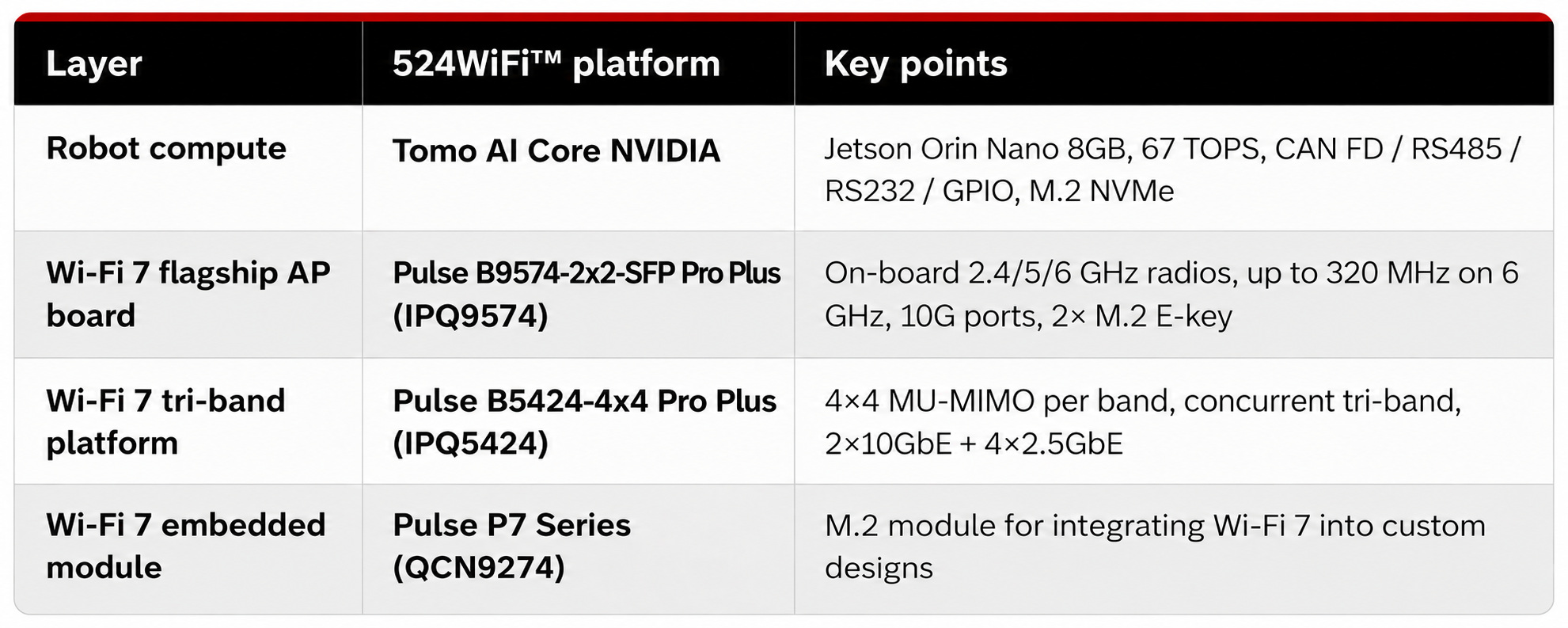
On the robot: the Tomo AI Core NVIDIA is built on the NVIDIA Jetson Orin Nano 8GB module with an industrial carrier board. It offers 67 TOPS of AI performance. Connectivity includes Gigabit Ethernet (one port with 48V PoE), optional Wi-Fi, and optional 4G/5G. Robot-side I/O includes CAN FD, RS485, RS232, GPIO, USB 3.0, and an M.2 NVMe slot. Select the compute, carrier I/O and wireless configuration around the requirements of the robot application.

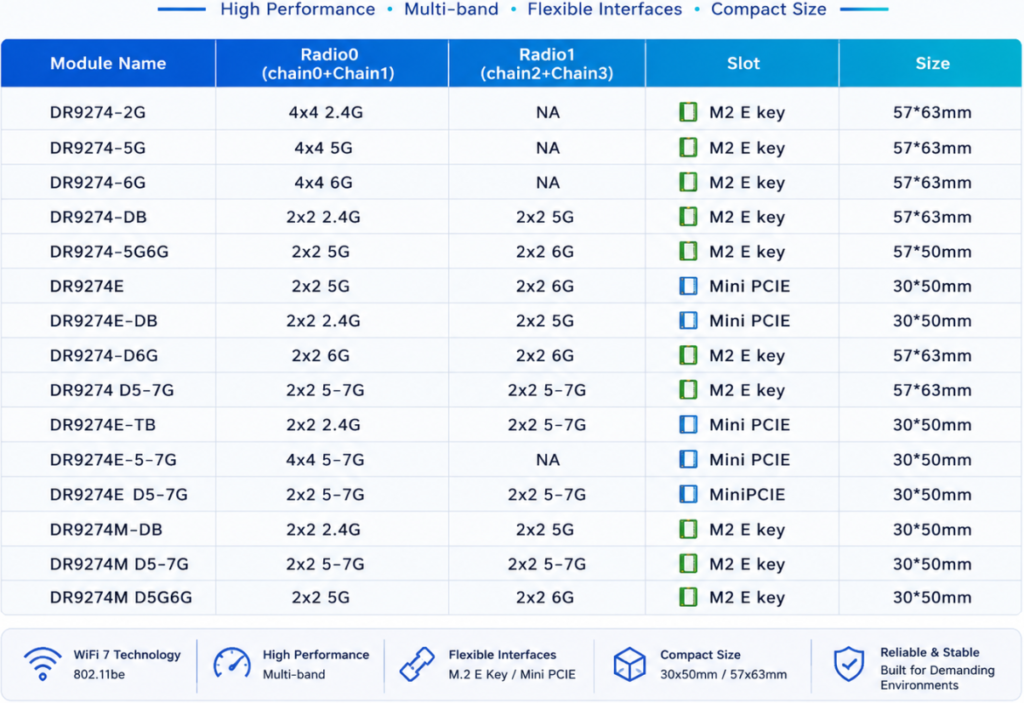
On the infrastructure side: Wi-Fi 7 platforms based on Qualcomm silicon serve as the access point layer. Examples are the Pulse B9574-2×2-SFP Pro Plus (IPQ9574), the Pulse B5424-4×4 Pro Plus (IPQ5424), and the Pulse P7 Series M.2 modules (QCN9274) for embedding Wi-Fi 7 into your own hardware.

One point worth stating clearly: tri-band does not always mean the same thing. On the Pulse B5424-4×4 Pro Plus and Pulse B9574-2×2-SFP Pro Plus, the 2.4 GHz, 5 GHz, and 6 GHz radios are three independent chains running concurrently. Some tri-band cards are tri-band switchable, meaning one radio moves between bands to avoid interference. Both approaches are useful, but they suit different designs, so check which one a product actually is before planning around it.

Compared with the usual approach
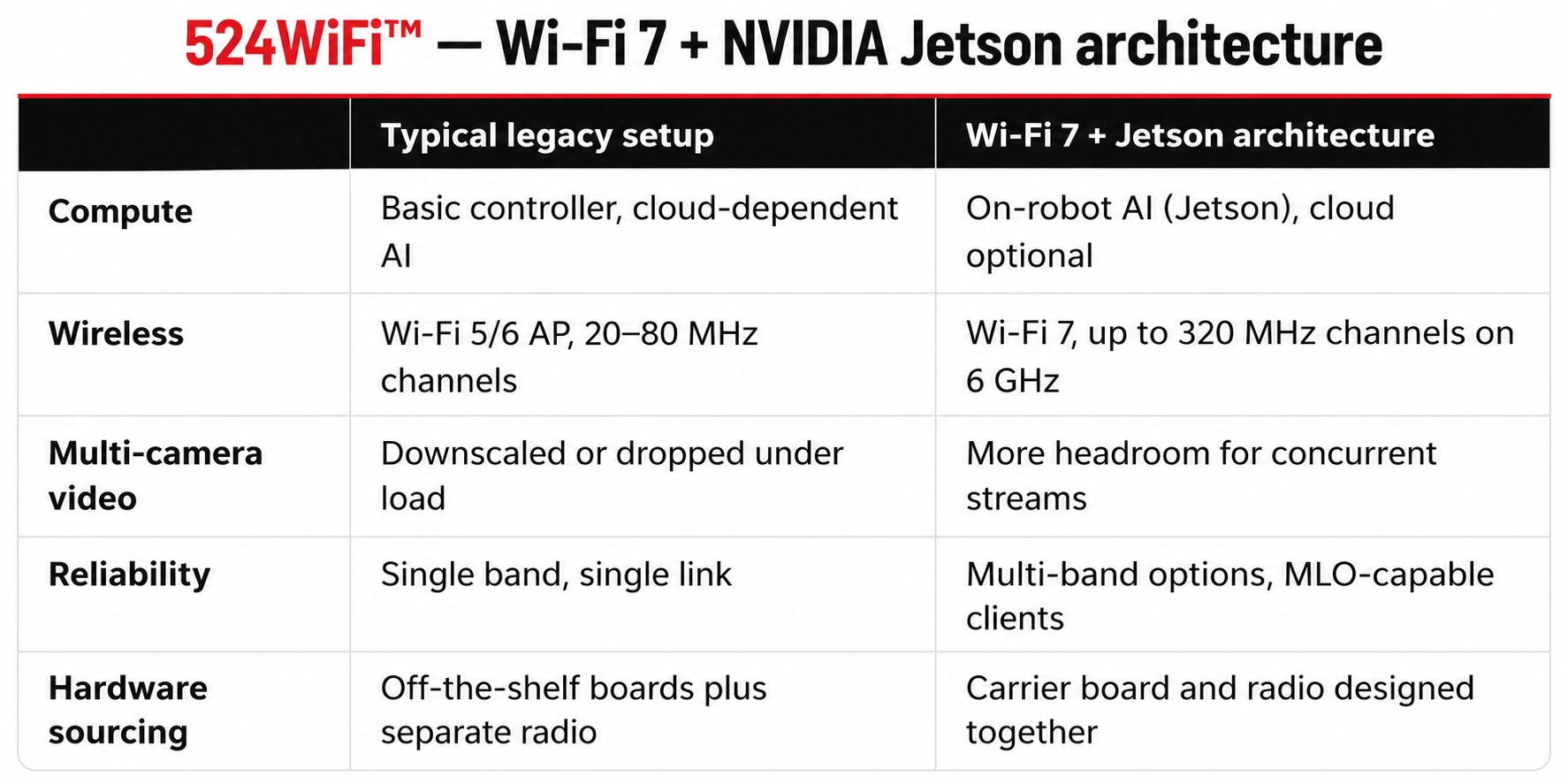
Wi-Fi 7 is not a magic fix. Real roaming performance still depends on AP placement, channel planning, and client support. But the higher-capacity link and the multi-band tools give the network more room to work with.

Where this architecture applies

  • Warehouse and logistics AMRs: dense multi-robot fleets with steady roaming and continuous telemetry
  • Port and yard vehicles: long-range coverage with camera-based monitoring
  • Machine vision on the move: multi-camera, high-resolution image transfer to inspection systems
  • Inspection and security robots: live video plus on-board detection
  • Agricultural and field robotics: long-range control and video links, with custom transmission software where needed

Hardware summary
Talk to us

If you are building mobile robots on Jetson and would rather not develop the wireless hardware yourself, we can supply the modules, routerboards, and custom carrier boards, and discuss the application software and transmission requirements of the complete system.

Explore Pulse B9574-2×2-SFP Pro Plus, Pulse B5424-4×4 Pro Plus and Pulse P7 radio modules.

Platform references: DR Cube, DR9574S, DR5424 and DR9274.
Posted on

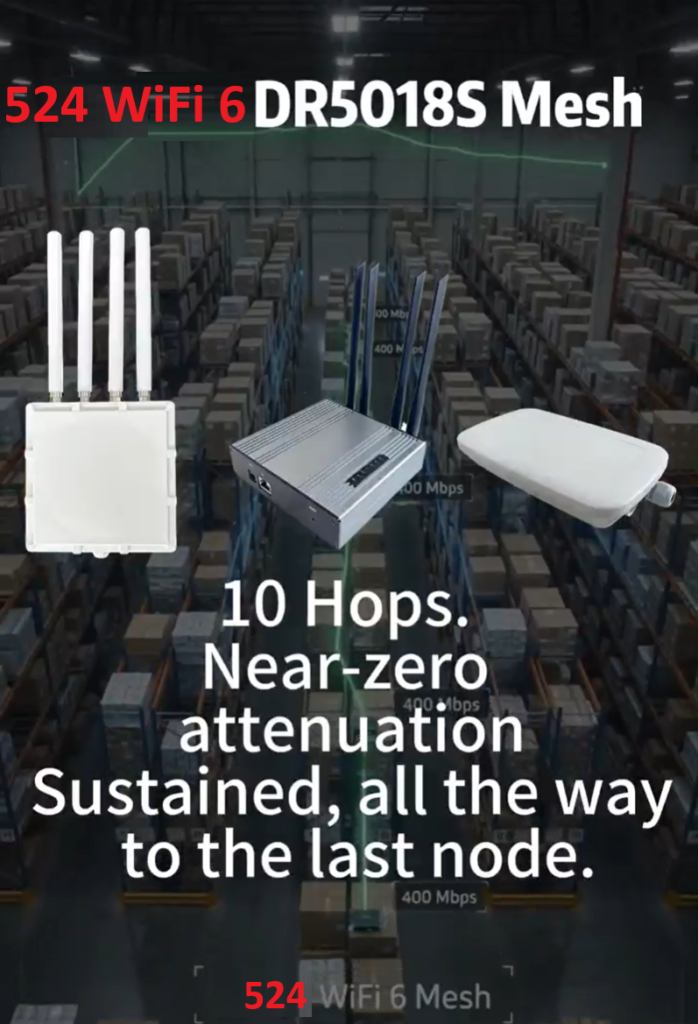
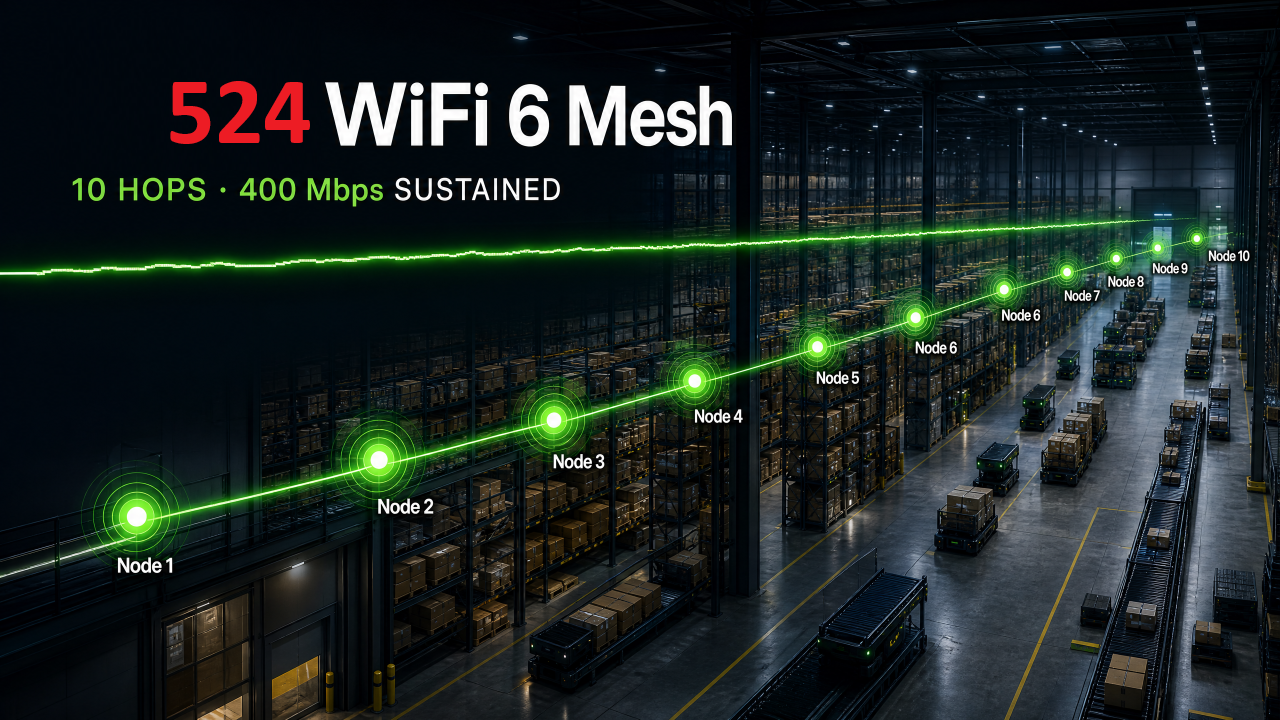
DR5018S 524 WiFi 6 MESH|10 Hops. Zero Compromise. 400Mbps

10 Hops. Near-zero attenuation. 400Mbps.

Most industrial mesh networks start choking after 3-4 hops — latency spikes, throughput collapses, and your robots lose their control link exactly when you need it most.

We just wrapped a 10-hop mesh stress test on our WiFi 6 platform, and the results speak for themselves: near-zero attenuation across all 10 hops, with sustained throughput of 400Mbps at the final node.

Article content
524WiFI mesh 10 hops testing environment

For AMR fleets, warehouse automation, and multi-robot deployments, this isn’t a lab number — it’s the difference between a robot that stays connected across a 50,000 sq ft facility and one that drops out the moment it turns a corner.

Article content
From PC1 to PC2 10 HOPS THROUGHPUT TEST RESULTS

No more compromising on coverage. No more babysitting mesh hops. Just reliable, high-throughput connectivity that scales with your facility, not against it — no need for WiFi 7 to get there.

Complete DR5018S MESh product family : https://524wifi.net/?s=mesh&post_type=product

Want the full test report or a demo on your floor plan? Please feel fre to contact us !

Posted on

A Smarter Drone Still Needs a Stronger Wireless Link

The future of drones is no longer only about flying.

Modern drones are becoming intelligent platforms equipped with:

  • AI vision systems
  • Autonomous navigation
  • Real-time data processing
  • Advanced sensors
  • Edge AI computing capabilities

But behind every smart drone, there is one critical infrastructure that is often overlooked:

Reliable wireless connectivity.

Because even the most advanced AI system becomes limited when the connection is unstable.


AI Makes Drones Smarter. Connectivity Makes Them Useful.

A drone performing industrial inspection, mapping, agriculture monitoring, or security missions needs to continuously exchange large amounts of data.

It needs to:

  • Stream high-resolution video in real time
  • Transfer sensor and vision data
  • Maintain low-latency control communication
  • Stay connected during high-speed movement

The wireless link is no longer just a communication channel.

It becomes the nervous system of an autonomous flying machine.


Why Drone Applications Need More Than Traditional Wireless Connectivity

Many UAV applications operate in challenging environments:

  • Long-range communication
  • High-speed mobility
  • Complex RF environments
  • Multiple drones working simultaneously
  • High-bandwidth AI data transmission

For these scenarios, peak speed alone is not enough.

A professional drone platform requires:

  • Stable connectivity
  • Low-latency response
  • Strong interference resistance
  • Reliable performance during long operation cycles

WiFi 6 and WiFi 7: Building the Wireless Foundation for Next-Generation UAVs

As drones become more intelligent, wireless technology must evolve to support higher demands.

Advanced WiFi platforms enable:

High-bandwidth AI applications

Real-time video streaming, multi-camera systems, and edge AI processing require fast and reliable data transmission.

Low-latency autonomous control

Faster response helps support autonomous navigation and mission-critical operations.

Multi-device communication

Future drone fleets and collaborative robotic systems will require efficient wireless networking.


524WiFi Industrial WiFi Modules for Intelligent Drone Platforms

For drone developers, selecting a wireless module is not only about maximum throughput.

Important considerations include:

  • Industrial-grade chipset platform
  • Driver and software support
  • Thermal stability
  • Flexible integration options
  • Long-term supply availability

Based on Qualcomm wireless platforms, Wallys provides WiFi solutions designed for industrial and AI-driven applications.


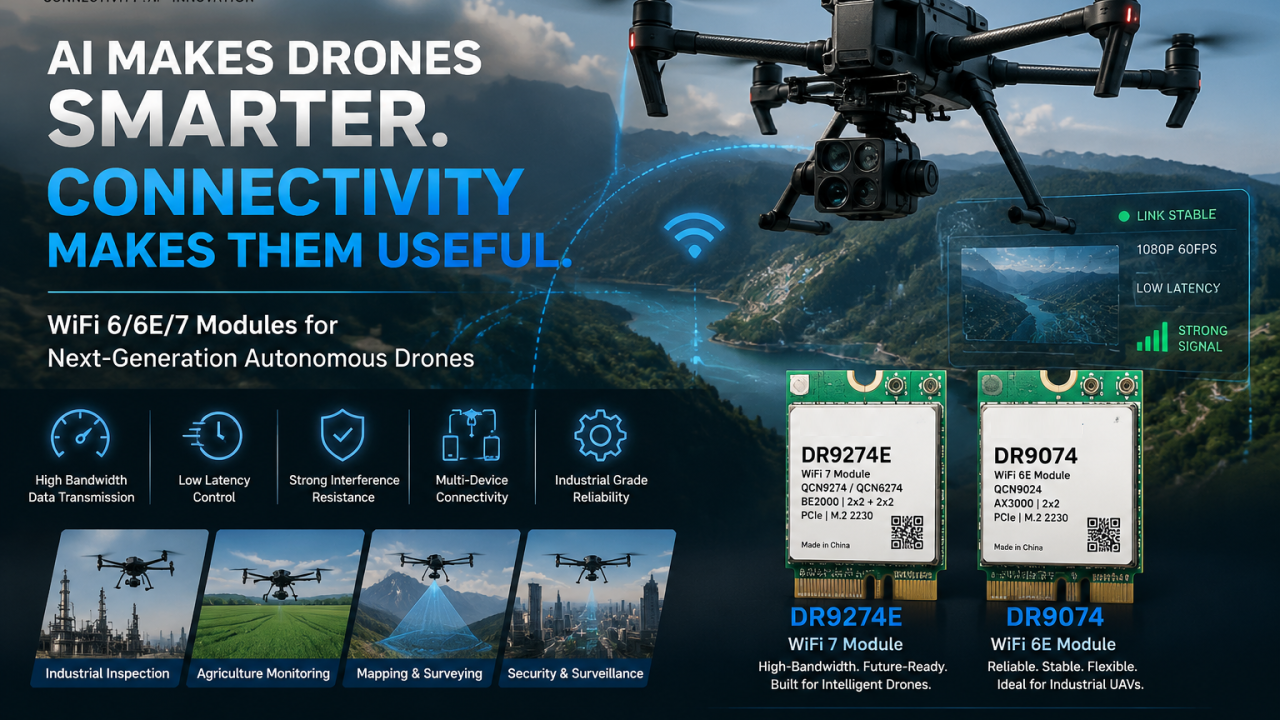
DR9274E WiFi 7 Module: Enabling Next-Generation Autonomous Drones

Powered by Qualcomm QCN9274 and QCN6274 platforms, the DR9274E WiFi 7 module is designed for applications requiring higher bandwidth, advanced connectivity, and future-ready wireless performance.

Potential applications include:

  • AI vision drones
  • Autonomous aerial robots
  • Industrial inspection UAVs
  • High-resolution video transmission systems

With WiFi 7 capabilities, it provides a powerful wireless foundation for intelligent devices requiring faster data exchange and more reliable connections.


DR9074 WiFi 6E Module: Reliable Connectivity for Industrial UAV Applications

Based on Qualcomm QCN9024, the DR9074 supports Tri-Band WiFi 6E operation across 2.4GHz, 5GHz, and 6GHz.

It is designed for applications requiring:

  • Stable wireless links
  • High-performance data transmission
  • Flexible frequency selection
  • Industrial deployment reliability

Suitable for:

  • Inspection drones
  • Mapping systems
  • Smart agriculture UAVs
  • Edge AI devices
Article content

Connecting the Future of Autonomous Flight

The future of drones will not only depend on better AI algorithms.

It will depend on the complete technology ecosystem:

AI provides intelligence. Sensors provide perception. Wireless connectivity enables action.

A smarter drone still needs a stronger wireless link.

At 524WiFi and Wallys, we are committed to providing Qualcomm-based WiFi 6 and WiFi 7 platforms for the next generation of drones, robotics, and edge AI applications.

The future of autonomous flight will not only be smarter.

It will be better connected.

Posted on

Physical AI Connectivity – AI Robots Don’t Run on AI Alone. They Run on Connectivity.

Every week, we see exciting breakthroughs in robotics.

Smarter vision models. Faster inference. More powerful edge AI hardware.

But when robots leave the lab and enter factories, warehouses, farms, or outdoor environments, something interesting happens.

The biggest challenge often isn’t AI.  It’s connectivity !

An autonomous robot may have enough computing power to understand its surroundings, but it still needs to:

  • Receive sensor data in real time
  • Stream video reliably
  • Exchange information with other robots
  • Connect to edge servers and cloud platforms
  • Roam seamlessly across large facilities without interruption

If the wireless network becomes unstable, even the most advanced AI model can’t perform as intended.

In real-world deployments, we’ve learned that customers rarely complain about TOPS or benchmark scores.

Instead, they ask questions like:

• Can the connection stay stable after days or weeks of continuous operation?

• Will roaming interrupt navigation?

• How does the network perform in environments with heavy RF interference?

• Can hundreds of devices operate simultaneously without impacting latency?

These are deployment questions—not benchmark questions.

As Physical AI continues to evolve, networking is no longer just supporting the system.

It is becoming part of the AI infrastructure itself.

The future of intelligent robots won’t be built by AI alone.

It will be built by the combination of:

  • AI Computing
  • Reliable Wireless Connectivity

⚡ Edge Networking

  • Seamless Mobility

The industry has spent years optimizing AI models.

Perhaps it’s time we give the same attention to the networks that keep those models connected.

AI may be the brain.  Connectivity is the nervous system.

I’d love to hear your perspective:

What has been the biggest networking challenge in your robotics or Edge AI deployments?

Posted on — Leave a comment

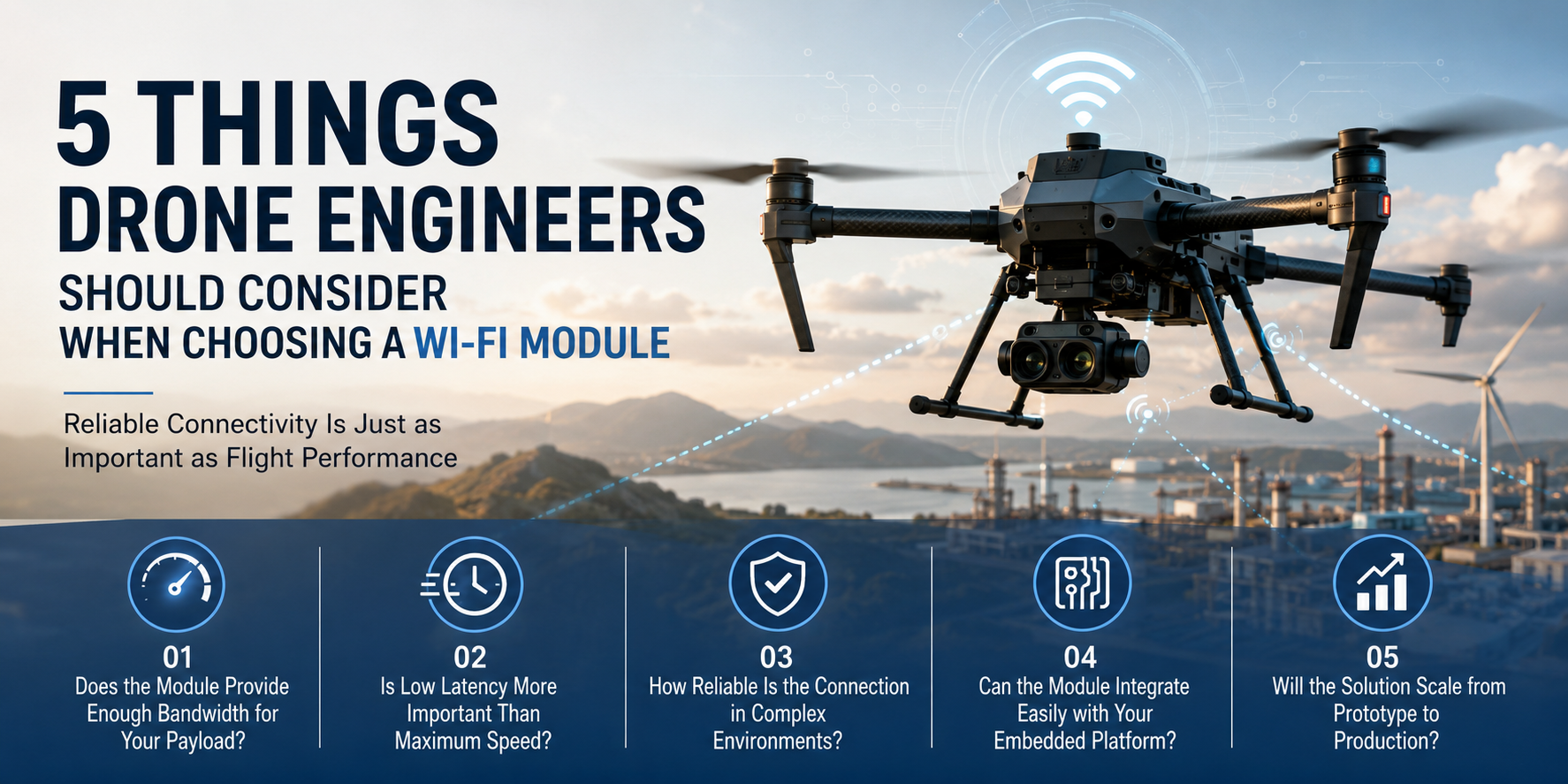
5 Things Drone Engineers Should Consider When Choosing a Wi-Fi Module

Reliable Connectivity Is Just as Important as Flight Performance

Modern drones are becoming far more than flying cameras.

Today, drones are used for:

  • Infrastructure inspection
  • Precision agriculture
  • Public safety
  • Mapping and surveying
  • Warehouse inventory
  • Mining operations
  • Industrial monitoring

At the same time, onboard computing is evolving rapidly. AI processors, multiple cameras, LiDAR, thermal imaging, and edge computing are becoming standard components of professional UAV platforms.

While engineers often spend months selecting flight controllers, sensors, and AI hardware, one component is frequently underestimated:

The wireless communication module.

Article content

A poorly chosen Wi-Fi module can become the bottleneck of an otherwise excellent drone design.

Here are five key factors every drone engineer should evaluate before selecting a wireless communication solution.


1. Does the Module Provide Enough Bandwidth for Your Payload?

Not every drone transmits the same type of data.

A basic inspection drone may only send telemetry and compressed video.

An AI-powered drone may simultaneously transmit:

  • Multiple HD video streams
  • AI inference results
  • Telemetry data
  • Sensor information
  • Remote control commands

As payloads become more sophisticated, wireless bandwidth quickly becomes a limiting factor.

When evaluating a Wi-Fi module, consider:

  • Maximum throughput
  • Number of spatial streams
  • Channel bandwidth
  • Support for Wi-Fi 6 or Wi-Fi 7

Higher bandwidth doesn’t simply improve video quality—it also creates more capacity for future upgrades.


2. Is Low Latency More Important Than Maximum Speed?

Many engineers focus on peak data rates.

However, drones often benefit more from consistent low latency than from maximum theoretical throughput.

For applications such as:

  • Remote piloting
  • Autonomous navigation
  • AI-assisted obstacle avoidance
  • Real-time monitoring

Stable communication is far more valuable than occasional bursts of high speed.

Look beyond the headline specifications and evaluate how the wireless solution performs under continuous, real-world workloads.


3. How Reliable Is the Connection in Complex Environments?

Drones rarely operate in ideal radio environments.

They may fly near:

  • Buildings
  • Metal structures
  • Industrial equipment
  • Trees
  • Utility infrastructure

These environments introduce interference, signal reflections, and changing link conditions.

A reliable Wi-Fi module should support features that help maintain stable communication under challenging conditions.

Modern technologies such as Wi-Fi 6 and Wi-Fi 7 introduce significant improvements in efficiency, interference management, and overall reliability compared with earlier generations.

For industrial UAVs, connection stability is often more important than achieving the highest benchmark speeds.


4. Can the Module Integrate Easily with Your Embedded Platform?

Selecting a Wi-Fi module is not only about radio performance.

Engineers should also consider integration.

Questions worth asking include:

  • Does it support Linux or OpenWrt?
  • Are software drivers actively maintained?
  • Is the hardware interface compatible with your design?
  • Is documentation readily available?
  • Can the module integrate with NVIDIA Jetson or other edge AI platforms?

Reducing development complexity can significantly shorten time-to-market.

Choosing a well-supported platform often saves more engineering time than selecting a module based solely on specifications.


5. Will the Solution Scale from Prototype to Production?

Many wireless solutions perform well during prototyping.

Production introduces different challenges:

  • Long-term availability
  • Industrial reliability
  • Certification requirements
  • Thermal performance
  • Supply chain stability

Choosing a communication platform with a clear product roadmap helps avoid redesigns later in the project lifecycle.

Engineers should think beyond the first prototype and evaluate whether the wireless solution can support future production volumes and product evolution.


Connectivity Is Becoming Part of the Drone Architecture

Modern drones are evolving into flying edge computing platforms.

A typical professional UAV now combines:

  • Flight control systems
  • AI processors
  • Vision sensors
  • Navigation systems
  • High-speed wireless communication

Each subsystem depends on the others.

Even the most advanced AI algorithms become less effective if communication is unstable.

Reliable wireless connectivity is no longer just another hardware component.

It has become part of the overall system architecture.


Looking Ahead

The next generation of drones will continue to demand:

  • Higher bandwidth
  • Lower latency
  • More reliable wireless links
  • Better support for AI workloads
  • Faster integration with embedded computing platforms

Selecting the right Wi-Fi module today is not simply about improving communication performance.

It is about building a platform that can support the future of autonomous aerial systems.

As drones become smarter, wireless connectivity will play an increasingly important role in enabling safe, efficient, and scalable operations.

Because in autonomous systems, intelligence may guide the mission—but connectivity keeps it flying.


What factors matter most when your team selects a wireless communication solution for UAV projects?

I’d be interested to hear how other drone engineers approach this decision.

Posted on

How Wi-Fi 7 Improves Industrial Connectivity: Low Latency, High Reliability

In the era of Industry 4.0, industries are increasingly relying on wireless networks to power automation, robotics, and intelligent systems. However, traditional Wi-Fi technologies often face challenges such as latency, interference, and limited bandwidth. Enter Wi-Fi 7 (IEEE 802.11be) — the next-generation wireless standard designed to deliver ultra-low latency, high reliability, and multi-gigabit speeds.

This breakthrough is reshaping industrial communication, making wireless connections as dependable as wired networks.


1. Low Latency for Real-Time Control

In industrial environments, even milliseconds matter. Robotic arms, sensors, and AGVs (Automated Guided Vehicles) require instant communication to maintain synchronization and avoid costly downtime.

Wi-Fi 7 introduces Multi-Link Operation (MLO) — a technology that allows simultaneous data transmission across multiple frequency bands (2.4 GHz, 5 GHz, and 6 GHz). This parallel data flow reduces latency to under 1 ms, ensuring real-time responsiveness for critical industrial applications.


2. High Throughput for Data-Intensive Applications

Factories today generate vast amounts of data — from machine vision cameras to AI-driven quality inspection systems. With 320 MHz channel bandwidth and 4096-QAM modulation, Wi-Fi 7 can reach speeds up to 46 Gbps, far beyond Wi-Fi 6.

This makes Wi-Fi 7 ideal for:

  • High-definition video streaming for monitoring and inspection
  • Edge computing systems that analyze data locally
  • AI and machine learning applications in manufacturing

3. Enhanced Reliability in Harsh Environments

Industrial facilities are notorious for electromagnetic interference, metal surfaces, and dense wireless traffic. Wi-Fi 7 tackles these challenges with Enhanced Puncturing and MLO redundancy, which allow stable connections even when certain channels face interference.

This ensures consistent, uninterrupted communication, vital for automated production lines, smart logistics, and industrial IoT (IIoT) devices.


4. Deterministic Networking for Industrial Automation

Wi-Fi 7 supports Time-Sensitive Networking (TSN), a key requirement for mission-critical industrial operations. TSN provides predictable latency and synchronized data transfer, ensuring that commands and responses are delivered exactly when needed.

This bridges the gap between traditional wired Ethernet and wireless networks — a game-changer for Industry 4.0.


5. Smooth Transition with Backward Compatibility

Adopting new technology doesn’t have to mean starting from scratch. Wi-Fi 7 devices are backward compatible with Wi-Fi 6/6E and Wi-Fi 5, enabling companies to upgrade their infrastructure gradually while maintaining interoperability with existing devices.


Conclusion

Wi-Fi 7 sets a new benchmark for industrial connectivity — blending ultra-low latency, high reliability, and extreme throughput. From smart factories and autonomous warehouses to AI-driven inspection systems, it enables a new level of efficiency and innovation in the industrial world.

Our latest Wi-Fi 7 boards, including the DR9574 (based on Qualcomm IPQ9574) and DR5332 (IPQ5332), are built for industrial environments that demand speed, reliability, and flexibility.

Posted on

IPQ5018 Inside: DR5018S Board Redefines Industrial WiFi 6 Connectivity

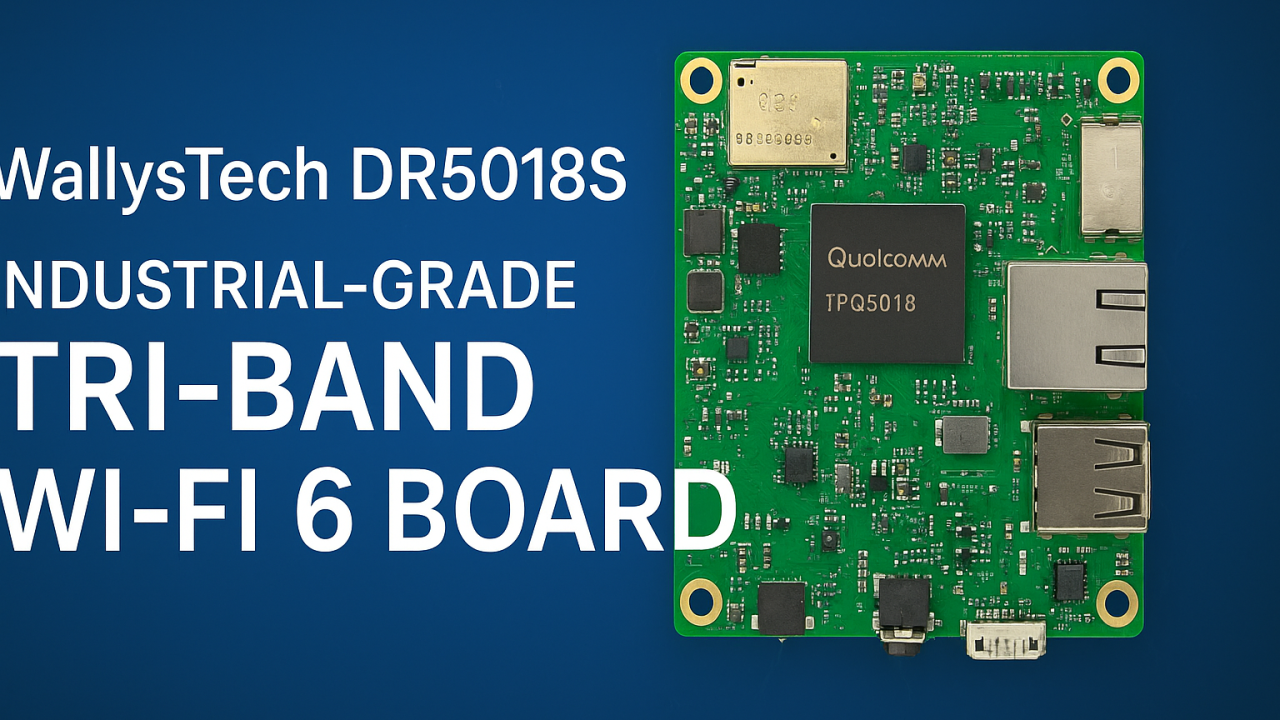
🌐 Introducing DR5018S — Industrial-Grade Tri-Band WiFi 6 Board for OpenWRT and OpenWiFi development

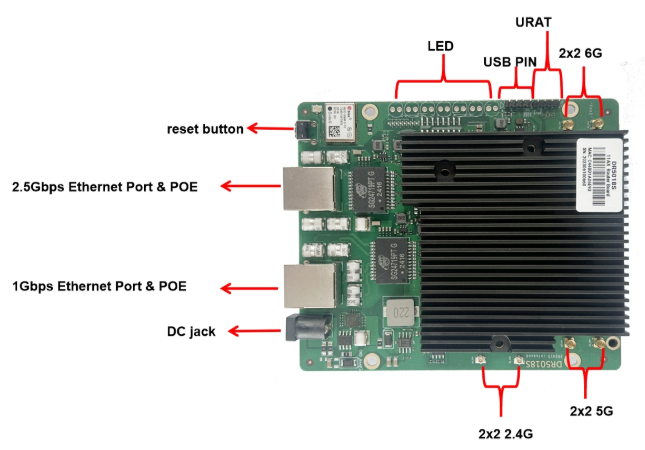
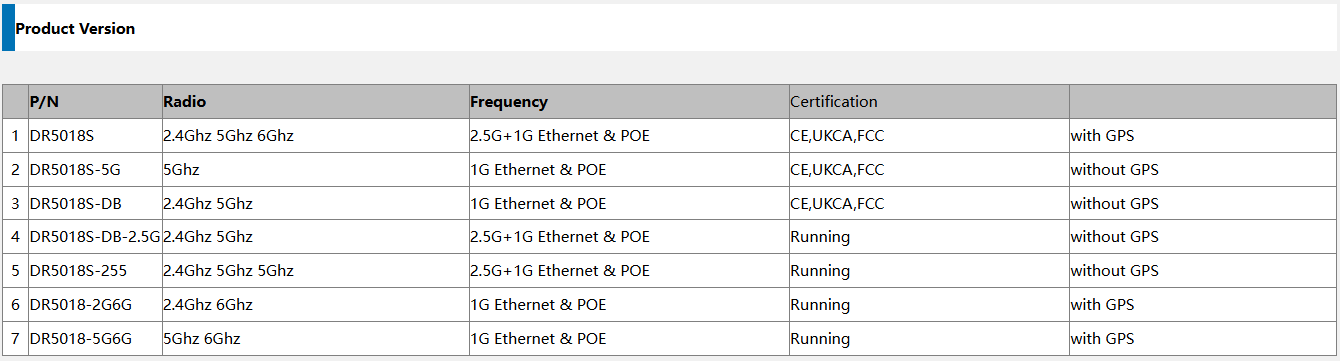
524WiFi introduces the WallysTech DR5018S, a high-performance industrial-grade WiFi 6 platform built for the next generation of wireless networks. Powered by the Qualcomm IPQ5018 SoC, the DR5018S integrates 2.4GHz, 5GHz, and 6GHz bands into one compact board — offering exceptional throughput, low latency, and strong adaptability for modern wireless environments.


⚙️ Key Features

  • Qualcomm IPQ5018 SoC — Dual-core ARM 64-bit A53 @1.0GHz
  • Tri-band support: 2.4GHz (573 Mbps) + 5GHz (2402 Mbps) + 6GHz (2402 Mbps)
  • WiFi 6 (802.11ax) with OFDMA, MU-MIMO, 1024-QAM
  • Memory & Storage: 512 MB DDR3L + 128 MB NAND Flash
  • Networking: 1× 2.5 GbE + 1× 1 GbE + USB 2.0 + SGMII + UART
  • Optional modules: GPS and Bluetooth 5.1
  • Power: 12–52 V DC or 802.3at/bt PoE
  • Operating temperature: –40 °C ~ +70 °C (industrial-grade)
  • Certifications: CE / FCC / UKCA
Article content

💡 Why DR5018S Stands Out

✅ Tri-band flexibility — handle high-density environments and interference-free operations

✅ Future-ready with 6GHz — prepared for WiFi 6E and early WiFi 7 transition

✅ Industrial-grade reliability — wide temperature, PoE, and durable design

✅ Open-source platform — OpenWRT/OpenWiFi for customization and fast development

✅ 2.5GbE interface — for high-throughput backhaul and mesh deployments

Article content

🏭 Real-World Applications

The DR5018S is designed for industrial and enterprise-grade wireless networks, enabling reliable connectivity in demanding conditions:

🔹 Mining & Oilfield Operations — establish long-distance wireless mesh links for remote monitoring, sensors, and field communication networks.

🔹 Smart Cities & Urban Infrastructure — build tri-band APs and gateways for IoT devices, cameras, and autonomous systems.

🔹 Industrial IoT & Automation — integrate into factory APs or gateways with OpenWRT for flexible control and connectivity.

🔹 Edge Computing & AI Gateways — combine compute + tri-band WiFi for edge data collection and analysis.

🔹 Warehouse & Logistics — enable low-latency mesh communication for autonomous AGVs and real-time tracking.

🔹 Outdoor Mesh & Backhaul Nodes — leverage 6GHz as a dedicated backhaul channel for high-speed, interference-free wireless mesh.

Its flexibility also makes DR5018S an excellent foundation for OEM/ODM wireless solutions, custom AP design, and smart industrial routers.


🚀 Empowering Wireless Innovation

At 524WiFi, we help partners accelerate product development and reduce evaluation costs through open, modular, and stable platforms. The DR5018S continues our mission to bridge industrial-grade reliability with open-source innovation — enabling faster time-to-market and future-ready WiFi 6/6E connectivity.

Posted on

Wi-Fi 7 AccessPoint DR9574 – Qualcomm IPQ 9574

WiFi 7 isn’t just faster—it’s smarter, stronger, and built for the future.


Meet Wallys DR9574 AP, our Qualcomm IPQ9574-based WiFi7 platform DR9574 designed for enterprise and industrial networks that demand more than just connectivity.


✅ Tri-band (2.4G / 5G / 6G) for maximum flexibility
✅ Dual 10GbE + Quad 1GbE ports for high-density deployments
✅ Rugged, industrial-grade build for tough environments

From smart factories to security systems, from hotels to convention centers—the DR9574 ensures high throughput, ultra-low latency, and reliable stability when it matters most.

https://524wifi.net/?s=dr5018s: Wi-Fi 7 AccessPoint DR9574 – Qualcomm IPQ 9574

Read more: Wi-Fi 7 AccessPoint DR9574 – Qualcomm IPQ 9574
Posted on

Chipset Comparison: IPQ5322 vs IPQ5424-What’s the Difference and Which One Fits Your Project?

DR5332S vs DR5424: What’s the Difference and Which One Fits Your Project?

As Wi-Fi 7 enters the spotlight of next-gen wireless connectivity, developers and OEMs are seeking powerful, cost-effective router boards to power AIoT, edge computing, mesh networking, and enterprise-grade gateways. At Wallys, we provide two flagship tri-band Wi-Fi 7 router boards: the DR5332S and the DR5424. While they share a common mission — delivering ultra-reliable, high-throughput connectivity — they are built on different SoC platforms and tailored for slightly different project needs.

Let’s break down the differences and help you decide which one is the right fit for your application.

1. Chipset Comparison: IPQ5322 vs IPQ5424

CPU Architecture: A53 vs A55

  • The IPQ5424 uses a Cortex-A55 @1.8GHz, which is newer, more efficient, and more powerful than the Cortex-A53 @1.5GHz in IPQ5332.
  • A55 supports out-of-order execution, making it significantly better for multitasking and edge workloads.

IPQ5424 offers superior computing performance, making it ideal for intensive processing and multitasking at the edge.

AI Acceleration

  • IPQ5424 benefits from its more capable CPU architecture and overall system bandwidth for smoother AI task handling.
Article content

If you’re considering router boards such as Wallys DR5332S (IPQ5332) or DR5424 (IPQ5424):

  • 🧩 DR5332S + IPQ5332: Great for budget-sensitive, compact, quick-to-market solutions
  • 🚀 DR5424 + IPQ5424: Built for edge intelligence, multi-client environments, and future-proof mesh deployments

🔍 DR5424 offers higher performance and better power efficiency at the same time the costs will be higher than DR5322S.

Article content

2. Wireless Capabilities (Tri-Band Wi-Fi 7)

Both boards support tri-band (2.4GHz + 5GHz + 6GHz) Wi-Fi 7, including:

  • Multi-Link Operation (MLO) for increased stability
  • 320MHz bandwidth support on 6GHz band
  • 4096-QAM for enhanced throughput
  • Onboard radio modules for space-saving and simplified integration

However, DR5424 has more headroom for advanced use cases involving concurrent client management, AI inference at the edge, or industrial-grade networking.

3. Use Case Suitability

💡 Recommendation:

  • Choose DR5332S if your project prioritizes cost, compactness, and moderate throughput.
  • Choose DR5424 if you need higher computing power, better future-proofing, and support for intensive applications like edge inference, video analytics, or high-density mesh.

4. Hardware Interface & Customization

Both boards offer:

  • 2.5G Ethernet
  • Multiple UART, I2C, SPI
  • M.2 / USB3.0 / GPIO
  • Support for OpenWRT SDK
  • Optional expansion for LTE/5G/Storage modules

Customization and ODM services are available for both platforms.

5. Pricing & Availability

Both models are available for sampling, with volume support for OEM/ODM integration. DR5332S is generally more affordable and available sooner for entry-level or mid-range products, while DR5424 is geared for premium products with long-term lifecycle planning.

📬 For pricing, datasheets, or demo kits, contact us at: 📧 info@524wifi dot net or com

🧠 Final Thoughts

Whether you’re building a smart city gateway, an industrial mesh router, or a next-gen enterprise AP, 524WiFi and Wallys’ Wi-Fi 7 router boards offer flexible, powerful foundations.

  • DR5332S → Cost-effective, compact, fast-to-market
  • DR5424 → High-performance, future-ready, edge-AI capable

Need help choosing or customizing for your unique application? 

Posted on

QCN9274 & QCN6274 Wi-Fi 7 with Multi-Link Operation (MLO) on X86 Devices: A New Era of Connectivity

Wi-Fi 7 with Multi-Link Operation (MLO) on X86 Devices: A New Era of Connectivity

As the world of wireless technology continues to evolve, the introduction of Wi-Fi 7 is nothing short of a game-changer. With its potential for significantly higher speeds, lower latency, and enhanced reliability, Wi-Fi 7 is set to revolutionize industries and applications ranging from industrial IoT to high-performance consumer devices. At Wallys, we’re always driven by customer needs, and as part of our commitment to offering cutting-edge solutions, we’re focused on expanding the possibilities for Wi-Fi 7 technology—specifically by enabling Multi-Link Operation (MLO) support on X86 platforms.

Expanding the Reach of Wi-Fi 7: A New Level of Compatibility

Last year, we introduced X86 driver support for our Wi-Fi 6 module, DR9074, which enabled seamless integration across a broader range of motherboard platforms, not just Qualcomm devices. This support empowered our customers to experience high-quality, stable Wi-Fi data transmission and opened the door for new applications that demand reliable and high-throughput wireless connections.

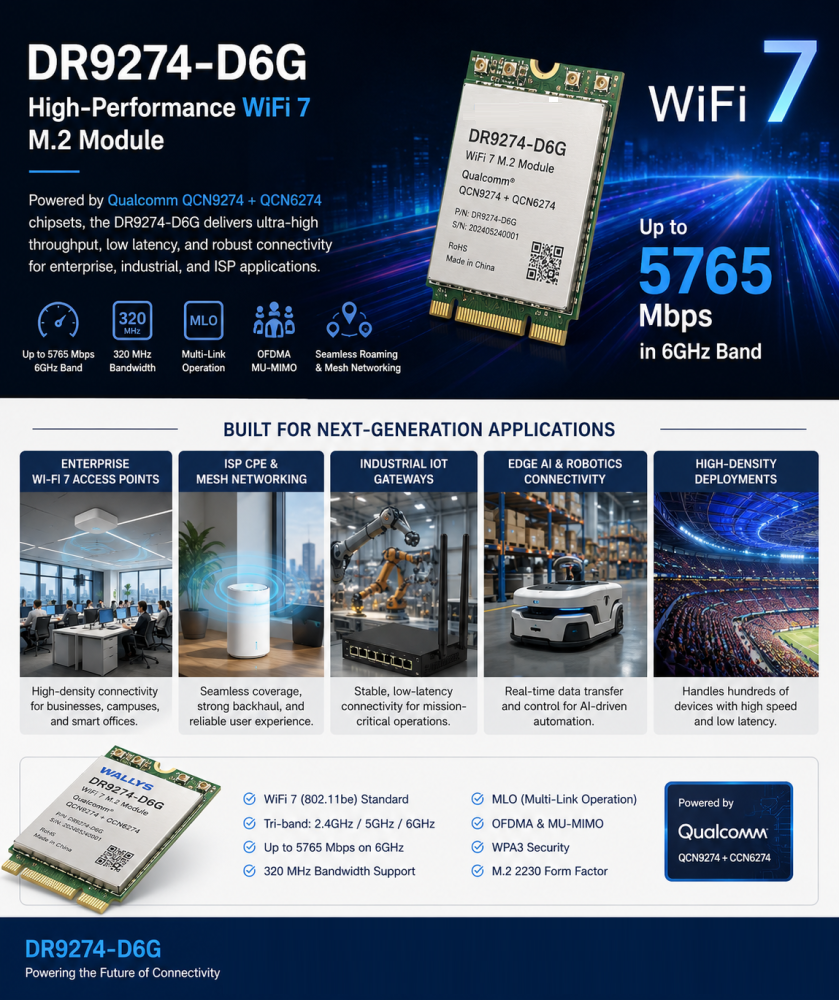
With the introduction of Wi-Fi 7, cross-platform compatibility becomes even more critical. Wi-Fi 7 brings with it a new set of features designed to push the boundaries of wireless connectivity, and one of the most significant is Multi-Link Operation (MLO). But to harness the full potential of MLO, we need to ensure that our solutions can operate on multiple platforms—something we’re excited to announce we’re working on with our DR9274 (QCN9274) and QCN6274 Wi-Fi 7 modules.

wifi6 vs wifi7

What is MLO? And Why Does It Matter?

Multi-Link Operation (MLO) is one of the standout features of Wi-Fi 7. MLO allows devices to transmit data across multiple frequency bands (like 2.4 GHz, 5 GHz, and 6 GHz) simultaneously. This multi-band transmission significantly improves throughput and reliability, while reducing latency and congestion, making it an ideal solution for environments that require high-speed and low-latency communication.

In simple terms, MLO will enable your devices to leverage the full bandwidth potential of Wi-Fi 7, resulting in faster speeds, more stable connections, and more efficient use of available spectrum.

Introducing the QCN9274 & QCN6274 Wi-Fi 7 Modules

To enable the full potential of MLO, we’re leveraging the power of QCN9274 and QCN6274—two of Qualcomm’s latest Wi-Fi 7 chipsets, both designed for high-performance applications.

  1. QCN9274 (Waikiki)
  2. QCN6274 (Waikiki)
MLO

These two powerful chipsets represent the future of Wi-Fi 7 and provide the foundation for expanding compatibility across a variety of platforms. With MLO support, both the QCN9274 and QCN6274 enable better utilization of the 2.4, 5, and 6 GHz bands, delivering faster speeds and more reliable connections.

wifi7 new features

What Will MLO Bring to Your X86 Devices?

By introducing MLO support for X86 devices, we’re pushing the envelope on what’s possible in wireless networking. Users of X86 platforms will now be able to tap into the full power of Wi-Fi 7, unlocking:

  • Higher Throughput: With MLO, data is split across multiple channels, leading to faster speeds and higher data rates, ideal for bandwidth-hungry applications like streaming, gaming, and industrial IoT.
  • Enhanced Reliability: MLO ensures that devices can maintain stable connections, even in environments with interference or congestion, by balancing traffic across different frequency bands.
  • Reduced Latency: Faster communication between devices can significantly reduce lag and improve the responsiveness of real-time applications, from virtual reality to autonomous systems.

The implications are significant. Wi-Fi 7, combined with MLO, could transform industries that rely on seamless, high-performance wireless connectivity—think smart cities, industrial automation, healthcare, and beyond.

524WiFi Adapter Card (wifi7 adapter card coming soon)

What’s Next for Wi-Fi 7 on X86?

At 524WiFi, we’re committed to ensuring that our solutions are as versatile and adaptable as possible. With the upcoming X86 driver support for DR9274 and MLO functionality, you’ll be able to take full advantage of Wi-Fi 7 speeds and unlock new potential for your devices.

Thoughtput testing:achieve 8Gbps+ speed

This new capability will open up new opportunities for a variety of applications, and we’re eager to see how our customers will integrate this powerful technology into their own use cases.

DR9274 wifi7 M.2 card

Are You Ready for the Future of Wireless Connectivity?

With Wi-Fi 7’s blazing-fast speeds and MLO’s game-changing capabilities, the possibilities are endless. How do you envision using Wi-Fi 7 with MLO on your X86 platforms? Whether it’s enhancing your industrial IoT devices, supporting next-gen gaming applications, or powering high-bandwidth communications, the potential is vast.

At 524WiFi, we’re excited to continue innovating and providing the tools you need to stay ahead in the rapidly evolving wireless landscape. If you’re interested in learning more about our Wi-Fi 7 solutions or how we can help with your next project, feel free to reach out to us.

Let’s shape the future of connectivity, together.