Posted on

GPS Smart Deployment for Long-Range WiFi PtP: What If Your AP Could Tell You Where to Point?

Deploying long-range wireless links has always been a field engineering challenge.

For a Point-to-Point (PtP) wireless connection, performance depends heavily on antenna alignment.

A few degrees of misalignment can mean:

  • Lower throughput
  • Reduced link stability
  • Poor signal quality
  • More time spent on-site troubleshooting

Traditionally, engineers need to rely on:

  • GPS devices
  • Maps
  • Compass tools
  • Signal strength monitoring
  • Multiple technicians communicating between two locations

But what if the wireless device itself could help you find the right direction?
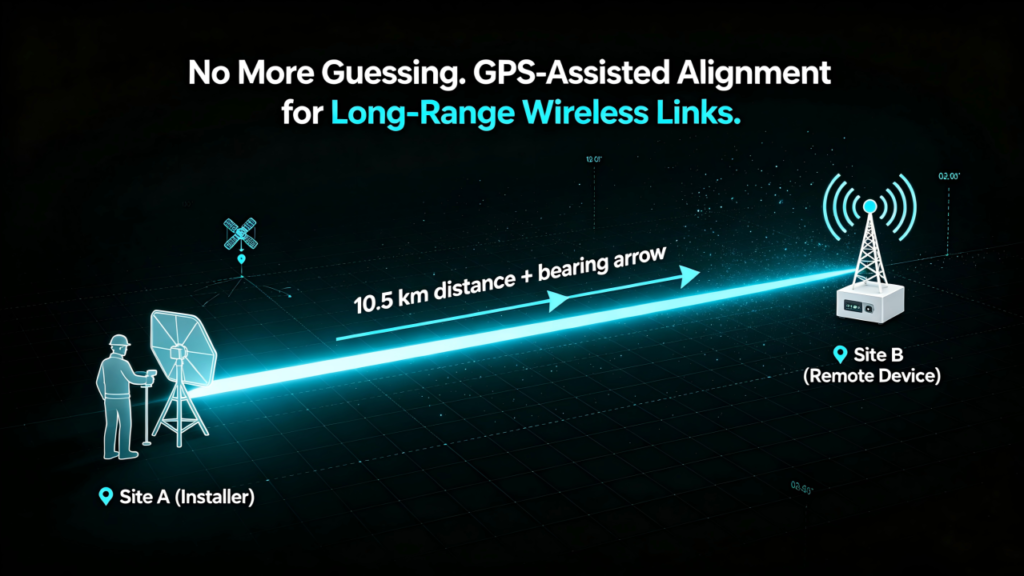

From GPS Location to Smart Alignment

Imagine this:

You install an AP at the local site.

After powering it on:

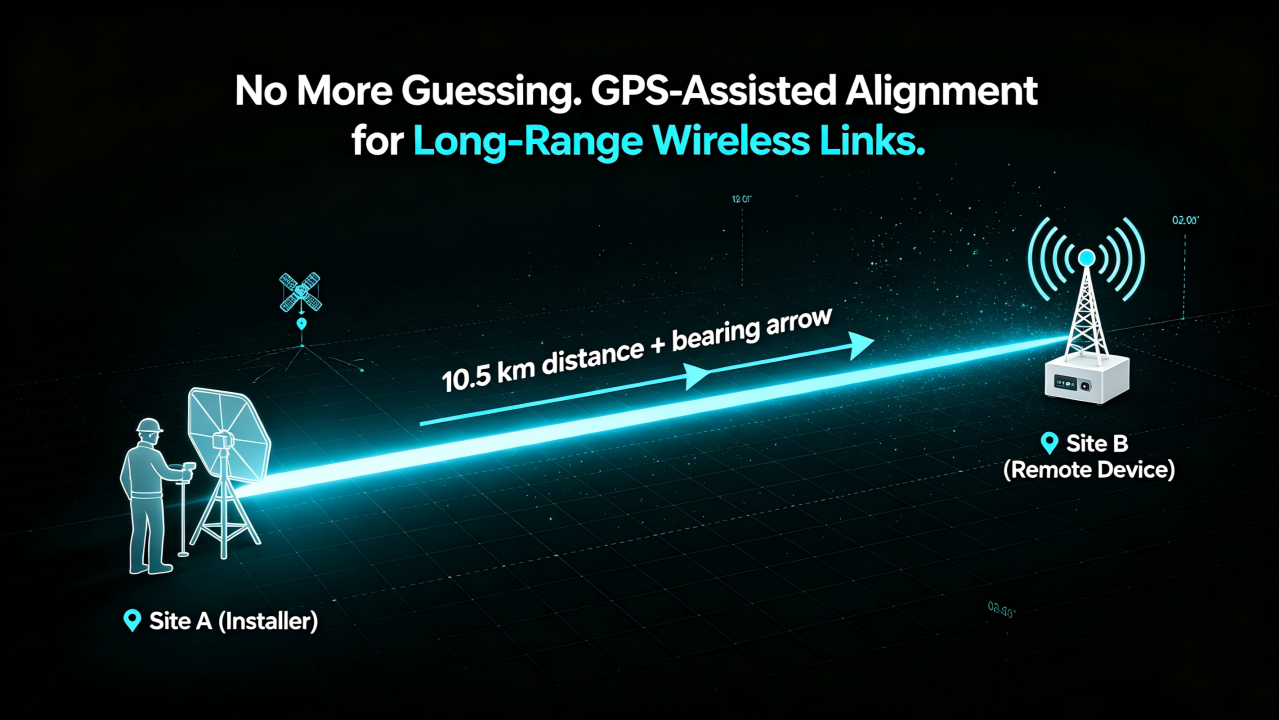
  1. The device automatically obtains its GPS coordinates.
  2. The remote site device shares its location information.
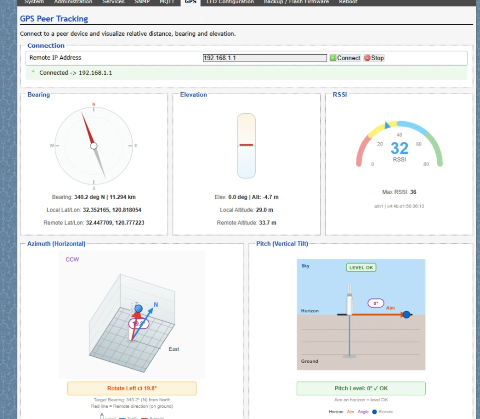
  3. The web interface calculates the optimal alignment direction.
  4. The system provides recommended:
  • Horizontal rotation angle (Azimuth)
  • Vertical tilt angle (Elevation)

Instead of asking:

“Which direction should I point this antenna?”

The system tells you:

“Rotate 127.5° horizontally and tilt 8.3° upward.”


Simplifying Long-Distance Wireless Deployment

For outdoor wireless networks, especially:

  • WISP networks
  • Rural broadband
  • Industrial campuses
  • Mining sites
  • Smart agriculture
  • Remote monitoring systems

deployment efficiency is critical.

GPS-assisted alignment can help engineers:

✅ Reduce installation time

✅ Minimize alignment errors

✅ Improve first-time connection success rate

✅ Simplify remote deployment and maintenance


How It Works

A GPS-enabled wireless platform combines:

1. Location Awareness

Each device knows its own:

  • Latitude
  • Longitude
  • Position information

2. Remote Device Coordination

The AP exchanges location data with the remote endpoint.

3. Direction Calculation

Based on two GPS points, the system calculates:

  • Distance between sites
  • Direction angle
  • Antenna pointing recommendation

4. Web-Based Guidance

Engineers can view the recommended installation angle directly through the device management interface.
Article content

No additional measurement tools required.


Designed for Next-Generation Outdoor Connectivity

524WiFi and Wallys have integrated GPS capability into selected industrial wireless platforms, including:

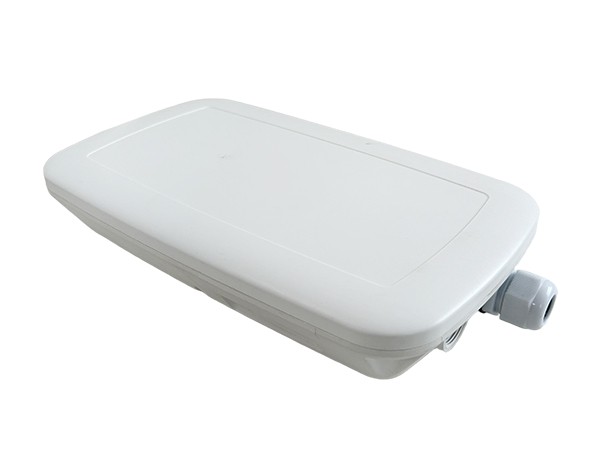
524WiFI WiFi 6 Long Range Kit

DRWAVE-1000 Built around Qualcomm IPQ5018 platform, designed for industrial networking applications requiring reliable wireless connectivity.
Article content

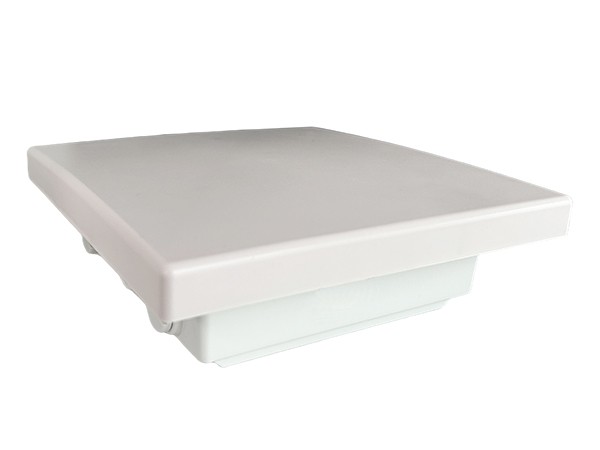
524WiFi WiFi 7 Long Range Kit

Powered by Qualcomm IPQ9574, supporting next-generation high-performance wireless applications.
Article content

With GPS integration, these platforms enable smarter deployment possibilities for long-range wireless networks.
Posted on

Qualcomm IPQ9574 with MLO support, dual 10G Ethernet, wide temperature industrial design – DR9574 support QSDK and OpenWRT 3 band MLO

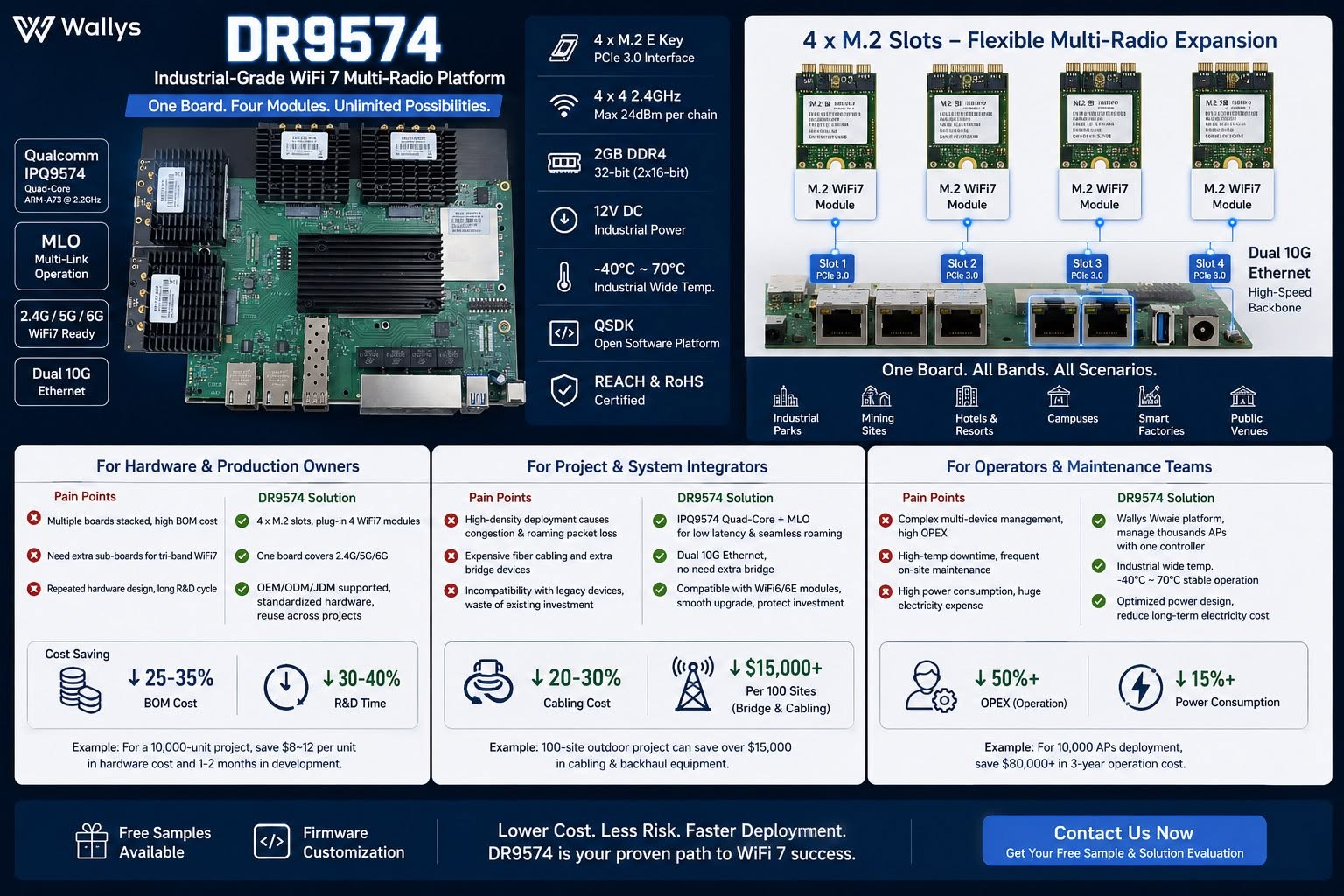
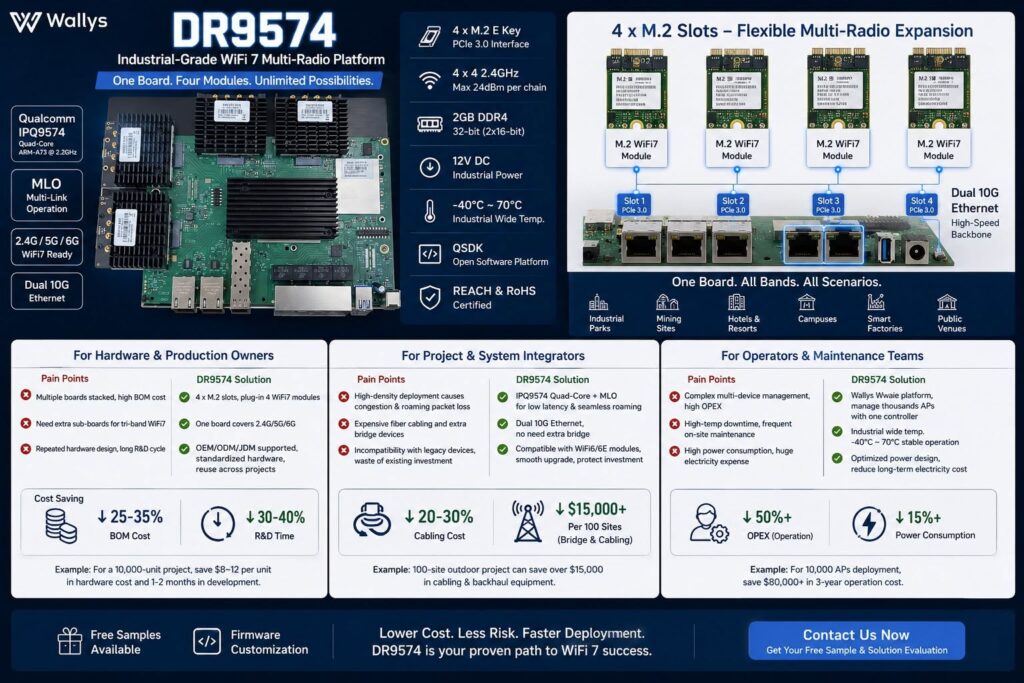
DR9574 Industrial WiFi7 Multi-Radio Board – One board, four M.2 radio modules, unlimited wireless deployment possibilities.

Built on Qualcomm IPQ9574 with MLO support, dual 10G Ethernet, wide temperature industrial design.

Lower BOM, less cabling cost, fewer maintenance workloads & power consumption for mass AP projects.

Ideal for system integrators, OEM hardware makers & wireless operators serving campuses, mining, smart factory & hospitality networks.

Testing samples & firmware customization available – DM to get your solution evaluation!

QSDK based firmware with QCA drivers is available , 3 card 3 band MLO support !! 4×4 MU MIMO or 2×2 MU MIMO configuration for 3 band MLO available.

https://wifi5.eu/dls/Wallys/DR9574

OpenWRT support available too !!

— working mainline OpenWrt port (10G + Wi-Fi 7 MLO)

Over the past few weeks we’ve brought the board up on a fully mainline stack — mainline Linux 6.12 + OpenWrt + ath12k, no QSDK and no out-of-tree datapath driver — and it now cold-boots from NAND into a working router/AP with both:

– 10G USXGMII ethernet (the AQR113C ports) bringing up a link and passing traffic with a DHCP lease, and
– a 3-link Wi-Fi 7 AP-MLD (one SSID across 6 / 5 / 2.4 GHz, WPA3-SAE) on mainline ath12k, with a real client associating and passing iperf traffic.

Getting the 10G working on mainline required root-causing and fixing an actual upstream kernel bug — a per-port clock that was left at the 10G rate regardless of the negotiated link speed. It’s a small, clean patch I’m preparing for the netdev mailing list, and it should help any IPQ95xx board with an Aquantia USXGMII PHY, not just this one.

Everything is public and reproducible here:
https://codeberg.org/insalata-fresca/openwrt-dr9574
(device tree, the patch set, and a write-up of the root cause.)

Why we think this could be interesting for you : a mainline-based firmware track means a current kernel with ongoing security fixes, an auditable, blob-minimal stack, and upstreamable patches — a strong story for customers who need long support windows, as a complement to the QSDK option.

W've pushed the mainline port further: the four 2.5G QCA8084 LAN ports are now the focus. The four copper PHYs come up and answer on mainline, and the 10G/USXGMII uplink and the 3-link Wi-Fi 7 MLO already work. But the 2.5G ports don't pass traffic yet,and I've traced it to one specific, well-understood gap.

In short: the QCA8084's internal XPCS never becomes reachable over MDIO. The chip's security-control config space (0xC90F000, which holds WORK_MODE and the SerDes/XPCS MDIO address fix-up) is readable but appears write-locked in our mainline bring-up. The driver writes the correct values (work mode 0x2f, XPCS MDIO address 7), but they don't take - so the XPCS stays at a default address, answers nowhere, and everything downstream (per-channel config, link, traffic) is blocked behind it. We are working on the final solution now.


The full write-up and the exact register evidence are on a public WIP page:

Status and the open question:
https://codeberg.org/insalata-fresca/openwrt-dr9574/src/branch/wip-qca8084-2p5g/docs/qca8084-2p5g-status.md

Register evidence (the actual readouts):
https://codeberg.org/insalata-fresca/openwrt-dr9574/src/branch/wip-qca8084-2p5g/docs/qca8084-2p5g-register-evidence.md

Repo root (device tree, 10G and Wi-Fi 7 patches):
https://codeberg.org/insalata-fresca/openwrt-dr9574

Posted on

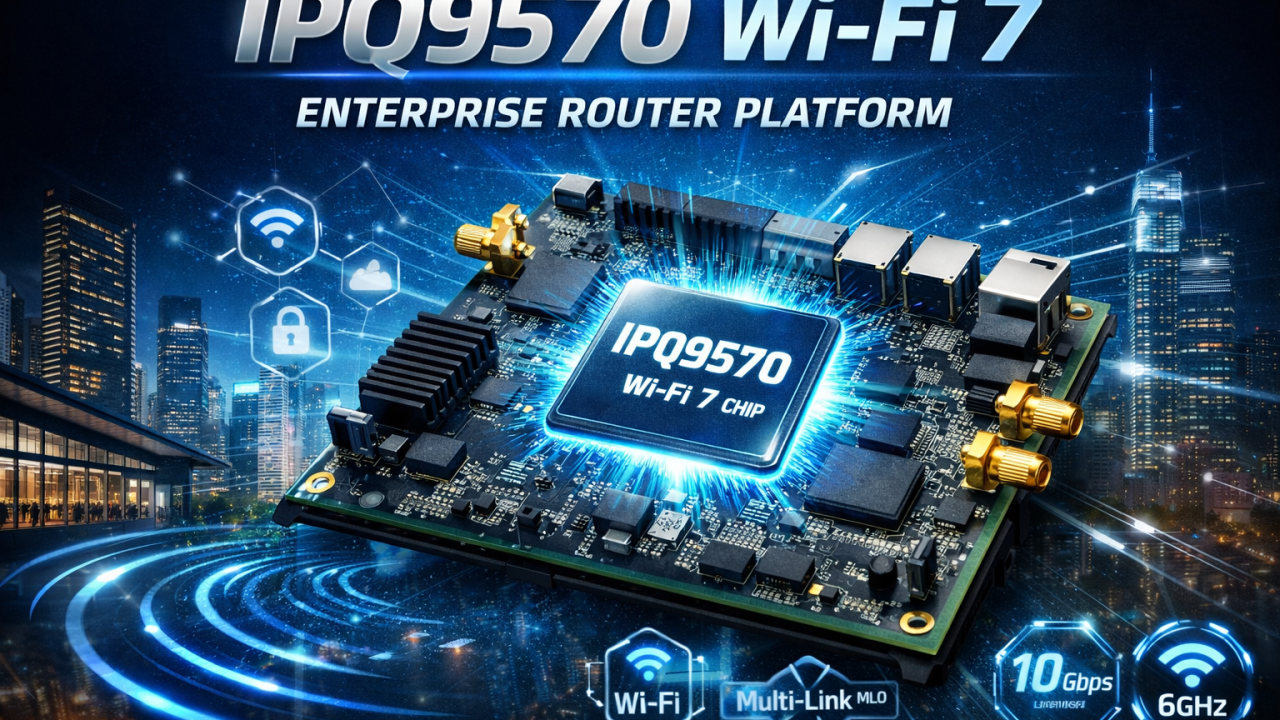
IPQ9570 Wi-Fi 7 Chip Overview: High-End Enterprise Router Platform

As Wi-Fi 7 (IEEE 802.11be) enters commercial deployment, enterprises and industrial users are demanding higher throughput, lower latency, stronger reliability, and scalable networking platforms. The Qualcomm IPQ9570 is designed precisely for these needs, positioning itself as a high-end Wi-Fi 7 router SoC for enterprise, industrial, and mission-critical networking applications.

This article provides a comprehensive overview of the IPQ9570 Wi-Fi 7 chipset, its key features, advantages, and typical application scenarios.

What Is IPQ9570?

The IPQ9570 is a flagship networking processor from Qualcomm’s Wi-Fi 7 router platform lineup. It targets enterprise-grade access points, high-performance gateways, and industrial routers, delivering advanced compute power, next-generation wireless capabilities, and rich wired connectivity.

Built for multi-gigabit networking, IPQ9570 is ideal for deployments where performance, stability, and long-term scalability are critical.

Key Features of IPQ9570 Wi-Fi 7 Platform

1. Wi-Fi 7 (802.11be) Support

IPQ9570 fully supports Wi-Fi 7, bringing major enhancements over Wi-Fi 6/6E:

  • 320 MHz channel bandwidth
  • Multi-Link Operation (MLO)
  • 4096-QAM
  • Significantly improved throughput and spectrum efficiency

These features enable ultra-fast wireless performance while maintaining stable connections in dense environments.

2. Multi-Link Operation (MLO)

One of the most important Wi-Fi 7 innovations, MLO, allows devices to transmit and receive data across multiple bands (2.4 GHz / 5 GHz / 6 GHz) simultaneously.

Benefits include:

  • Lower latency
  • Seamless roaming
  • Higher reliability
  • Reduced packet loss in mission-critical applications

This makes IPQ9570 particularly suitable for enterprise roaming, industrial mobility, and real-time communication systems.

3. High-Performance Quad-Core CPU

IPQ9570 integrates a high-performance quad-core processor, delivering strong computing capability for:

  • Advanced routing
  • Firewall and security services
  • VPN acceleration
  • Edge computing and traffic management

This ensures stable operation even under heavy traffic loads and complex network conditions.

4. Multi-Gigabit Ethernet Connectivity

To eliminate wired bottlenecks, IPQ9570 supports:

  • 2.5G / 5G / 10G Ethernet interfaces
  • High-speed LAN and WAN configurations

This enables full utilization of Wi-Fi 7 wireless speeds and supports modern enterprise network architectures.

5. Enterprise-Grade Security and Reliability

IPQ9570 is designed with enterprise and industrial reliability in mind, offering:

  • Hardware-accelerated security
  • Secure boot and encryption
  • Long-term platform support

It is well suited for 24/7 operation in demanding environments.

Typical Applications of IPQ9570

Thanks to its high-end positioning, IPQ9570 is widely applicable in:

  • Enterprise Wi-Fi 7 Access Points
  • High-performance Wi-Fi 7 Routers & Gateways
  • Industrial Wireless Routers
  • Smart Factories & Industrial Automation
  • Smart Ports, Airports, and Transportation Systems
  • Mesh & Seamless Roaming Networks
  • Edge Computing Gateways

IPQ9570 vs Previous-Generation Platforms

Compared with Wi-Fi 6/6E platforms, IPQ9570 offers:

  • Up to 2×–3× higher wireless throughput
  • Lower latency for real-time applications
  • Better performance in high-density environments
  • Improved future-proofing for next-generation devices

For enterprises planning long-term network upgrades, IPQ9570 provides a solid foundation.

Why Choose IPQ9570 for Wi-Fi 7 Projects?

Choosing IPQ9570 means investing in:

  • Future-ready Wi-Fi 7 performance
  • Enterprise-grade stability
  • Scalable hardware and software architecture
  • Support for advanced features like MLO and multi-gig Ethernet

It is an ideal solution for customers who require high reliability, customization flexibility, and long product lifecycle support.

Conclusion

The Qualcomm IPQ9570 stands out as a high-end Wi-Fi 7 router platform designed for enterprise and industrial applications. With support for Wi-Fi 7, MLO, multi-gigabit Ethernet, and strong processing power, IPQ9570 enables next-generation wireless networks that are faster, more reliable, and ready for the future.

For companies planning to deploy Wi-Fi 7 enterprise routers, industrial APs, or custom wireless solutions, IPQ9570 is a powerful and forward-looking choice.

524WiFi and Wallys IPQ9570 Router Board & ODM Services

We provide IPQ9570-based Wi-Fi 7 router boards and customized ODM solutions for enterprise and industrial applications.

With in-house R&D, manufacturing, and software customization capabilities, Wallys helps customers accelerate Wi-Fi 7 product development, from concept to mass production. Our IPQ9570 router board solutions support:

  • Wi-Fi 7 (802.11be) architecture with MLO support
  • Multi-gigabit Ethernet (2.5G / 5G / 10G) designs
  • Industrial-grade hardware options
  • Customized RF, antenna, and enclosure design
  • OpenWrt / Linux-based firmware customization
  • OEM / ODM / JDM project support

Whether you are building enterprise Wi-Fi 7 routers, industrial gateways, mesh & roaming systems, or customized wireless platforms, 524WiFi delivers flexible, reliable, and scalable solutions tailored to your project requirements.

Posted on

DR9574 WiFi 7: Built for AI Applications, Pushing Performance Limits – Core Advantages of WiFi 7 for AI Applications

With the rapid development of AI and IoT, traditional network architectures are no longer capable of handling the growing demands for data traffic and ultra-low latency. 524WiFis WiFi 7 hardware, with its groundbreaking technology, is specifically designed for AI-driven applications, offering infinite possibilities for the future of networking.

Core Advantages of WiFi 7 for AI Applications:

🔌 Ultra-High Bandwidth WiFi 7 hardware supports an impressive 46.116 Gbps link speed(maximum 6ghz peak data rate 11.529 Gbps x 4), effortlessly handling the massive data transfers required by AI algorithms. It ensures smooth operation for AI applications such as machine learning, data analysis, and automation, while also managing high-bandwidth device connections.

🌐 Seamless AI Device Connectivity WiFi 7 supports multiple devices simultaneously, ensuring AI-driven endpoints like smart cameras, industrial robots, and automation control systems enjoy ultra-stable, high-bandwidth connections. This meets the demands of industrial automation and smart city infrastructure.

💡 Future-Proofing Capability Wallys WiFi 7 hardware is compatible with future 5G networks and edge computing, offering ultra-low latency and efficient transmission to allow real-time interaction between AI applications and IoT devices, building a smarter and more interconnected ecosystem.

Solutions Tailored for Industrial AI Applications

Whether in smart factories, smart cities, autonomous driving, or telemedicine, 524WiFi WiFi 7 ensures seamless connectivity and ultra-fast transmission, guaranteeing real-time performance and stability for AI applications.

  • Enhanced Signal Coverage
  • Intelligent Bandwidth Management
  • Ultra-Low Latency
  • Self-Healing Network Failures
  • Supports Multiple Device Connections Simultaneously

Experience the Future Network for the AI Era Today

Contact us to get a product trial and detailed technical information.

Posted on

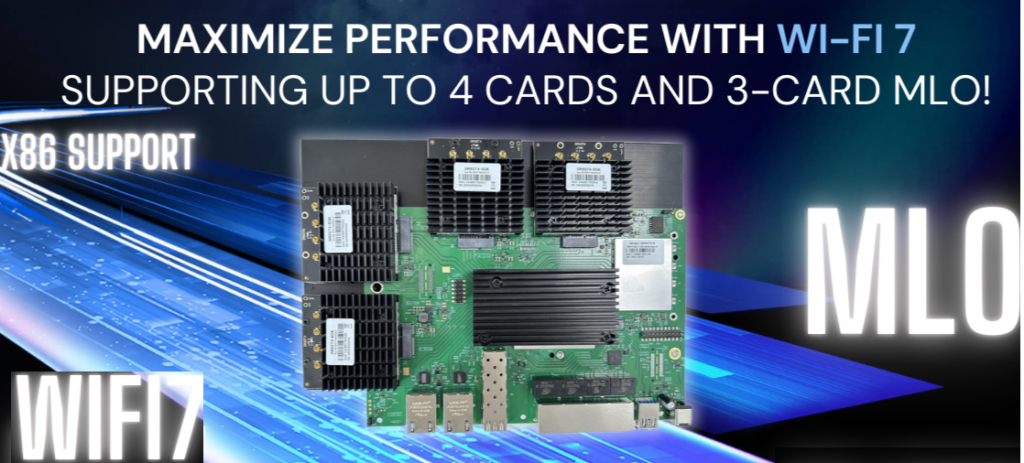
IPQ9574 Supports 4 QCN9274 Cards and Any 3-Card MLO Configuration Wi-Fi 7 Upgraded DR9574

Maximizing Wireless Performance with the Qualcomm IPQ9574: A Wi-Fi 7 Powerhouse

In today’s fast-paced digital world, industries are increasingly relying on advanced wireless technologies to support high-speed data transfer and seamless connectivity. The Qualcomm IPQ9574, a cutting-edge chipset powering the DR9574 router board, is revolutionizing wireless communication by supporting Wi-Fi 7 and offering industry-leading performance for demanding applications. This article delves into the key features and specifications of the IPQ9574 and DR9574, highlighting how they are shaping the future of wireless networking.

Why the Qualcomm IPQ9574 is a Game-Changer for Wi-Fi 7 Networks

The IPQ9574 chipset is at the heart of the DR9574, delivering unmatched wireless capabilities. It supports up to 4 Wi-Fi 7 cards, allowing flexibility for a variety of MLO (Multi-Link Operation) configurations, including compatibility with any 3-card MLO setup. This level of flexibility and performance ensures that industries can scale their networks to meet the growing demand for high-speed wireless communication.

Key Features of the IPQ9574-Based DR9574

  1. Advanced Quad-Core ARM Processor: The IPQ9574 chipset is powered by a Quad-Core ARM-A73 processor running at 2.2GHz. This ensures high-speed processing for data-intensive tasks and complex networking functions.
  2. Support for Wi-Fi 7: The IPQ9574 is designed to support the latest Wi-Fi 7 technology, providing faster speeds, better efficiency, and higher network capacity compared to its predecessors.
  3. Multiple M.2 E Key Interfaces: The DR9574 offers 4 M.2 E Key interfaces with PCIe 3.0, enabling support for up to four Wi-Fi 7 cards. This flexibility is crucial for environments that require high-performance networking.
  4. Excellent Power Efficiency: The board consumes 13W without the onboard Wi-Fi and up to 23W with Wi-Fi integrated, striking a balance between power efficiency and high-performance operation.
  5. Broad Operating Range: With operating temperatures between -20°C to 70°C and storage temperatures from -40°C to 90°C, the DR9574 is built to endure harsh industrial environments.
  6. Optimized for High-Speed Data: The 2.4GHz band supports 802.11b/g/n/ax standards, with data rates reaching 24dBm per chain, ensuring robust and fast wireless connections.

Key Hardware Specifications of the DR9574 Router Board

SpecificationDetails

ChipsetQualcomm IPQ9574 Quad-Core ARM-A73 @ 2.2GHz

System Memory2GB DDR4, 32-bit interface (2×16-bit)

PCIe InterfacePCIe 3.0

Frequency Range2.4GHz: 2.412~2.472GHz

Data Rates for WLAN2.4GHz 802.11b/g/n/ax, max 24dBm per chain

Modulation TechniquesBPSK, QPSK, DBPSK, DQPSK, 16-QAM, 64-QAM, 256-QAM, 1024QAM, 4096QAM

Operating Voltage12V

Power Consumption13W (Board only), 23W (with onboard Wi-Fi)

Temperature RangeOperating: -20°C to 70°C, Storage: -40°C to 90°C

Applications of the DR9574 in Industry

With its robust feature set and Wi-Fi 7 capabilities, the DR9574 is perfect for a variety of industries, including:

  • Smart Cities: The ability to support multiple Wi-Fi 7 cards and MLO configurations makes it ideal for managing the wireless backbone of smart cities, where high-speed and reliable communication are essential.
  • Industrial IoT (IIoT): As industrial applications increasingly rely on wireless technology for device communication, the DR9574 ensures reliable data transfer, low latency, and the ability to scale as the number of connected devices grows.
  • Telecommunications: The IPQ9574 chipset allows telecommunications providers to build next-generation infrastructures that offer superior performance and capacity.

Absolute Maximum Ratings for Reliable Operation

Parameter/RatingUnit

Operating Temperature-20 ~ 70ºC

Storage Temperature-40 ~ 90ºC

Operating Humidity5% ~ 95 (non-condensing)%

Storage Humidity0% ~ 90 (non-condensing)%

Conclusion: Future-Proof Your Network with IPQ9574 and DR9574

The Qualcomm IPQ9574 and DR9574 router board are poised to lead the charge in Wi-Fi 7 technology, providing businesses and industries with the high-performance, reliable, and scalable networking solutions they need. With support for multiple Wi-Fi 7 cards, MLO configurations, and the ability to operate in challenging environments, the DR9574 is an ideal choice for industries looking to upgrade their wireless networks for the future.

As Wi-Fi 7 continues to gain traction in the industry, the IPQ9574 is at the forefront of delivering the connectivity that next-gen applications demand, from industrial IoT to smart cities and beyond.

Posted on

IPQ5018, IPQ9574 WiFi 6/7 Modules for AIoT and Autonomous Robotics

Unlocking High-Performance Wireless Connectivity for Next-Gen Intelligent Systems

Introduction

As AIoT ( Artificial Intelligence of Things ) and autonomous robotics continue to transform industries — from smart factories to unmanned logistics and surveillance systems — high-performance wireless connectivity has become a mission-critical requirement. Advanced machines need real-time data exchange, seamless remote control, and ultra-reliable low-latency communication (URLLC). This is exactly where WiFi 6 and WiFi 7 modules powered by Qualcomm’s IPQ5018 and IPQ9574 shine.


Why Wireless Connectivity Matters for AIoT & Autonomous Robots

1. Real-Time Sensor Fusion

Robots in smart warehouses, delivery drones, and autonomous patrol vehicles rely on multiple sensors, including cameras, LiDAR, and radar. These sensors generate vast amounts of data that need to be transmitted to central controllers or edge processing nodes in real time.

2. Collaborative Operations

Swarm robotics (groups of robots working together) demand synchronized communication to coordinate movements, object handling, and obstacle avoidance — requiring high bandwidth and low latency.

3. Mobile AI Processing

For AIoT devices in industrial and outdoor environments, real-time data streaming between edge AI processors and cloud systems is crucial to optimize performance using advanced analytics and machine learning models.


Meet the Power Duo: IPQ5018 and IPQ9574

📡 IPQ5018 — Optimized WiFi 6 Solution for Cost-Effective Performance

Ideal for Mid-Range AIoT and Autonomous Devices

Feature Specification : Wireless StandardWiFi 6 802.11ax Bands 2.4GHz + 5GHz Dual-band Data Rate Up to 3Gbps CPU Dual-core ARM Cortex A53 Security WPA3, Secure Boot, Trusted Execution Environment (TEE)Target Applications Drones, AGVs, Smart Cameras, Industrial Sensors

🚀 IPQ9574 — High-Performance WiFi 7 Solution for Next-Level Intelligence

Designed for High-End Robotics and AIoT Hubs

Feature Specification: Wireless StandardWiFi 7 802.11be Bands Tri-band (2.4GHz + 5GHz + 6GHz) Data Rate Up to 21Gbps CPU Quad-core ARM Cortex A73 MLO (Multi-Link Operation)✅ Supported Target Applications Autonomous Vehicles, Smart Manufacturing, Large-Scale Sensor Networks


Key Benefits for AIoT and Autonomous Robotics

✅ Ultra-Low Latency Control

With OFDMA and MLO (in WiFi 7), these modules significantly reduce wireless communication delays, which is essential for real-time remote control and mission-critical data feedback.

✅ High Throughput for AI Workloads

AI-driven devices, particularly those with onboard vision processing or collaborative SLAM (Simultaneous Localization and Mapping), generate vast streams of data. WiFi 6/7 ensures uninterrupted, high-bandwidth transmission.

✅ Interference Mitigation in Dense Environments

AIoT ecosystems often operate in challenging RF environments — factories, ports, or urban areas — where multiple devices compete for bandwidth. Features like BSS Coloring and MU-MIMO (in both WiFi 6 & 7) guarantee efficient channel sharing.

✅ Future-Proof Connectivity

With WiFi 7’s 320 MHz channels and 4096-QAM, autonomous robots and AIoT nodes can benefit from unprecedented wireless speeds, supporting emerging workloads like real-time AI inference streaming or collaborative deep learning updates.


Application Scenarios

Use Case WiFi Module Recommendation Autonomous Mobile Robots (AMR) IPQ5018 Smart Drones IPQ5018 High-Speed AGVs in Warehouses IPQ9574 Remote AI Surveillance Towers IPQ9574 AIoT Sensor Networks in Smart Cities IPQ5018 Large-Scale Robotic Fleets IPQ9574


Why Choose DR5018S & DR9574 Modules

At 524WiFi and Wallys Communications, we specialize in developing cutting-edge wireless hardware tailored for industrial applications. Our DR5018S (IPQ5018) and DR9574 (IPQ9574) modules offer:

✅ Industrial-grade durability for harsh environments

✅ Full support for OpenWRT and customizable firmware

✅ Compact form factors perfect for integration into AIoT devices

✅ Strong RF performance with advanced antenna design support

✅ Flexible customization — from hardware interfaces to security features


Final Thoughts

As AIoT and autonomous robots become smarter and more connected, choosing the right wireless solution becomes a strategic decision. Whether you’re building the next-gen delivery robot or deploying a real-time AI sensor network in a smart factory, 524WiFi’s IPQ5018 and IPQ9574-based modules ensure your devices communicate reliably and efficiently — today and into the future.

Posted on

Your Go-To Guide for Loading Firmware and Configuring MLO on QCA DR9574 IPQ9574 !

Your Go-To Guide for Loading Firmware and Configuring MLO on IPQ9574 !

Hey there! Are you feeling a bit lost when it comes to loading firmware and configuring MLO on the IPQ9574? Fret not! Here at 524WiFi, we’ve crafted a super easy and detailed tutorial just for you. Let’s jump right into it!

Why This Guide?

Whether you’re a seasoned pro or a complete newbie, setting up advanced hardware can be daunting. That’s why we’re here to break it down into simple, manageable steps. By the end of this guide, you’ll be a pro at loading firmware and configuring your device like a champ!

What You’ll Get

  • Clear Hardware Setup: We’ll kick things off by connecting the hardware. Don’t worry; we’ll guide you through the process of connecting your UART cable without any hassle.
  • Seamless Firmware Loading: Next, we’ll tackle loading the firmware. We’ll ensure you have everything in the right place and give you step-by-step instructions to make it a breeze.
  • Effortless AP Configuration: Finally, we’ll walk you through configuring the Access Point. This step is crucial for ensuring your device runs at its best.

Stick Around for More!

But wait, there’s more! If you stick around until the end of the video, you’ll get an exclusive sneak peek at our upcoming DR9574kit throughput test. Trust us, you won’t want to miss it!

Ready to Dive In?

So, what are you waiting for? Click the link below to watch our tutorial and empower yourself with the skills to conquer firmware loading and MLO configuration!

📺 Watch here:

P.S.: The MLO for DR5332/DR5322 is currently in active preparation. We appreciate your patience as our R&D team works diligently on this. Stay tuned for the latest updates coming your way soon—just you wait!

Posted on

IPQ 9574: Does DR9574 Router Powered by Qualcomm IPQ9574 Support MLO?

524WiFi Wi-Fi 7 Router Powered by Qualcomm IPQ9574 and QCN9274: Enhanced Network Experience with MLO Technology

MLO (Multi-Link Operation) is a key technology in Wi-Fi 7 that allows data to be transmitted across multiple wireless links simultaneously, significantly improving network performance, stability, and efficiency. Specifically, MLO enables devices to transmit and receive data on multiple frequency bands (2.4GHz, 5GHz, and 6GHz) at the same time, rather than being limited to a single band.

Key Roles of MLO in Wi-Fi 7:

  • Increased Throughput: MLO allows devices to utilize multiple links for data transmission, greatly boosting bandwidth and data transfer speeds, especially for high-bandwidth applications like 4K/8K streaming, cloud gaming, and VR/AR.
  • Reduced Latency: Parallel transmission across multiple links accelerates data transfer, lowering latency, which is crucial for real-time applications like online gaming and video conferencing.
  • Enhanced Reliability: MLO can automatically switch to other links if one experiences interference or congestion, ensuring connection stability, especially in crowded environments or when devices are far from the router.
  • More Efficient Spectrum Usage: MLO dynamically distributes traffic across different links, improving spectrum resource utilization and reducing wireless congestion.

Why Many Applications Need MLO:

  • High Bandwidth Demands: As 4K/8K video and immersive media become more prevalent, applications increasingly require higher bandwidth. MLO’s multi-link capability meets these demands.
  • Low Latency Requirements: Applications like cloud gaming and video conferencing require very low latency. MLO can significantly reduce latency through parallel transmission.
  • Reliability: Smart home and industrial automation applications need stable connections. MLO’s multi-link mechanism ensures stability even if one link fails.

About IPQ9574 and QCN9274:

  • Qualcomm IPQ9574: This powerful SoC (System on Chip) is designed for high-performance networking applications, providing robust processing power and advanced features to support next-gen Wi-Fi 7 capabilities. Its architecture is optimized for handling multiple data streams, ensuring seamless connectivity and improved network efficiency.
  • Qualcomm QCN9274: Qualcomm Wi-Fi 7 ‘Waikiki’ series radio solution.

In summary, MLO is a core technology in Wi-Fi 7 that enhances network experience by providing higher throughput, lower latency, and greater reliability, making it essential for modern high-performance applications.

524WiFi Solution:

524WiFI and Wallystech’s Wi-Fi 7 router DR9574 supports MLO functionality with the DR9274 Wi-Fi 7 card, fulfilling diverse Wi-Fi project needs:

  • DR9574 supports 3 DR9274 single cards: 2.4G, 5G, and 6G can operate simultaneously.
  • DR9574 supports one DBDC card: DR9274-5G6G
Posted on

Stable Wireless PTP Long Range Transmission Hardware: 524 WiFi Industrial Wireless Routerboards

IPQ5018, IPQ6018, IPQ8072, IPQ9574, IPQ5332 Routerboards

Choosing Stable Wireless Transmission Hardware: Recommended 524 WiFi Industrial Wireless Routers

In point-to-point WiFi long-distance transmission, selecting the right hardware platform is crucial. To achieve stable signal transmission, it’s important to focus on key factors such as processor performance, transmission standards, RF (radio frequency) performance, and heat dissipation design. Wallys offers a range of industrial wireless routers that meet these needs, particularly excelling in scenarios requiring stable transmission over distances of up to 23 kilometers.

1. Processor Performance

Choosing routers with high-performance CPUs is essential. 524WiFi’ industrial routers are equipped with powerful multi-core processors capable of handling high data traffic, ensuring a smooth network experience even with multiple device connections. This level of performance guarantees reliability in data-intensive applications, such as video monitoring and real-time data transmission.

WIFI6 VS WIFI7
WIFI6 VS WIFI7

2. Transmission Standards

To achieve higher efficiency and lower latency, it’s vital to select devices that support the latest WiFi standards. Wallys 524WiFi routers support WiFi 6 and WiFi 6E, with preparations for WiFi 7. This means users can enjoy faster connection speeds and greater network capacity, making them suitable for high-density user environments.

3. RF (Radio Frequency) Performance

Good RF performance is another key factor for stable transmission. 524WiFi’ industrial wireless routers employ advanced RF designs that optimize signal transmission and reception, significantly enhancing signal stability and interference resistance. This is especially important in complex environments such as factories or warehouses, ensuring stable signal transmission even over distances of up to 23 kilometers.

4. Heat Dissipation Design

Overheating can severely impact device performance, so a good heat dissipation design is crucial. Wallys 524WiFi routers utilize efficient heat management solutions to maintain stable performance during long-term operation. This design allows devices to operate efficiently under high load conditions, ensuring continuous network connectivity.

Wallys WIFI7 Heat Dissipation Design
524WIFI 7 Heat Dissipation Design

5. Quality Control

524WiFi’ commitment to quality is reflected in its manufacturing process. All devices undergo 100% calibration before shipment, ensuring that signal quality and performance meet high standards. This rigorous quality control measure gives users peace of mind, ensuring that devices can operate reliably in various environments.

Recommended Models

  • DR5018S: Based on the Qualcomm IPQ5018 CPU, supports WiFi 6, suitable for high-density connection environments, offering robust data processing capabilities.
DR5018S router board
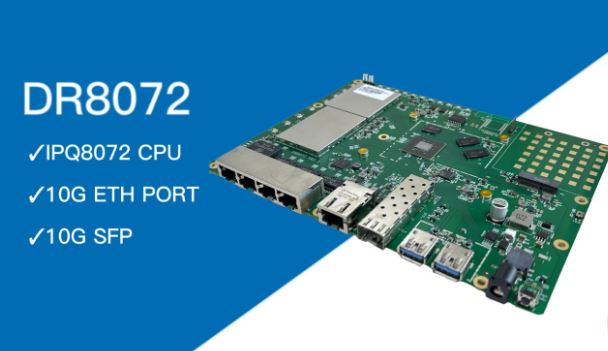
  • DR8072: Features the Qualcomm IPQ8072 CPU, supports WiFi 6E, with excellent RF performance and heat dissipation design, ideal for industrial applications.
DR8072
  • Wallys DR6018: Based on the Qualcomm IPQ6010 CPU, suitable for environments that require stable transmission and efficient processing.
Wallys DR6018
  • DR5332: A forward-looking design supporting WiFi 7, based on the Qualcomm IPQ5332 CPU, offering multiple connectivity options to meet future needs.
IPQ6010 VS IPQ5332
IPQ6010 VS IPQ5332
  • DR9574: Equipped with the Qualcomm IPQ9574 CPU, providing exceptional performance and efficient signal transmission, suitable for large-scale applications.
Wallys DR9574

Conclusion

Choosing the right industrial wireless router is essential for ensuring stable wireless transmission. 524WiFi’ products excel in processor performance, transmission standards, RF performance, and heat dissipation design, making them ideal for achieving efficient point-to-point WiFi connections while maintaining stability over distances of up to 23 kilometers. By selecting the appropriate model based on specific application scenarios and requirements, you can maximize network stability and efficiency, ensuring reliable wireless communication.