

Posted on

Wi-Fi 8 for Engineers: 802.11bn in Industrial Robotics

Key takeaways

  • IEEE 802.11bn targets tail latency, packet loss and reliability under difficult real-world conditions.
  • Multi-AP coordination and dynamic channel use reshape network architecture beyond single-link performance.
  • Modular mainboards and radios provide flexibility while Wi-Fi 8 silicon and the draft continue to mature.

What Is Wi-Fi 8, and Why Does It Matter for Engineers?

Wi-Fi 8 is the market name for IEEE 802.11bn, the standard succeeding Wi-Fi 7 (802.11be). Unlike previous generations, which were sold primarily on peak throughput, 802.11bn’s official designation is Ultra High Reliability (UHR) — the standard is built to make wireless connections more consistent and predictable in difficult real-world RF conditions rather than simply chasing higher headline speeds.

For engineers, this reframing is the story. Industry research on 802.11bn targets at least 25% better throughput, 25% lower 95th-percentile latency, and 25% lower packet loss compared to Wi-Fi 7 under real conditions — the kind of tail-latency and drop-rate improvement that matters far more than peak Mbps when you’re running AMR fleets, machine vision links, or multi-robot warehouse networks.

As of mid-2026, the 802.11bn task group has draft work underway covering spectrum from 1 GHz to 7.25 GHz, with final IEEE ratification projected for 2028, though chipset vendors are moving early — Broadcom has announced Wi-Fi 8 silicon (BCM4918 APU, BCM6714/6719 radios) and MediaTek has previewed its Filogic 8000 chip series, with early hardware expected to run on draft specifications ahead of full ratification.

Key Technical Features Engineers Should Track

802.11bn introduces several mechanisms that directly reshape multi-AP network design:

  • Multi-AP Coordination (MAPC): access points coordinate airtime, spatial reuse, and transmissions instead of behaving as independent, competing radios — a shift from Wi-Fi 7’s Multi-Link Operation, which optimizes a single AP-client link rather than the whole deployment.
  • Coordinated Spatial Reuse and Coordinated Beamforming: neighboring APs share scheduling information to transmit on the same channel without stepping on each other, and align antenna patterns to cut interference.
  • Dynamic Subchannel Operation and Non-Primary Channel Access: wide channels are used more flexibly, so a busy primary channel no longer blocks all traffic on that link.
  • Single Mobility Domain behavior: 802.11bn is expected to allow a client to associate with multiple access points simultaneously (and vice versa), fundamentally changing roaming and airtime management compared to 802.11be.

Together these features are what actually deliver the reliability gains — not a new modulation scheme, but coordination logic across the AP layer.

How This Integrates With Wallys’ Wi-Fi 8 Platform

524WiFi™ and Wallys tech Wi-Fi 8 lineup is already moving from prototype to production, built around Qualcomm’s next-generation platforms:

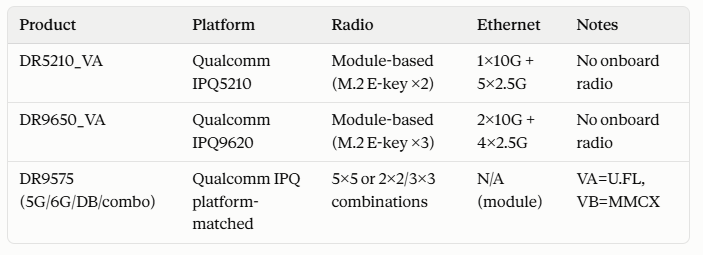
  • DR5210_VA — IPQ5210-based mainboard, DDR4 + NOR/NAND flash, 2× M.2 E-key slots, 1× 10G copper + 5× 2.5G Ethernet, 12V input, no onboard radio (module-based design).
  • DR9650_VA — IPQ9620-based mainboard, DDR4 + NOR/NAND flash, 3× M.2 E-key slots, 2× 10G copper + 4× 2.5G Ethernet, 12V input, also module-based.
  • DR9575 module family — 5×5 5GHz, 5×5 6GHz, dual-band (2×2 2.4GHz + 3×3 5GHz), and a 5G/6G combo variant (3×3 5GHz + 2×2 6GHz, VB connector only). VA boards use U.FL connectors; VB variants use MMCX.

The modular mainboard-plus-radio-module architecture matters here specifically because of MAPC and coordinated spatial reuse: a fixed single-radio AP can’t easily be re-tuned as the 802.11bn draft evolves, but a mainboard that accepts interchangeable M.2 radio modules can be re-radioed as Wi-Fi 8 chipsets mature — relevant given the standard won’t be fully ratified until 2028.

Wi-Fi 8 vs. Wi-Fi 7: What Actually Changes

Article content

This is a distinct axis from the tri-band switchable vs. concurrent distinction that matters for current Wi-Fi 7 hardware selection — Wi-Fi 8’s coordination features operate at the network-topology level, above the radio-chain level.

Applications Enabled: Where UHR Actually Pays Off

  • Multi-robot warehouse fleets: coordinated multi-AP scheduling and reduced tail latency directly address the roaming-drop and airtime-contention problems that show up once you have more than a handful of AMRs sharing a floor.
  • Industrial vision networks: camera links tolerate throughput variance poorly; UHR’s packet-loss reduction target is more relevant here than raw peak bandwidth.
  • Port, mining, and campus deployments: environments already using seamless-roaming Wi-Fi 6 APs (like our DR5018S-R series) are the natural upgrade path once Wi-Fi 8 silicon matures, since the underlying pain point — clean handoff between APs — is exactly what MAPC targets.

Hardware Summary – future products coming soon
Posted on

Wi-Fi 8 DSO Explained: Dynamic Sub-band Operation

Key takeaways

  • DSO addresses capability mismatches between wide-channel access points and narrower-channel clients.
  • More flexible sub-band allocation can preserve capacity instead of forcing the network to the lowest common denominator.
  • The feature matters most in mixed fleets and dense industrial networks with varied client radios.

What is DSO, and why does it exist?

IEEE 802.11bn (Wi-Fi 8) introduces Dynamic Sub-band Operation (DSO) — sometimes called Dynamic Sub-Channel Operation — to solve a very concrete problem: the capability gap between access points and client devices. A modern AP chipset can run 160 MHz or even 320 MHz channels. Most connected stations — sensors, cameras, handheld scanners, mobile robots — only support 20 MHz or 40 MHz. Under Wi-Fi 6/7 rules, once an AP grants a TXOP (transmit opportunity) to a narrow-band station, the rest of that wide channel sits idle for the whole transmission window. A 160 MHz AP serving a 40 MHz station wastes 120 MHz on every single TXOP.

DSO fixes this at the MAC layer. Instead of allocating the full wide channel to one narrow-band station, the AP schedules multiple stations onto different sub-channels within the same TXOP, using an ICF/ICR (Intra-TXOP Control Frame / Response) exchange to coordinate who transmits where before data starts flowing. Four 40 MHz stations can now share a single 160 MHz TXOP concurrently instead of taking four separate turns.

How this changes AP/module design

For hardware teams building on Qualcomm Wi-Fi 7/8 platforms (IPQ9574, IPQ5424, QCN9274-class silicon), DSO isn’t just a MAC firmware feature — it changes how you think about channel width provisioning. Wide-channel APs stop being “wasted” on mixed-capability deployments; the same 320 MHz radio design that used to only pay off with all-320 MHz clients now scales efficiency gracefully down to 20 MHz legacy devices in the same BSS.

DSO vs. the Wi-Fi 7 alternative (static OFDMA/channel bonding only)

Wi-Fi 7 already gave us Multi-Link Operation and preamble puncturing, but scheduling flexibility within one TXOP for mixed-bandwidth clients wasn’t part of the toolkit. DSO is a Wi-Fi 8-specific MAC mechanism that works alongside Non-Primary Channel Access (NPCA) — where a station can move off a busy primary channel — to squeeze real throughput out of dense, mixed-device networks rather than relying purely on wider channels or more spectrum.

Applications this enables

  • Dense AMR/AGV warehouse fleets where robots, handheld scanners, and fixed cameras all share one AP with very different bandwidth capabilities
  • Multi-camera industrial vision networks mixing high-res inspection cameras with low-bandwidth trigger/status sensors
  • Any industrial site consolidating mixed-generation devices onto one Wi-Fi 8 AP instead of running parallel 6/7/8 networks

Where we’re headed

We’re preparing our Wi-Fi 8 routerboard platform now, building on the same IPQ9574/IPQ5424-class hardware lineage we already ship in DR9574 and DR5424. If DSO-level MAC efficiency matters for your next-gen industrial AP or robot connectivity design, happy to compare notes.

Posted on 1 Comment

What Is Wi-Fi 8? Practical 802.11bn Guide for Developers

Key takeaways

  • Wi-Fi 8 focuses on reliability, mobility and predictable performance rather than a new peak-speed headline.
  • SMD, Multi-AP Coordination, DSO and ELR address distinct roaming, density, spectrum and range problems.
  • Product teams can prototype early while tracking the draft revision and interoperability path.

What Is Wi-Fi 8? A Practical Guide for Product Developers

If you’re speccing a router, gateway, or edge device roadmap for 2027-2028, “Wi-Fi 8” has probably already landed in a requirements doc somewhere — usually with no more detail than the name itself. Here’s what the standard actually is, what’s still moving, and what it means if you’re the one who has to put it on a board.

It’s not “faster Wi-Fi 7”

Every previous Wi-Fi generation sold itself on peak throughput. Wi-Fi 8 doesn’t. It’s built on the IEEE 802.11bn amendment, officially named Ultra High Reliability (UHR) — and the name is the point. The target isn’t a bigger link-rate number; it’s making real-world connections behave more predictably when a network is dense, noisy, or full of moving clients. Peak throughput stays roughly in Wi-Fi 7 territory; what improves is the worst case.

That distinction matters for how you plan a product. If your customer’s pain point is “our AP throughput number looks great in a spec sheet but connections still drop when we’ve got 40 clients in one warehouse bay,” Wi-Fi 8 is aimed squarely at you. If the pitch you need is a bigger peak-speed number, it isn’t.

The four features actually worth designing around

Strip away the marketing layer and 802.11bn comes down to four mechanisms:

  • Single Mobility Domain (SMD) — lets a station stay associated while moving between APs inside the same domain, instead of doing a full re-association each time. This is the direct answer to multi-AP roaming latency and packet loss — the exact failure mode that shows up as “the robot’s connection blips every time it crosses a cell boundary.”
  • Multi-AP Coordination (MAPC) — APs coordinate channel access and spectrum use with each other rather than competing independently. In a facility with high AP density, this is what actually improves reliability, not adding more radios.
  • Dynamic Subband Operation (DSO) — lets an AP hand a client a slice of bandwidth outside that client’s normal operating range when there’s a capability mismatch, instead of falling back to the lowest common denominator.
  • Enhanced Long Range (ELR) — addresses the link-budget imbalance between AP and station, with defined support for uplink transmission on 2.4/5/6 GHz and downlink on 2.4 GHz. Relevant to anything using a low-power, small-antenna client at range — a drone, a sensor node, a handheld.

None of these are throughput features. All four are reliability-under-real-conditions features, which is a different design conversation than the one Wi-Fi 6→7 required.

Where the standard actually stands (be honest about this)

This is the part vendors tend to blur, and it’s worth stating plainly: 802.11bn is a draft, not a shipped standard. The IEEE task group released its first draft (D1.0) in mid-2025, sponsor ballot is expected around 2027, and final ratification isn’t expected before 2028. Pre-standard silicon is expected to start appearing in 2026, with early devices based on draft specifications rather than a locked amendment.

What that means practically: anything shipping under a “Wi-Fi 8” label before ~2027-2028 is a pre-standard implementation. Features can still shift before ratification, and interoperability between different vendors’ pre-standard silicon isn’t guaranteed. If a supplier tells you otherwise, that’s the question to push on.

What we’re actually doing about it

We didn’t want to wait for a ratified spec to start learning the platform, so we’re already building out a Qualcomm-based Wi-Fi 8 reference design — not a product announcement, an engineering exercise to understand what changes at the board level once SMD/MAPC/DSO/ELR are real silicon features instead of spec-sheet lines.

A few things stand out working with early boards like this one:

Article content
Figure 1 — reference board

(Figure 1 — reference board, RF/SoC section) The RF and processing cluster on this design sits in a dedicated shielded zone with the SoC and its companion radio ICs laid out for short, controlled trace lengths — coordination features like MAPC put more demand on tight timing between radio paths than a standalone AP design ever did.

Article content
Figure 2 — reference board, underside

(Figure 2 — reference board, underside) The support circuitry — power sequencing, clocking — is denser than what we’re used to on a Wi-Fi 6/7 board of similar size, which tracks with a chipset doing more real-time coordination work rather than just more raw PHY throughput.

What this means if you’re planning a 2027 product

  • Don’t wait for ratification to start prototyping. By the time the standard is final, you want your firmware and RF integration lessons already learned on pre-standard silicon.
  • Match the feature to the actual problem. SMD solves roaming, MAPC solves density, ELR solves range, DSO solves capability mismatches. Pick the one that maps to your customer’s actual failure mode rather than treating “Wi-Fi 8” as one undifferentiated upgrade.
  • Ask suppliers exactly which draft revision their silicon targets. “Wi-Fi 8 ready” is not yet a standardized claim — it’s a pre-standard implementation claim, and the details differ by vendor and by draft version.

If you’re evaluating a Qualcomm-based Wi-Fi 8 platform for your own product — whether that’s a carrier board, an ODM hardware partnership, or just a technical sounding board while the standard finishes settling — we’re happy to compare