

Key takeaways
- Wi-Fi 8 focuses on reliability, mobility and predictable performance rather than a new peak-speed headline.
- SMD, Multi-AP Coordination, DSO and ELR address distinct roaming, density, spectrum and range problems.
- Product teams can prototype early while tracking the draft revision and interoperability path.
What Is Wi-Fi 8? A Practical Guide for Product Developers
If you’re speccing a router, gateway, or edge device roadmap for 2027-2028, “Wi-Fi 8” has probably already landed in a requirements doc somewhere — usually with no more detail than the name itself. Here’s what the standard actually is, what’s still moving, and what it means if you’re the one who has to put it on a board.
It’s not “faster Wi-Fi 7”
Every previous Wi-Fi generation sold itself on peak throughput. Wi-Fi 8 doesn’t. It’s built on the IEEE 802.11bn amendment, officially named Ultra High Reliability (UHR) — and the name is the point. The target isn’t a bigger link-rate number; it’s making real-world connections behave more predictably when a network is dense, noisy, or full of moving clients. Peak throughput stays roughly in Wi-Fi 7 territory; what improves is the worst case.
That distinction matters for how you plan a product. If your customer’s pain point is “our AP throughput number looks great in a spec sheet but connections still drop when we’ve got 40 clients in one warehouse bay,” Wi-Fi 8 is aimed squarely at you. If the pitch you need is a bigger peak-speed number, it isn’t.
The four features actually worth designing around
Strip away the marketing layer and 802.11bn comes down to four mechanisms:
- Single Mobility Domain (SMD) — lets a station stay associated while moving between APs inside the same domain, instead of doing a full re-association each time. This is the direct answer to multi-AP roaming latency and packet loss — the exact failure mode that shows up as “the robot’s connection blips every time it crosses a cell boundary.”
- Multi-AP Coordination (MAPC) — APs coordinate channel access and spectrum use with each other rather than competing independently. In a facility with high AP density, this is what actually improves reliability, not adding more radios.
- Dynamic Subband Operation (DSO) — lets an AP hand a client a slice of bandwidth outside that client’s normal operating range when there’s a capability mismatch, instead of falling back to the lowest common denominator.
- Enhanced Long Range (ELR) — addresses the link-budget imbalance between AP and station, with defined support for uplink transmission on 2.4/5/6 GHz and downlink on 2.4 GHz. Relevant to anything using a low-power, small-antenna client at range — a drone, a sensor node, a handheld.
None of these are throughput features. All four are reliability-under-real-conditions features, which is a different design conversation than the one Wi-Fi 6→7 required.
Where the standard actually stands (be honest about this)
This is the part vendors tend to blur, and it’s worth stating plainly: 802.11bn is a draft, not a shipped standard. The IEEE task group released its first draft (D1.0) in mid-2025, sponsor ballot is expected around 2027, and final ratification isn’t expected before 2028. Pre-standard silicon is expected to start appearing in 2026, with early devices based on draft specifications rather than a locked amendment.
What that means practically: anything shipping under a “Wi-Fi 8” label before ~2027-2028 is a pre-standard implementation. Features can still shift before ratification, and interoperability between different vendors’ pre-standard silicon isn’t guaranteed. If a supplier tells you otherwise, that’s the question to push on.
Planning a 524WiFi™ Wi-Fi 8 platform
524WiFi™ platform planning combines Qualcomm-based mainboards with dedicated radio modules. The Pulse B8-01 and Pulse B8-02 mainboard architectures use M.2 E-key radio expansion, while the Pulse P8 module family provides band-specific and combined-radio configurations. This modular approach gives product teams a practical framework for host interfaces, Ethernet backhaul, RF connectors and integration requirements.
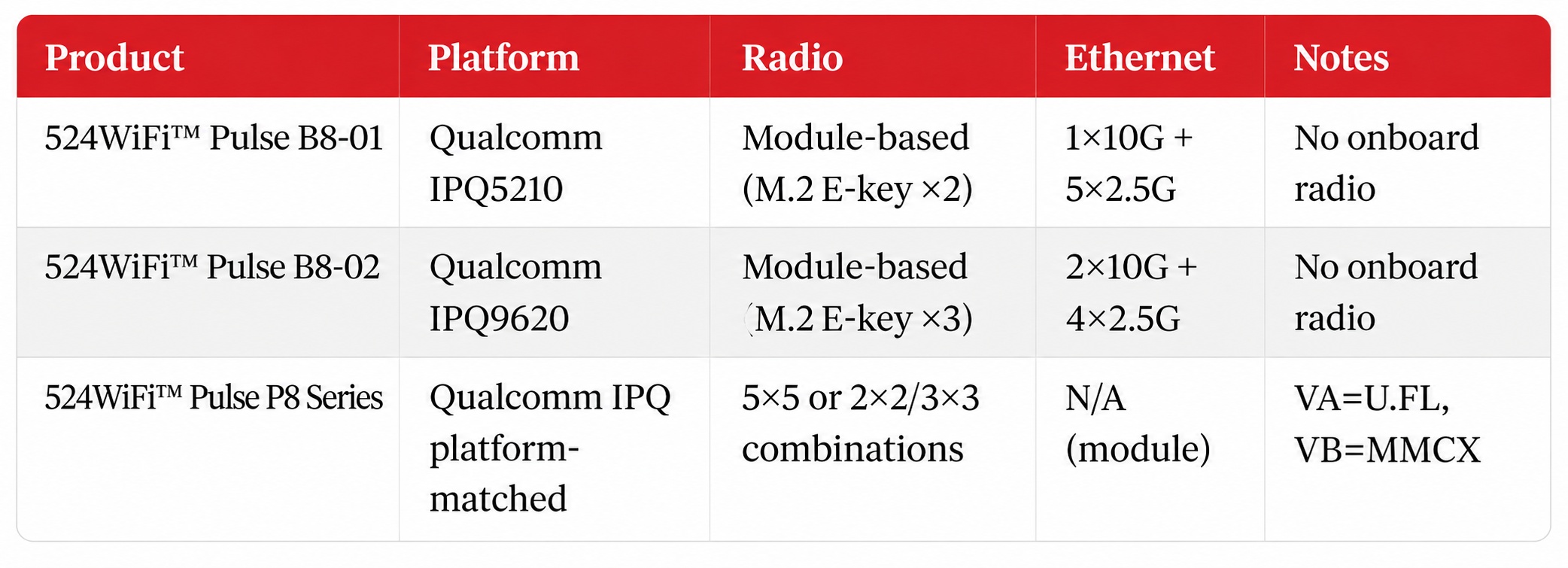
For an early design, confirm the production specification, supported draft revision, firmware interfaces and regulatory path for the selected mainboard and radio configuration. RF trace layout, radio timing, power sequencing and thermal design remain part of the complete system integration.
What this means if you’re planning a 2027 product
- Don’t wait for ratification to start prototyping. By the time the standard is final, you want your firmware and RF integration lessons already learned on pre-standard silicon.
- Match the feature to the actual problem. SMD solves roaming, MAPC solves density, ELR solves range, DSO solves capability mismatches. Pick the one that maps to your customer’s actual failure mode rather than treating “Wi-Fi 8” as one undifferentiated upgrade.
- Ask suppliers exactly which draft revision their silicon targets. “Wi-Fi 8 ready” is not yet a standardized claim — it’s a pre-standard implementation claim, and the details differ by vendor and by draft version.
If you’re evaluating a Qualcomm-based Wi-Fi 8 platform for your own product — whether that’s a carrier board, an ODM hardware partnership, or just a technical sounding board while the standard finishes settling — we’re happy to compare
[…] See DSO in the wider Wi-Fi 8 roadmap […]
[…] Read the practical Wi-Fi 8 developer guide […]
[…] Read the practical Wi-Fi 8 developer guide […]
[…] Plan a product around Wi-Fi 8 […]