Posted on

GPS Smart Deployment for Long-Range WiFi PtP: What If Your AP Could Tell You Where to Point?

Deploying long-range wireless links has always been a field engineering challenge.

For a Point-to-Point (PtP) wireless connection, performance depends heavily on antenna alignment.

A few degrees of misalignment can mean:

  • Lower throughput
  • Reduced link stability
  • Poor signal quality
  • More time spent on-site troubleshooting

Traditionally, engineers need to rely on:

  • GPS devices
  • Maps
  • Compass tools
  • Signal strength monitoring
  • Multiple technicians communicating between two locations

But what if the wireless device itself could help you find the right direction?

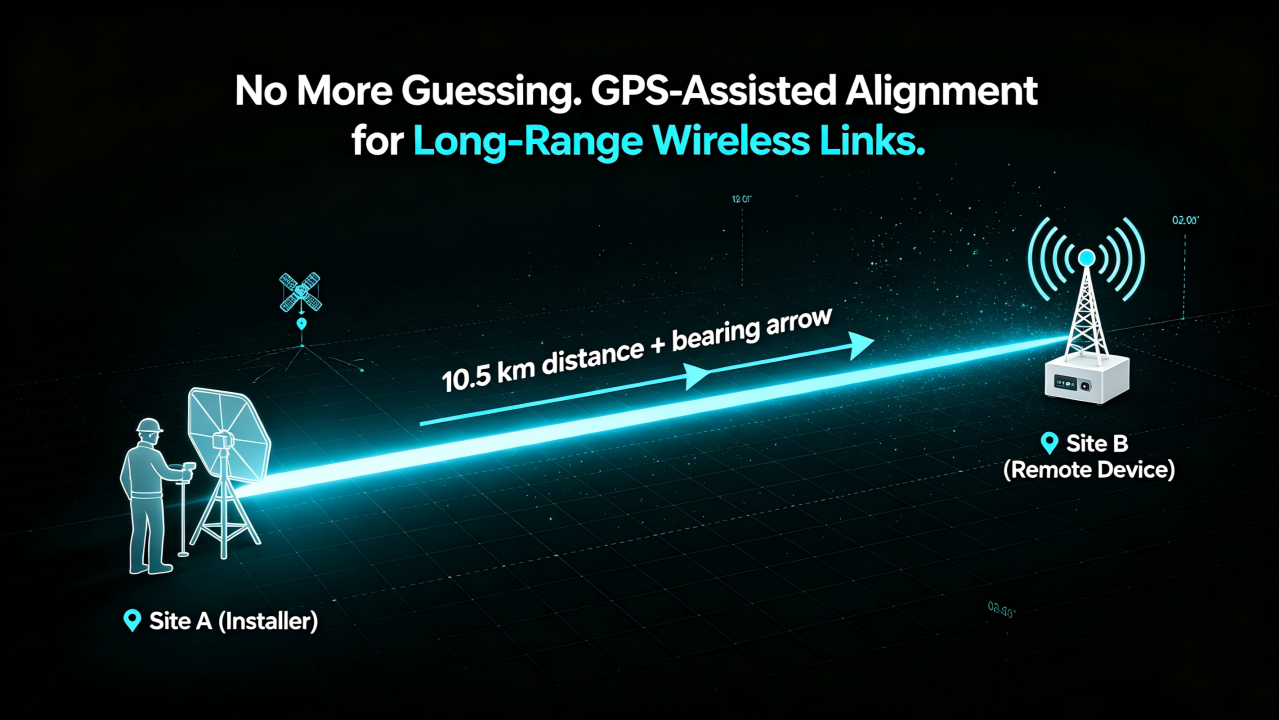
From GPS Location to Smart Alignment

Imagine this:

You install an AP at the local site.

After powering it on:

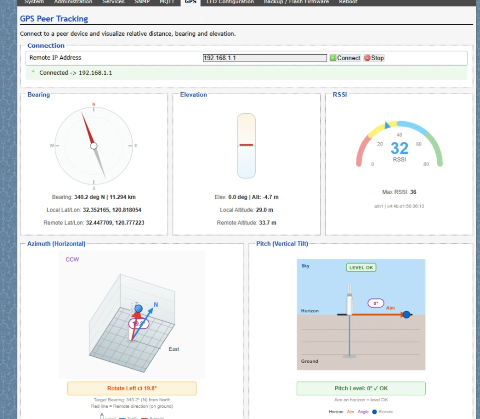
  1. The device automatically obtains its GPS coordinates.
  2. The remote site device shares its location information.
  3. The web interface calculates the optimal alignment direction.
  4. The system provides recommended:
  • Horizontal rotation angle (Azimuth)
  • Vertical tilt angle (Elevation)

Instead of asking:

“Which direction should I point this antenna?”

The system tells you:

“Rotate 127.5° horizontally and tilt 8.3° upward.”


Simplifying Long-Distance Wireless Deployment

For outdoor wireless networks, especially:

  • WISP networks
  • Rural broadband
  • Industrial campuses
  • Mining sites
  • Smart agriculture
  • Remote monitoring systems

deployment efficiency is critical.

GPS-assisted alignment can help engineers:

✅ Reduce installation time

✅ Minimize alignment errors

✅ Improve first-time connection success rate

✅ Simplify remote deployment and maintenance


How It Works

A GPS-enabled wireless platform combines:

1. Location Awareness

Each device knows its own:

  • Latitude
  • Longitude
  • Position information

2. Remote Device Coordination

The AP exchanges location data with the remote endpoint.

3. Direction Calculation

Based on two GPS points, the system calculates:

  • Distance between sites
  • Direction angle
  • Antenna pointing recommendation

4. Web-Based Guidance

Engineers can view the recommended installation angle directly through the device management interface.
Article content

No additional measurement tools required.


Designed for Next-Generation Outdoor Connectivity

524WiFi and Wallys have integrated GPS capability into selected industrial wireless platforms, including:

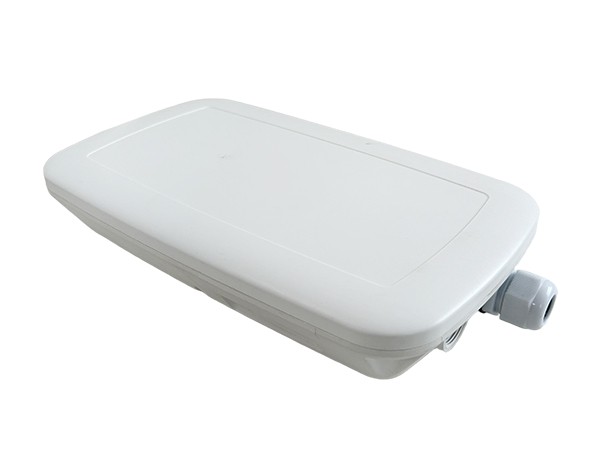
524WiFI WiFi 6 Long Range Kit

DRWAVE-1000 Built around Qualcomm IPQ5018 platform, designed for industrial networking applications requiring reliable wireless connectivity.
Article content

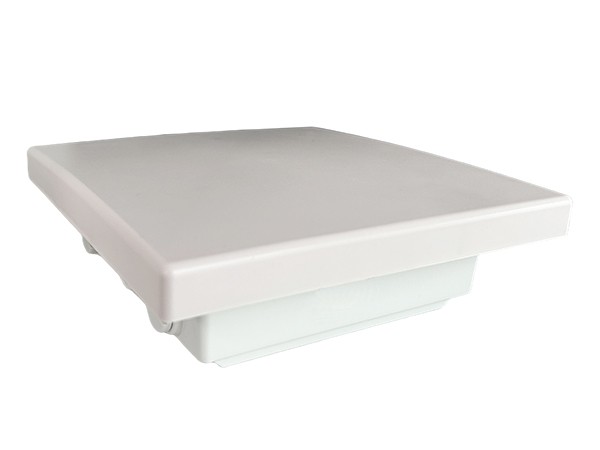
524WiFi WiFi 7 Long Range Kit

Powered by Qualcomm IPQ9574, supporting next-generation high-performance wireless applications.
Article content

With GPS integration, these platforms enable smarter deployment possibilities for long-range wireless networks.

Posted on

Physical AI Connectivity – AI Robots Don’t Run on AI Alone. They Run on Connectivity.

Every week, we see exciting breakthroughs in robotics.

Smarter vision models. Faster inference. More powerful edge AI hardware.

But when robots leave the lab and enter factories, warehouses, farms, or outdoor environments, something interesting happens.

The biggest challenge often isn’t AI.  It’s connectivity !

An autonomous robot may have enough computing power to understand its surroundings, but it still needs to:

  • Receive sensor data in real time
  • Stream video reliably
  • Exchange information with other robots
  • Connect to edge servers and cloud platforms
  • Roam seamlessly across large facilities without interruption

If the wireless network becomes unstable, even the most advanced AI model can’t perform as intended.

In real-world deployments, we’ve learned that customers rarely complain about TOPS or benchmark scores.

Instead, they ask questions like:

• Can the connection stay stable after days or weeks of continuous operation?

• Will roaming interrupt navigation?

• How does the network perform in environments with heavy RF interference?

• Can hundreds of devices operate simultaneously without impacting latency?

These are deployment questions—not benchmark questions.

As Physical AI continues to evolve, networking is no longer just supporting the system.

It is becoming part of the AI infrastructure itself.

The future of intelligent robots won’t be built by AI alone.

It will be built by the combination of:

  • AI Computing
  • Reliable Wireless Connectivity

⚡ Edge Networking

  • Seamless Mobility

The industry has spent years optimizing AI models.

Perhaps it’s time we give the same attention to the networks that keep those models connected.

AI may be the brain.  Connectivity is the nervous system.

I’d love to hear your perspective:

What has been the biggest networking challenge in your robotics or Edge AI deployments?

Posted on

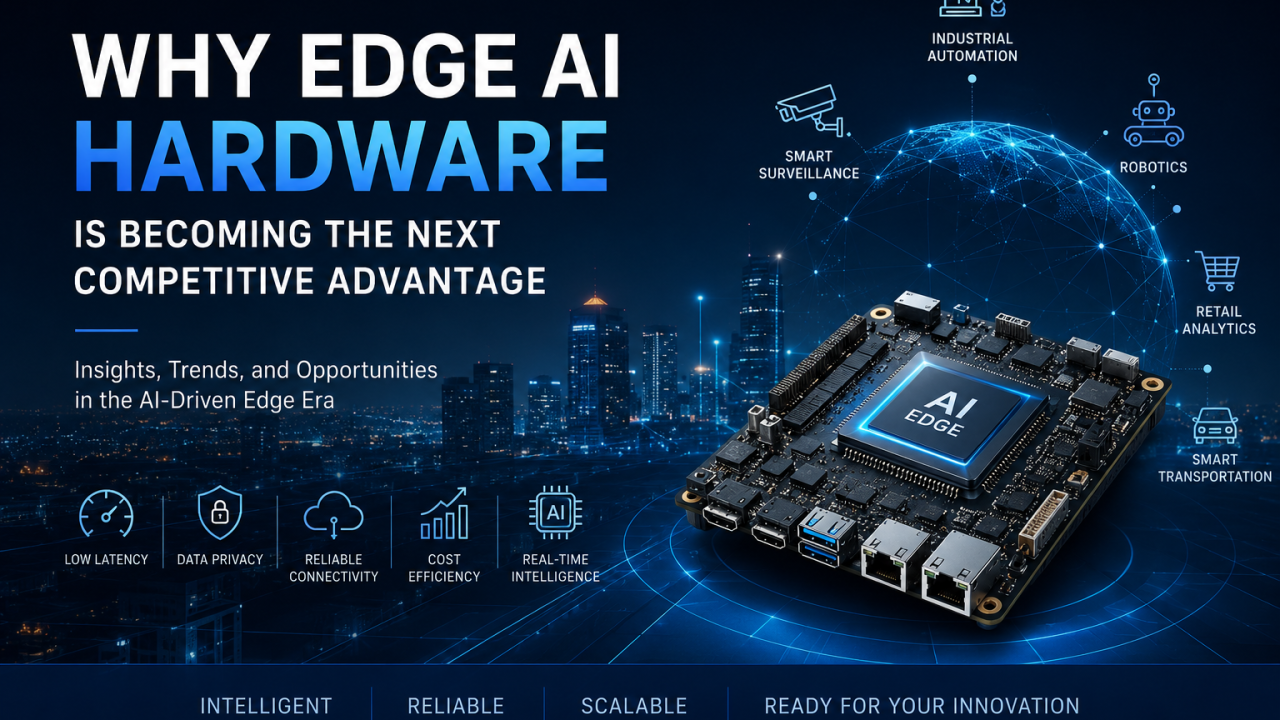
Why Edge AI Hardware Is Becoming the Next Competitive Advantage

Artificial Intelligence has evolved at an incredible pace over the past few years. From large language models to computer vision and predictive analytics, AI software has become increasingly powerful and accessible.

But as AI adoption accelerates, I’ve noticed a shift in conversations with customers and partners.

The discussion is no longer just about models.

It’s about deployment.

AI Doesn’t Create Value Until It Reaches the Edge

Training an AI model is only part of the journey. Real business value is created when AI runs where decisions need to be made—inside factories, warehouses, vehicles, retail stores, hospitals, and smart cities.

For many applications, relying entirely on cloud computing creates several challenges:

  • High latency
  • Expensive bandwidth
  • Privacy concerns
  • Unstable network connectivity
  • Ongoing cloud operating costs

This is why Edge AI has become one of the fastest-growing segments of the AI industry.

Processing data locally enables faster responses, better reliability, and greater control over sensitive information.

The New Bottleneck Isn’t Software

Five years ago, companies asked:

“Which AI framework should we use?”

Today they ask:

“Which hardware platform should we build on?”

Many AI startups have exceptional software teams, yet hardware development often delays commercialization.

Designing an embedded AI system involves far more than selecting a processor. Teams must address thermal management, power optimization, connectivity, storage, operating system support, long-term component availability, manufacturing, and certification.

For companies whose core strength lies in AI algorithms or industry expertise, developing custom hardware from scratch may not be the best use of resources.

Why OEM and ODM Partnerships Matter More Than Ever

Instead of reinventing the hardware platform, many companies are choosing to collaborate with experienced OEM and ODM manufacturers.

This approach allows engineering teams to focus on what truly differentiates their products:

  • AI applications
  • Software platforms
  • User experience
  • Industry-specific solutions

Meanwhile, hardware partners provide mature platforms that reduce development risk and shorten time-to-market.

In today’s competitive environment, launching six months earlier can be more valuable than achieving marginal improvements in hardware performance.

Flexibility Is Becoming More Important Than Raw Performance

The AI industry often focuses on TOPS, GPU cores, and benchmark scores.

While computing power certainly matters, customers increasingly ask different questions:

  • Can this platform be customized?
  • Does it support industrial environments?
  • Can wireless connectivity be added?
  • Is storage expandable?
  • Will the platform still be available in three years?
  • Can it scale from prototype to mass production?

These practical considerations often determine whether a product succeeds in the market.

Performance attracts attention.

Flexibility wins projects.

Looking Ahead

Edge AI is no longer an emerging trend—it is becoming the standard architecture for many intelligent devices.

Whether it’s machine vision, robotics, industrial automation, transportation, or smart retail, demand for reliable, customizable AI hardware continues to grow.

I believe the next wave of innovation won’t come solely from more powerful AI models.

It will come from making AI easier to deploy in real-world environments.

Companies that can combine intelligent software with reliable, scalable hardware will be best positioned to deliver practical AI solutions.

As someone working closely with Edge AI platforms, it’s exciting to see how quickly the industry is evolving.

I’m curious to hear your perspective.

What do you think will become the biggest challenge for Edge AI over the next five years—computing power, deployment, cost, or something else?

Let’s discuss.

Posted on

Chipset Comparison: IPQ5322 vs IPQ5424-What’s the Difference and Which One Fits Your Project?

DR5332S vs DR5424: What’s the Difference and Which One Fits Your Project?

As Wi-Fi 7 enters the spotlight of next-gen wireless connectivity, developers and OEMs are seeking powerful, cost-effective router boards to power AIoT, edge computing, mesh networking, and enterprise-grade gateways. At Wallys, we provide two flagship tri-band Wi-Fi 7 router boards: the DR5332S and the DR5424. While they share a common mission — delivering ultra-reliable, high-throughput connectivity — they are built on different SoC platforms and tailored for slightly different project needs.

Let’s break down the differences and help you decide which one is the right fit for your application.

1. Chipset Comparison: IPQ5322 vs IPQ5424

CPU Architecture: A53 vs A55

  • The IPQ5424 uses a Cortex-A55 @1.8GHz, which is newer, more efficient, and more powerful than the Cortex-A53 @1.5GHz in IPQ5332.
  • A55 supports out-of-order execution, making it significantly better for multitasking and edge workloads.

IPQ5424 offers superior computing performance, making it ideal for intensive processing and multitasking at the edge.

AI Acceleration

  • IPQ5424 benefits from its more capable CPU architecture and overall system bandwidth for smoother AI task handling.
Article content

If you’re considering router boards such as Wallys DR5332S (IPQ5332) or DR5424 (IPQ5424):

  • 🧩 DR5332S + IPQ5332: Great for budget-sensitive, compact, quick-to-market solutions
  • 🚀 DR5424 + IPQ5424: Built for edge intelligence, multi-client environments, and future-proof mesh deployments

🔍 DR5424 offers higher performance and better power efficiency at the same time the costs will be higher than DR5322S.

Article content

2. Wireless Capabilities (Tri-Band Wi-Fi 7)

Both boards support tri-band (2.4GHz + 5GHz + 6GHz) Wi-Fi 7, including:

  • Multi-Link Operation (MLO) for increased stability
  • 320MHz bandwidth support on 6GHz band
  • 4096-QAM for enhanced throughput
  • Onboard radio modules for space-saving and simplified integration

However, DR5424 has more headroom for advanced use cases involving concurrent client management, AI inference at the edge, or industrial-grade networking.

3. Use Case Suitability

💡 Recommendation:

  • Choose DR5332S if your project prioritizes cost, compactness, and moderate throughput.
  • Choose DR5424 if you need higher computing power, better future-proofing, and support for intensive applications like edge inference, video analytics, or high-density mesh.

4. Hardware Interface & Customization

Both boards offer:

  • 2.5G Ethernet
  • Multiple UART, I2C, SPI
  • M.2 / USB3.0 / GPIO
  • Support for OpenWRT SDK
  • Optional expansion for LTE/5G/Storage modules

Customization and ODM services are available for both platforms.

5. Pricing & Availability

Both models are available for sampling, with volume support for OEM/ODM integration. DR5332S is generally more affordable and available sooner for entry-level or mid-range products, while DR5424 is geared for premium products with long-term lifecycle planning.

📬 For pricing, datasheets, or demo kits, contact us at: 📧 info@524wifi dot net or com

🧠 Final Thoughts

Whether you’re building a smart city gateway, an industrial mesh router, or a next-gen enterprise AP, 524WiFi and Wallys’ Wi-Fi 7 router boards offer flexible, powerful foundations.

  • DR5332S → Cost-effective, compact, fast-to-market
  • DR5424 → High-performance, future-ready, edge-AI capable

Need help choosing or customizing for your unique application? 

Posted on

Robotics + Edge Computing: How WiFi 7 Enhances Data Transmission Efficiency

Introduction

The rapid advancements in robotics and edge computing have revolutionized industries such as manufacturing, healthcare, logistics, and smart cities. However, these innovations require ultra-fast, low-latency, and highly reliable wireless communication to function effectively. Enter WiFi 7 (802.11be)—the next-generation wireless standard that significantly improves data transmission efficiency, making it an ideal solution for robotics and edge computing applications.

Challenges in Robotics and Edge Computing Connectivity

Robotic systems and edge devices process vast amounts of data in real time, often in environments with high device density, dynamic movement, and complex networking needs. Some of the key connectivity challenges include:

  • High Bandwidth Demand – Robots generate and transmit high-resolution sensor data, video feeds, and AI computations, requiring ultra-fast wireless speeds.
  • Low Latency Requirement – Real-time control, decision-making, and autonomous navigation depend on millisecond-level latency.
  • Interference & Network Congestion – Industrial and urban environments are packed with multiple wireless devices, leading to potential signal interference and congestion.
  • Seamless Handover & Reliability – Mobile robots, drones, and AGVs (Automated Guided Vehicles) need consistent connectivity without dropouts when moving across different network zones.

How WiFi 7 Enhances Data Transmission Efficiency for Robotics & Edge Computing

1. Multi-Link Operation (MLO) for Lower Latency & Higher Reliability

WiFi 7 introduces Multi-Link Operation (MLO), allowing devices to simultaneously transmit and receive data over multiple frequency bands (2.4 GHz, 5 GHz, and 6 GHz). This enhances:

  • Lower latency by dynamically selecting the best path with minimal interference.
  • Increased reliability by enabling seamless switching between channels, preventing disruptions in robotic control systems.

2. Wider Channel Bandwidth (Up to 320 MHz) for Faster Data Transmission

WiFi 7 supports 320 MHz channel bandwidth (double that of WiFi 6), offering significantly higher data transfer speeds. For edge AI applications and real-time video analytics, this means:

  • Faster data exchange between robotic sensors and edge servers.
  • Reduced congestion in high-density environments such as smart factories or hospitals.

3. 4K QAM Modulation for Increased Data Throughput

WiFi 7 introduces 4096-QAM (4K QAM), compared to 1024-QAM in WiFi 6, boosting the amount of data transmitted per signal. This results in:

  • Up to 20% higher throughput, making it ideal for transmitting high-resolution images, LIDAR data, and AI-driven commands in real-time.
  • Improved efficiency for multi-robot coordination and cloud-edge communication.

4. Better Performance in Congested Environments

With features like Preamble Puncturing, WiFi 7 can efficiently utilize spectrum even in noisy environments, preventing bandwidth wastage. This is especially useful in:

  • Industrial automation, where multiple machines operate wirelessly.
  • Smart cities, where multiple sensors, cameras, and edge devices coexist.

5. Deterministic Latency for Time-Sensitive Operations

WiFi 7 introduces deterministic latency mechanisms, ensuring that time-sensitive robotic tasks are completed with predictable timing. This is crucial for:

  • Robotic surgery and medical robotics, where even slight delays can impact outcomes.
  • Autonomous vehicles and drone networks, where real-time decision-making is critical.

Real-World Applications of WiFi 7 in Robotics & Edge Computing

🔹 Smart Manufacturing

  • WiFi 7 enables real-time monitoring and control of robotic arms and AGVs in factories.
  • High-speed connectivity ensures seamless data exchange between sensors, AI models, and cloud platforms.

🔹 Healthcare & Medical Robotics

  • Enhances low-latency video streaming for remote robotic surgeries and AI-driven diagnostics.
  • Supports real-time data analytics in hospitals with multiple edge AI applications.

🔹 Autonomous Vehicles & Drones

  • WiFi 7’s high throughput and MLO allow faster V2X (Vehicle-to-Everything) communication for autonomous driving.
  • Drones used in agriculture, surveillance, and delivery services benefit from more reliable long-range communication.

Conclusion

WiFi 7 is a game-changer for robotics and edge computing, providing the necessary speed, reliability, and efficiency to support next-generation AI-driven applications. As industries adopt autonomous systems, real-time AI processing, and IoT, WiFi 7 will be at the core of ensuring seamless and intelligent connectivity.

Looking for a WiFi 7 hardware solution for your robotics or edge computing project? Contact us for industrial-grade WiFi 7 router boards, network cards, and custom solutions.