
Posted on

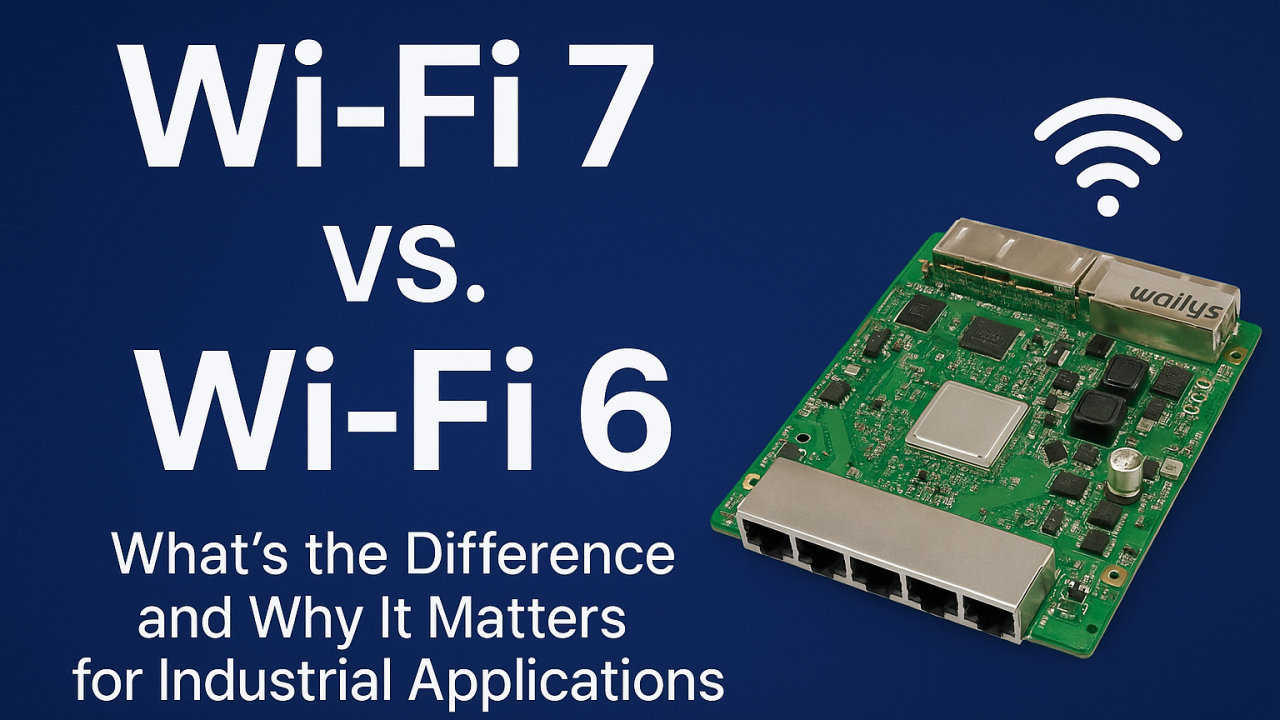
Wi-Fi 7 vs. Wi-Fi 6: What’s the Difference and Why It Matters for Industrial Applications?

As industrial environments become more automated, connected, and data-driven, the demand for a faster, more reliable wireless network continues to grow. Wi-Fi 6 has served industries well in recent years, but Wi-Fi 7 introduces features that fundamentally reshape performance, latency, and reliability—especially in mission-critical industrial applications.

Many factories, warehouses, and outdoor industrial sites are now evaluating whether upgrading to Wi-Fi 7 is worth it. The answer becomes clear once you understand the major improvements Wi-Fi 7 brings compared to Wi-Fi 6.


What’s New in Wi-Fi 7 Compared to Wi-Fi 6?

Wi-Fi 7 introduces several breakthroughs that directly benefit industrial environments:

Faster Speeds and Higher Throughput Wi-Fi 7 supports up to 320 MHz channels and 4K QAM, providing significantly higher bandwidth. This is especially beneficial for AI vision systems, 4K/8K video streams, and large volumes of sensor data in industrial scenarios.

Multi-Link Operation (MLO) This is the most important upgrade for industrial automation. MLO allows devices to connect to multiple Wi-Fi bands at the same time, dramatically enhancing:

  • Reliability
  • Latency
  • Roaming
  • Interference resistance

When one link experiences congestion or interference, data continues flowing through the other link—ideal for AGVs, AMRs, and robotic control systems.

Lower Latency for Real-Time Control Wi-Fi 7 reduces latency to sub-millisecond levels, enabling smoother machine-to-machine communication, PLC data exchange, and industrial robot coordination.

Better Performance in Noisy Industrial Environments Factories, ports, and warehouses contain many devices that create interference. Wi-Fi 7 handles these challenges through:

  • Intelligent multi-link scheduling
  • Faster channel switching
  • Improved OFDMA efficiency

This results in more stable wireless networks, even in heavily congested areas.


Why Wi-Fi 7 Matters for Industrial Applications

Enhanced Reliability for Smart Factories Real-time monitoring, predictive maintenance, and machine communication depend on uninterrupted connectivity. Wi-Fi 7 ensures stable links for sensors, controllers, and production lines.

Seamless Mobility for AGV and AMR Fleets Automated robots cannot afford Wi-Fi dead zones or packet loss. MLO supports smoother roaming, faster handovers, and high-precision navigation.

Better Edge Computing and AI Performance Industrial AI workloads often transmit large amounts of data for inference or analysis. Wi-Fi 7 accommodates high-throughput data without compromising stability.

Higher Density Support for IIoT Deployments Factories may have thousands of connected devices. Wi-Fi 7’s improved scheduling and wider channels support larger device ecosystems without congestion.

Strengthening Industrial Video Surveillance AI-enhanced cameras and real-time analytics benefit from Wi-Fi 7’s higher bitrate capacity and lower latency.


Real-World Industrial Use Cases for Wi-Fi 7

  • AGV/AMR navigation and fleet management
  • Smart logistics and warehouse management systems
  • Industrial video surveillance with AI analytics
  • Real-time sensor networks in smart factories
  • Wireless backhaul bridging for ports and outdoor sites
  • Edge computing devices with high data demands
  • Autonomous machines and robotics

Wi-Fi 7 enables smoother, safer, and more efficient industrial operations.


Why Choose 524WiFi and Wallys Wi-Fi 7 Routerboards?

We provide industrial-grade Wi-Fi 7 routerboards such as DR5322S (IPQ5322) and next-generation DR9574 (IPQ9574) that support:

  • Wi-Fi 7 + MLO
  • POE/POE Out
  • Long-distance transmission
  • Industrial temperature rating
  • Customizable hardware and firmware
  • Mesh & roaming solutions
  • OEM/ODM/JDM services for industry customers

Each board is optimized for harsh industrial deployment and supports custom configurations for automation, logistics, or edge computing projects.


Wi-Fi 7 is not just an incremental improvement over Wi-Fi 6—it’s a major leap designed for industries that require reliability, speed, and real-time responsiveness. For industrial automation companies planning future-proof networks, upgrading to Wi-Fi 7 can unlock significant performance and operational advantages.

For customized Wi-Fi 7 routerboards and industrial wireless solutions, contact us !

Posted on

QCN9274 vs QCN9024: Comparing the Speed and Efficiency of Qualcomm’s Best Wi-Fi Chipsets

As industrial networks grow more complex, the need for high-performance, efficient wireless connectivity becomes more critical. Qualcomm’s QCN9274 (Wi-Fi 7) and QCN9024 (Wi-Fi 6) are both top-tier chipsets that power industrial wireless solutions, but each is optimized for different needs. In this article, we’ll compare the QCN9274 and QCN9024, focusing on their speed, efficiency, and application suitability, to help you determine which chipset is best for your industrial Wi-Fi network.


Overview of QCN9274 and QCN9024

QCN9274 – The Power of Wi-Fi 7

The QCN9274 is Qualcomm’s latest offering featuring Wi-Fi 7 (802.11be). Wi-Fi 7 brings revolutionary improvements to speed, latency, and capacity compared to previous generations. With Wi-Fi 7, the QCN9274 is designed to handle extremely high-demand environments, making it the perfect choice for future-proofing large-scale industrial networks, AI and IoT applications, and high-bandwidth use cases.

Key Features of QCN9274:

  • Wi-Fi 7 (802.11be) Support: Provides ultra-fast speeds and advanced features like Multi-Link Operation (MLO) and Enhanced QAM (Quadrature Amplitude Modulation).
  • Data Rates up to 5.8Gbps: The QCN9274 supports significantly faster speeds than its predecessors, ideal for large data transfers and demanding applications.
  • Reduced Latency: With Wi-Fi 7, the QCN9274 is optimized for ultra-low latency, which is crucial for real-time industrial applications.
  • Higher Capacity: Enhanced support for more simultaneous connections without sacrificing performance.
  • Advanced Features: Includes MLO for simultaneous operation on multiple channels, reducing congestion and improving network reliability.
524WiFi Dream QCN9274 Modules

QCN9024 – The Reliability of Wi-Fi 6

The QCN9024, based on Wi-Fi 6 (802.11ax), delivers faster speeds and improved efficiency compared to previous Wi-Fi standards like Wi-Fi 5. It supports OFDMA (Orthogonal Frequency Division Multiple Access) and MU-MIMO (Multi-User, Multiple Input Multiple Output), which optimize the use of available spectrum, making it ideal for crowded environments with multiple connected devices. While Wi-Fi 6 doesn’t offer the same level of performance as Wi-Fi 7, the QCN9024 still provides excellent performance in most industrial settings.

Key Features of QCN9024:

  • Wi-Fi 6 (802.11ax) Support: Provides faster speeds and improved efficiency compared to Wi-Fi 5, though it lacks the advancements found in Wi-Fi 7.
  • Data Rates up to 2.4Gbps: Offers strong throughput for most industrial applications, though not as high as Wi-Fi 7.
  • Improved Efficiency: Supports OFDMA and MU-MIMO for better use of available bandwidth.
  • Good for High-Density Environments: While it doesn’t scale as well as Wi-Fi 7 in extremely dense environments, it still offers excellent performance in smaller to mid-sized applications.

Speed and Throughput Comparison

QCN9274: Unmatched Speed with Wi-Fi 7

The QCN9274 supports Wi-Fi 7, delivering data rates up to 5.8Gbps. This makes it ideal for high-demand applications such as 4K/8K video streaming, virtual reality (VR), augmented reality (AR), and large-scale industrial automation systems. The advanced capabilities of Wi-Fi 7, such as Multi-Link Operation (MLO), allow the chipset to utilize multiple channels simultaneously, improving throughput and reducing network congestion.

Wi-Fi 7 offers dramatic speed improvements over Wi-Fi 6, enabling faster data transfers, better device density handling, and the ability to operate seamlessly in congested environments.

DR9274 6G SPEED THOUGHPUT TEST

QCN9024: Excellent Wi-Fi 6 Performance

On the other hand, QCN9024 supports Wi-Fi 6, with data rates up to 2.4Gbps. While this is more than sufficient for many industrial applications, it doesn’t match the ultra-high speeds of Wi-Fi 7. Wi-Fi 6 excels in dense environments with many devices, offering improved network efficiency and reduced latency compared to older Wi-Fi standards like Wi-Fi 5.

However, for environments with extreme data throughput requirements, Wi-Fi 7 offers significant improvements in both speed and efficiency.

DR9074(QCN9074)-6E SPEED THOUGHPUT TEST

Efficiency and Capacity

QCN9274: Higher Efficiency for Dense, High-Traffic Environments

The QCN9274, supporting Wi-Fi 7, offers significantly higher capacity and better efficiency compared to Wi-Fi 6. With the help of MLO and Wider Channel Bandwidth, it can handle multiple data streams simultaneously, making it perfect for high-density environments. This is a critical feature in industrial networks, where many devices (IoT sensors, automated machines, etc.) need to operate concurrently.

Wi-Fi 7 is specifically designed for environments that require simultaneous handling of multiple high-bandwidth applications, ensuring that each device gets sufficient bandwidth without causing congestion.

QCN9024: Efficient but Less Scalable

The QCN9024, based on Wi-Fi 6, performs well in dense environments, but it has limitations when scaling up to larger networks. It does support OFDMA and MU-MIMO, which helps in efficient spectrum use and ensures that the network can handle more devices without slowing down. However, compared to Wi-Fi 7, Wi-Fi 6 does not have the same level of capacity or congestion mitigation.

While the QCN9024 is highly efficient in environments with moderate device density, Wi-Fi 6 has its limits in large-scale, high-density industrial deployments.


Latency and Real-Time Applications

QCN9274: Ultra-Low Latency with Wi-Fi 7

One of the key benefits of Wi-Fi 7 is its ultra-low latency, crucial for real-time applications in industrial environments. The QCN9274 is designed for instantaneous communication, which is essential for applications like real-time monitoring, automated systems, and video surveillance. Wi-Fi 7 improves upon Wi-Fi 6 with reduced delay and more predictable performance, even in busy environments.

QCN9024: Reliable but Slightly Higher Latency

The QCN9024, with its Wi-Fi 6 capabilities, also provides low latency, making it suitable for most industrial applications. However, when compared to Wi-Fi 7, the latency is slightly higher, especially in large-scale environments where many devices are connected simultaneously. This might be noticeable in highly time-sensitive applications.


Which Chipset is Right for Your Industrial Wi-Fi Network?

Choose QCN9274 if:

  • You need ultra-fast speeds and high data throughput for demanding applications.
  • Your industrial network requires low latency for real-time monitoring, automation, and control.
  • You have a large number of devices connected to the network and need a future-proof solution.
  • You want to take advantage of Wi-Fi 7‘s advanced features, such as MLO and wider channels for optimal performance in dense environments.

Choose QCN9024 if:

  • Your network has a moderate number of devices and Wi-Fi 6 is sufficient for your current needs.
  • You don’t need the latest Wi-Fi 7 features but still require high-speed connectivity for industrial applications.
  • You are looking for a reliable, cost-effective solution for environments that do not demand extreme speeds or massive scalability.

Conclusion

Both the QCN9274 and QCN9024 are excellent choices, but they cater to different needs. The QCN9274 with Wi-Fi 7 is ideal for high-performance, large-scale, and future-proof industrial networks, while the QCN9024 with Wi-Fi 6 is a great option for environments where Wi-Fi 6’s capabilities are more than adequate. Ultimately, the right choice depends on your network’s requirements—whether it’s speed, efficiency, capacity, or future scalability.

By selecting the right chipset, you can ensure your industrial Wi-Fi network delivers the performance, reliability, and efficiency required for success.

Posted on

Robotics + Edge Computing: How WiFi 7 Enhances Data Transmission Efficiency

Introduction

The rapid advancements in robotics and edge computing have revolutionized industries such as manufacturing, healthcare, logistics, and smart cities. However, these innovations require ultra-fast, low-latency, and highly reliable wireless communication to function effectively. Enter WiFi 7 (802.11be)—the next-generation wireless standard that significantly improves data transmission efficiency, making it an ideal solution for robotics and edge computing applications.

Challenges in Robotics and Edge Computing Connectivity

Robotic systems and edge devices process vast amounts of data in real time, often in environments with high device density, dynamic movement, and complex networking needs. Some of the key connectivity challenges include:

  • High Bandwidth Demand – Robots generate and transmit high-resolution sensor data, video feeds, and AI computations, requiring ultra-fast wireless speeds.
  • Low Latency Requirement – Real-time control, decision-making, and autonomous navigation depend on millisecond-level latency.
  • Interference & Network Congestion – Industrial and urban environments are packed with multiple wireless devices, leading to potential signal interference and congestion.
  • Seamless Handover & Reliability – Mobile robots, drones, and AGVs (Automated Guided Vehicles) need consistent connectivity without dropouts when moving across different network zones.

How WiFi 7 Enhances Data Transmission Efficiency for Robotics & Edge Computing

1. Multi-Link Operation (MLO) for Lower Latency & Higher Reliability

WiFi 7 introduces Multi-Link Operation (MLO), allowing devices to simultaneously transmit and receive data over multiple frequency bands (2.4 GHz, 5 GHz, and 6 GHz). This enhances:

  • Lower latency by dynamically selecting the best path with minimal interference.
  • Increased reliability by enabling seamless switching between channels, preventing disruptions in robotic control systems.

2. Wider Channel Bandwidth (Up to 320 MHz) for Faster Data Transmission

WiFi 7 supports 320 MHz channel bandwidth (double that of WiFi 6), offering significantly higher data transfer speeds. For edge AI applications and real-time video analytics, this means:

  • Faster data exchange between robotic sensors and edge servers.
  • Reduced congestion in high-density environments such as smart factories or hospitals.

3. 4K QAM Modulation for Increased Data Throughput

WiFi 7 introduces 4096-QAM (4K QAM), compared to 1024-QAM in WiFi 6, boosting the amount of data transmitted per signal. This results in:

  • Up to 20% higher throughput, making it ideal for transmitting high-resolution images, LIDAR data, and AI-driven commands in real-time.
  • Improved efficiency for multi-robot coordination and cloud-edge communication.

4. Better Performance in Congested Environments

With features like Preamble Puncturing, WiFi 7 can efficiently utilize spectrum even in noisy environments, preventing bandwidth wastage. This is especially useful in:

  • Industrial automation, where multiple machines operate wirelessly.
  • Smart cities, where multiple sensors, cameras, and edge devices coexist.

5. Deterministic Latency for Time-Sensitive Operations

WiFi 7 introduces deterministic latency mechanisms, ensuring that time-sensitive robotic tasks are completed with predictable timing. This is crucial for:

  • Robotic surgery and medical robotics, where even slight delays can impact outcomes.
  • Autonomous vehicles and drone networks, where real-time decision-making is critical.

Real-World Applications of WiFi 7 in Robotics & Edge Computing

🔹 Smart Manufacturing

  • WiFi 7 enables real-time monitoring and control of robotic arms and AGVs in factories.
  • High-speed connectivity ensures seamless data exchange between sensors, AI models, and cloud platforms.

🔹 Healthcare & Medical Robotics

  • Enhances low-latency video streaming for remote robotic surgeries and AI-driven diagnostics.
  • Supports real-time data analytics in hospitals with multiple edge AI applications.

🔹 Autonomous Vehicles & Drones

  • WiFi 7’s high throughput and MLO allow faster V2X (Vehicle-to-Everything) communication for autonomous driving.
  • Drones used in agriculture, surveillance, and delivery services benefit from more reliable long-range communication.

Conclusion

WiFi 7 is a game-changer for robotics and edge computing, providing the necessary speed, reliability, and efficiency to support next-generation AI-driven applications. As industries adopt autonomous systems, real-time AI processing, and IoT, WiFi 7 will be at the core of ensuring seamless and intelligent connectivity.

Looking for a WiFi 7 hardware solution for your robotics or edge computing project? Contact us for industrial-grade WiFi 7 router boards, network cards, and custom solutions.

Posted on

Speed, Efficiency, Security: IPQ5332 vs. IPQ6010 – Which One is Right for You?

As modern network technology continues to evolve, choosing the right WiFi solution is crucial for both businesses and individual users. Among many wireless chipsets, the IPQ5332 and IPQ6010 stand out as prominent choices. This article delves into a detailed comparison of these two chipsets to help you understand their advantages and suitable applications.

1. Performance Comparison

IPQ5332

  • Processor: The IPQ5332 features a Quad-Core ARM Cortex-A53 processor with a clock speed of 1.5 GHz. This “Miami” series processor offers excellent energy efficiency while providing stable performance.
  • Memory: It supports up to 2GB of DDR4 memory, ensuring fast data transmission and processing capabilities.
  • Network Standard: It supports the latest WiFi 7 standard, offering higher bandwidth and lower latency, ideal for future high-speed network demands.

IPQ6010

  • Processor: The IPQ6010 is powered by a Quad-core ARM 64-bit A53 processor with a clock speed of 1.8 GHz. With a higher clock speed compared to the IPQ5332, the IPQ6010 delivers stronger computing power.
  • Memory: It supports up to 1GB of DDR3 memory, which, while less than the IPQ5332, is still sufficient for most network applications.
  • Network Standard: It supports the WiFi 6 standard, providing high bandwidth and low latency suitable for current mainstream network needs.

2. Features and Capabilities

IPQ5332

  • High-Speed Connectivity: Supports up to 8 data streams, providing faster transmission speeds and wider coverage.
  • Advanced MIMO Technology: Supports 8×8 MU-MIMO, enhancing efficiency when multiple users access simultaneously.
  • Security: Built-in advanced security protocols, including WPA3, ensuring network security.
  • Expandability: Supports more interfaces and peripherals, suitable for various complex network topologies.

IPQ6010

  • Stable Connectivity: Supports 4 data streams, offering stable transmission speeds and coverage.
  • MIMO Technology: Supports 4×4 MU-MIMO, ideal for typical home and small office use.
  • Security: Supports WPA3 protocol, providing good security.
  • Cost-Effective: While providing basic functionality, it offers a higher cost-performance ratio, suitable for budget-conscious users.

3. Suitable Scenarios

IPQ5332

  • Enterprise Networks: Ideal for medium to large enterprises’ internal networks, capable of supporting many devices and providing efficient data transmission.
  • High-Density Environments: Suitable for venues like large conference centers, schools, hospitals, where many concurrent connections are needed.
  • Future Network Demands: Perfect for scenarios requiring support for future high-bandwidth applications, such as 4K/8K video streaming, virtual reality, etc.

IPQ6010

  • Home Networks: Perfect for home users, providing stable and fast WiFi coverage for daily internet needs.
  • Small Offices: Suitable for small business offices, supporting basic office network needs.
  • Budget-Conscious Users: For users with limited budgets, the IPQ6010 offers an economical solution with good performance.

Conclusion

The IPQ5332 and IPQ6010 each have distinct features and suitable applications. The IPQ5332, with its high-performance processor, advanced MIMO technology, and support for the latest WiFi standards, is ideal for users needing high-speed, large-scale network solutions. The IPQ6010, with its cost-effective nature and sufficient performance, is the perfect choice for home users and small businesses. When choosing, users should consider their specific needs and budget to determine the best solution.