Posted on

524WiFi™ Pulse B7-05: Wi-Fi 7 Platform for Custom Wireless Products

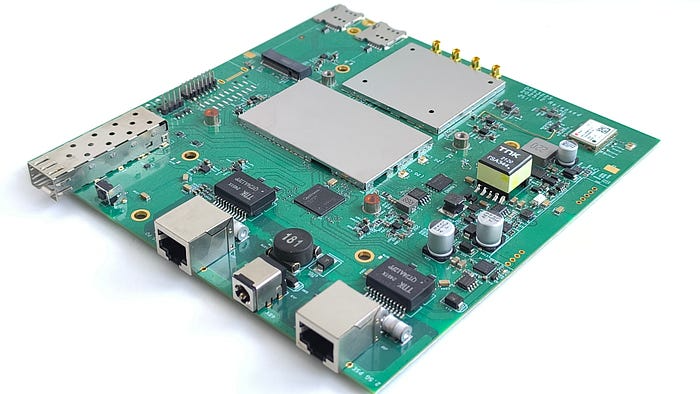
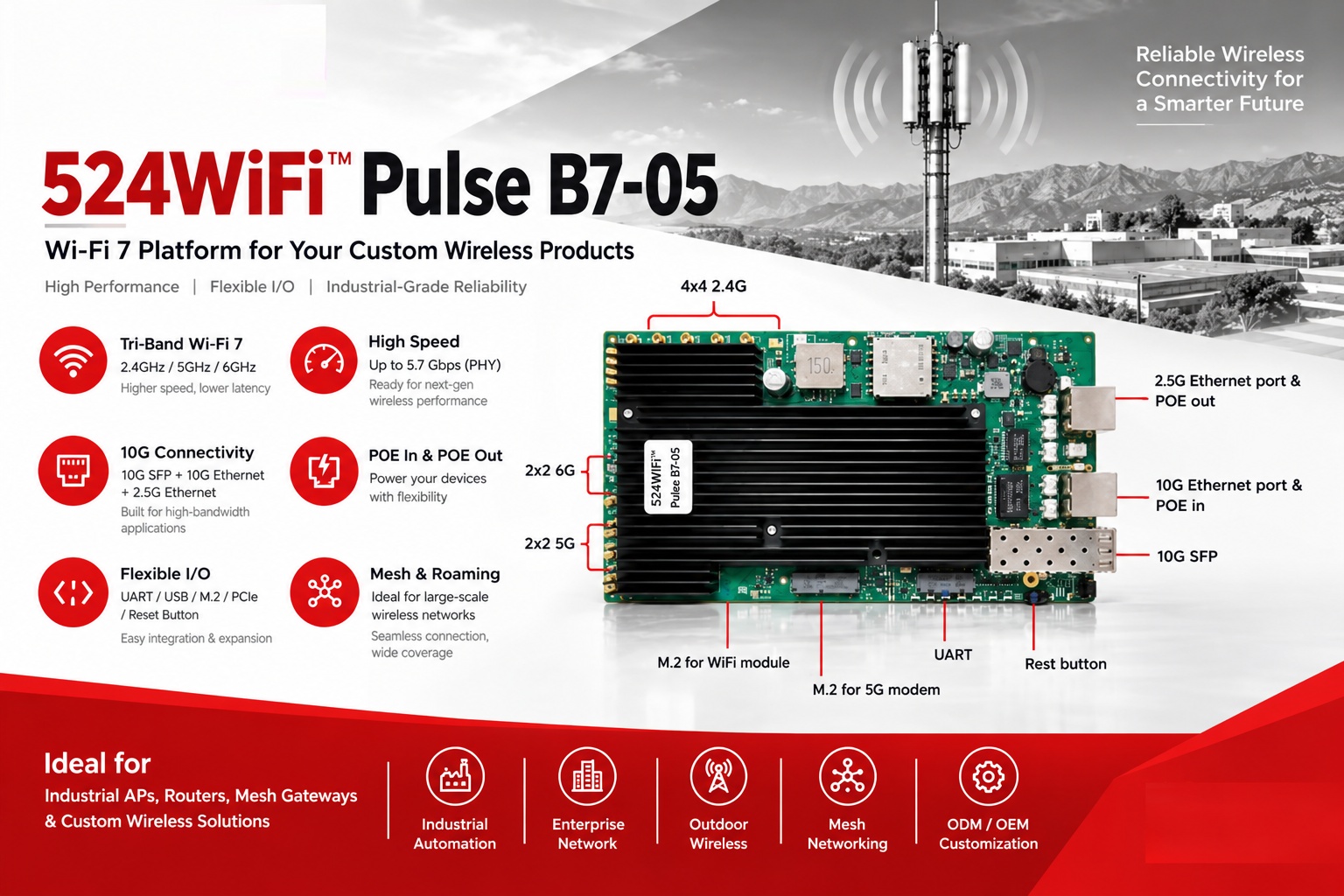
524WiFi™ Pulse B7-05 Wi-Fi 7 platform and hardware interfaces

524WiFi™ Pulse B7-05 is our tri-band (2.4/5/6GHz) Wi-Fi 7 platform for OEM/ODM projects, with 10G Ethernet, 10G SFP, and PoE in/out options on board.

It’s a good fit for:
→ Industrial APs
→ Enterprise routers
→ Mesh gateways
→ Outdoor wireless devices

We can help with hardware customization and software development, so you don’t have to build everything from scratch.

Have a project in mind? Let’s talk about whether 524WiFi™ Pulse B7-05 is the right fit – info at 524wifi.net or .com

Platform reference: DR5424S.

Posted on

Long-Range Drone Video & Control Links: Choosing Between DR5322, DR9574S, and DR5424

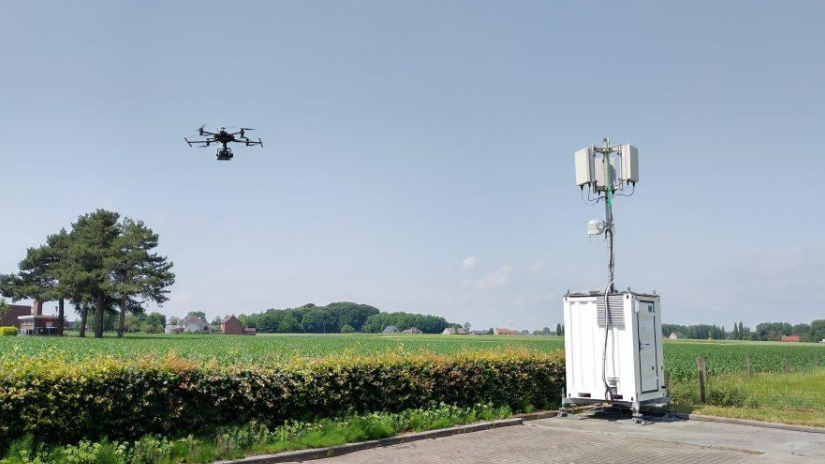
For agricultural, inspection, and mapping drones, the weakest link in the field is rarely the flight controller — it’s the wireless link. Video dropouts, control-command latency, and interference between multiple concurrent aircraft all directly affect operational efficiency and, in some cases, flight safety. Picking the right wireless hardware platform ultimately comes down to trade-offs between throughput, range, integration approach, and deployment environment.

524WiFi and Wallys currently offer three Qualcomm WiFi 7-based platforms that map to different drone video/control link scenarios: DR5322, DR9574S, and DR5424. Here’s how they differ, and which one fits which use case.

DR5322: Lightweight and modular, built for cost-sensitive edge nodes

The DR5322 is built on Qualcomm’s IPQ5322 (quad-core Cortex-A53 @1.5GHz) and is essentially a compact routerboard: onboard 2×2 2.4GHz radio, with 5GHz/6GHz handled through an add-on QCN9274/QCN6274 WiFi 7 module, reaching up to roughly 5764Mbps physical data rate. It offers 4x 2.5G Ethernet ports plus 1x 10G SFP, with 802.3bt PoE support.

This “onboard 2.4G + pluggable high-band module” architecture makes the DR5322 well suited as a relay node or video-transmission hub for a single small multirotor — where the priority is small footprint, low power, and controlled cost rather than maximum throughput. Think field-deployable relay boxes or vehicle-mounted repeaters.

DR9574S: The modular flagship, built for relay towers and multi-drone coordination

The DR9574S runs on Qualcomm’s IPQ9574 (quad-core ARM-A73 @2.2GHz) and is the most configurable of the three — six version options (2×2/4×4, 5G/6G/5-7G) let you tailor the band mix to the project. It supports OFDMA, MU-MIMO, and multi-link operation (MLO), with 10G SFP, 10G Ethernet with PoE, and 2 Gigabit ports, plus optional GPS. Industrial-grade design supports operation from -20°C to 70°C.

This configuration is a better fit for fixed base stations, relay towers, or scenarios that need to manage video/control links for multiple drones at once — for example, a large-scale agricultural operation running several spraying drones simultaneously, where the ground station needs to reliably carry multiple concurrent video and control streams.

DR5424: High-throughput tri-band, built for aggregating high-definition multi-stream video

The DR5424 is the most integrated of the three: Qualcomm IPQ5424 (quad-core Cortex-A55 @1.8GHz), full onboard tri-band WiFi 7 (4×4 MU-MIMO), 320MHz channel width, with theoretical physical data rates up to 1376Mbps on 2.4GHz, 8647Mbps on 5GHz, and 11530Mbps on 6GHz. It also carries the strongest port configuration of the three: 4x 2.5G plus 2x 10G Ethernet.

One important clarification: DR5424’s tri-band design is switchable, not concurrent — the three bands are there to be switched between as needed to avoid interference, not to simultaneously carry separate traffic types (e.g., control on one band, video on another, backhaul on a third). This distinction matters when evaluating a project’s actual concurrent multi-video-stream capacity.

With onboard tri-band radios and multiple high-speed Ethernet ports, the DR5424 is well suited as an aggregation gateway for high-definition, multi-channel video feeds — for example, when several aerial video streams need to be backhauled simultaneously to a ground station for real-time stitching or AI-based analysis.

Side-by-side comparison

DR5322 DR9574S DR5424 Chipset IPQ5322 (A53 @1.5GHz) IPQ9574 (A73 @2.2GHz) IPQ5424 (A55 @1.8GHz) Radio architecture Onboard 2.4G + pluggable 5/6G module Modular, 6 version options (2×2/4×4) Full onboard tri-band, 4×4 Max theoretical rate ~5764Mbps ~5765Mbps (per radio) ~11530Mbps (6GHz) Channel width — Up to 160MHz Up to 320MHz Ethernet 4x 2.5G + 1x 10G SFP 2x 1G + 1x 10G+PoE + 1x 10G SFP 4x 2.5G + 2x 10G GPS No Optional No Typical use case Lightweight relay node / cost-sensitive projects Fixed base station / multi-drone relay tower High-definition multi-stream aggregation gateway

Which one should you choose?

  • Budget-constrained projects that only need to support a single drone or a small number of video links — a lightweight relay node: go with DR5322.
  • Larger operational radius, managing multiple drones online at once, needing a fixed base station or relay tower: go with DR9574S, selecting the version that matches your band requirements.
  • Concurrent high-definition multi-stream video backhaul with high Ethernet aggregation bandwidth requirements, needing an edge gateway: go with DR5424.

All three platforms support OEM/ODM customization, including long-range transmission software tuning, antenna selection, and enclosure design. If you’re evaluating wireless hardware for a drone video/control link project, reach out to info at 524wifi.net or 524wifi.com for selection guidance or to request samples.

Posted on

Chipset Comparison: IPQ5322 vs IPQ5424-What’s the Difference and Which One Fits Your Project?

DR5332S vs DR5424: What’s the Difference and Which One Fits Your Project?

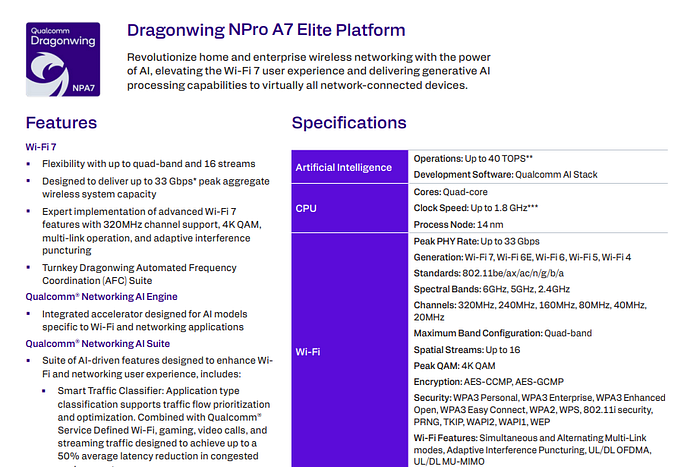
As Wi-Fi 7 enters the spotlight of next-gen wireless connectivity, developers and OEMs are seeking powerful, cost-effective router boards to power AIoT, edge computing, mesh networking, and enterprise-grade gateways. At Wallys, we provide two flagship tri-band Wi-Fi 7 router boards: the DR5332S and the DR5424. While they share a common mission — delivering ultra-reliable, high-throughput connectivity — they are built on different SoC platforms and tailored for slightly different project needs.

Let’s break down the differences and help you decide which one is the right fit for your application.

1. Chipset Comparison: IPQ5322 vs IPQ5424

CPU Architecture: A53 vs A55

  • The IPQ5424 uses a Cortex-A55 @1.8GHz, which is newer, more efficient, and more powerful than the Cortex-A53 @1.5GHz in IPQ5332.
  • A55 supports out-of-order execution, making it significantly better for multitasking and edge workloads.

IPQ5424 offers superior computing performance, making it ideal for intensive processing and multitasking at the edge.

AI Acceleration

  • IPQ5424 benefits from its more capable CPU architecture and overall system bandwidth for smoother AI task handling.
Article content

If you’re considering router boards such as Wallys DR5332S (IPQ5332) or DR5424 (IPQ5424):

  • 🧩 DR5332S + IPQ5332: Great for budget-sensitive, compact, quick-to-market solutions
  • 🚀 DR5424 + IPQ5424: Built for edge intelligence, multi-client environments, and future-proof mesh deployments

🔍 DR5424 offers higher performance and better power efficiency at the same time the costs will be higher than DR5322S.

Article content

2. Wireless Capabilities (Tri-Band Wi-Fi 7)

Both boards support tri-band (2.4GHz + 5GHz + 6GHz) Wi-Fi 7, including:

  • Multi-Link Operation (MLO) for increased stability
  • 320MHz bandwidth support on 6GHz band
  • 4096-QAM for enhanced throughput
  • Onboard radio modules for space-saving and simplified integration

However, DR5424 has more headroom for advanced use cases involving concurrent client management, AI inference at the edge, or industrial-grade networking.

3. Use Case Suitability

💡 Recommendation:

  • Choose DR5332S if your project prioritizes cost, compactness, and moderate throughput.
  • Choose DR5424 if you need higher computing power, better future-proofing, and support for intensive applications like edge inference, video analytics, or high-density mesh.

4. Hardware Interface & Customization

Both boards offer:

  • 2.5G Ethernet
  • Multiple UART, I2C, SPI
  • M.2 / USB3.0 / GPIO
  • Support for OpenWRT SDK
  • Optional expansion for LTE/5G/Storage modules

Customization and ODM services are available for both platforms.

5. Pricing & Availability

Both models are available for sampling, with volume support for OEM/ODM integration. DR5332S is generally more affordable and available sooner for entry-level or mid-range products, while DR5424 is geared for premium products with long-term lifecycle planning.

📬 For pricing, datasheets, or demo kits, contact us at: 📧 info@524wifi dot net or com

🧠 Final Thoughts

Whether you’re building a smart city gateway, an industrial mesh router, or a next-gen enterprise AP, 524WiFi and Wallys’ Wi-Fi 7 router boards offer flexible, powerful foundations.

  • DR5332S → Cost-effective, compact, fast-to-market
  • DR5424 → High-performance, future-ready, edge-AI capable

Need help choosing or customizing for your unique application? 

Posted on

IPQ5424 Sneak Peek: The Cost-Effective Path to WiFi 7 Starts Here

As WiFi 7 begins to reshape industrial and commercial networking, not every project requires the horsepower (or cost) of top-tier platforms like IPQ9574. That’s where Qualcomm’s IPQ5424 comes into play — offering a balanced, quad-core solution designed to bring the Marina family of chipsets to the mainstream market.

Wallys is excited to announce that IPQ5424-based router boards are in the pipeline, aiming to help developers and OEMs transition smoothly into WiFi 7 with a cost-effective and scalable solution.

🌟 Key Specs of IPQ5424 (Preview)

  • Processor: Quad-core ARM Cortex-A55 @ 1.8GHz
  • Target Use: SMB routers, industrial APs, mesh nodes
  • WiFi Support: 4×4 2.4GHz / 4×4 5GHz (potential MLO support)
  • Firmware: OpenWrt/QSDK support in progress
  • Memory Support: DDR4 up to 2GB
  • I/O: USB 3.0, PCIe Gen3, SGMII/USXGMII

This makes the IPQ5424 a strategic choice for:

  • Mid-tier WiFi 7 CPE development
  • Smart building and IoT gateway integration
  • Compact enterprise wireless solutions

🔗 Positioned Between Performance and Affordability

If you’re currently using platforms like IPQ5018 or IPQ6018, the IPQ5424 offers a smooth upgrade path — unlocking multi-gig capabilities without the power draw or cost of premium SoCs.

It also complements high-end modules like QCN9074 or QCN9024, allowing system integrators to build hybrid solutions: high-performance uplinks powered by QCN modules, with local routing managed by IPQ5424.

And of course, for users already deploying IPQ9574, the IPQ5424 can serve as a cost-optimized secondary node in distributed mesh or WiFi 7 extender environments.


📦 Stay Tuned: Wallys Upcoming IPQ5424-Based Board

We’re currently developing a new IPQ5424 router board, which will feature:

  • Industrial-grade stability
  • WiFi 7-ready MLO
  • Open SDK support
  • Flexible PCIe for WiFi modules like QCN9274 or QCN6274

👉 Want early access or technical previews? Contact us!


📌 Related 524WiFi and Wallys Products You Can Explore Now:

  • DR5018S – WiFi 6 router board with tcpdump support
  • DR9574 – High-performance WiFi 7 board based on IPQ9574
  • DR9274 – M.2 module based on QCN9274
  • DR8072A – Mature WiFi 6 AP based on IPQ8072
  • DR6018 – Cost-effective solution based on IPQ6018

Posted on

Powering the WiFi 7 Era: QCN9274 & QCN6274 Modules in Action

Powering the WiFi 7 Era: QCN9274 & QCN6274 Modules in Action

WiFi 7 isn’t just faster — it’s smarter, more efficient, and built for the future of connectivity. At the heart of this transformation are Qualcomm’s QCN9274 and QCN6274 WiFi 7 modules, engineered for high-throughput, low-latency wireless environments.

These modules are perfect for: ???? Industrial APs and high-density public deployments ???? Mesh systems requiring seamless roaming ???? Ultra-responsive applications like AR/VR, video streaming, and edge AI

???? Pair It with Wallys DR5322 (IPQ5322)

To bring these modules to life, 524WiFi offers the DR5322 router board, a powerhouse based on the IPQ5322 SoC, featuring:

  • ✅ 10G SFP port for fiber uplink
  • ✅ 1GB DDR4 (16-bit) RAM
  • ✅ Mini PCIe & M.2 slots for flexible wireless expansion
  • ✅ Perfectly compatible with QCN9274 / QCN6274 modules
  • ✅ Full support for OpenWrt/QSDK

???? Product details:  https://www.524wifi.com/index.php/catalogsearch/result/?q=5332


???? Coming Soon: IPQ5424 “Marina” Series

Wallys is preparing to release a new generation of boards based on Qualcomm’s IPQ5424 (Quad-core ARM A55 @1.8GHz) — codename Marina — offering enhanced processing power, optimized wireless efficiency, and designed with enterprise-level networking in mind.

Stay tuned for updates on our IPQ5424 platform launch!

Posted on

QCN9274 + IPQ9574: Leading WiFi 7, Watching IPQ5424

As industrial and enterprise wireless demand skyrockets, the need for extreme throughput, multi-link flexibility, and custom firmware capabilities has never been more critical. At the heart of this new era? Qualcomm’s flagship WiFi 7 combo: QCN9274 + IPQ9574.

But what if you could get WiFi 7 performance in a more compact, power-efficient design?

Introducing a sneak peek at the upcoming IPQ5424 — Qualcomm’s Quad-Core ARM Cortex-A55 SoC, clocked at 1.8GHz, and part of the Marina series. Wallys is actively prototyping boards based on this chip.


⚡ QCN9274 (DR9274): The WiFi 7 Gold Standard

  • Qualcomm WiFi 7 radio (successor to QCN9074)
  • 4096-QAM, 320 MHz channels
  • 4×4 MU-MIMO support
  • Ultra-fast 5/6GHz performance
  • Multi-Link Operation (MLO) ready
  • WPA3, DFS, and industrial-grade reliability

Paired with boards like the Wallys DR9574, it’s ideal for future-proof enterprise APs, smart logistics, and ultra-reliable long-range bridges.


🧠 IPQ9574: The Brains Behind Next-Gen Routing

  • High-performance quad-core ARM architecture
  • Native support for QCN9274 in tri-band setups
  • Integrated WiFi 6 radio for unified design
  • Designed for OpenWrt/QSDK 12+
  • Suitable for high-end router boards like DR9574

Perfect for OEMs building advanced gateways, CPEs, or edge routers — capable of handling gigabit WiFi + backhaul + edge computing in one.


👀 On the Radar: IPQ5424

Wallys is currently prototyping new boards based on the IPQ5424 “Marina” Series — a mid-tier SoC with:

  • Quad-core ARM Cortex-A55 @1.8GHz
  • Optimized for compact, efficient WiFi 7 deployments
  • Ideal for SMB routers, mesh APs, edge nodes

While IPQ9574 leads the pack, IPQ5424 fills the cost-performance gap — making WiFi 7 more accessible for scaled applications.


🔧 Compatible SoCs & Modules for QCN9274/QCN9024:

  • IPQ9574 — WiFi 7 flagship
  • IPQ8072/IPQ8074 — WiFi 6 platform
  • IPQ6010 — Mid-range WiFi 6
  • IPQ4019/IPQ4029 — Entry-level WiFi 5/6 bridges
  • Coming soon: DR5424 (IPQ5424-based board)

Wallys modules supporting these platforms include: DR9274–6E, DR9574, DR6018, and DR8074