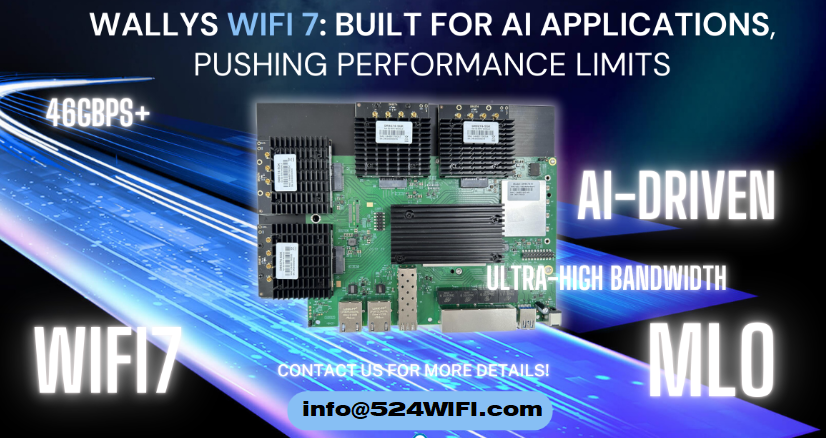
Posted on

Long-Range Drone Video & Control Links: Choosing Between DR5322, DR9574S, and DR5424

For agricultural, inspection, and mapping drones, the weakest link in the field is rarely the flight controller — it’s the wireless link. Video dropouts, control-command latency, and interference between multiple concurrent aircraft all directly affect operational efficiency and, in some cases, flight safety. Picking the right wireless hardware platform ultimately comes down to trade-offs between throughput, range, integration approach, and deployment environment.

524WiFi and Wallys currently offer three Qualcomm WiFi 7-based platforms that map to different drone video/control link scenarios: DR5322, DR9574S, and DR5424. Here’s how they differ, and which one fits which use case.

DR5322: Lightweight and modular, built for cost-sensitive edge nodes

The DR5322 is built on Qualcomm’s IPQ5322 (quad-core Cortex-A53 @1.5GHz) and is essentially a compact routerboard: onboard 2×2 2.4GHz radio, with 5GHz/6GHz handled through an add-on QCN9274/QCN6274 WiFi 7 module, reaching up to roughly 5764Mbps physical data rate. It offers 4x 2.5G Ethernet ports plus 1x 10G SFP, with 802.3bt PoE support.

This “onboard 2.4G + pluggable high-band module” architecture makes the DR5322 well suited as a relay node or video-transmission hub for a single small multirotor — where the priority is small footprint, low power, and controlled cost rather than maximum throughput. Think field-deployable relay boxes or vehicle-mounted repeaters.

DR9574S: The modular flagship, built for relay towers and multi-drone coordination

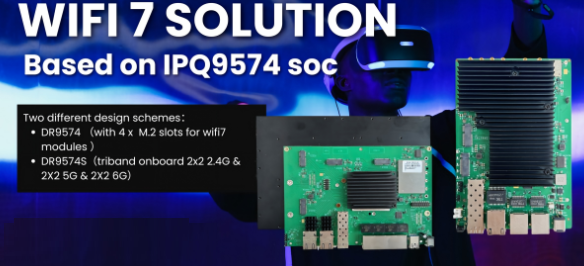
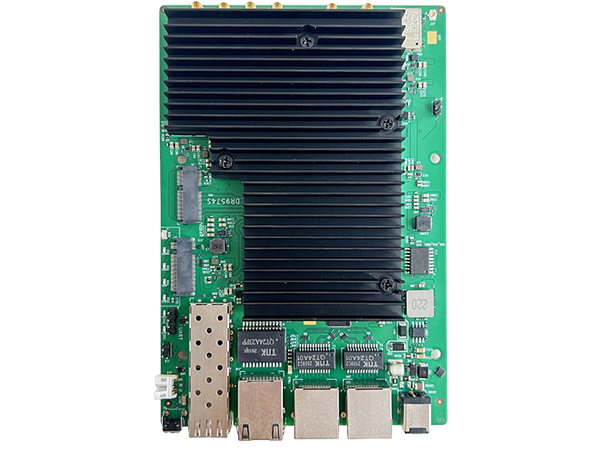
The DR9574S runs on Qualcomm’s IPQ9574 (quad-core ARM-A73 @2.2GHz) and is the most configurable of the three — six version options (2×2/4×4, 5G/6G/5-7G) let you tailor the band mix to the project. It supports OFDMA, MU-MIMO, and multi-link operation (MLO), with 10G SFP, 10G Ethernet with PoE, and 2 Gigabit ports, plus optional GPS. Industrial-grade design supports operation from -20°C to 70°C.

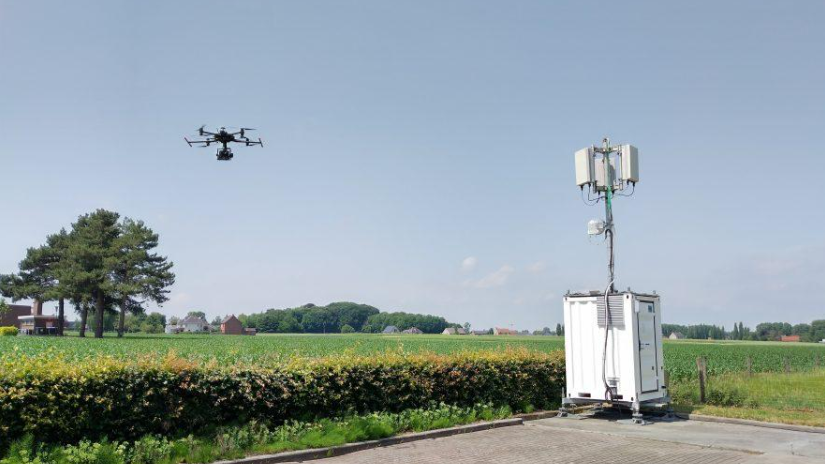
This configuration is a better fit for fixed base stations, relay towers, or scenarios that need to manage video/control links for multiple drones at once — for example, a large-scale agricultural operation running several spraying drones simultaneously, where the ground station needs to reliably carry multiple concurrent video and control streams.

DR5424: High-throughput tri-band, built for aggregating high-definition multi-stream video

The DR5424 is the most integrated of the three: Qualcomm IPQ5424 (quad-core Cortex-A55 @1.8GHz), full onboard tri-band WiFi 7 (4×4 MU-MIMO), 320MHz channel width, with theoretical physical data rates up to 1376Mbps on 2.4GHz, 8647Mbps on 5GHz, and 11530Mbps on 6GHz. It also carries the strongest port configuration of the three: 4x 2.5G plus 2x 10G Ethernet.

One important clarification: DR5424’s tri-band design is switchable, not concurrent — the three bands are there to be switched between as needed to avoid interference, not to simultaneously carry separate traffic types (e.g., control on one band, video on another, backhaul on a third). This distinction matters when evaluating a project’s actual concurrent multi-video-stream capacity.

With onboard tri-band radios and multiple high-speed Ethernet ports, the DR5424 is well suited as an aggregation gateway for high-definition, multi-channel video feeds — for example, when several aerial video streams need to be backhauled simultaneously to a ground station for real-time stitching or AI-based analysis.

Side-by-side comparison

DR5322 DR9574S DR5424 Chipset IPQ5322 (A53 @1.5GHz) IPQ9574 (A73 @2.2GHz) IPQ5424 (A55 @1.8GHz) Radio architecture Onboard 2.4G + pluggable 5/6G module Modular, 6 version options (2×2/4×4) Full onboard tri-band, 4×4 Max theoretical rate ~5764Mbps ~5765Mbps (per radio) ~11530Mbps (6GHz) Channel width — Up to 160MHz Up to 320MHz Ethernet 4x 2.5G + 1x 10G SFP 2x 1G + 1x 10G+PoE + 1x 10G SFP 4x 2.5G + 2x 10G GPS No Optional No Typical use case Lightweight relay node / cost-sensitive projects Fixed base station / multi-drone relay tower High-definition multi-stream aggregation gateway

Which one should you choose?

  • Budget-constrained projects that only need to support a single drone or a small number of video links — a lightweight relay node: go with DR5322.
  • Larger operational radius, managing multiple drones online at once, needing a fixed base station or relay tower: go with DR9574S, selecting the version that matches your band requirements.
  • Concurrent high-definition multi-stream video backhaul with high Ethernet aggregation bandwidth requirements, needing an edge gateway: go with DR5424.

All three platforms support OEM/ODM customization, including long-range transmission software tuning, antenna selection, and enclosure design. If you’re evaluating wireless hardware for a drone video/control link project, reach out to info at 524wifi.net or 524wifi.com for selection guidance or to request samples.
Posted on

DR9574S: Building WiFi 7 Industrial APs with Qualcomm IPQ9574

The next generation of industrial wireless networks is not only about faster WiFi speeds.

For industrial applications, wireless infrastructure needs to deliver:

  • High-capacity connectivity
  • Reliable performance under heavy traffic
  • Low-latency communication
  • Multi-device scalability
  • Long-term platform stability

This is where WiFi 7 is becoming a key technology for the future of industrial networking.

However, transforming WiFi 7 technology into a reliable industrial product requires more than just a powerful chipset.

It requires a complete hardware platform, optimized RF design, thermal management, and industrial deployment experience.

Introducing DR9574S — A WiFi 7 Industrial AP Platform Powered by Qualcomm IPQ9574

DR9574S is built around the Qualcomm IPQ9574 networking platform, designed for high-performance enterprise and industrial wireless applications.

With advanced WiFi 7 capabilities, DR9574S provides a strong foundation for customers developing:

  • Industrial access points
  • Enterprise WiFi systems
  • Smart factory networks
  • AI edge connectivity solutions
  • Outdoor wireless infrastructure
  • Customized OEM/ODM wireless products
Article content

WiFi7 DR9574S

Why WiFi 7 Matters for Industrial Networks

Traditional WiFi upgrades mainly focus on higher throughput.

WiFi 7 introduces several technologies that improve not only speed, but also network efficiency and reliability.

1. Multi-Link Operation (MLO)

MLO allows devices to use multiple wireless links simultaneously.

Benefits include:

  • Higher throughput
  • Better connection stability
  • Improved latency performance
  • More reliable wireless communication

For industrial environments with robots, cameras, sensors, and mobile devices, maintaining stable connectivity is often more important than peak speed.

2. 320MHz Channel Support

WiFi 7 doubles channel bandwidth compared with previous generations.

This enables:

  • Higher wireless capacity
  • Better support for high-bandwidth applications
  • More efficient network utilization

Applications such as industrial vision inspection, AI cameras, and real-time data transmission can benefit from this increased capacity.

3. 4096-QAM

Higher-order modulation improves data efficiency, allowing more data transmission within the same spectrum conditions.

This helps maximize wireless performance in modern high-density networks.


Built for Industrial Product Development

DR9574S is designed for companies that need a reliable WiFi 7 hardware foundation without starting from zero.

Wallys provides:

Hardware Platform

  • Qualcomm IPQ9574 platform
  • WiFi 7 architecture
  • High-performance CPU processing
  • Enterprise-level wireless capability
  • Flexible hardware customization

Development Support

Our engineering team supports:

  • Hardware customization
  • Antenna optimization
  • Thermal design
  • Firmware integration
  • OEM/ODM/JDM projects

Helping customers accelerate their product development cycle.


WiFi 7 + Industrial AI: The Next Connectivity Era

As AI moves from the cloud to the edge, wireless networks are becoming a critical infrastructure component.

Future applications such as:

  • Autonomous mobile robots (AMR)
  • Industrial automation
  • AI vision systems
  • Smart factories
  • Drones
  • Edge computing devices

will require wireless networks that are faster, more stable, and more intelligent.

WiFi 7 is not just an upgrade in speed.

It is becoming the foundation for next-generation industrial connectivity.


Build Your Next WiFi 7 Product with 524WiFi

Whether you are developing an industrial AP, enterprise wireless solution, or customized networking product, DR9574S provides a powerful Qualcomm-based platform to accelerate your innovation.

Contact 524WiFi to explore your next WiFi 7 project!

Posted on

Qualcomm IPQ9574 with MLO support, dual 10G Ethernet, wide temperature industrial design – DR9574 support QSDK and OpenWRT 3 band MLO

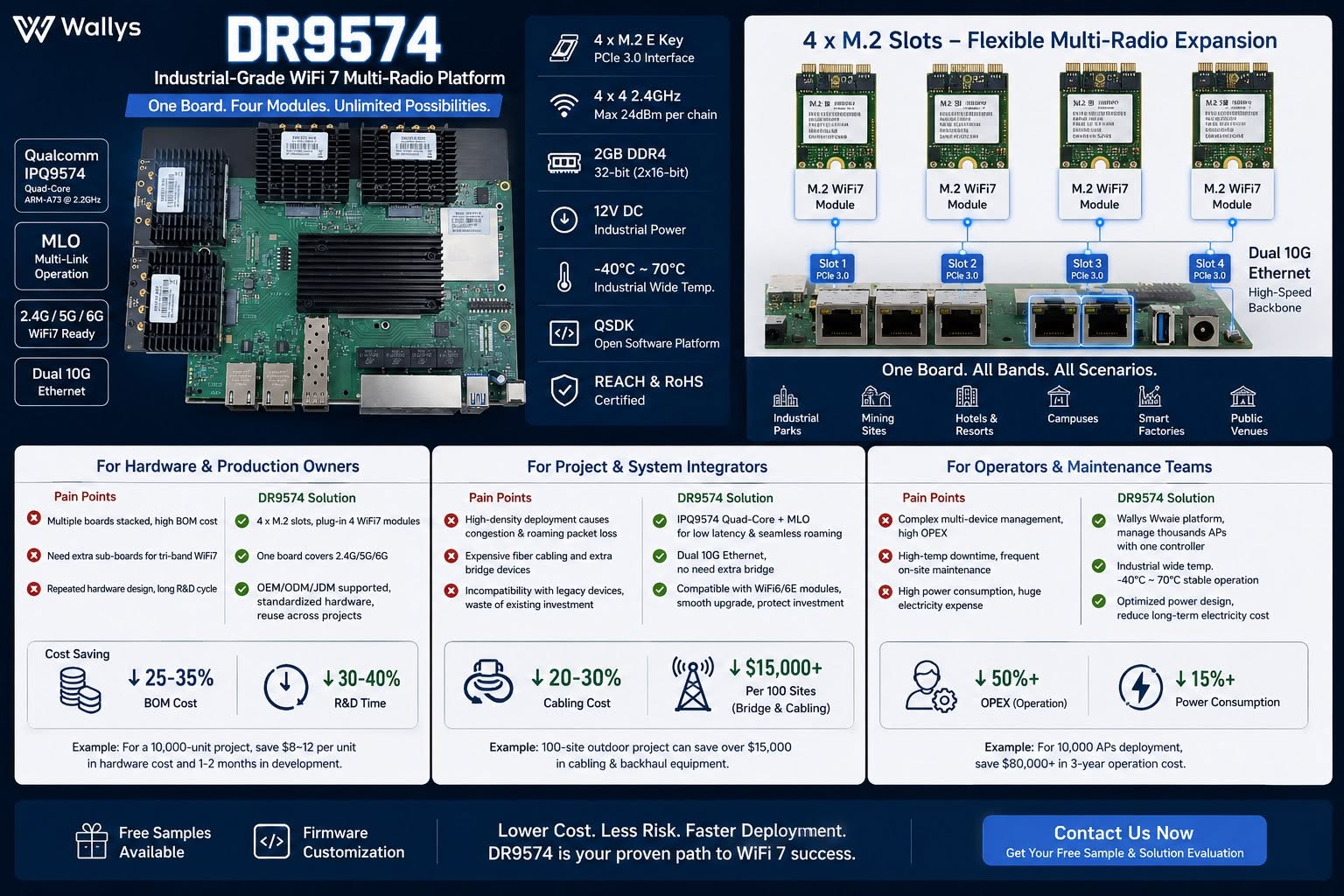
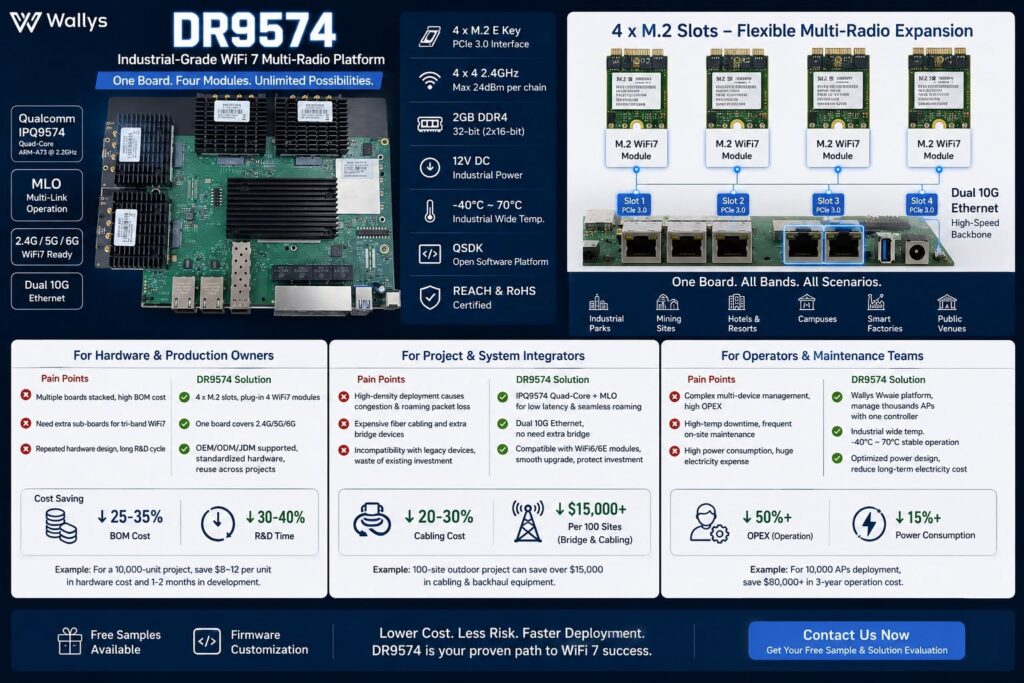
DR9574 Industrial WiFi7 Multi-Radio Board – One board, four M.2 radio modules, unlimited wireless deployment possibilities.

Built on Qualcomm IPQ9574 with MLO support, dual 10G Ethernet, wide temperature industrial design.

Lower BOM, less cabling cost, fewer maintenance workloads & power consumption for mass AP projects.

Ideal for system integrators, OEM hardware makers & wireless operators serving campuses, mining, smart factory & hospitality networks.

Testing samples & firmware customization available – DM to get your solution evaluation!

QSDK based firmware with QCA drivers is available , 3 card 3 band MLO support !! 4×4 MU MIMO or 2×2 MU MIMO configuration for 3 band MLO available.

https://wifi5.eu/dls/Wallys/DR9574

OpenWRT support available too !!

— working mainline OpenWrt port (10G + Wi-Fi 7 MLO)

Over the past few weeks we’ve brought the board up on a fully mainline stack — mainline Linux 6.12 + OpenWrt + ath12k, no QSDK and no out-of-tree datapath driver — and it now cold-boots from NAND into a working router/AP with both:

– 10G USXGMII ethernet (the AQR113C ports) bringing up a link and passing traffic with a DHCP lease, and
– a 3-link Wi-Fi 7 AP-MLD (one SSID across 6 / 5 / 2.4 GHz, WPA3-SAE) on mainline ath12k, with a real client associating and passing iperf traffic.

Getting the 10G working on mainline required root-causing and fixing an actual upstream kernel bug — a per-port clock that was left at the 10G rate regardless of the negotiated link speed. It’s a small, clean patch I’m preparing for the netdev mailing list, and it should help any IPQ95xx board with an Aquantia USXGMII PHY, not just this one.

Everything is public and reproducible here:
https://codeberg.org/insalata-fresca/openwrt-dr9574
(device tree, the patch set, and a write-up of the root cause.)

Why we think this could be interesting for you : a mainline-based firmware track means a current kernel with ongoing security fixes, an auditable, blob-minimal stack, and upstreamable patches — a strong story for customers who need long support windows, as a complement to the QSDK option.

W've pushed the mainline port further: the four 2.5G QCA8084 LAN ports are now the focus. The four copper PHYs come up and answer on mainline, and the 10G/USXGMII uplink and the 3-link Wi-Fi 7 MLO already work. But the 2.5G ports don't pass traffic yet,and I've traced it to one specific, well-understood gap.

In short: the QCA8084's internal XPCS never becomes reachable over MDIO. The chip's security-control config space (0xC90F000, which holds WORK_MODE and the SerDes/XPCS MDIO address fix-up) is readable but appears write-locked in our mainline bring-up. The driver writes the correct values (work mode 0x2f, XPCS MDIO address 7), but they don't take - so the XPCS stays at a default address, answers nowhere, and everything downstream (per-channel config, link, traffic) is blocked behind it. We are working on the final solution now.


The full write-up and the exact register evidence are on a public WIP page:

Status and the open question:
https://codeberg.org/insalata-fresca/openwrt-dr9574/src/branch/wip-qca8084-2p5g/docs/qca8084-2p5g-status.md

Register evidence (the actual readouts):
https://codeberg.org/insalata-fresca/openwrt-dr9574/src/branch/wip-qca8084-2p5g/docs/qca8084-2p5g-register-evidence.md

Repo root (device tree, 10G and Wi-Fi 7 patches):
https://codeberg.org/insalata-fresca/openwrt-dr9574

Posted on

From Wi-Fi 6 to Wi-Fi 7: Why IPQ9574 Sets a New Performance Benchmark

From IPQ8074 to IPQ9574: How Wi-Fi 7 Redefines Wireless Performance

As wireless networks evolve, the leap from Qualcomm’s IPQ8074 (Wi-Fi 6/6E) to the next-generation IPQ9574 (Wi-Fi 7) represents one of the most significant performance shifts in recent years. For industrial, enterprise, and high-density environments, this upgrade isn’t just incremental—it’s transformational. In this article, we break down what changes with Wi-Fi 7, why IPQ9574 is a major step forward, and how it unlocks new possibilities for advanced wireless solutions.


1. The Legacy of IPQ8074: A Strong Wi-Fi 6 Foundation

Qualcomm’s IPQ8074 helped establish Wi-Fi 6/6E in demanding applications by offering:

  • High throughput via 8×8 5 GHz + 4×4 2.4 GHz capabilities
  • OFDMA and MU-MIMO for better multi-user efficiency
  • Enhanced reliability through higher modulation and optimized scheduling
  • Support for 6 GHz (Wi-Fi 6E) in many deployments

This platform has been widely used in enterprise APs, outdoor CPEs, industrial gateways, and operator-grade devices. But growing demand for ultra-low latency, multi-link performance, and higher spectrum efficiency set the stage for the next leap: Wi-Fi 7.


2. Enter IPQ9574: Qualcomm’s Wi-Fi 7 Powerhouse

The IPQ9574 brings a new architecture, improved RF design, and cutting-edge Wi-Fi 7 features. Key upgrades include:

✔ 320 MHz Channel Support

Wi-Fi 7 doubles the maximum channel width from 160 MHz (Wi-Fi 6) to 320 MHz, enabling much higher peak throughput.

✔ Multi-Link Operation (MLO)

One of the biggest breakthroughs:

  • Devices can simultaneously use multiple bands
  • Improved reliability, near-zero latency, and seamless failover
  • Ideal for industrial and mission-critical networks

✔ Higher Modulation: 4096-QAM

Compared to IPQ8074’s 1024-QAM, Wi-Fi 7 pushes spectral efficiency even further.

✔ Enhanced OFDMA & Preamble Puncturing

Better resource allocation in congested spectrum environments.

✔ Multi-RU Capability

More flexible scheduling across users and channels.


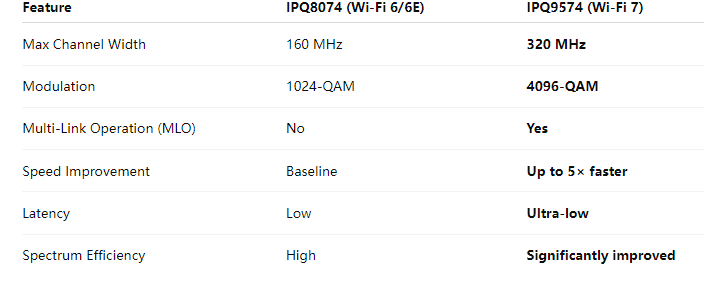
3. Performance Comparison: IPQ8074 vs IPQ9574

Article content

The IPQ9574 isn’t just faster—it is more stable, adaptive, and efficient, especially in congested or industrial environments.


4. Real-World Impact: Why the Upgrade Matters

✔ Industrial IoT

  • Stable multi-link communication
  • Reduced packet loss in noisy RF environments
  • Higher throughput for camera streams, sensors, and gateway devices

✔ Enterprise and Public Networks

  • Better performance in stadiums, airports, shopping malls
  • Improved roaming and handoff with MLO

✔ Outdoor Wireless & WISP

  • Stronger long-range performance
  • Less interference due to flexible spectrum use

✔ AI, Edge Computing & Real-Time Apps

  • Consistent high-speed connection
  • Enabling latency-sensitive applications such as robotics and AR/VR

5. Hardware Evolution: DR8074 → DR9574

As the chipset evolves, so do high-performance hardware platforms. Our DR9574 brings the full power of the IPQ9574 Wi-Fi 7 SoC into a production-ready board designed for:

  • 2× 10G Ethernet + 4× 1G Ethernet
  • 4× M.2 slots for QCN9274/6274 Wi-Fi 7 radios
  • Industrial-grade operation
  • High-power RF design for long-range wireless
  • Customizable firmware and OpenWrt/QSDK support

It is an ideal upgrade path for users currently deploying DR8074/IPQ8074 platforms but looking to move into Wi-Fi 7 performance levels.


6. Conclusion: Wi-Fi 7 Redefines What’s Possible

The transition from IPQ8074 to IPQ9574 is more than a chipset upgrade—it is a shift to a new era of wireless networking:

  • Faster speeds
  • Lower latency
  • Higher reliability
  • Better performance in crowded environments
  • New capabilities through MLO and 320 MHz channels

For industrial, enterprise, and high-density deployments, adopting Wi-Fi 7 solutions such as the IPQ9574-based DR9574 creates a stronger, more scalable wireless infrastructure ready for the future.

Posted on

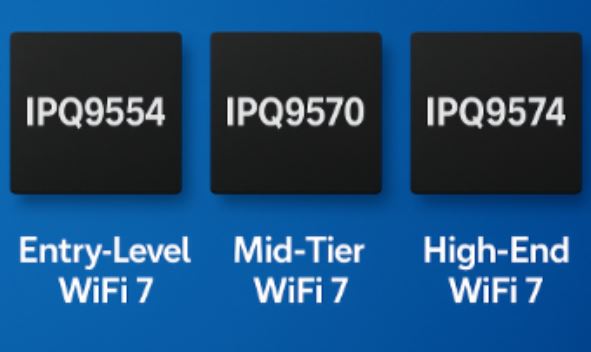
Qualcomm WiFi 7 Platforms Explained: IPQ9554, IPQ9570, and IPQ9574

WiFi 7 (802.11be) is the latest generation of wireless technology, designed to deliver unprecedented throughput, ultra-low latency, and improved reliability for both consumer and industrial applications. Qualcomm, as a leader in wireless innovation, has introduced several system-on-chip (SoC) platforms to power WiFi 7 devices—among them the IPQ9554, IPQ9570, and IPQ9574.

Though they all share the same WiFi 7 foundation, these three platforms are designed for different performance tiers and deployment scenarios.


1. Qualcomm IPQ9554 – Entry-Level WiFi 7 Platform

The IPQ9554 is positioned as an entry WiFi 7 solution, balancing performance and efficiency. It is suitable for devices that require reliable WiFi 7 functionality without the complexity of high-end designs.

Key Technical Points:

  • Supports Multi-Link Operation (MLO) and 4K QAM
  • Optimized for cost-effective and thermally efficient designs
  • Good fit for mainstream routers, small enterprise APs, and IoT gateways

2. Qualcomm IPQ9570 – Mid-Tier WiFi 7 Platform

The IPQ9570 is a step up from IPQ9554, offering stronger processing capabilities and enhanced wireless capacity. It is intended for environments with heavier traffic and multiple concurrent connections.

Key Technical Points:

  • Higher throughput and concurrency handling compared to IPQ9554
  • Designed for mesh networks and enterprise-grade deployments
  • Supports advanced WiFi 7 features such as enhanced MU-MIMO
  • Balanced between performance and power efficiency

3. Qualcomm IPQ9574 – High-End WiFi 7 Flagship

The IPQ9574 represents Qualcomm’s flagship WiFi 7 solution, designed for maximum performance in carrier-grade, enterprise, and industrial networks.

Key Technical Points:

  • Full WiFi 7 feature set: 320 MHz channels, MLO, 4K QAM, advanced MU-MIMO
  • High-capacity design for dense user environments
  • Optimized thermal management for sustained heavy workloads
  • Supports scalability in large enterprise networks, ISPs, and industrial deployments

4. Technical Comparison

Feature IPQ9554 IPQ9570 IPQ9574 Performance Tier Entry-Level Mid-Tier High-End Flagship WiFi 7 Support MLO, 4K QAMMLO, enhanced MU-MIMO Full WiFi 7 suite (MLO, 320 MHz, advanced MU-MIMO) Throughput Good Strong Excellent, highest Use Case SMB routers, small APsMesh, enterprise, industrialCarrier, enterprise, high-density deployments


5. Conclusion

Qualcomm’s WiFi 7 platforms are designed to cover the entire spectrum of networking needs:

  • IPQ9554 → A balanced entry for cost-sensitive designs.
  • IPQ9570 → A mid-tier option for enterprise and automation.
  • IPQ9574 → A flagship platform for maximum throughput and scalability.

By offering these three tiers, Qualcomm ensures that WiFi 7 technology can be applied across consumer, enterprise, and industrial networks, depending on performance and cost requirements.

Posted on

IPQ8072 vs IPQ9574: Why Upgrade to Wi-Fi 7 for Your Next Wireless Project

The Qualcomm IPQ8072 has long been a reliable choice for Wi-Fi 6 networking hardware. Many enterprise routers, carrier CPEs, and industrial access points are still powered by IPQ8072 due to its strong balance of cost and performance. However, with the rapid evolution of Wi-Fi 7 (802.11be), the Qualcomm IPQ9574 offers significant technical advantages that make it the logical upgrade path for next-generation solutions.

In this article, we compare IPQ8072 vs IPQ9574, highlighting the major differences and why developers should consider migrating to Wi-Fi 7 hardware.


Overview of IPQ8072 (Wi-Fi 6 SoC)

The Qualcomm IPQ8072 is part of the IPQ807x family, designed for Wi-Fi 6. It features:

  • Quad-core ARM Cortex-A53 processor
  • 8×8 MU-MIMO capability
  • Up to 160 MHz channel bandwidth
  • 1024-QAM modulation
  • Robust support for enterprise and carrier-grade networking

While still capable, the IPQ8072 has reached maturity, and limitations in throughput and latency become noticeable in demanding applications.


Overview of IPQ9574 (Wi-Fi 7 SoC)

The Qualcomm IPQ9574 represents the new generation of Wi-Fi 7 platforms, optimized for ultra-high throughput and low latency. Key features include:

  • Enhanced multi-core CPU architecture for higher processing power
  • 320 MHz channel bandwidth (double that of IPQ8072)
  • 4096-QAM modulation for higher spectral efficiency
  • Support for Multi-Link Operation (MLO)
  • Designed for advanced enterprise, industrial, and carrier networks

This makes IPQ9574 ideal for data-heavy applications such as 8K video streaming, AR/VR, industrial IoT, and low-latency control systems.


IPQ8072 vs IPQ9574 Technical Comparison

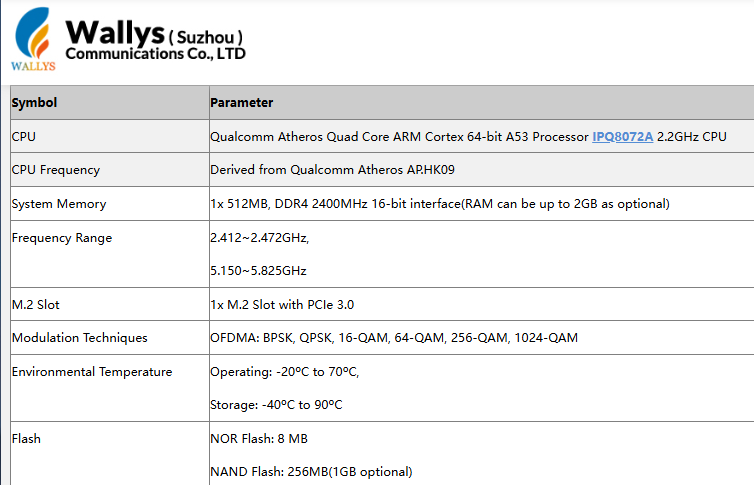
The Qualcomm IPQ8072 is a Wi-Fi 6 (802.11ax) SoC built with a quad-core Cortex-A53 processor. It supports channel bandwidths of up to 160 MHz and uses 1024-QAM modulation, making it a strong choice for enterprise routers, carrier CPE, and industrial APs.

Article content
Data from Wallys DR8072 Webpage

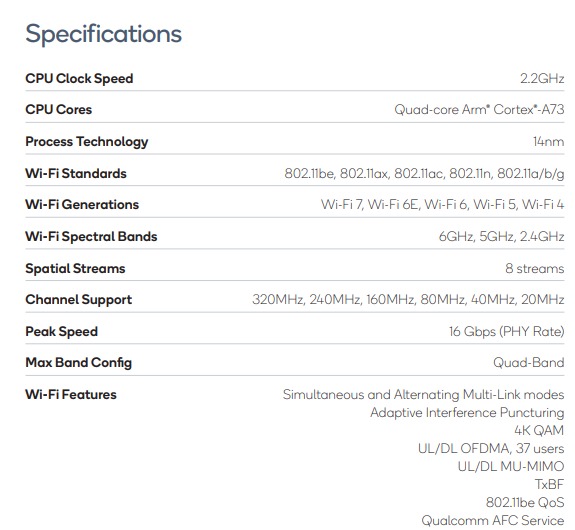
By contrast, the Qualcomm IPQ9574 belongs to the Wi-Fi 7 (802.11be) generation. It features a more advanced multi-core CPU architecture, supports 320 MHz channel bandwidth (double that of IPQ8072), and enables 4096-QAM modulation for higher spectral efficiency. Unlike IPQ8072, it also supports Multi-Link Operation (MLO), a Wi-Fi 7 feature that allows simultaneous use of multiple frequency bands to reduce latency and improve stability. These enhancements make IPQ9574 ideal for next-generation enterprise networks, industrial IoT deployments, low-latency applications, and high-density environments.

Article content
Data from Qualcomm IPQ9574 Datasheet

Why Upgrade from IPQ8072 to IPQ9574?

  1. Performance Leap – Wi-Fi 7 doubles available channel bandwidth and introduces 4096-QAM for significantly higher throughput.
  2. Ultra-Low Latency – MLO ensures faster and more reliable connectivity, critical for real-time applications.
  3. Future-Proofing – As Wi-Fi 6 hardware reaches end of lifecycle, Wi-Fi 7 ensures long-term product competitiveness.
  4. Scalability – IPQ9574’s stronger CPU supports more devices, traffic, and complex networking tasks.

524WiFi and Wallys’ IPQ9574 Router Board Solution

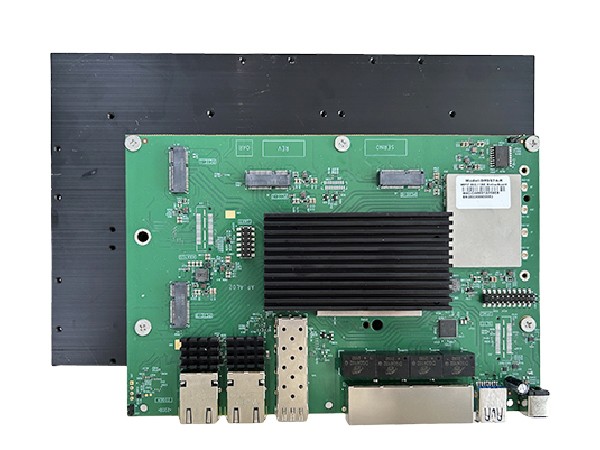
At 524WiFi, we provide hardware solutions based on Qualcomm IPQ9574, including the DR9574 Router Board, designed for Wi-Fi 7 networks. With strong processing power, advanced wireless features, and industrial-grade reliability, it is the perfect upgrade path for developers currently using IPQ8072-based designs.

Frequently Asked Questions (FAQ)

1. Is IPQ8072 still good in 2025?

Yes. The Qualcomm IPQ8072 is still a stable and cost-effective Wi-Fi 6 chipset, suitable for enterprise routers and industrial APs. However, for new projects that require higher throughput, lower latency, and longer product lifecycle, Wi-Fi 7 chipsets such as IPQ9574 are strongly recommended.

Article content
DR9574 board

2. What is the difference between IPQ8072 and IPQ9574?

The IPQ8072 is a Wi-Fi 6 (802.11ax) SoC, supporting up to 160 MHz bandwidth and 1024-QAM. The IPQ9574 is a Wi-Fi 7 (802.11be) SoC with 320 MHz bandwidth, 4096-QAM, and Multi-Link Operation (MLO), enabling much higher throughput and lower latency.

3. Why upgrade from Wi-Fi 6 to Wi-Fi 7?

Upgrading to Wi-Fi 7 provides faster data rates, reduced latency, and better efficiency in high-density environments. For applications such as AR/VR, 8K streaming, and industrial automation, Wi-Fi 7 ensures future-proof performance and competitiveness.

4. Does 524WiFi provide IPQ9574-based solutions?

Yes. 524WiFi and Wallys Communications offer router boards and network modules based on Qualcomm IPQ9574, including the DR9574 Router Board. These solutions are designed for enterprise, carrier, and industrial use cases that demand next-generation Wi-Fi 7 performance.

Posted on

Wi-Fi 7 for AIoT: How IPQ9574 and QCN9274 Enable Real-Time Edge AI

When we talk about Wi-Fi 7 (802.11be), most discussions focus on its impressive speed upgrades — and rightly so. But beneath the surface, Wi-Fi 7 is quietly becoming a critical enabler for Artificial Intelligence (AI) and AIoT (Artificial Intelligence of Things). It’s not just about faster wireless — it’s about making intelligent devices truly efficient, real-time, and scalable.

🚀 What Makes Wi-Fi 7 Different?

Wi-Fi 7 introduces groundbreaking features like:

  • Multi-Link Operation (MLO) — enabling devices to connect across multiple bands simultaneously, improving reliability and reducing latency.
  • Higher throughput — supporting up to 46 Gbps, ideal for high-data AI workloads.
  • Lower latency — essential for real-time AI inference.
  • Improved concurrency — allowing more smart devices to communicate simultaneously without congestion.

These capabilities make Wi-Fi 7 a natural fit for the AI revolution — both in the cloud and at the edge.


🧠 AI + Wi-Fi 7: A Perfect Match

1. Faster Real-Time Inference at the Edge

Edge AI devices like smart cameras, traffic sensors, or inspection drones require:

  • Constant data streams
  • Real-time decision-making
  • High connection reliability

Wi-Fi 7 ensures ultra-low latency and high bandwidth — perfect for AI models processing data in real time, directly on edge devices.

📍 Example: In smart manufacturing, a defect detection system running AI vision models can send high-resolution images instantly over Wi-Fi 7 for sub-second inference.


2. Scalable AIoT Networks

AIoT means connecting and managing hundreds or thousands of smart devices, often with edge AI capabilities.

Wi-Fi 7 supports:

  • Massive device concurrency
  • Dynamic bandwidth allocation
  • Superior QoS (Quality of Service)

This allows factories, campuses, or smart buildings to scale up their AIoT systems without overloading the network.

📍 Example: A smart office can deploy hundreds of AI-enabled occupancy sensors and environmental monitors — all reporting in real time — without lag.


3. Wireless Edge AI Gateways

Many AIoT systems use a local AI gateway that:

  • Aggregates data from various sensors
  • Runs local AI models
  • Connects wirelessly to the cloud or central system

Wi-Fi 7’s multi-band capabilities ensure that these gateways maintain stable, high-speed connections — even in noisy RF environments.

📍 Example: In a hospital, an AI-powered patient monitoring system can use a Wi-Fi 7-enabled gateway to transmit continuous multi-sensor data with minimal delay or risk of interruption.


🌐 AI-Powered Devices Need a Smarter Network — That’s Wi-Fi 7

As AI models become more complex and real-time applications more common, the network needs to evolve as well. Wi-Fi 7 is not just keeping up — it’s paving the way forward.

Whether it’s in:

  • Retail analytics
  • Autonomous vehicles
  • Healthcare monitoring
  • Smart agriculture
  • or Industrial robotics…

AI + Wi-Fi 7 is the new power couple for connected intelligence.


🔧 524WiFi and Wallys Wi-Fi 7 Hardware: Designed for AI and AIoT Deployments

At 524WiFi and Wallys, we offer industrial-grade Wi-Fi 7 solutions based on Qualcomm platforms such as IPQ9574 and QCN9274. Our high-performance router boards and wireless modules are ideal for:

  • AI-enabled edge computing devices
  • Custom AIoT gateways
  • High-bandwidth data streaming systems

🔹 DR9574 Router Board – (CPU:Qualcomm IPQ9574) Perfect for AI gateways with multiple high-speed interfaces

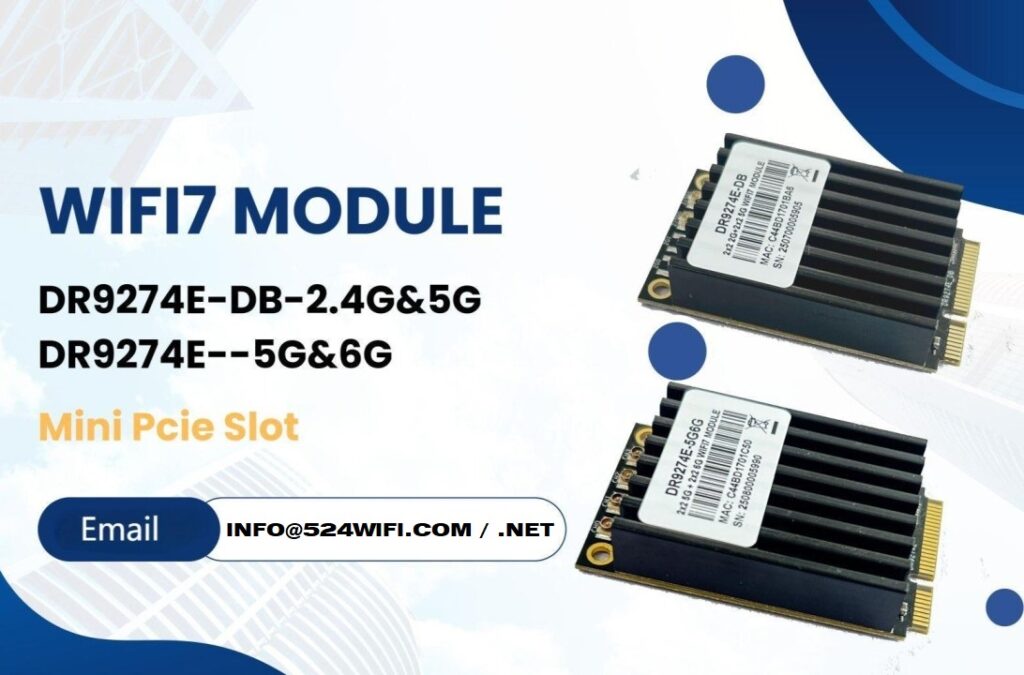
🔹 DR9274 Mini PCIe Module – (CPU:Qualcomm QCN9274/QCN6274) Compact and powerful Wi-Fi 7 module for embedded AI system

🔹 Custom ODM/OEM support – Tailor-made solutions for your AI product roadmap

👉 Contact our team at info@524wifi dor net or com to discuss your AI project and how Wi-Fi 7 can help you scale it smarter and faster.

Posted on

QCN9274 + IPQ9574: Leading WiFi 7, Watching IPQ5424

As industrial and enterprise wireless demand skyrockets, the need for extreme throughput, multi-link flexibility, and custom firmware capabilities has never been more critical. At the heart of this new era? Qualcomm’s flagship WiFi 7 combo: QCN9274 + IPQ9574.

But what if you could get WiFi 7 performance in a more compact, power-efficient design?

Introducing a sneak peek at the upcoming IPQ5424 — Qualcomm’s Quad-Core ARM Cortex-A55 SoC, clocked at 1.8GHz, and part of the Marina series. Wallys is actively prototyping boards based on this chip.


⚡ QCN9274 (DR9274): The WiFi 7 Gold Standard

  • Qualcomm WiFi 7 radio (successor to QCN9074)
  • 4096-QAM, 320 MHz channels
  • 4×4 MU-MIMO support
  • Ultra-fast 5/6GHz performance
  • Multi-Link Operation (MLO) ready
  • WPA3, DFS, and industrial-grade reliability

Paired with boards like the Wallys DR9574, it’s ideal for future-proof enterprise APs, smart logistics, and ultra-reliable long-range bridges.


🧠 IPQ9574: The Brains Behind Next-Gen Routing

  • High-performance quad-core ARM architecture
  • Native support for QCN9274 in tri-band setups
  • Integrated WiFi 6 radio for unified design
  • Designed for OpenWrt/QSDK 12+
  • Suitable for high-end router boards like DR9574

Perfect for OEMs building advanced gateways, CPEs, or edge routers — capable of handling gigabit WiFi + backhaul + edge computing in one.


👀 On the Radar: IPQ5424

Wallys is currently prototyping new boards based on the IPQ5424 “Marina” Series — a mid-tier SoC with:

  • Quad-core ARM Cortex-A55 @1.8GHz
  • Optimized for compact, efficient WiFi 7 deployments
  • Ideal for SMB routers, mesh APs, edge nodes

While IPQ9574 leads the pack, IPQ5424 fills the cost-performance gap — making WiFi 7 more accessible for scaled applications.


🔧 Compatible SoCs & Modules for QCN9274/QCN9024:

  • IPQ9574 — WiFi 7 flagship
  • IPQ8072/IPQ8074 — WiFi 6 platform
  • IPQ6010 — Mid-range WiFi 6
  • IPQ4019/IPQ4029 — Entry-level WiFi 5/6 bridges
  • Coming soon: DR5424 (IPQ5424-based board)

Wallys modules supporting these platforms include: DR9274–6E, DR9574, DR6018, and DR8074

Posted on

QCN9074, QCN9274, IPQ9574, and QCN9024: Robust WiFi Modules for Modern Robotic Applications

How 524WiFi’ WiFi 6/7 Modules Adapt to Different Robotic Applications

Robots are transforming industries, from manufacturing and logistics to agriculture. However, each type of robot—industrial, warehouse, and agricultural—operates in unique environments with distinct wireless connectivity requirements. Reliable, high-speed communication is critical for real-time control, data transmission, and seamless automation. 524WiFi’ WiFi 6/7 modules, such as the DR9074 and DR9574, are designed to meet these varying demands, ensuring optimal performance in different robotic applications.

Industrial Robots: Low Latency and High Reliability

Industrial robots work in highly automated factories, assembling products with precision. These environments require ultra-low latency and high-reliability wireless connections to support real-time data exchange between robots and control systems. 524WiFi’ WiFi 6/7 modules offer:

  • Multi-Link Operation (MLO): Reducing latency by transmitting data over multiple channels simultaneously.
  • MU-MIMO and OFDMA: Enhancing efficiency in high-density environments with multiple robots operating simultaneously.
  • Advanced Security Features: Protecting sensitive manufacturing data from cyber threats.

Warehouse Robots: Seamless Roaming and Scalability

Autonomous Mobile Robots (AMRs) and Automated Guided Vehicles (AGVs) in warehouses require stable connections as they move between access points. The DR9074 and DR9574 ensure:

  • Fast Roaming Support: Minimizing disruptions when transitioning between WiFi coverage zones.
  • High Throughput & Low Power Consumption: Maintaining efficiency for long operational hours.
  • Interference Mitigation: Ensuring smooth operation in environments with multiple wireless networks.

Agricultural Robots: Long-Range Connectivity and Rugged Performance

Drones and autonomous farming machines operate in vast, open fields with limited infrastructure. Wireless modules for these applications must provide long-range coverage and withstand harsh outdoor conditions. 524WiFi’ solutions offer:

  • Extended Coverage with Beamforming: Enhancing signal strength over long distances.
  • Rugged Design for Extreme Conditions: Operating reliably in dust, humidity, and temperature variations.
  • Low-Latency Video Streaming: Enabling real-time monitoring of crops and livestock.

Conclusion

From precise industrial automation to large-scale warehouse logistics and autonomous farming, different robotic applications demand tailored wireless solutions. 524′ WiFi 6/7 modules, including the DR9074 and DR9574, provide the speed, stability, and security needed to meet these challenges. As robotics continue to evolve, robust wireless connectivity will be key to unlocking their full potential.

Want to optimize your robotic applications with cutting-edge WiFi technology? Contact us today to learn more about our solutions!

524 DREAM WiFi7 Modules
524 DREAM WiFi6 Modules