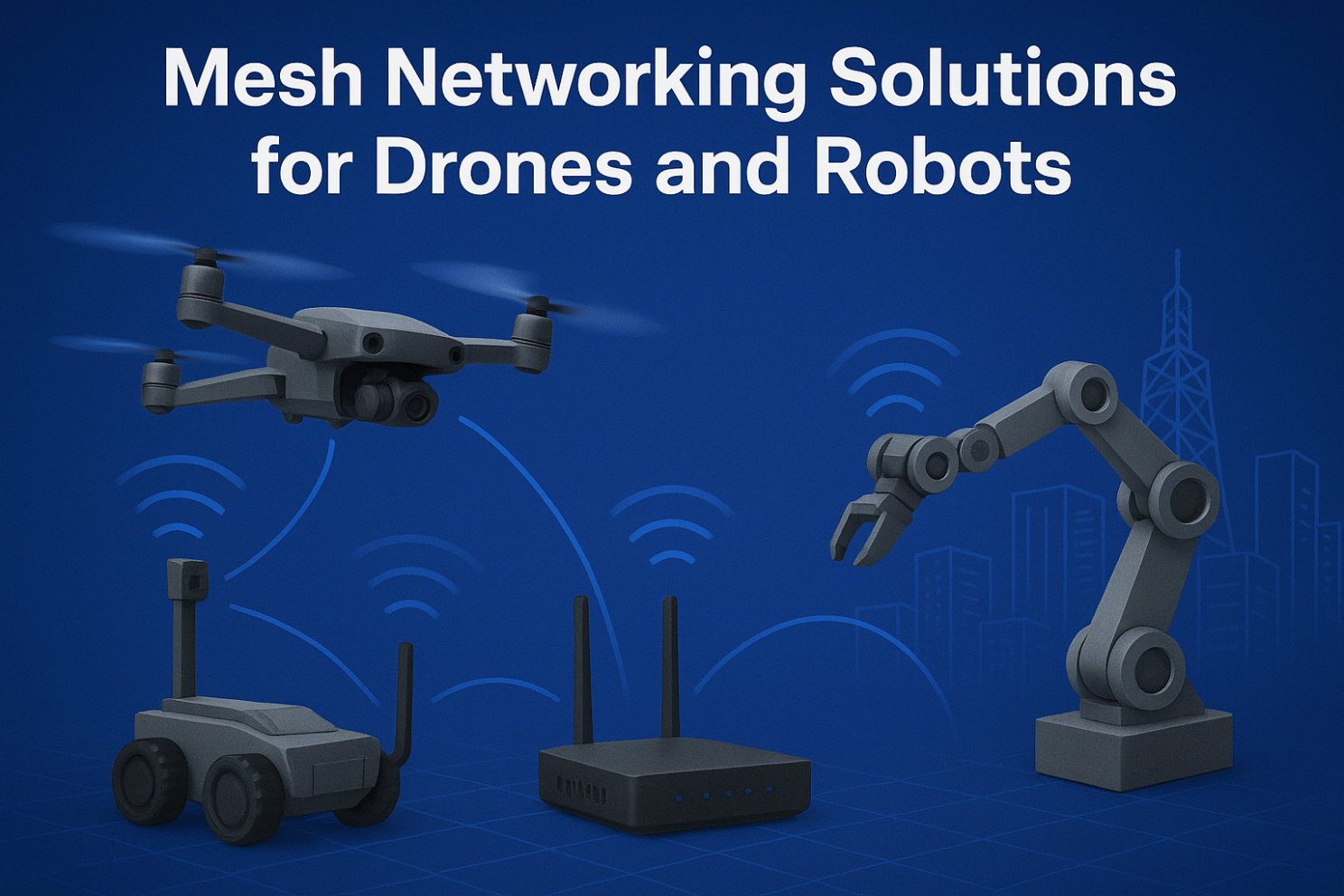
Mesh Networking Solutions for Drones and Robots
1. Introduction: Why Mesh for Drones and Robots?
Traditional wireless setups (AP + client) often fail in dynamic, mobile, and large-scale environments. Drones and robots require:
- Low-latency links for real-time control
- Resilient communication when nodes move or fail
- Flexible scalability for adding new devices instantly
This is where Mesh networking shines — offering self-healing, self-configuring, and adaptive connectivity.
2. Mesh Networking for Drones
- Formation Flying & Swarm Operations Drones in formation need constant synchronization of GPS, sensor, and video feeds. Mesh ensures each drone acts as a node, maintaining real-time links.
- Emergency Response & Disaster Recovery In areas without cellular coverage, drones can instantly deploy a Mesh network, relaying data back to the command center for faster rescue operations.
- Beyond Line-of-Sight Missions Mesh allows drones to extend their communication range via relays, enabling operators to control them far beyond visual range.
3. Mesh Networking for Robots
- Smart Warehouses & Industrial Automation Robots need to stay connected across large spaces with moving inventory. Mesh avoids single-point AP failures and supports seamless roaming.
- Security & Patrol Robots Continuous connectivity is essential for live video streaming and real-time threat detection. Mesh keeps robots online without service drops.
- Collaborative Swarm Robots Multiple robots can share sensory data, distribute tasks, and adapt dynamically using Mesh as their backbone.
4. Key Technical Aspects of Drone & Robot Mesh
- Dynamic Routing Protocols (OLSR, B.A.T.M.A.N, HWMP) ensure optimal paths in mobile networks.
- Frequency Bands:
- 2.4 GHz for longer range
- 5 GHz / 6 GHz for high throughput
- Wi-Fi 6/7 with MLO for ultra-stable multi-link performance
- Security: WPA3, AES encryption, and private protocols protect mission-critical data.
- Low Latency Optimization: Necessary for navigation and collision avoidance in autonomous systems.
5. Real-World Use Cases
- Drone Relay Networks for Search & Rescue
- Mesh-Enabled Warehouse Robots for Amazon-like Logistics
- Hybrid Mesh + 5G Networks for Smart City Patrols
6. Future Trends
- Wi-Fi 7 with Multi-Link Operation (MLO): Brings reliability and speed to swarms of robots and drones.
- Integration with 6G & Edge AI: Mesh networks will work hand-in-hand with edge computing for local decision-making.
- Larger-Scale Autonomous Systems: From 5 drones to 500 robots, Mesh will scale efficiently.
Mesh networking is transforming how drones and robots communicate in real time. Whether for industrial automation, emergency missions, or smart city deployments, Mesh provides the backbone for reliability and scalability.
👉 At 524WiFi and Wallys, we design industrial-grade router boards and network cards (IPQ5018, IPQ9574, QCN9074, etc.) that support advanced Mesh networking. Our hardware enables drone and robotics developers to build custom, robust, and scalable Mesh solutions.