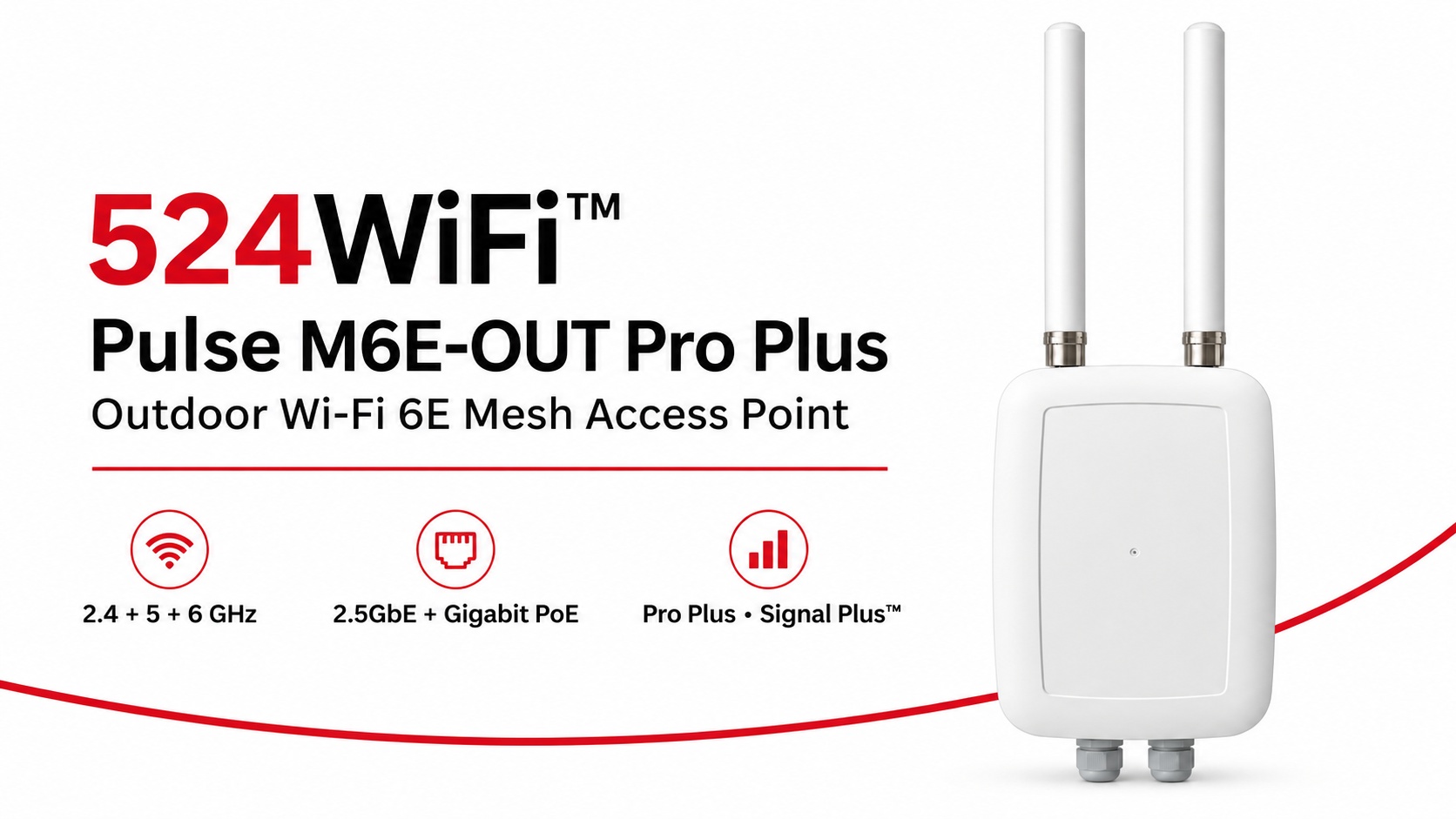
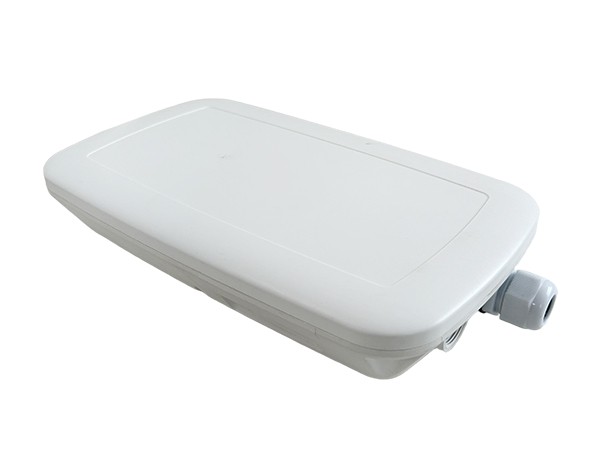
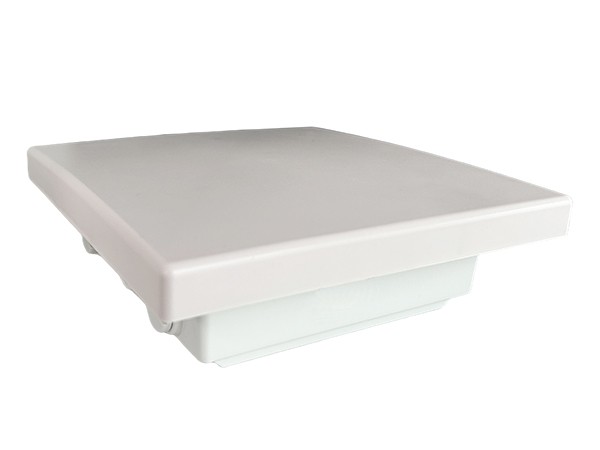
524WiFi™ Pulse M6E-OUT Pro Plus brings the radio platform, outdoor enclosure and model-specific antenna assembly together for a professionally planned Wi-Fi 6E mesh installation. Start with a complete fixed network node and build coverage and inter-node links around the working area.
Three radio bands for the complete site network
Independent 2.4, 5 and 6 GHz radios give the installation three concurrent 2×2 radio paths. The Qualcomm IPQ5018 platform combines a dual-core ARM Cortex-A53 processor at 1.0 GHz with 512 MB DDR3L. A 2.5GbE interface supports the wired uplink, while a Gigabit Ethernet interface with PoE provides practical network and power integration.
The published theoretical PHY rates are up to 573 Mb/s at 2.4 GHz and 2,402 Mb/s each at 5 and 6 GHz. Channel widths reach 40 MHz at 2.4 GHz and 160 MHz on the two higher bands. Choose channels and radio roles around client traffic, the mesh topology and the operating country.
An antenna assembly matched to the outdoor node
The assembly combines two external 5 GHz omnidirectional antennas, two internal 2.4 GHz omnidirectional antennas and an internal directional 6 GHz panel serving the two 6 GHz RF paths. Aim the panel toward the intended link and keep its enclosure face clear of metalwork. This lets the installation use directional interconnection and local coverage deliberately.
Pro Plus and Signal Plus™ for deployment
Pro Plus combines our tuned product configuration, model-specific firmware selection and integration support. Signal Plus™ brings antenna placement, polarization, feed losses, radio roles and channel planning into the same RF system. Commission the complete node under the traffic and RF conditions of the actual site.
Fixed mesh nodes and moving clients
Use the M6E-OUT as a fixed outdoor infrastructure node. Pair it with Pulse M6E-IN for indoor infrastructure and Pulse R6-D2-IN or R6-T3-IN roaming clients on moving Ethernet-equipped machinery. Plan compatible firmware, authentication and RF overlap across the route. Mesh interconnection and moving-client roaming serve complementary roles in the complete network.
Mobile robots used to be limited mainly by batteries and mechanics. Increasingly, the limit is data movement. A modern AMR or UGV carries multiple cameras, LiDAR, and depth sensors. It runs perception models on board, and it has to stay connected while roaming across a warehouse, port, or factory floor. Compute has advanced quickly with NVIDIA Jetson. The wireless link has often stayed one generation behind.
Pairing Jetson-class edge compute with a Wi-Fi 7 network is one practical way to close that gap.
Why Jetson and Wi-Fi 7 belong in the same architecture
Jetson runs perception, localization, and navigation on the robot itself, so the robot does not depend on the network for real-time decisions. But the network still carries the data that matters at fleet level:
Compressed multi-camera streams for remote monitoring and teleoperation
Map and model updates pushed to many robots at once
Fleet telemetry, task dispatch, and OTA firmware
Handover of the robot’s connection between access points while moving
Wi-Fi 7 (IEEE 802.11be) addresses these directly. Channels of up to 320 MHz in the 6 GHz band raise per-link capacity. 4K-QAM raises spectral efficiency. Multi-Link Operation (MLO) lets a client use more than one band to improve reliability and reduce latency variation. Multi-RU scheduling helps when many small clients share a channel, which is the typical multi-robot case.
How the pieces fit together: 524WiFi™ edge platform
At 524WiFi™, we treat the robot’s compute and its radio as one design problem rather than two separate purchases.
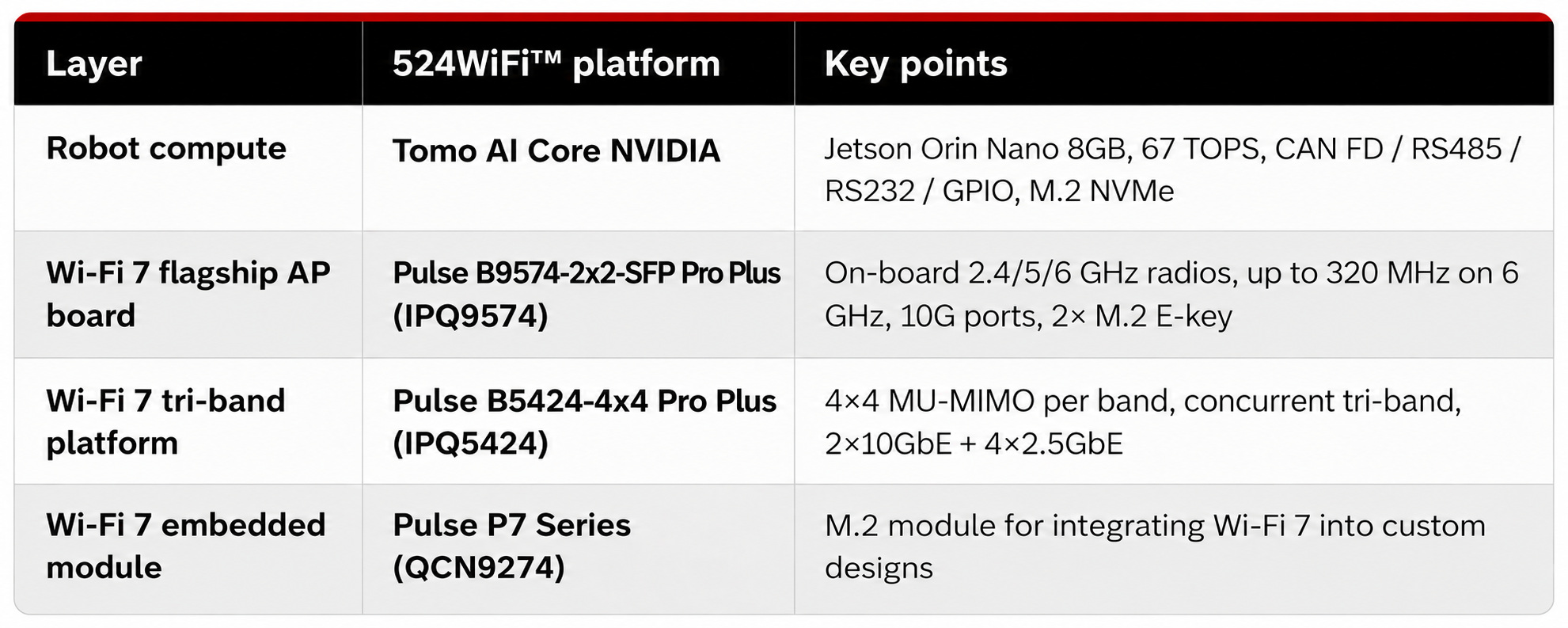
On the robot: the Tomo AI Core NVIDIA is built on the NVIDIA Jetson Orin Nano 8GB module with an industrial carrier board. It offers 67 TOPS of AI performance. Connectivity includes Gigabit Ethernet (one port with 48V PoE), optional Wi-Fi, and optional 4G/5G. Robot-side I/O includes CAN FD, RS485, RS232, GPIO, USB 3.0, and an M.2 NVMe slot. Select the compute, carrier I/O and wireless configuration around the requirements of the robot application.
On the infrastructure side: Wi-Fi 7 platforms based on Qualcomm silicon serve as the access point layer. Examples are the Pulse B9574-2×2-SFP Pro Plus (IPQ9574), the Pulse B5424-4×4 Pro Plus (IPQ5424), and the Pulse P7 Series M.2 modules (QCN9274) for embedding Wi-Fi 7 into your own hardware.
One point worth stating clearly: tri-band does not always mean the same thing. On the Pulse B5424-4×4 Pro Plus and Pulse B9574-2×2-SFP Pro Plus, the 2.4 GHz, 5 GHz, and 6 GHz radios are three independent chains running concurrently. Some tri-band cards are tri-band switchable, meaning one radio moves between bands to avoid interference. Both approaches are useful, but they suit different designs, so check which one a product actually is before planning around it.
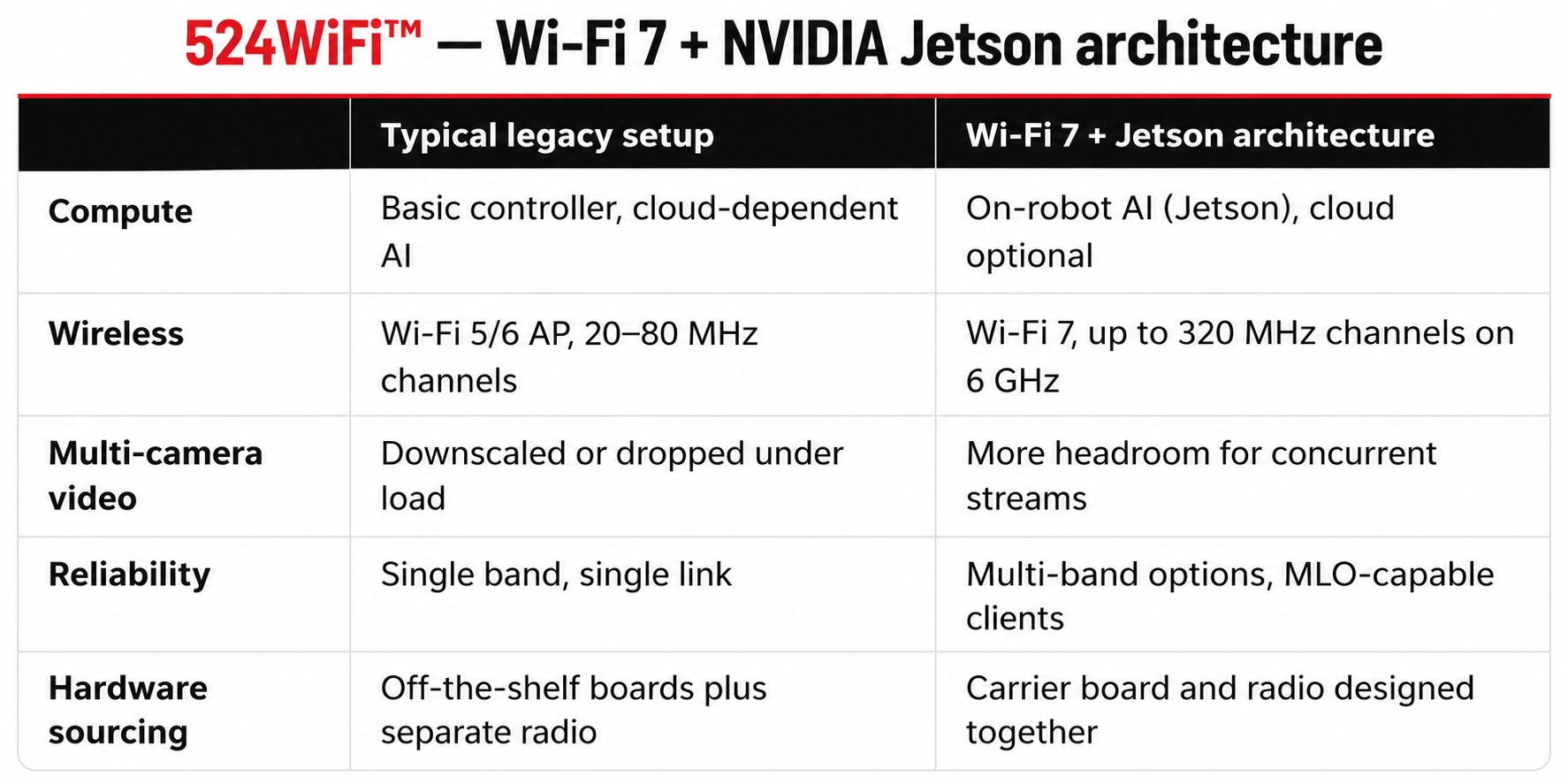
Compared with the usual approach
Wi-Fi 7 is not a magic fix. Real roaming performance still depends on AP placement, channel planning, and client support. But the higher-capacity link and the multi-band tools give the network more room to work with.
Where this architecture applies
Warehouse and logistics AMRs: dense multi-robot fleets with steady roaming and continuous telemetry
Port and yard vehicles: long-range coverage with camera-based monitoring
Machine vision on the move: multi-camera, high-resolution image transfer to inspection systems
Inspection and security robots: live video plus on-board detection
Agricultural and field robotics: long-range control and video links, with custom transmission software where needed
Hardware summary
Talk to us
If you are building mobile robots on Jetson and would rather not develop the wireless hardware yourself, we can supply the modules, routerboards, and custom carrier boards, and discuss the application software and transmission requirements of the complete system.
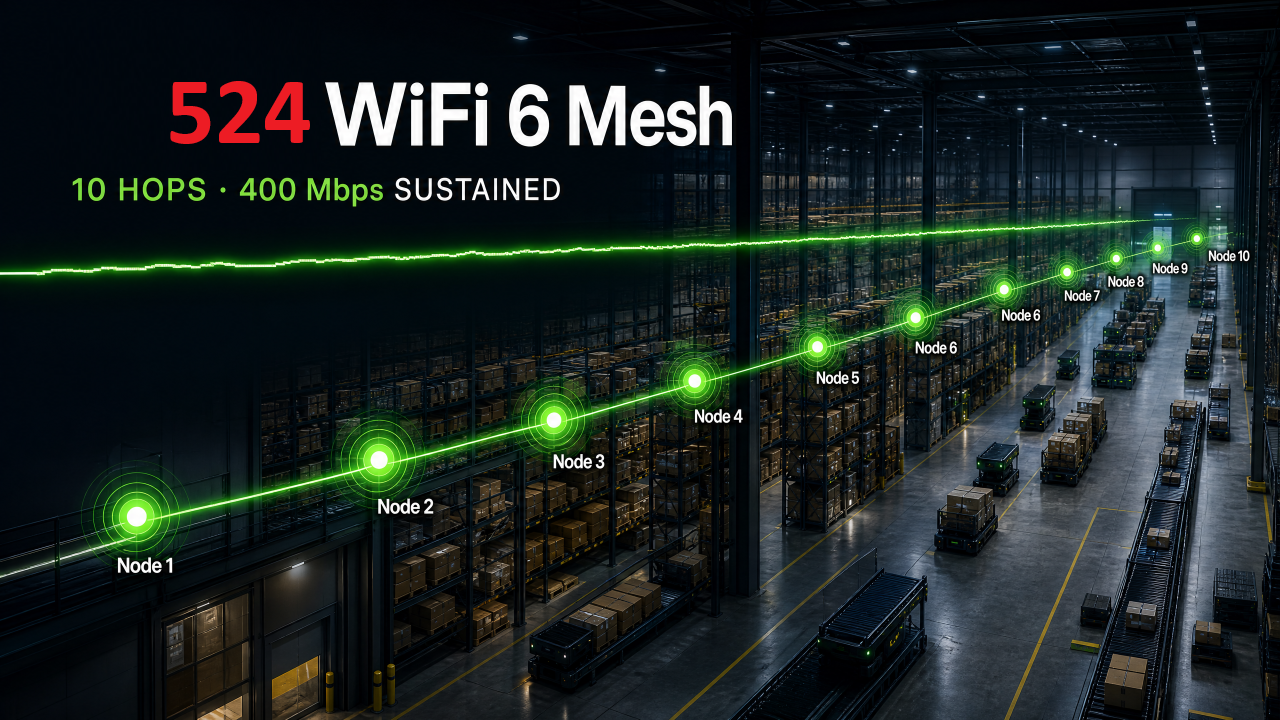
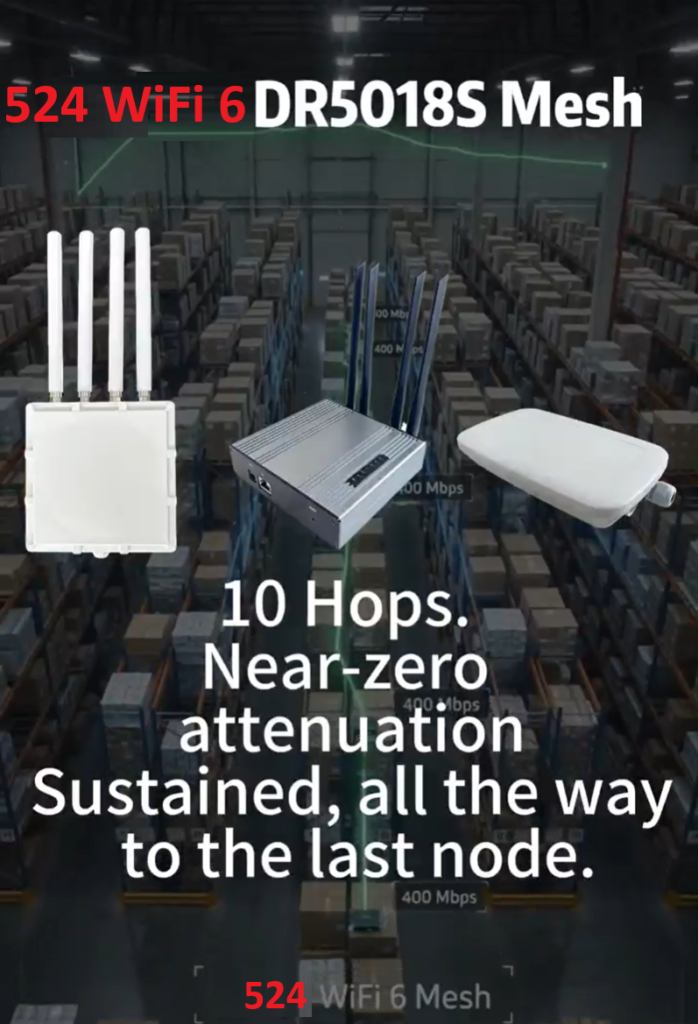
Most industrial mesh networks start choking after 3-4 hops — latency spikes, throughput collapses, and your robots lose their control link exactly when you need it most.
We just wrapped a 10-hop mesh stress test on our WiFi 6 platform, and the results speak for themselves: near-zero attenuation across all 10 hops, with sustained throughput of 400Mbps at the final node.
524WiFI mesh 10 hops testing environment
For AMR fleets, warehouse automation, and multi-robot deployments, this isn’t a lab number — it’s the difference between a robot that stays connected across a 50,000 sq ft facility and one that drops out the moment it turns a corner.
From PC1 to PC2 10 HOPS THROUGHPUT TEST RESULTS
No more compromising on coverage. No more babysitting mesh hops. Just reliable, high-throughput connectivity that scales with your facility, not against it — no need for WiFi 7 to get there.
In our hyper-connected world, we think of networks in terms of Wi-Fi signals, ethernet cables, and blazing 5G. But beneath the surface of every email sent, every stream buffered, and every video call connected, lies a critical piece of software that rarely gets the spotlight: the network driver. These digital workhorses are the essential interpreters that allow your computer’s operating system to have a meaningful conversation with the physical hardware that connects you to the world.
Understanding them isn’t just academic; it’s key to troubleshooting a flaky connection, boosting performance, or simply appreciating the hidden complexity of a networked world.
The Universal Translator for Your Hardware
At its core, a network driver is a specialized software module that acts as a universal translator. It sits between a computer’s operating system (like Windows, Linux, or macOS) and its Network Interface Card (NIC)—the physical or virtual hardware that sends and receives data.
The operating system speaks in high-level, standardized commands (“send this packet,” “check the connection”). The NIC, whether it’s a gigabit ethernet port, a Wi-Fi adapter, or a 5G modem, has its own unique, hardware-specific language. The driver’s sole purpose is to translate the OS’s generic commands into the precise instructions the specific NIC model needs to function. Without the correct driver, even the most advanced, expensive network card is a useless piece of silicon.
A Spectrum of Drivers: From Universal to Specialized
Not all drivers are created equal. They exist on a spectrum, designed to meet different needs for compatibility, performance, and cost.
In-Box Drivers: These are the generic drivers built directly into an operating system. They provide basic functionality for a wide range of common hardware, allowing you to get online immediately after a fresh OS install. Think of them as a phrasebook—it gets the basic job done but lacks the nuance for high-performance tasks.
Vendor-Supplied Drivers: This is where the real magic happens. These are the optimized drivers written and maintained by the hardware manufacturer (like Intel, Broadcom, or Qualcomm). They are finely tuned to unlock the full potential of their specific hardware, offering enhanced features, better power management, superior stability, and lower latency. For any serious application, these are the gold standard.
Generic NDIS Drivers: The Network Driver Interface Specification (NDIS) is a standard framework, primarily in Windows, that provides a universal API. This allows hardware vendors to write a single driver that can interface with multiple versions of the Windows OS, simplifying development and ensuring broad compatibility.
Why Drivers Matter: The Practical Impact
You might only think about a driver when something goes wrong, but their quality and configuration have a daily impact on your experience.
Performance: A well-tuned driver can maximize throughput (speed) and minimize latency (lag), which is crucial for online gaming, video conferencing, and large data transfers. A poorly optimized driver can create a bottleneck, leaving you with slower-than-expected speeds.
Stability & Reliability: The infamous “Blue Screen of Death” or a persistent, dropped connection can often be traced back to a corrupt, outdated, or buggy network driver. A stable driver is the foundation of a reliable network connection.
Security: Drivers operate at a privileged level in the system. As such, they can be a target for security vulnerabilities. Manufacturers regularly release driver updates to patch these security holes, making keeping your drivers current a critical cybersecurity practice.
Feature Enablement: Advanced hardware features like Wake-on-LAN, traffic prioritization (QoS), or teaming multiple network ports together are almost always dependent on support from the vendor-specific driver.
The Evolution: Virtualization and the Cloud
The role of the driver is evolving beyond physical hardware. In virtualized and cloud environments, the physical NIC is shared among multiple virtual machines (VMs). Here, virtual network drivers become crucial.
Technologies like virtio-net (for Linux/KVM) and VMXNET3 (for VMware) are paravirtualized drivers. They are not tied to any specific physical hardware but are designed for optimal performance within a virtualized ecosystem. They communicate directly with the hypervisor, drastically reducing overhead and providing near-native network performance to VMs, which is the lifeblood of modern cloud infrastructure.
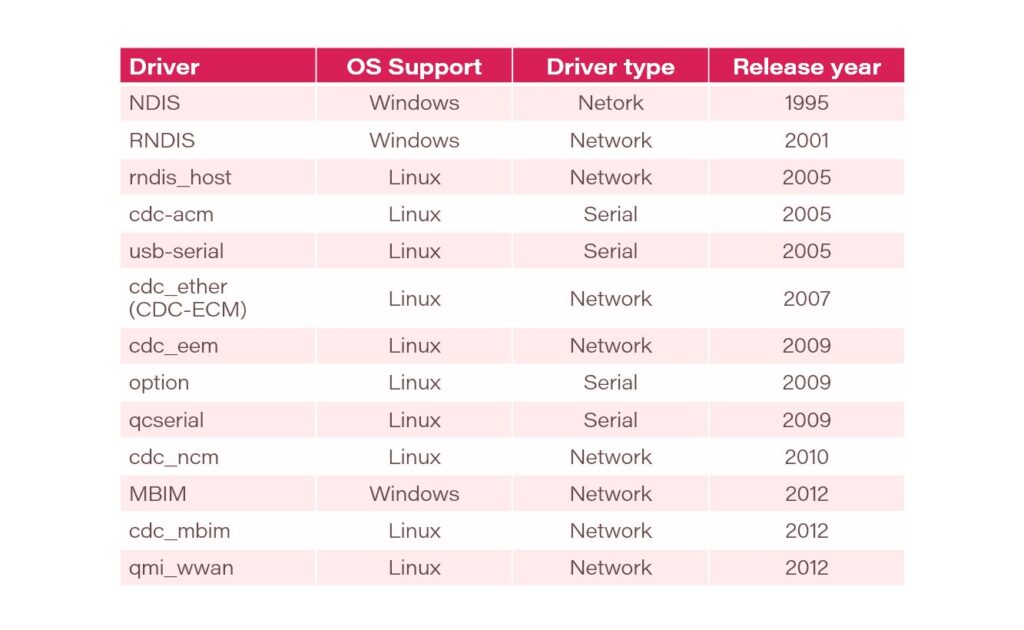
Here is a history of the network drivers:
The Bottom Line
Network drivers are a fundamental, if invisible, component of our digital lives. They are the diligent interpreters that transform abstract data into electrical signals and radio waves, connecting our devices to the global network. By understanding their role—from the basic in-box version to the high-performance vendor driver—we gain a deeper appreciation for the complexity of connectivity and the tools to build faster, more stable, and more secure networked systems. The next time you have a flawless video call, remember to thank the unsung interpreter working behind the scenes.
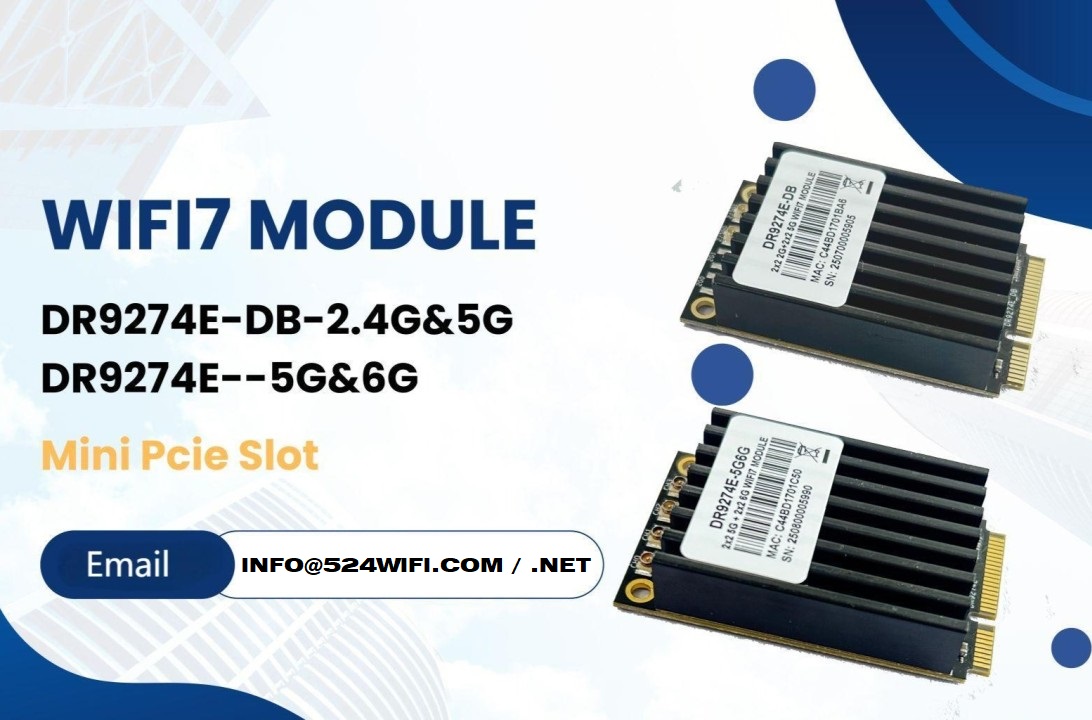
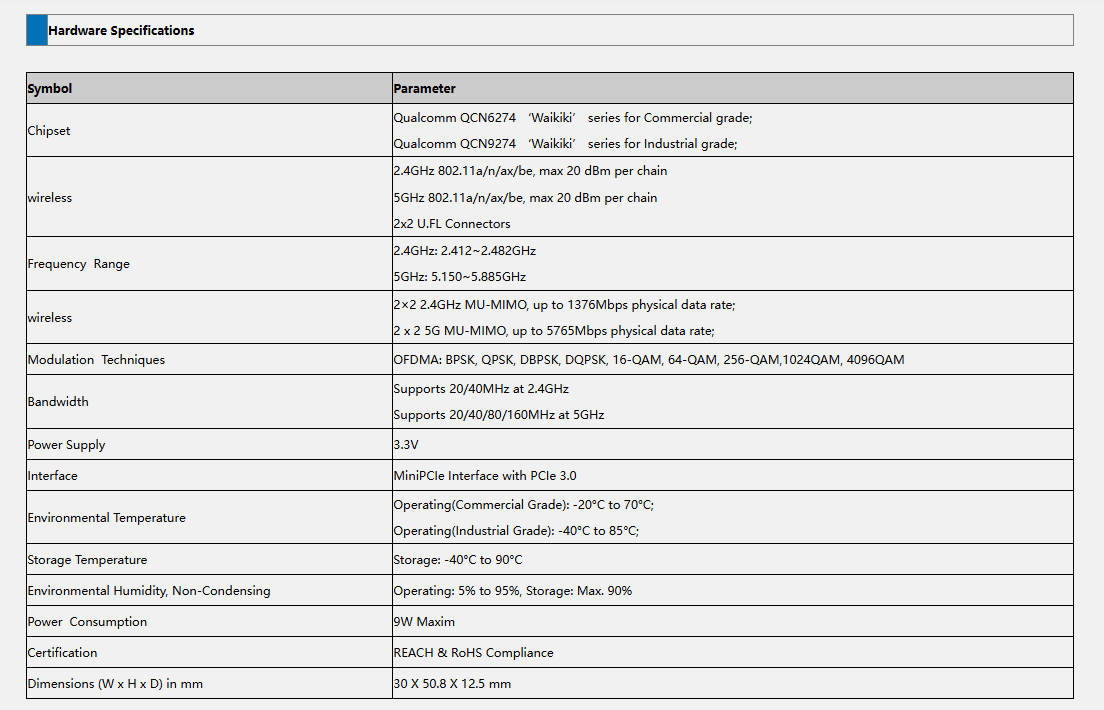
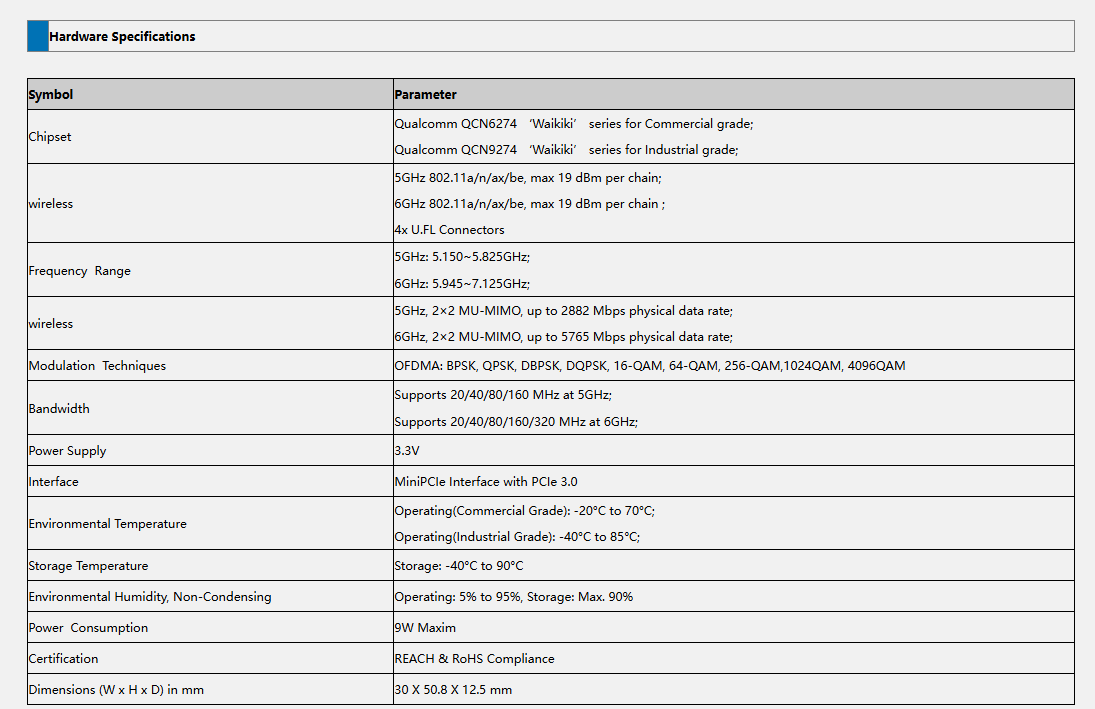
The DR9274E is a family of high-performance WiFi 7 radio modules built on Qualcomm’s QCN9274 or QCN6274 ‘Waikiki’ series chipsets.
524WiFi is proud to announce the launch of two brand-new WiFi 7 MiniPCIe modules — the DR9274E-DB and DR9274E-5G6G, engineered to meet the demands of today’s most advanced industrial and commercial wireless applications.
These modules are part of the DR9274E family, built on Qualcomm’s QCN9274 / QCN6274 ‘Waikiki’ series chipsets, and designed to unlock the full potential of WiFi 7 in a compact MiniPCIe form factor. Samples available with QCN9274 chipset now !
When it comes to building high-performance wireless infrastructure for industrial or outdoor use, stability and scalability matter just as much as speed.
At 524WiFi and Wallys, we continue to support our customers with proven, cost-effective WiFi 6 solutions — like the DR6018 router board paired with the QCN9024 module — designed for real-world performance in smart cities, surveillance networks, and rugged environments.
🔧 DR6018: Built to Perform
Powered by the Qualcomm IPQ6010/IPQ6018 platform, the DR6018 is one of our most popular and versatile router boards. It features:
✅ Dual-band concurrent 2.4GHz + 5GHz support
✅ Mini PCIe and M.2 slots for modular expansion
✅ 5x Gigabit Ethernet ports
✅ USB 3.0, SD card, SIM support
✅ PoE optional
✅ OpenWrt and QSDK compatibility
Its modularity and robustness make it a go-to choice for OEM/ODM clients who need a balance of performance, flexibility, and cost.
📶 Why QCN9024?
QCN9024 is Qualcomm’s high-throughput WiFi 6 radio chip:
🔁 Supports 4×4 MU-MIMO
📡 Optimized for DFS, long-range & outdoor stability
⚙️ Excellent Linux/OpenWrt driver support
🔩 Easily integrated into DR6018 or DR5018S for consistent results
Whether you’re setting up outdoor CPEs, APs for city-wide WiFi, or reliable backhaul links for security systems, QCN9024 delivers where it counts.
Your project is unique — and our team is here to help you tailor the right solution.
📢 Coming Soon: IPQ5424 Support
Looking ahead? Our R&D team is preparing a new line based on Qualcomm IPQ5424 (Marina Series), featuring Quad-Core ARM-A55 @1.8GHz. Ideal for next-gen industrial APs and higher-end deployments. Stay tuned!
Our latest solution, the DR5332 and DR5322s router boards, combine the power of Qualcomm IPQ 5332 / IPQ5322 and the high-speed QCN9274 wireless module to deliver multi-gigabit connectivity, ultra-low latency, and industrial-grade reliability.
Paired with DR5322s, this combo brings elite wireless performance to OEM/ODM platforms in:
Industrial APs
Outdoor wireless CPEs
Edge mesh gateways
🔧 Future-Proof Your Wireless Projects
This isn’t just a board. It’s a WiFi 7 infrastructure base built for the next 5–10 years. And yes — QCN6274, QCN9024, and even QCN9074 (WiFi 6) are all supported too, for backward compatibility.
📩 Want to test a DR5322s sample or request a spec sheet? Contact us!
With the increasing demand for high-speed wireless networks, WiFi 6 technology has become the preferred choice for upgrading enterprise and industrial wireless solutions. Offering higher throughput, lower latency, and superior interference resistance, WiFi 6 enables seamless connectivity across multiple applications.
524WiFi introduces the DR9074-TRIBAND, a high-performance WiFi 6 tri-band network card powered by the Qualcomm QCN9024 chipset. Supporting 2.4GHz, 5GHz, and 6GHz frequency bands, this card is designed for high-density environments, multi-device connectivity, and low-latency applications. This article will explore the technical features, application scenarios, and benefits of the DR9074-TRIABND in upgrading wireless network solutions.
DR9074-TRIABND Specifications
524WIFi DREAM DR9074-TRIBAND is built on the Qualcomm QCN9024 chipset and boasts the following core specifications:
ParameterSpecificationChipset Qualcomm QCN9024 WiFi Standard 802.11ax (WiFi 6) Frequency Bands 2.4GHz / 5GHz / 6GHz Antenna Interface 4×4 MU-MIMO Throughput 2.4GHz: 1148 Mbps ;5GHz: 2402 Mbps ;6GHz: 2402 Mbps Interface PCIe 3.0 Transmit Power Up to 23dBm Security WPA3 Encryption Compatibility Supports OpenWRT / Linux / Custom Firmware
Advantages of a Tri-Band WiFi Design
One of the standout features of the DR9074-TRIABDN is its tri-band support (2.4GHz, 5GHz, 6GHz). Compared to traditional single-band or dual-band network cards, it provides higher throughput, reduced interference, and more flexible networking options.
1. 2.4GHz Band: Wide Coverage, Ideal for IoT Devices
Advantages: Strong penetration capability, suitable for long-distance connections.
Applications: Smart home devices, industrial sensors, low-power IoT devices.
2. 5GHz Band: High Throughput for Mainstream Wireless Applications
Advantages: Supports higher bandwidth while avoiding congestion in the 2.4GHz band.
Applications: Enterprise WiFi networks, HD video streaming, cloud computing offices.
BSS Coloring ✅ Supported ❌ Not Supported ❌ Not Supported
TWT Power Saving ✅ Supported ❌ Not Supported ❌ Not Supported
WPA3 Security ✅ Supported ❌ Not Supported ❌ Not Supported
As seen in the comparison, DR9074-TRIBAND offers superior performance, broader frequency options, less interference, and enhanced security, making it a leading WiFi 6 solution.
Why Choose 524WiFi DR9074-TRIBAND?
✅ Tri-band WiFi 6 support – 2.4G / 5G / 6G compatibility for diverse applications. ✅ Powered by Qualcomm QCN9024 – 4×4 MU-MIMO for ultra-fast, stable connections. ✅ OFDMA & BSS Coloring – Increases network efficiency and reduces congestion. ✅ Advanced WPA3 security – Ideal for enterprise and industrial wireless deployments. ✅ Mesh & Backhaul compatibility – Perfect for high-density WiFi installations.
The 524WiFi DREAM DR9074-TRIBAND is designed for enterprises, industrial applications, smart cities, and high-performance wireless networking, bringing WiFi 6 capabilities to the next level.
op IPQ9574 Chip Features for Next-Gen Wi-Fi 7 Connectivity
As the demand for faster, more reliable wireless networks continues to grow, the introduction of Wi-Fi 7 has become a game-changer in the world of wireless technology. At the heart of this new generation of Wi-Fi is the IPQ9574 chip, designed by Qualcomm, which is quickly emerging as one of the leading chips for Wi-Fi 7 connectivity. With its advanced features, the IPQ9574 is set to unlock unprecedented speeds, capacity, and reliability, paving the way for cutting-edge applications across industries. In this article, we’ll take a closer look at the top features of the IPQ9574 chip and how it is revolutionizing the way we connect.
1. Multi-Link Operation (MLO) for Ultra-Fast Speeds
One of the standout features of the IPQ9574 chip is its support for Multi-Link Operation (MLO), a critical component of Wi-Fi 7. MLO allows devices to simultaneously connect to multiple frequency bands (e.g., 2.4 GHz, 5 GHz, and 6 GHz) instead of relying on a single band. This results in faster data transfer speeds and improved network efficiency.
With MLO, the IPQ9574 can combine multiple data streams from different channels, enhancing throughput and reducing latency. This makes it ideal for demanding applications such as 4K/8K video streaming, virtual reality (VR), and high-speed gaming, where a seamless and ultra-fast connection is essential.
2. Increased Capacity for Dense Environments
The IPQ9574 chip is built with the capacity to handle a large number of devices simultaneously, which is critical in today’s increasingly connected world. Whether it’s a smart home, a busy office, or a large public venue, the chip ensures that network congestion is minimized, allowing for smooth communication even in dense environments.
With the Wi-Fi 7 technology powered by the IPQ9574, your network will be able to efficiently handle more devices without sacrificing performance. This is especially important as the Internet of Things (IoT) continues to expand and more smart devices are added to networks every day.
3. Better Spectrum Utilization with 320 MHz Channel Width
The IPQ9574 chip supports 320 MHz channel width, which significantly increases the amount of data that can be transmitted over the network. This feature is crucial for taking full advantage of the newly available 6 GHz spectrum offered by Wi-Fi 7, allowing for less interference and more bandwidth.
With wider channels, users can expect higher throughput and faster data speeds. For example, large file transfers, high-definition video streaming, and bandwidth-intensive tasks will see massive improvements in speed and efficiency.
4. Enhanced Reliability and Reduced Latency
One of the most important factors in ensuring a reliable network is minimizing latency—the delay between sending and receiving data. The IPQ9574 chip addresses this with advanced features that optimize network reliability and ensure a low-latency experience.
In applications such as live streaming, online gaming, and real-time video conferencing, low latency is essential for smooth, uninterrupted experiences. The IPQ9574 chip’s ability to provide consistent, stable connections is what sets it apart, ensuring high performance even during heavy traffic periods.
5. Seamless Connectivity with Enhanced Roaming
The IPQ9574 chip supports seamless roaming, which allows devices to smoothly transition between access points without interruption. Whether you’re walking around your home or office, the network will automatically hand off your connection to the nearest access point, ensuring a continuous, reliable experience.
This is especially beneficial in larger spaces or environments with many users, such as hotels, hospitals, or large campuses, where maintaining an uninterrupted connection is crucial.
6. Backward Compatibility with Wi-Fi 5 and Wi-Fi 6
Although the IPQ9574 chip is built for the future with Wi-Fi 7, it also maintains backward compatibility with older Wi-Fi standards, such as Wi-Fi 5 and Wi-Fi 6. This means that users with older devices can still enjoy fast and reliable connections on Wi-Fi 7 networks, without the need to upgrade all their devices at once.
Conclusion: The Future of Wireless Connectivity
The IPQ9574 chip is a powerhouse for Wi-Fi 7 technology, offering game-changing features like Multi-Link Operation (MLO), higher capacity, wider channels, and seamless roaming. These features make it the perfect choice for applications demanding high-speed, reliable, and efficient wireless connections—whether it’s for streaming, gaming, smart cities, or enterprise networks.
At Wallys Communications, we leverage the IPQ9574 chip to deliver cutting-edge solutions that meet the needs of modern wireless networks. Additionally, we have developed AI-driven solutions, such as human recognition and vehicle detection, powered by QCN9074 chips, offering innovative applications in security and automation.
Contact us today to learn more about how our Wi-Fi 7 solutions powered by IPQ9574 can elevate your wireless network and unlock the full potential of next-gen connectivity.