
Posted on

Chipset Comparison: IPQ5322 vs IPQ5424-What’s the Difference and Which One Fits Your Project?

DR5332S vs DR5424: What’s the Difference and Which One Fits Your Project?

As Wi-Fi 7 enters the spotlight of next-gen wireless connectivity, developers and OEMs are seeking powerful, cost-effective router boards to power AIoT, edge computing, mesh networking, and enterprise-grade gateways. At Wallys, we provide two flagship tri-band Wi-Fi 7 router boards: the DR5332S and the DR5424. While they share a common mission — delivering ultra-reliable, high-throughput connectivity — they are built on different SoC platforms and tailored for slightly different project needs.

Let’s break down the differences and help you decide which one is the right fit for your application.

1. Chipset Comparison: IPQ5322 vs IPQ5424

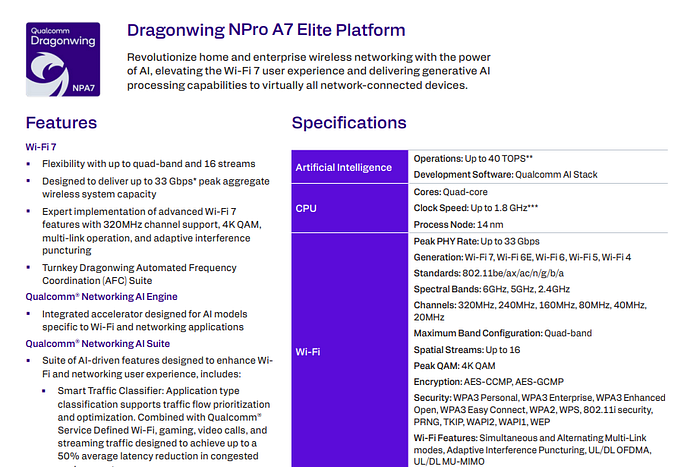
CPU Architecture: A53 vs A55

  • The IPQ5424 uses a Cortex-A55 @1.8GHz, which is newer, more efficient, and more powerful than the Cortex-A53 @1.5GHz in IPQ5332.
  • A55 supports out-of-order execution, making it significantly better for multitasking and edge workloads.

IPQ5424 offers superior computing performance, making it ideal for intensive processing and multitasking at the edge.

AI Acceleration

  • IPQ5424 benefits from its more capable CPU architecture and overall system bandwidth for smoother AI task handling.
Article content

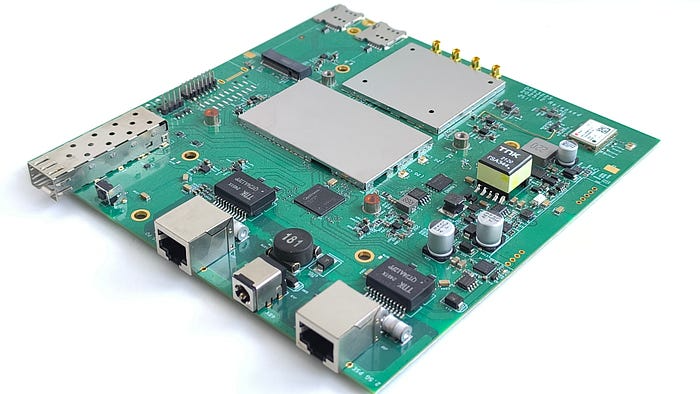
If you’re considering router boards such as Wallys DR5332S (IPQ5332) or DR5424 (IPQ5424):

  • 🧩 DR5332S + IPQ5332: Great for budget-sensitive, compact, quick-to-market solutions
  • 🚀 DR5424 + IPQ5424: Built for edge intelligence, multi-client environments, and future-proof mesh deployments

🔍 DR5424 offers higher performance and better power efficiency at the same time the costs will be higher than DR5322S.
Article content

2. Wireless Capabilities (Tri-Band Wi-Fi 7)

Both boards support tri-band (2.4GHz + 5GHz + 6GHz) Wi-Fi 7, including:

  • Multi-Link Operation (MLO) for increased stability
  • 320MHz bandwidth support on 6GHz band
  • 4096-QAM for enhanced throughput
  • Onboard radio modules for space-saving and simplified integration

However, DR5424 has more headroom for advanced use cases involving concurrent client management, AI inference at the edge, or industrial-grade networking.

3. Use Case Suitability

💡 Recommendation:

  • Choose DR5332S if your project prioritizes cost, compactness, and moderate throughput.
  • Choose DR5424 if you need higher computing power, better future-proofing, and support for intensive applications like edge inference, video analytics, or high-density mesh.

4. Hardware Interface & Customization

Both boards offer:

  • 2.5G Ethernet
  • Multiple UART, I2C, SPI
  • M.2 / USB3.0 / GPIO
  • Support for OpenWRT SDK
  • Optional expansion for LTE/5G/Storage modules

Customization and ODM services are available for both platforms.

5. Pricing & Availability

Both models are available for sampling, with volume support for OEM/ODM integration. DR5332S is generally more affordable and available sooner for entry-level or mid-range products, while DR5424 is geared for premium products with long-term lifecycle planning.

📬 For pricing, datasheets, or demo kits, contact us at: 📧 info@524wifi dot net or com

🧠 Final Thoughts

Whether you’re building a smart city gateway, an industrial mesh router, or a next-gen enterprise AP, 524WiFi and Wallys’ Wi-Fi 7 router boards offer flexible, powerful foundations.

  • DR5332S → Cost-effective, compact, fast-to-market
  • DR5424 → High-performance, future-ready, edge-AI capable

Need help choosing or customizing for your unique application? 

Posted on

DR5322S + QCN9274: Next-Gen WiFi 7 for Industrial Networks

WiFi 7 is here — and 524WiFi is ready.

Our latest solution, the DR5332 and DR5322s router boards, combine the power of Qualcomm IPQ 5332 / IPQ5322 and the high-speed QCN9274 wireless module to deliver multi-gigabit connectivity, ultra-low latency, and industrial-grade reliability.

🧠 Key Platform Specs — DR5322

  • ✅ Based on Qualcomm IPQ5322 SoC
  • ✅ Dual 2.5G Ethernet ports + 10G SFP
  • ✅ Supports Tri-band: 2.4G / 5G / 6G (via QCN9274/QCN6274)
  • ✅ PCIe 3.0 slot for flexible radio support
  • ✅ DDR4 1GB, eMMC 8GB onboard
  • ✅ Fully OpenWrt/QSDK customizable

📶 Why QCN9274?

  • ✅ 4×4 MIMO
  • ✅ 320 MHz channel width
  • ✅ Multi-Link Operation (MLO) ready
  • ✅ Supports WiFi 7 (802.11be) features

Paired with DR5322s, this combo brings elite wireless performance to OEM/ODM platforms in:

  • Industrial APs
  • Outdoor wireless CPEs
  • Edge mesh gateways

🔧 Future-Proof Your Wireless Projects

This isn’t just a board. It’s a WiFi 7 infrastructure base built for the next 5–10 years. And yes — QCN6274, QCN9024, and even QCN9074 (WiFi 6) are all supported too, for backward compatibility.

📩 Want to test a DR5322s sample or request a spec sheet? Contact us!

Posted on

QCN9024-Powered DR9074-TRIBAND: Advanced WiFi 6 Tri-Band Solution

DR9074-TRIBAND: High-Performance WiFi 6 Tri-Band Network Card for Next-Gen Wireless Solutions

Introduction

With the increasing demand for high-speed wireless networks, WiFi 6 technology has become the preferred choice for upgrading enterprise and industrial wireless solutions. Offering higher throughput, lower latency, and superior interference resistance, WiFi 6 enables seamless connectivity across multiple applications.

524WiFi introduces the DR9074-TRIBAND, a high-performance WiFi 6 tri-band network card powered by the Qualcomm QCN9024 chipset. Supporting 2.4GHz, 5GHz, and 6GHz frequency bands, this card is designed for high-density environments, multi-device connectivity, and low-latency applications. This article will explore the technical features, application scenarios, and benefits of the DR9074-TRIABND in upgrading wireless network solutions.


DR9074-TRIABND Specifications

524WIFi DREAM DR9074-TRIBAND is built on the Qualcomm QCN9024 chipset and boasts the following core specifications:

Parameter Specification Chipset Qualcomm QCN9024 WiFi Standard 802.11ax (WiFi 6) Frequency Bands 2.4GHz / 5GHz / 6GHz Antenna Interface 4×4 MU-MIMO Throughput 2.4GHz: 1148 Mbps ;5GHz: 2402 Mbps ;6GHz: 2402 Mbps Interface PCIe 3.0 Transmit Power Up to 23dBm Security WPA3 Encryption Compatibility Supports OpenWRT / Linux / Custom Firmware


Advantages of a Tri-Band WiFi Design

One of the standout features of the DR9074-TRIABDN is its tri-band support (2.4GHz, 5GHz, 6GHz). Compared to traditional single-band or dual-band network cards, it provides higher throughput, reduced interference, and more flexible networking options.

1. 2.4GHz Band: Wide Coverage, Ideal for IoT Devices

  • Advantages: Strong penetration capability, suitable for long-distance connections.
  • Applications: Smart home devices, industrial sensors, low-power IoT devices.

2. 5GHz Band: High Throughput for Mainstream Wireless Applications

  • Advantages: Supports higher bandwidth while avoiding congestion in the 2.4GHz band.
  • Applications: Enterprise WiFi networks, HD video streaming, cloud computing offices.

3. 6GHz Band: Low-Interference, High-Speed Wireless Connectivity

  • Advantages: Offers higher bandwidth and less interference, meeting the needs of WiFi 6E devices.
  • Applications: VR/AR, low-latency cloud gaming, high-speed wireless backhaul.

With tri-band operation, the DR9074-TRIBAND can support multiple use cases simultaneously, optimizing network performance and reducing interference.


Qualcomm QCN9024: The Power Behind WiFi 6

As the core of the DR9074-TRIBAND, the QCN9024 chipset from Qualcomm is a flagship WiFi 6 solution offering:

✅ 4×4 MU-MIMO – Enables simultaneous multi-user transmissions, improving throughput and network efficiency. ✅ OFDMA (Orthogonal Frequency Division Multiple Access) – Efficient data scheduling, reducing network latency. ✅ BSS Coloring Technology – Reduces co-channel interference, enhancing network stability. ✅ TWT (Target Wake Time) – Reduces power consumption, extending the battery life of IoT devices. ✅ WPA3 Security – Provides enhanced wireless security for modern network environments.


Application Scenarios and Industry Benefits

The DR9074-TRIBAND is well-suited for enterprise WiFi, industrial IoT, wireless Mesh networks, and dedicated wireless systems.

1. Enterprise-Grade Wireless AP / WiFi Solutions

  • High-concurrency WiFi connectivity for office environments.
  • OFDMA & MU-MIMO improve multi-device performance.
  • 6GHz support reduces interference, ensuring a fast and reliable WiFi experience.

2. Industrial IoT (IIoT) & Smart Cities

  • 2.4GHz for IoT device connections, ideal for long-range, low-power sensors.
  • 5GHz/6GHz for industrial data transmission, supporting smart factories and remote monitoring.
  • TWT technology extends the battery life of IoT sensors and edge devices.

3. High-Performance Mesh & Backhaul Networks

  • 6GHz as a dedicated backhaul frequency, enhancing mesh WiFi efficiency.
  • Compatible with BATMAN and other mesh networking protocols, optimizing multi-hop routing.

4. Wireless HD Video & Low-Latency Gaming

  • WiFi 6 + 6GHz low-interference connectivity for smooth 4K/8K video streaming.
  • Ultra-low latency for cloud gaming and VR/AR applications.

Comparison with Other WiFi 6 Network Cards

Parameter DR9074-TRIBAND Competitor A Competitor B

WiFi Standard WiFi 6 (802.11ax) WiFi 6 WiFi 5

Frequency Bands 2.4G / 5G / 6G 2.4G / 5G 5G

MU-MIMO 4×4 2×2 2×2

Max Throughput 2402 Mbps (5G/6G) 1733 Mbps (5G) 1300 Mbps (5G)

BSS Coloring ✅ Supported ❌ Not Supported ❌ Not Supported

TWT Power Saving ✅ Supported ❌ Not Supported ❌ Not Supported

WPA3 Security ✅ Supported ❌ Not Supported ❌ Not Supported

As seen in the comparison, DR9074-TRIBAND offers superior performance, broader frequency options, less interference, and enhanced security, making it a leading WiFi 6 solution.


Why Choose 524WiFi DR9074-TRIBAND?

✅ Tri-band WiFi 6 support – 2.4G / 5G / 6G compatibility for diverse applications. ✅ Powered by Qualcomm QCN9024 – 4×4 MU-MIMO for ultra-fast, stable connections. ✅ OFDMA & BSS Coloring – Increases network efficiency and reduces congestion. ✅ Advanced WPA3 security – Ideal for enterprise and industrial wireless deployments. ✅ Mesh & Backhaul compatibility – Perfect for high-density WiFi installations.

The 524WiFi DREAM DR9074-TRIBAND is designed for enterprises, industrial applications, smart cities, and high-performance wireless networking, bringing WiFi 6 capabilities to the next level.

Posted on

Why OpenWrt + WiFi 6 = Future-Proof Networking? Unlock Next-Gen Networking with 524WiFi’ OpenWrt-Supported WiFi 6 Solutions

The demand for high-performance, customizable wireless solutions is surging across industries – from enterprise networks to industrial IoT and smart city deployments. At Wallys Communications, we bridge cutting-edge hardware with open-source flexibility through our OpenWrt-compatible WiFi 6 modules, engineered for reliability and scalability.

Why OpenWrt + WiFi 6 = Future-Proof Networking

OpenWrt Advantages: Full network stack control, lightweight operation (ideal for embedded systems), and 3,000+ software packages

WiFi 6 Benefits:

▶ 4× device capacity vs. WiFi 5

▶ 75% lower latency

▶ 1.8Gbps aggregate throughput (DR7915)

▶ BSS Coloring for dense deployments

Mediatek DR7915 MT7915

Featured Solutions: Enterprise-Grade WiFi 6 Modules

1. DR7915 Mini PCIe Module

✅ Chipset: MediaTek MT7915 + MT7975 (2×2 dual-band)

✅ Performance:

2.4GHz: 23dBm max power, 574Mbps

5GHz: 20dBm max power, 1201Mbps

-40°C to 70°C operating range

✅ Key Features:

DFS radar detection

MU-MIMO & OFDMA

LDPC/STBC encoding

Full OpenWrt 21.02+ support

2. DR4019 – The Robust Foundation for DR7915 WiFi 6 Solutions

DR4019 – The Robust Foundation for DR7915 WiFi 6 Solutions

Why Engineers Choose 524WiFi and Wallys?

🔧 Open-Source First:

Full driver source code access

Community-supported builds

🛠️ Design-to-Deployment Support:

RF layout optimization guidance

Thermal management consulting

FCC/CE pre-certification testing

🌐 Proven in Production:

Batch-to-batch consistency

Implementation Scenarios

• Industrial IoT gateways (5G + WiFi 6 edge computing)

• High-density office APs (200+ concurrent users)

• Outdoor mesh networks (-40°C hardened)