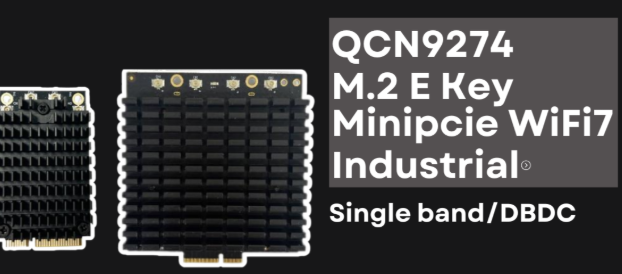
Posted on

QCA9880 to QCN9274/QCN6274: A WiFi 5 to WiFi 7 Module Selection Guide — 524WiFi 600VX / 900VX and DR9274E-TB Compared

From QCA9880 to QCN9274/QCN6274: A WiFi 5-to-WiFi 7 Module Selection Guide — 524WiFi 600VX / 900VX, and DR9274E-TB Compared

For years, the Qualcomm-Atheros QCA9880 has been the default chipset behind a lot of industrial WiFi 5 designs — routers, CPEs, access points, embedded gateways. It’s mature, well-documented, and easy to source, which is exactly why so many product lines are still built around it. But the ground is shifting. As more networks have to handle a pile of devices talking at once — robot fleets on a warehouse floor, banks of industrial cameras, multiple video streams heading back to a controller — WiFi 5’s two crowded bands start to show their age, and WiFi 7 platforms have gotten mature enough to be a real option instead of just a roadmap item.

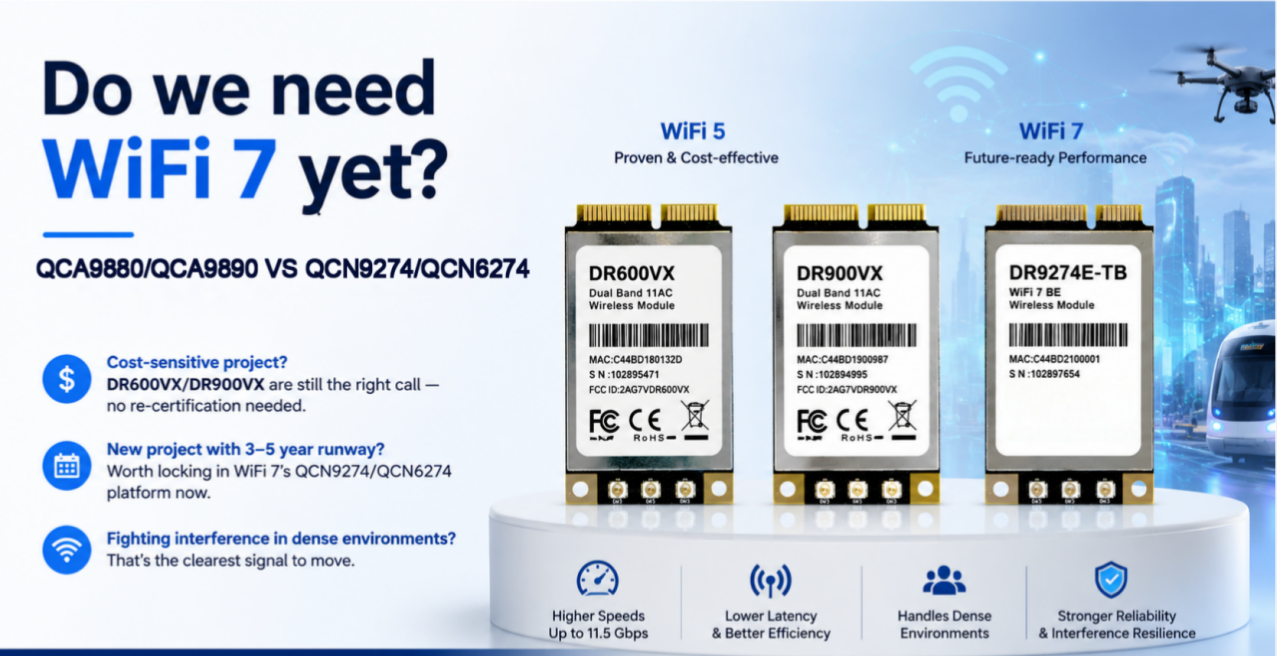
We get this question a lot from customers still speccing hardware around QCA9880: is it time to move, and if so, to what? Below is a practical comparison of two of our QCA9880 modules, 524WiFi 600VX / 900VX Pro+, against DR9274E-TB, which runs on Qualcomm’s newer QCN9274/QCN6274 platform.

The three modules

524WiFi 600VX Pro+ and DR600VX are a 2×2 MIMO 802.11ac module — 2T2R, theoretical throughput up to 867Mbps. Two UF.L antenna connectors, 2.4GHz and 5GHz (including 4.9GHz), TX power up to 24dBm/23dBm, Mini PCIe interface, -40°C to 70°C operating range. It’s a small board — 30.0 × 50.9 × 3.2mm — and it’s been a workhorse for cost-sensitive designs that don’t need a third antenna chain.

524WiFi 600VX Pro+ and DR600vx – QCA9880 2X2

524WiFi 600VX Pro+ and DR900VX are the same chipset, same footprint, same pinout — but 3×3 MIMO instead of 2×2, pushing theoretical throughput to 1.3Gbps and TX power up a couple of dB (26dBm/25dBm) thanks to the extra chain. There’s also a DR900VX-i variant on QCA9890 rated for 85°C, and a DR900VX-4.9 with 4.9GHz support. Because the mechanical and electrical interface is identical to DR600VX, swapping between the two mostly comes down to whether your enclosure has room to route a third antenna.
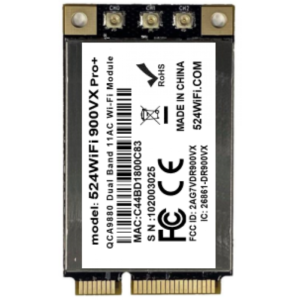
524WiFi 900VX Pro+ and DR900vx – QCA9890 3X3

DR9274E-TB is a different generation entirely. It’s built on QCN9274/QCN6274 and supports WiFi 7 (802.11be) across three bands — 2.4GHz, 5GHz, and 6GHz. Worth being precise here: it’s tri-band switchable, meaning the module picks the best band to operate on, not three bands running separate traffic simultaneously. It’s a 2×2 MIMO design, Mini PCIe, and mechanically compatible with existing WiFi 5 module footprints, so it’s aimed at the same kinds of products — industrial routers, enterprise APs, outdoor CPEs and bridges, mesh systems, edge AI platforms — just with more headroom.
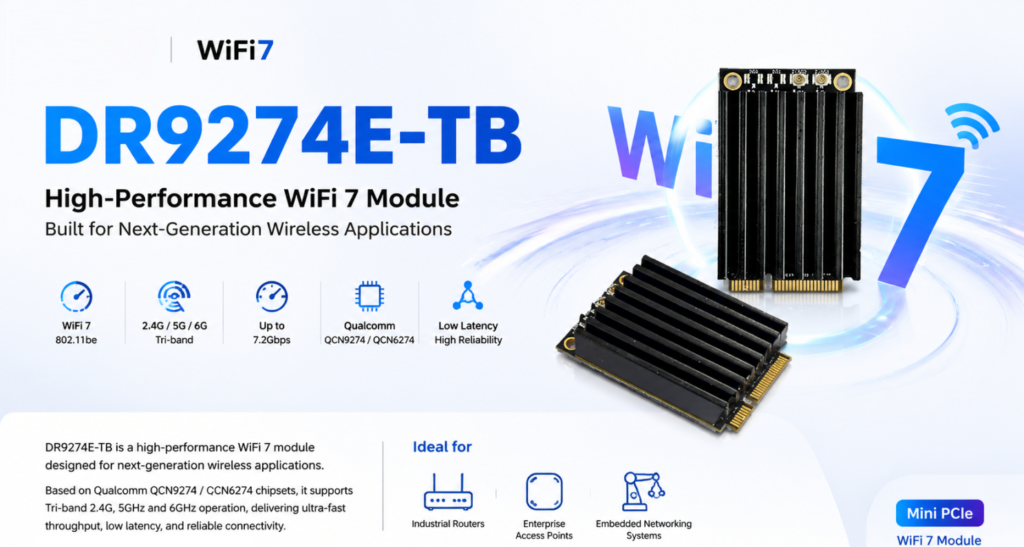
Side by side
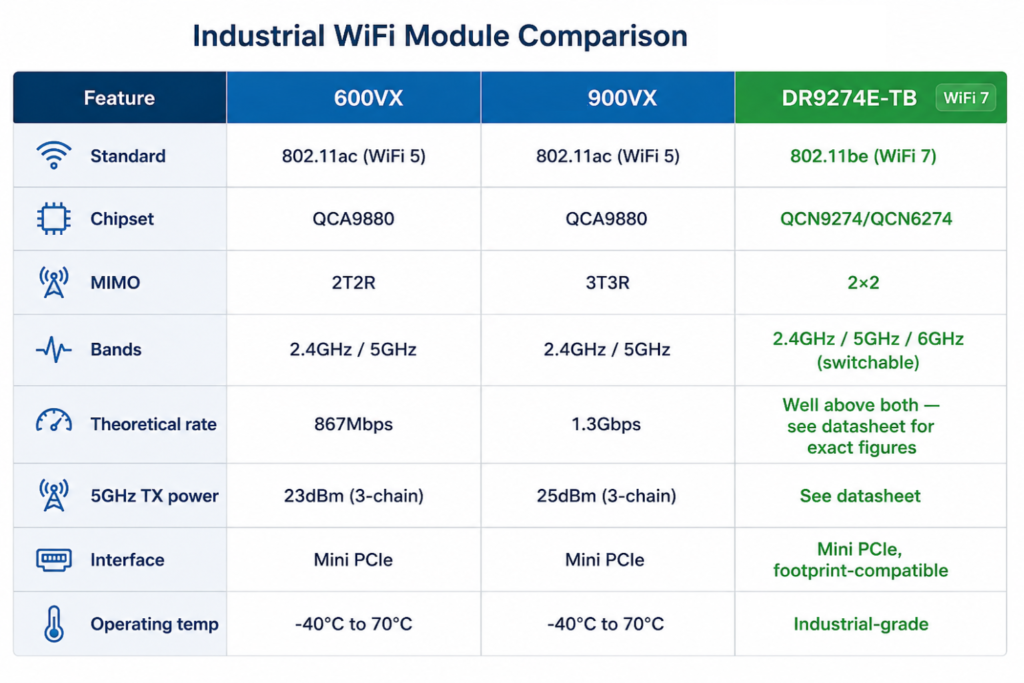
QCA9880 VS QCN9274

What actually changes

Going from 2T2R to 3T3R (600VX to 900VX) is a fairly straightforward upgrade — one more spatial stream, a bit more throughput, and a bit more stability in multipath environments, since the extra chain gives the radio more to work with. If your enclosure has the space and the budget allows it, 524WiFi 900VX Pro+ is the easy call.

The jump to WiFi 7 is a different kind of change, and it’s not really about raw speed. The number that matters most is 6GHz — an almost entirely clean band with none of the legacy congestion that 2.4GHz and 5GHz have accumulated over a decade of deployments. In a warehouse or factory environment with dozens of APs and client devices fighting for airtime, that alone can matter more than any Mbps figure on a spec sheet. WiFi 7 also brings multi-link operation, which lets a device coordinate traffic across bands rather than being locked to one — though how much of that you actually get depends on chipset support and firmware, so it’s worth checking specifics for your use case rather than assuming every feature is turned on out of the box.

None of this means everyone needs WiFi 7 today. A lot of deployments — point-to-point links, smaller networks, applications without dozens of devices packed into one space — are still perfectly well served by QCA9880. The cases where it’s worth moving now are the ones already running into interference or density problems, or new designs with a long enough runway that the 6GHz advantage will keep paying off for years.

Which one fits your project

If you’ve already built a product around QCA9880 — PCB layout done, drivers sorted, certifications in hand — there’s usually no reason to change anything. 524WiFi 600VX Pro+ and 524WiFi 900VX Pro+ share a footprint and pinout, so you can pick between them based on cost and available antenna space without touching your certification.

If you’re starting a new design with a multi-year lifecycle ahead of it, DR9274E-TB is worth a serious look even though WiFi 7 silicon costs more up front. QCA9880 is an older chipset generation at this point, and long-term sourcing risk tends to creep up as a platform ages. Locking in 6GHz early also means you’re not scrambling to redesign in a couple of years when everyone else has already made the jump.

And if you’re already seeing throughput drop off or latency get jittery once you cross a certain device count — a common story with AMR fleets, multi-camera vision setups, dense AP coverage — that’s usually a clearer signal than any roadmap discussion. Tri-band switching, combined with sensible planning around which traffic goes where, tends to ease that bottleneck in a way a WiFi 5 dual-band design just can’t.

Bottom line

  • Sticking with an existing QCA9880 design, watching cost closely → 524WiFi 600VX or 524WiFi 900VX Pro+
  • New project, long lifecycle, want to be ahead of the spectrum curve → DR9274E-TB
  • Already fighting interference or density issues → DR9274E-TB

Every deployment is a little different, and the right call depends on your device density, antenna space, budget, and how long the product needs to stay in the field. If you want to talk through your specific case, or need test data, samples, or custom development — antenna layout, firmware tuning, OEM/ODM support — reach out info at 524wifi.net .
Posted on

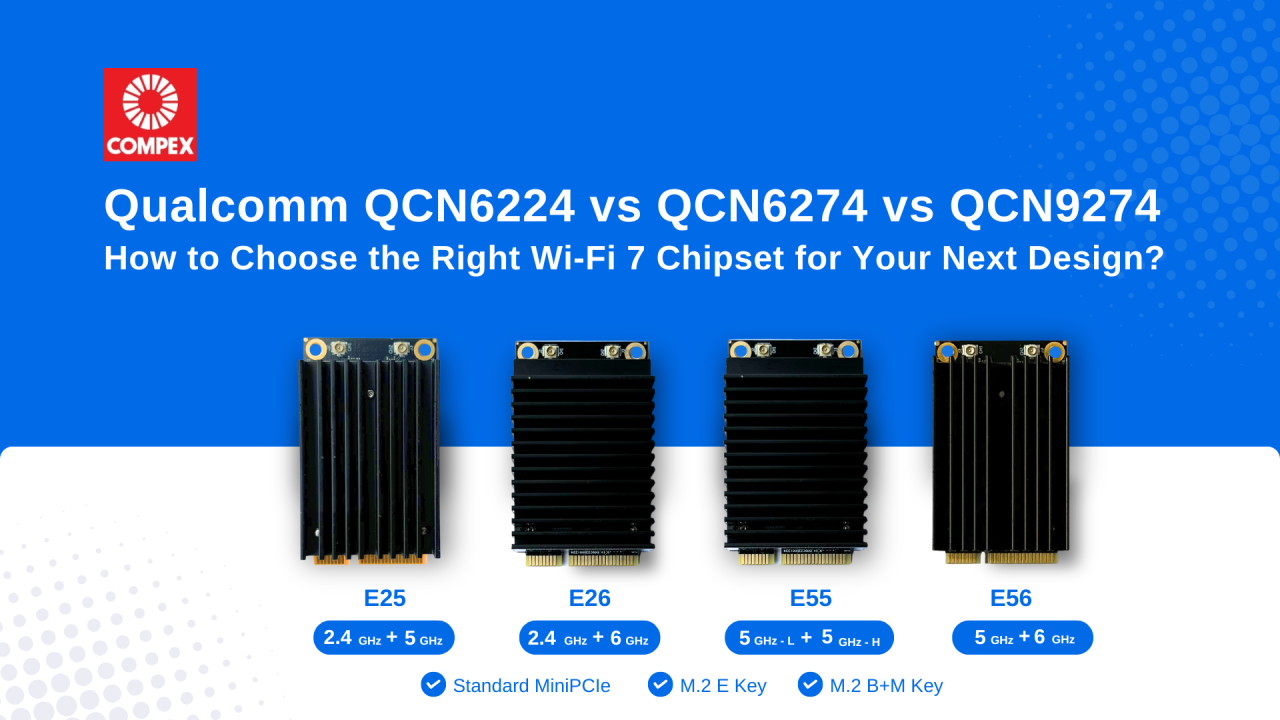
Qualcomm QCN6224 vs QCN6274 vs QCN9274: Which Wi-Fi 7 Chipset Should You Design With?

Wi-Fi 7 is rapidly becoming the standard for enterprise networking, industrial IoT, Edge AI and next-generation wireless infrastructure. When choosing between Qualcomm’s QCN6224, QCN6274, and QCN9274, engineering teams often ask us which one is “best.” The real question is: Which one fits your application’s capacity, thermal and cost?

Here is a quick breakdown to guide your next design:

Qualcomm QCN6224

It is designed for applications where cost efficiency and reliable Wi-Fi 7 performance are priorities, well suited for embedded systems and entry-level enterprise networking products. Supporting up to 128 concurrent clients, it offers reliable wireless performance for applications that do not require extremely high connection density. For many OEMs/ ODMs, QCN6224 offers an excellent balance between performance and affordability.

Qualcomm QCN6274

The Qualcomm QCN6274 targets enterprise-class networking. With support for the 6 GHz spectrum, wider channel bandwidth and up to 256 clients, it is well suited for enterprise access points, smart manufacturing, healthcare and campus networks where higher capacity is required.

Qualcomm QCN9274

The Qualcomm QCN9274 is Qualcomm’s flagship Wi-Fi 7 networking chipset for demanding enterprise and industrial applications. Supporting up to 512 concurrent clients, it is ideal for high-density enterprise deployments, mission-critical wireless infrastructure and industrial applications that demand maximum wireless capacity and low latency.

Article content
ChipsetNo of ClientsBest ForKey Advantages
QCN6224Up to 128 clientsSmall-Medium Business NetworkingCost-effective Wi-Fi 7 performance
QCN6274Up to 256 clientsEnterprise Access PointsHigher throughput, 6 GHz support, enterprise scalability
QCN9274Up to 512 clientsHigh-density Enterprise, Mission-critical NetworksMaximum capacity, advanced RF performance, premium enterprise features

Rather than asking which chipset is “better,” a more important question is: Which chipset is the right fit for your application requirements?

Choose Qualcomm QCN6224 when cost efficiency and dependable Wi-Fi 7 performance are your priorities.

Choose Qualcomm QCN6274 when your product needs higher throughput, 6 GHz support and greater client capacity.

Choose Qualcomm QCN9274 when you are designing high-density wireless infrastructure where scalability, low latency and high concurrent client capacity are critical.

Looking Beyond the Chipset

Selecting the right chipset is only one part of developing a successful Wi-Fi 7 product. RF front-end design, thermal dissipation and host platform integration can add months to your development cycle.

At 524WiFi and Compex, our Wi-Fi 7 Module Family supports single and dual-band configuration with both commercial grade and industrial grade chipset. Available in standard MiniPCIe form factor and M.2 variants, the module family are compatible with Qualcomm platforms as well as various third-party industrial CPU platforms, including Intel x86, NVIDIA and ARM-based processors such as NXP and Marvell, helping OEMs/ ODMs reduce integration risk and accelerate product development.

To learn more about Compex Wi-Fi 7 Standard MiniPCIe and M.2 Qualcomm-based Wi-Fi 7 module, contact us directly !

Posted on

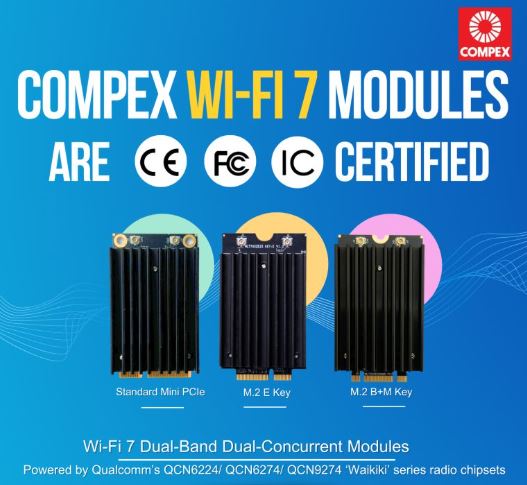
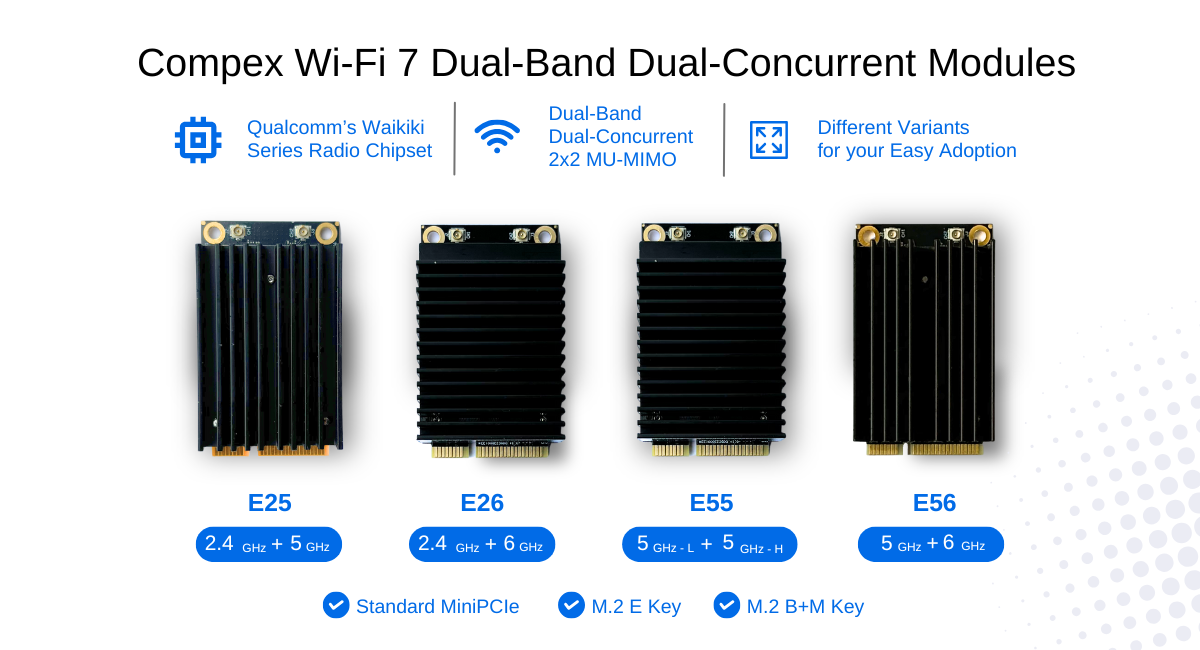
Compex Wi-Fi 7 Dual-Band Dual-Concurrent Modules are CE, FCC and IC certified and Ready for the World

𝗖𝗲𝗿𝘁𝗶𝗳𝗶𝗲𝗱 𝗮𝗻𝗱 𝗥𝗲𝗮𝗱𝘆 𝗳𝗼𝗿 𝘁𝗵𝗲 𝗪𝗼𝗿𝗹𝗱.

Compex Wi-Fi 7 Dual-Band Dual-Concurrent Modules are CE, FCC and IC certified, bringing together global compliance and industry-leading performance. Available in Standard MiniPCIe form factor and M.2 variants, our Qualcomm-powered modules deliver reliable and high-performance wireless connectivity for markets worldwide.

✅Powered by Qualcomm’s QCN6224 / QCN6274 / QCN9274 “Waikiki” series chipsets
✅Comes with band options: 2.4+5GHz, 2.4+6GHz, 5+5GHz and 5+6GHz
✅Multi-Link Operation (MLO) for higher throughput, lower latency and improved reliability
✅Diplexer Design to reduce the need for multiple Wi-Fi antennas for transmission
✅Open Source Ath12k Support

📩 Reach out to us at info@524wifi dot net or com to explore how we can power your next project.

Posted on

524 WiFi 7 DR9274E – QCN 9274 / 6274 Dual band concurrent miniPCIE Network Cards

The DR9274E is a family of high-performance WiFi 7 radio modules built on Qualcomm’s QCN9274 or QCN6274 ‘Waikiki’ series chipsets.

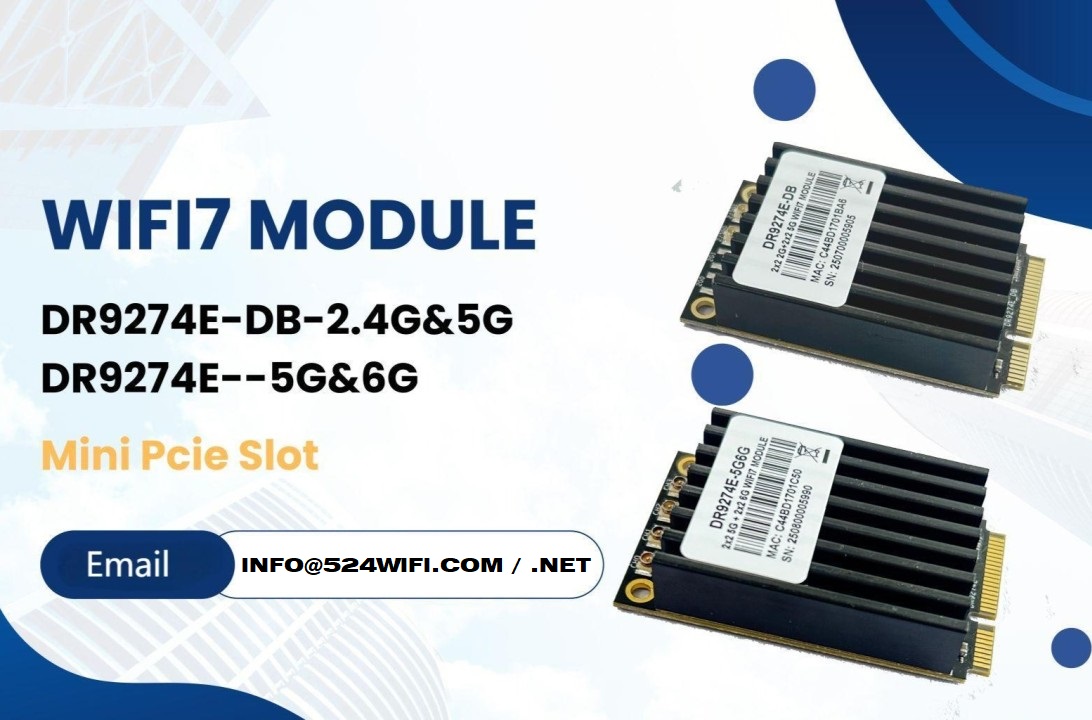
524WiFi is proud to announce the launch of two brand-new WiFi 7 MiniPCIe modules — the DR9274E-DB and DR9274E-5G6G, engineered to meet the demands of today’s most advanced industrial and commercial wireless applications.

These modules are part of the DR9274E family, built on Qualcomm’s QCN9274 / QCN6274 ‘Waikiki’ series chipsets, and designed to unlock the full potential of WiFi 7 in a compact MiniPCIe form factor. Samples available with QCN9274 chipset now !


🔧 Product Variants


⚙️ Key Features at a Glance

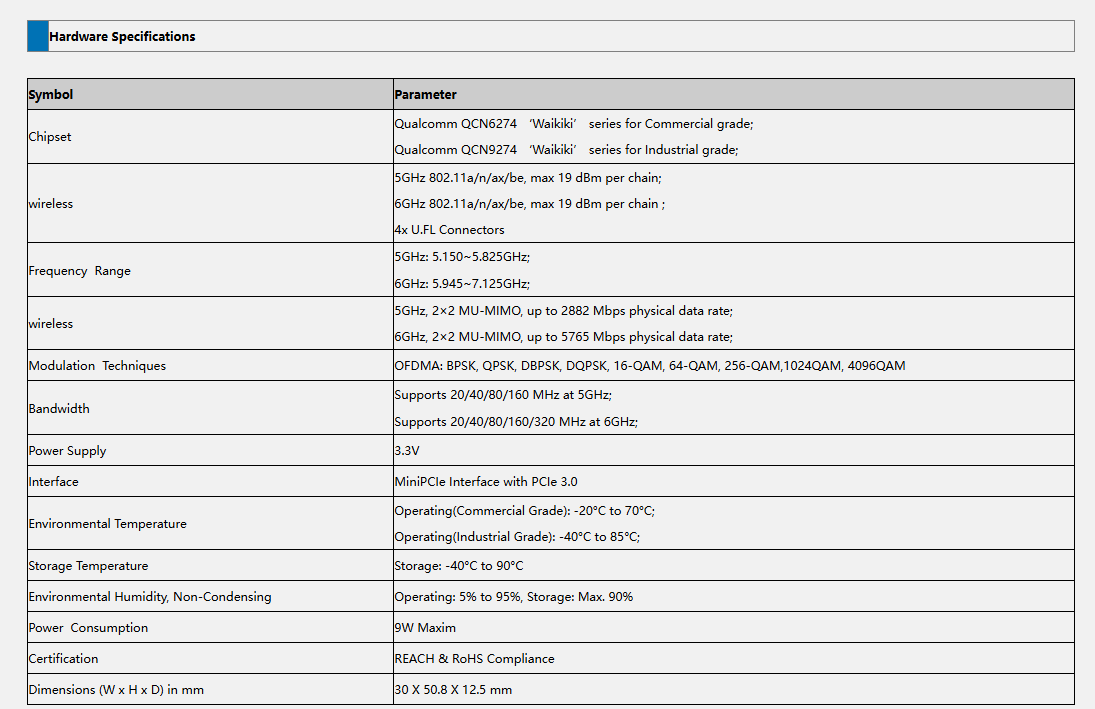
✅ Based on Qualcomm QCN6274 (Commercial Grade) or QCN9274 (Industrial Grade)

✅ Supports WiFi 7 (802.11be) for next-generation speed and efficiency

✅ 2×2 MU-MIMO at 5GHz and 6GHz

✅ Max throughput: 2882 Mbps (5GHz) and 5765 Mbps (6GHz)

✅ 320 MHz ultra-wide bandwidth support in 6GHz

✅ MiniPCIe interface with PCIe 3.0

✅ Ultra-rugged: Operating Temp up to -40°C to 85°C (Industrial)

✅ REACH & RoHS Compliant


🌐 Perfect for Demanding Applications

Whether you’re building the next smart city or designing rugged outdoor systems, the DR9274E modules are built for:

  • Industrial & Commercial WiFi Infrastructure
  • Security Surveillance Systems
  • Hotel and Campus Wireless Coverage
  • Forest Fire Monitoring Projects
  • Remote Area Connectivity
  • Custom Applications in Challenging Environments

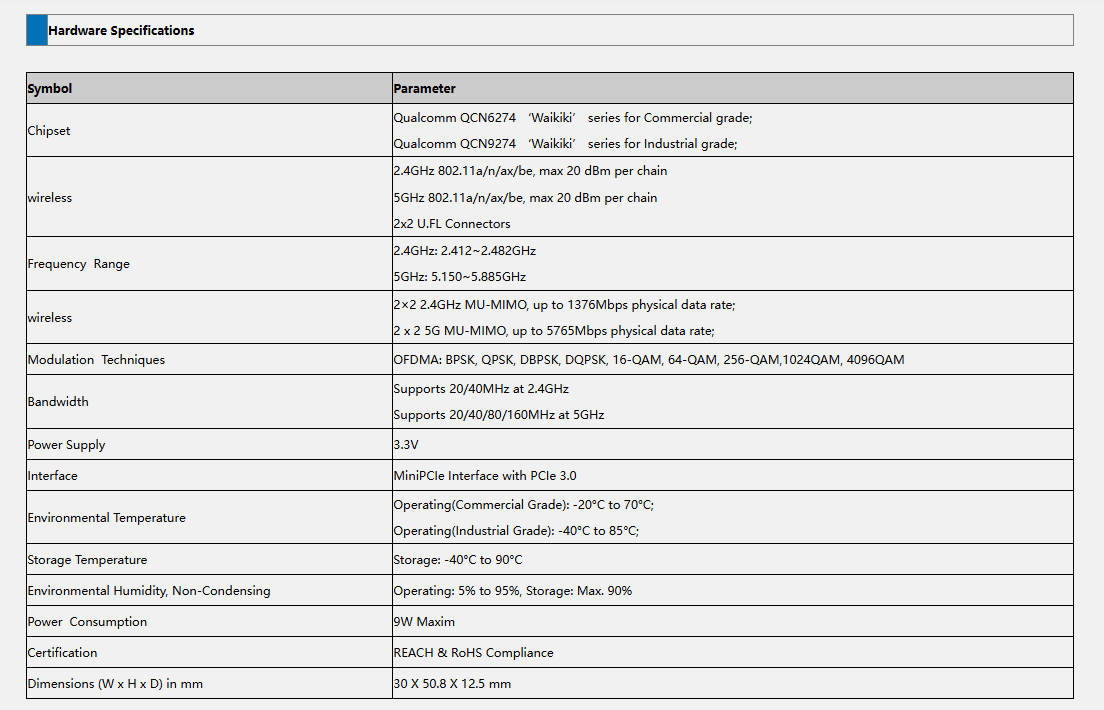
📏 Tech Specs Snapshot

Article content
DR9274E-DB
Article content
DR9274E-5G6G

💼 Looking to Integrate WiFi 7 Into Your Product?

524WiFi and Wallys specialize in custom industrial wireless solutions, and we’re ready to support your projects with:

  • Hardware customization
  • Software/driver support
  • Long-term supply guarantee
  • Technical documentation and enclosure design references

📩 Contact our sales team today at [email protected] to request datasheets, samples, or technical consultation.

Posted on

WiFi 7 M.2 E Key PCIe Module for Embedded Systems

DR9274 QCN9274 QCN6274 WiFi 7 Single Band M.2 E Key Module Datasheet

Overview

The DR9274 WiFi 7 Single Band M.2 E Key module is based on the Qualcomm® QCN9274 or QCN6274 chipset, delivering exceptional wireless performance for industrial, enterprise, and embedded applications. With Single Band (5 GHz or 6 GHz) capability and M.2 E Key form factor, it offers high-speed, low-latency connectivity optimized for modern networking solutions.


Key Features

  • Chipset Options: Qualcomm® QCN9274 or QCN6274
  • WiFi Standard: IEEE 802.11be (WiFi 7)
  • Band Support: Single Band (5 GHz or 6 GHz)
  • Form Factor: M.2 E Key
  • Interface: PCIe Gen 3
  • Modulation: Up to 4096-QAM for higher throughput
  • Security: WPA3, Enhanced Encryption
  • Industrial Temperature Range: -40°C to +85°C

Performance Advantages

  1. Ultra-High Throughput – Supports up to 320 MHz channel bandwidth for faster data transfer.
  2. Low Latency – Ideal for time-sensitive industrial control, AR/VR, and streaming applications.
  3. Improved Spectrum Efficiency – Thanks to Multi-Link Operation (MLO) and advanced modulation.
  4. Long-Range Capability – High-gain antennas and optimized RF design extend coverage.
  5. Power Efficiency – Optimized for battery-powered or embedded devices.

Applications

  • Industrial Wireless APs
  • 5G/WiFi 7 Gateways
  • Smart Cities and IoT
  • AR/VR and Immersive Media
  • High-Speed Enterprise Networking
  • Embedded Systems with M.2 E Key Interface

Technical Specifications

ParameterDescriptionChipsetQCN9274 / QCN6274StandardWiFi 7 (IEEE 802.11be)BandSingle Band (5 GHz / 6 GHz)InterfaceM.2 E Key, PCIe Gen 3Channel BandwidthUp to 320 MHzModulationUp to 4096-QAMAntenna ConnectorIPEX MHF4Temperature Range-40°C to +85°CSecurityWPA3


Why Choose Wallys DR9274 Module from 524WiFi ?

Wallys and 524WiFi specializes in custom industrial wireless solutions, offering:

  • Optimized firmware for WiFi 7 performance
  • Custom hardware design based on QCN9274/QCN6274
  • OEM/ODM/JDM services for industrial clients
  • Global technical support
Posted on

Powering the WiFi 7 Era: QCN9274 & QCN6274 Modules in Action

Powering the WiFi 7 Era: QCN9274 & QCN6274 Modules in Action

WiFi 7 isn’t just faster — it’s smarter, more efficient, and built for the future of connectivity. At the heart of this transformation are Qualcomm’s QCN9274 and QCN6274 WiFi 7 modules, engineered for high-throughput, low-latency wireless environments.

These modules are perfect for: ???? Industrial APs and high-density public deployments ???? Mesh systems requiring seamless roaming ???? Ultra-responsive applications like AR/VR, video streaming, and edge AI

???? Pair It with Wallys DR5322 (IPQ5322)

To bring these modules to life, 524WiFi offers the DR5322 router board, a powerhouse based on the IPQ5322 SoC, featuring:

  • ✅ 10G SFP port for fiber uplink
  • ✅ 1GB DDR4 (16-bit) RAM
  • ✅ Mini PCIe & M.2 slots for flexible wireless expansion
  • ✅ Perfectly compatible with QCN9274 / QCN6274 modules
  • ✅ Full support for OpenWrt/QSDK

???? Product details:  https://www.524wifi.com/index.php/catalogsearch/result/?q=5332


???? Coming Soon: IPQ5424 “Marina” Series

Wallys is preparing to release a new generation of boards based on Qualcomm’s IPQ5424 (Quad-core ARM A55 @1.8GHz) — codename Marina — offering enhanced processing power, optimized wireless efficiency, and designed with enterprise-level networking in mind.

Stay tuned for updates on our IPQ5424 platform launch!

Posted on

QCN9274 / QCN6274 Chip | x86 & Ubuntu Support | Enterprise Grade Networking

524WiFi DR9274 Wi-Fi 7 PCIe Card

QCN9274/QCN6274 Chip | x86 & Ubuntu Support | Enterprise-Grade Networking

High-Density, Low-Latency Wireless Solutions for Industrial IoT & Enterprise WiFi 7 Deployments

Introduction: The Next Era of Enterprise Wireless Connectivity

The rapid evolution of Wi-Fi 7 (IEEE 802.11be) is revolutionizing enterprise networks, demanding hardware that combines cutting-edge performance with seamless integration. The 524WiFi DR9274 PCIe Wireless Card, powered by Qualcomm QCN9274/QCN6274 chips, emerges as a game-changer. Designed for x86 architecture and fully compatible with Ubuntu systems, this module delivers multi-gigabit speeds, industrial-grade reliability, and future-proof scalability — ideal for high-stakes environments like smart factories, dense office networks, and mission-critical IoT deployments.

5 Key Advantages of 524WiFi DR9274 Wi-Fi 7 Modules

1. x86 & Ubuntu Compatibility: Unleash Developer Flexibility

  • Native x86 Support: Seamlessly integrates with Intel/AMD-based servers, industrial PCs, and edge gateways, eliminating driver conflicts.
  • Ubuntu 22.04 LTS Optimization: Pre-certified drivers and SDKs enable rapid deployment on Linux environments, with full access to OpenWRT/OpenWiFi for custom network policies.
  • Use Case: Deploy as a software-defined access point (SDAP) or cloud-managed wireless controller on existing x86 infrastructure.

2. Wi-Fi 7 Performance: Redefining Wireless Limits

  • 320MHz Channel Bandwidth: Achieves ~40Gbps aggregate throughput — 2x faster than WiFi 6E.
  • 4K QAM Modulation: Boosts data density by 20%, enhancing bandwidth-hungry applications like 8K video streaming and AR/VR.
  • Multi-Link Operation (MLO): Transmits data across 2.4GHz, 5GHz, and 6GHz bands, reducing latency to <1ms for industrial automation.

3. Flexible Deployment: Single/Dual-Band Configurations

  • Single-Band Models: Optimized for interference-free 6GHz backhaul or dedicated 5GHz IoT sensor networks.
  • Dual-Band Models: Combine 5GHz+6GHz for enterprise-grade mesh networks or 2.4GHz+5GHz for legacy device compatibility.
  • Example: Deploy 5GHz+6GHz dual-band cards in stadiums to handle 10,000+ concurrent users with zero packet loss.

4. Industrial Durability: Built for Harsh Environments

  • Extended Temperature Range: Operates at -40°C to +85°C, certified for outdoor smart grids and factory floors.
  • Hardened Security: Supports WPA3-Enterprise, AES-256 encryption, and Secure Boot to meet NIST compliance.
  • Open-Source Firmware: Customize QoS rules, VLAN tagging, and spectrum analysis via OpenWRT.

5. Qualcomm QCN9274/QCN6274: A Proven Silicon Foundation

  • 16-Stream MU-MIMO: Supports 500+ devices per card with dynamic beamforming.
  • Hardware Accelerators: Offloads CPU load for tasks like packet prioritization and intrusion detection.

Application Scenarios: Where Wi-Fi 7 Drives Transformation

1. Enterprise Wi-Fi 7 Networks

  • High-Density Offices: Support 200+ users per AP with zero buffering in 4K video conferencing.
  • HD Telemedicine: Enable real-time transmission of MRI/CT scans over 6GHz wireless links.

2. Industrial IoT & Automation

  • AGV Fleet Control: Achieve sub-millisecond latency for robotic coordination in smart warehouses.
  • Wireless PLCs: Replace wired EtherCAT networks with secure 5GHz wireless loops.

3. Carrier & Smart City Infrastructure

  • Wireless Backhaul: Replace fiber with 6GHz point-to-point links for 5G small cell aggregation.
  • Public Wi-Fi 7 Hotspots: Deploy in airports or malls with captive portals and AI-driven traffic shaping.

4. Defense & Mission-Critical Systems

  • Tactical Mesh Networks: Build self-healing wireless grids using MLO and 4K QAM.
  • Drone Command Centers: Stream 360° LiDAR data via 320MHz channels.

Conclusion: Future-Proof Your Wireless Infrastructure Today

The DR9274 Wi-Fi 7 PCIe Card transcends traditional wireless limitations by merging Qualcomm’s silicon excellence, x86/Ubuntu adaptability, and industrial resilience. Whether upgrading enterprise networks, automating factories, or building smart city backbones, this module delivers unparalleled speed, reliability, and control.

Posted on

IPQ5322 + QCN9274 + QCN6274: The Ultimate Tri-Band Wi-Fi 7 Networking Platform

With the rapid adoption of Wi-Fi 7, businesses and industrial applications require high-performance, multi-band networking platforms that deliver exceptional speed, low latency, and robust connectivity. The IPQ5322 + QCN9274 + QCN6274 solution is a powerful 10-stream Wi-Fi 7 networking platform, designed for next-generation routers, enterprise APs, and industrial wireless deployments.

Key Features of IPQ5322 + QCN9274 + QCN6274 Wi-Fi 7 Platform

🔹 Tri-Band Wi-Fi 7 with 10-Stream Configuration

  • IPQ5322: Dual-core networking SoC for high-speed processing
  • QCN9274 (5GHz 4×4 MIMO): High-performance Wi-Fi 7 radio
  • QCN6274 (6GHz 4×4 MIMO): Optimized for the new 6GHz band
  • DR5322 + DR9274-5G + DR9274-6G: Complete module integration

🔹 Multi-Link Operation (MLO) & 320MHz Channels

  • Combines multiple frequency bands for lower latency
  • Supports 320MHz ultra-wide channels for faster throughput

🔹 High-Speed Connectivity & Low Latency

  • 10Gbps+ total throughput, ideal for industrial networking
  • Reduced interference & congestion with 6GHz band support

🔹 Optimized for Enterprise & Industrial Wi-Fi Applications

  • Supports large-scale wireless deployments
  • Enhanced performance in smart factories, warehouses, and IoT networks

Why Choose IPQ5322 + QCN9274 + QCN6274 for Wi-Fi 7?

🚀 Superior Wi-Fi 7 Performance: Supports 10 streams for ultra-fast, low-latency wireless connectivity.

🔗 Enhanced MLO & MU-MIMO: Ensures seamless multi-device communication with high efficiency.

🏭 Industrial-Grade Reliability: Ideal for smart cities, industrial automation, and enterprise networking.

🛠 Customizable & Scalable: Flexible OEM/ODM options for tailored solutions.


Get Started with 524WiFi Wi-Fi 7 Solutions

524WiFi and Wallys provide a full range of Wi-Fi 7 networking platforms, including IPQ5322-based solutions with QCN9274 and QCN6274 modules. Whether you’re developing enterprise APs, industrial routers, or high-performance wireless systems, our custom hardware and software solutions can help accelerate your project.

Posted on

IPQ5322 + QCN9274 + QCN6274: The Ultimate Tri-Band Wi-Fi 7 Networking Platform

IPQ5322 + QCN9274 + QCN6274: The Ultimate Tri-Band Wi-Fi 7 Networking Platform

With the rapid adoption of Wi-Fi 7, businesses and industrial applications require high-performance, multi-band networking platforms that deliver exceptional speed, low latency, and robust connectivity. The IPQ5322 + QCN9274 + QCN6274 solution is a powerful 10-stream Wi-Fi 7 networking platform, designed for next-generation routers, enterprise APs, and industrial wireless deployments.

Key Features of IPQ5322 + QCN9274 + QCN6274 Wi-Fi 7 Platform

🔹 Tri-Band Wi-Fi 7 with 10-Stream Configuration

  • IPQ5322: Dual-core networking SoC for high-speed processing
  • QCN9274 (5GHz 4×4 MIMO): High-performance Wi-Fi 7 radio
  • QCN6274 (6GHz 4×4 MIMO): Optimized for the new 6GHz band
  • DR5322 + DR9274-5G + DR9274-6G: Complete module integration

🔹 Multi-Link Operation (MLO) & 320MHz Channels

  • Combines multiple frequency bands for lower latency
  • Supports 320MHz ultra-wide channels for faster throughput

🔹 High-Speed Connectivity & Low Latency

  • 10Gbps+ total throughput, ideal for industrial networking
  • Reduced interference & congestion with 6GHz band support

🔹 Optimized for Enterprise & Industrial Wi-Fi Applications

  • Supports large-scale wireless deployments
  • Enhanced performance in smart factories, warehouses, and IoT networks

Why Choose IPQ5322 + QCN9274 + QCN6274 for Wi-Fi 7?

🚀 Superior Wi-Fi 7 Performance: Supports 10 streams for ultra-fast, low-latency wireless connectivity.

🔗 Enhanced MLO & MU-MIMO: Ensures seamless multi-device communication with high efficiency.

🏭 Industrial-Grade Reliability: Ideal for smart cities, industrial automation, and enterprise networking.

🛠 Customizable & Scalable: Flexible OEM/ODM options for tailored solutions.


Get Started with Wallys’ Wi-Fi 7 Solutions

524WiFi provides a full range of Wi-Fi 7 networking platforms, including IPQ5322-based solutions with QCN9274 and QCN6274 modules. Whether you’re developing enterprise APs, industrial routers, or high-performance wireless systems, our custom hardware and software solutions can help accelerate your project.

Posted on

QCN9274 & QCN6274 Wi-Fi 7 with Multi-Link Operation (MLO) on X86 Devices: A New Era of Connectivity

Wi-Fi 7 with Multi-Link Operation (MLO) on X86 Devices: A New Era of Connectivity

As the world of wireless technology continues to evolve, the introduction of Wi-Fi 7 is nothing short of a game-changer. With its potential for significantly higher speeds, lower latency, and enhanced reliability, Wi-Fi 7 is set to revolutionize industries and applications ranging from industrial IoT to high-performance consumer devices. At Wallys, we’re always driven by customer needs, and as part of our commitment to offering cutting-edge solutions, we’re focused on expanding the possibilities for Wi-Fi 7 technology—specifically by enabling Multi-Link Operation (MLO) support on X86 platforms.

Expanding the Reach of Wi-Fi 7: A New Level of Compatibility

Last year, we introduced X86 driver support for our Wi-Fi 6 module, DR9074, which enabled seamless integration across a broader range of motherboard platforms, not just Qualcomm devices. This support empowered our customers to experience high-quality, stable Wi-Fi data transmission and opened the door for new applications that demand reliable and high-throughput wireless connections.

With the introduction of Wi-Fi 7, cross-platform compatibility becomes even more critical. Wi-Fi 7 brings with it a new set of features designed to push the boundaries of wireless connectivity, and one of the most significant is Multi-Link Operation (MLO). But to harness the full potential of MLO, we need to ensure that our solutions can operate on multiple platforms—something we’re excited to announce we’re working on with our DR9274 (QCN9274) and QCN6274 Wi-Fi 7 modules.

wifi6 vs wifi7

What is MLO? And Why Does It Matter?

Multi-Link Operation (MLO) is one of the standout features of Wi-Fi 7. MLO allows devices to transmit data across multiple frequency bands (like 2.4 GHz, 5 GHz, and 6 GHz) simultaneously. This multi-band transmission significantly improves throughput and reliability, while reducing latency and congestion, making it an ideal solution for environments that require high-speed and low-latency communication.

In simple terms, MLO will enable your devices to leverage the full bandwidth potential of Wi-Fi 7, resulting in faster speeds, more stable connections, and more efficient use of available spectrum.

Introducing the QCN9274 & QCN6274 Wi-Fi 7 Modules

To enable the full potential of MLO, we’re leveraging the power of QCN9274 and QCN6274—two of Qualcomm’s latest Wi-Fi 7 chipsets, both designed for high-performance applications.

  1. QCN9274 (Waikiki)
  2. QCN6274 (Waikiki)
MLO

These two powerful chipsets represent the future of Wi-Fi 7 and provide the foundation for expanding compatibility across a variety of platforms. With MLO support, both the QCN9274 and QCN6274 enable better utilization of the 2.4, 5, and 6 GHz bands, delivering faster speeds and more reliable connections.

wifi7 new features

What Will MLO Bring to Your X86 Devices?

By introducing MLO support for X86 devices, we’re pushing the envelope on what’s possible in wireless networking. Users of X86 platforms will now be able to tap into the full power of Wi-Fi 7, unlocking:

  • Higher Throughput: With MLO, data is split across multiple channels, leading to faster speeds and higher data rates, ideal for bandwidth-hungry applications like streaming, gaming, and industrial IoT.
  • Enhanced Reliability: MLO ensures that devices can maintain stable connections, even in environments with interference or congestion, by balancing traffic across different frequency bands.
  • Reduced Latency: Faster communication between devices can significantly reduce lag and improve the responsiveness of real-time applications, from virtual reality to autonomous systems.

The implications are significant. Wi-Fi 7, combined with MLO, could transform industries that rely on seamless, high-performance wireless connectivity—think smart cities, industrial automation, healthcare, and beyond.

524WiFi Adapter Card (wifi7 adapter card coming soon)

What’s Next for Wi-Fi 7 on X86?

At 524WiFi, we’re committed to ensuring that our solutions are as versatile and adaptable as possible. With the upcoming X86 driver support for DR9274 and MLO functionality, you’ll be able to take full advantage of Wi-Fi 7 speeds and unlock new potential for your devices.

Thoughtput testing:achieve 8Gbps+ speed

This new capability will open up new opportunities for a variety of applications, and we’re eager to see how our customers will integrate this powerful technology into their own use cases.

DR9274 wifi7 M.2 card

Are You Ready for the Future of Wireless Connectivity?

With Wi-Fi 7’s blazing-fast speeds and MLO’s game-changing capabilities, the possibilities are endless. How do you envision using Wi-Fi 7 with MLO on your X86 platforms? Whether it’s enhancing your industrial IoT devices, supporting next-gen gaming applications, or powering high-bandwidth communications, the potential is vast.

At 524WiFi, we’re excited to continue innovating and providing the tools you need to stay ahead in the rapidly evolving wireless landscape. If you’re interested in learning more about our Wi-Fi 7 solutions or how we can help with your next project, feel free to reach out to us.

Let’s shape the future of connectivity, together.