Posted on

Qualcomm IPQ9574 with MLO support, dual 10G Ethernet, wide temperature industrial design – DR9574 support QSDK and OpenWRT 3 band MLO

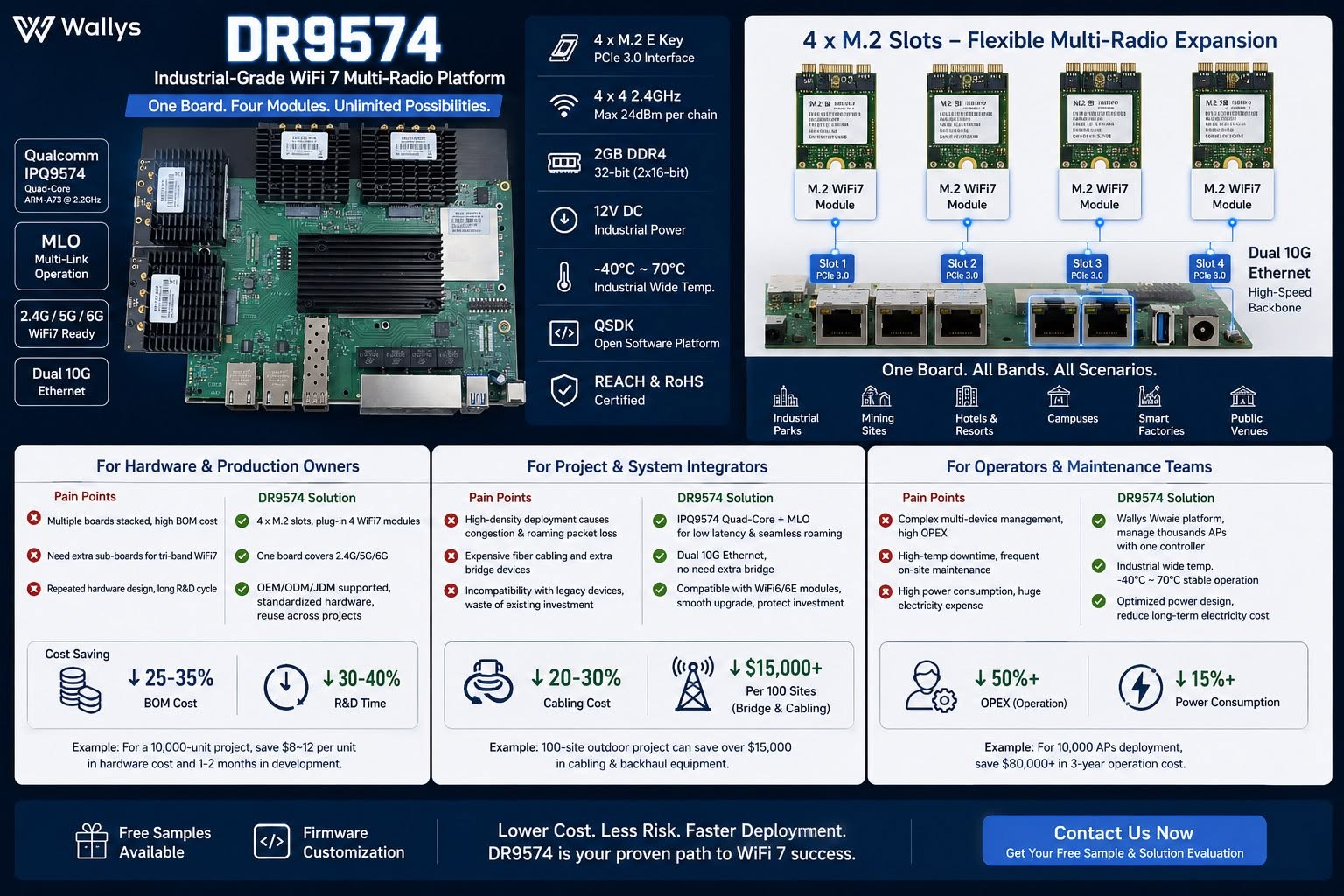
DR9574 Industrial WiFi7 Multi-Radio Board – One board, four M.2 radio modules, unlimited wireless deployment possibilities.

Built on Qualcomm IPQ9574 with MLO support, dual 10G Ethernet, wide temperature industrial design.

Lower BOM, less cabling cost, fewer maintenance workloads & power consumption for mass AP projects.

Ideal for system integrators, OEM hardware makers & wireless operators serving campuses, mining, smart factory & hospitality networks.

Testing samples & firmware customization available – DM to get your solution evaluation!
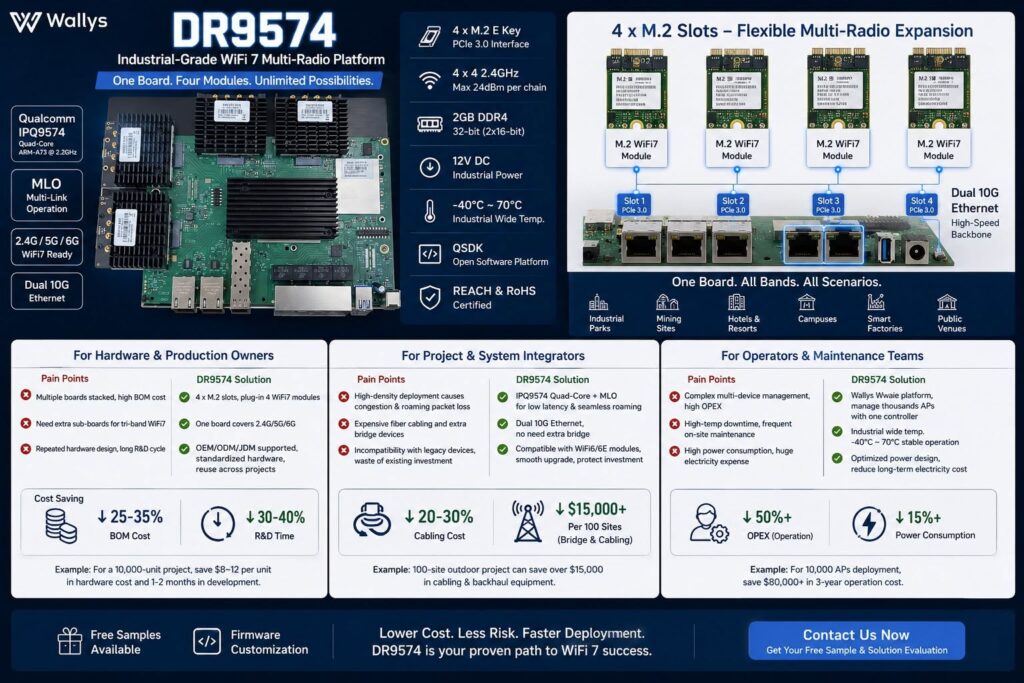
QSDK based firmware with QCA drivers is available , 3 card 3 band MLO support !! 4×4 MU MIMO or 2×2 MU MIMO configuration for 3 band MLO available.

https://wifi5.eu/dls/Wallys/DR9574

OpenWRT support available too !!

— working mainline OpenWrt port (10G + Wi-Fi 7 MLO)

Over the past few weeks we’ve brought the board up on a fully mainline stack — mainline Linux 6.12 + OpenWrt + ath12k, no QSDK and no out-of-tree datapath driver — and it now cold-boots from NAND into a working router/AP with both:

– 10G USXGMII ethernet (the AQR113C ports) bringing up a link and passing traffic with a DHCP lease, and
– a 3-link Wi-Fi 7 AP-MLD (one SSID across 6 / 5 / 2.4 GHz, WPA3-SAE) on mainline ath12k, with a real client associating and passing iperf traffic.

Getting the 10G working on mainline required root-causing and fixing an actual upstream kernel bug — a per-port clock that was left at the 10G rate regardless of the negotiated link speed. It’s a small, clean patch I’m preparing for the netdev mailing list, and it should help any IPQ95xx board with an Aquantia USXGMII PHY, not just this one.

Everything is public and reproducible here:
https://codeberg.org/insalata-fresca/openwrt-dr9574
(device tree, the patch set, and a write-up of the root cause.)

Why we think this could be interesting for you : a mainline-based firmware track means a current kernel with ongoing security fixes, an auditable, blob-minimal stack, and upstreamable patches — a strong story for customers who need long support windows, as a complement to the QSDK option.

W've pushed the mainline port further: the four 2.5G QCA8084 LAN ports are now the focus. The four copper PHYs come up and answer on mainline, and the 10G/USXGMII uplink and the 3-link Wi-Fi 7 MLO already work. But the 2.5G ports don't pass traffic yet,and I've traced it to one specific, well-understood gap.

In short: the QCA8084's internal XPCS never becomes reachable over MDIO. The chip's security-control config space (0xC90F000, which holds WORK_MODE and the SerDes/XPCS MDIO address fix-up) is readable but appears write-locked in our mainline bring-up. The driver writes the correct values (work mode 0x2f, XPCS MDIO address 7), but they don't take - so the XPCS stays at a default address, answers nowhere, and everything downstream (per-channel config, link, traffic) is blocked behind it. We are working on the final solution now.


The full write-up and the exact register evidence are on a public WIP page:

Status and the open question:
https://codeberg.org/insalata-fresca/openwrt-dr9574/src/branch/wip-qca8084-2p5g/docs/qca8084-2p5g-status.md

Register evidence (the actual readouts):
https://codeberg.org/insalata-fresca/openwrt-dr9574/src/branch/wip-qca8084-2p5g/docs/qca8084-2p5g-register-evidence.md

Repo root (device tree, 10G and Wi-Fi 7 patches):
https://codeberg.org/insalata-fresca/openwrt-dr9574

Posted on

VLAN Applications in the Logistics Industry – Smart Warehouse & Automation Systems

As the logistics industry continues to evolve, there is a growing need for efficient, stable, and flexible networking solutions. Virtual Local Area Networks (VLANs) provide a powerful tool for managing network traffic, optimizing resources, and improving both efficiency and security within logistics operations. Below are several key VLAN application scenarios within the logistics industry.


1. Smart Warehouse & Automation Systems

Smart warehouses, equipped with automated systems like robotic arms, conveyor belts, sensors, and RFID systems, rely on a robust network for seamless data exchange. VLANs can improve network performance by segmenting traffic based on device type.

  • VLAN Segmentation:
  • VLAN 10 (Automated Guided Vehicle Network): Ensures low-latency, high-priority communication for automated guided vehicles (AGVs).
  • VLAN 20 (RFID & Scanners): Provides dedicated bandwidth for RFID systems and scanners, ensuring real-time tracking.
  • VLAN 30 (Surveillance Network): Segregates video surveillance data from other traffic to prevent congestion.

VLAN helps ensure that critical devices such as AGVs and RFID scanners can communicate without interference, enhancing warehouse efficiency.


2. Sorting Systems in Distribution Centers

Sorting systems in distribution centers often involve complex automation machinery that requires real-time communication to optimize the sorting of parcels. VLANs help ensure smooth operation by prioritizing the traffic of sorting equipment.

  • VLAN Segmentation:
  • VLAN 100 (Sorting Equipment Network): Dedicated VLAN for the machinery that handles sorting, minimizing delays caused by high data traffic.
  • VLAN 200 (Office Management Network): Separates office traffic from operational machinery, avoiding disruptions to real-time sorting tasks.
  • VLAN 300 (Customer Service Interface): Isolates customer-facing systems, ensuring customer data remains secure while other operational processes run smoothly.

VLANs optimize data flow within the sorting systems and prevent network congestion, increasing overall throughput.


3. IoT Devices and Wireless Networks

In the logistics industry, IoT devices such as temperature sensors, GPS trackers, and smart locks play an integral role in monitoring and managing goods during transit and storage. VLANs are essential for managing and securing wireless network traffic.

  • VLAN Segmentation:
  • VLAN 50 (IoT Device Network): Creates a dedicated VLAN for all IoT devices, ensuring reliable data transfer while isolating traffic from other networks.
  • VLAN 60 (Customer Wi-Fi Network): Segregates visitor and employee Wi-Fi access from critical business systems to ensure security.

Using VLANs ensures that sensitive logistics data from IoT devices is protected and prioritized, enabling real-time monitoring and secure communications.


4. Security and Data Isolation

The logistics industry handles sensitive customer data, inventory management information, and delivery details. VLANs are used to isolate these critical data streams from other less sensitive traffic, adding an additional layer of security.

  • VLAN Segmentation:
  • VLAN 10 (Management and Control Network): Isolates administrative systems and critical control networks to prevent unauthorized access.
  • VLAN 20 (Customer Data Network): Protects customer and order information by creating a separate VLAN for processing sensitive data.
  • VLAN 30 (Surveillance Network): Ensures video feeds from surveillance cameras are kept within a dedicated network, preventing bandwidth overload.

VLANs improve data security by isolating sensitive systems from regular traffic, reducing the risk of data breaches or unauthorized access.


5. Integration with 5G Networks

As logistics operations increasingly incorporate 5G technology, VLANs help ensure that high-priority devices, such as autonomous delivery vehicles and drones, have dedicated network resources for efficient communication.

  • VLAN Segmentation:
  • VLAN 70 (Autonomous Vehicle Network): Dedicated VLAN for vehicles and drones that require low-latency and high-bandwidth communication.
  • VLAN 80 (Public-facing Network): Provides separate VLANs for external systems, ensuring no interference with mission-critical logistics systems.

Integrating VLANs with 5G allows logistics companies to optimize network performance for high-demand devices, ensuring smooth and efficient operations.

Router board DR4019 Vlan Solution

✅ Industrial-Grade Performance

  • Qualcomm IPQ4019/IPQ4029 chipset for stable, 24/7 operation.

✅ High-Power Wireless Connectivity

  • Dual-band radios: 2×2 5GHz & 2×2 2.4GHz high-power modules.
  • Frequency range: 4.940GHz–5.825GHz & 2.400GHz–2.482GHz.
  • MMCX connectors for flexible antenna deployment.
  • Supports 5MHz/10MHz/20MHz/40MHz/80MHz bandwidth.

✅ VLAN & Network Optimization

  • VLAN-ready for secure network segmentation in logistics hubs.
  • 802.11s Mesh support for seamless warehouse connectivity.
  • Fixed data rate for AGVs, RFID, and IoT tracking.

✅ Flexible Firmware & Integration

  • Supports OpenWRT, QSDK, OpenWiFi.
  • Compatible with Quectel modules for LTE/5G expansion.

✅ Environmentally Safe

  • RoHS compliant, ensuring safety and sustainability.
DR4019 mainboard ipq4019

Conclusion

VLAN technology plays a crucial role in optimizing network performance, improving security, and supporting the growth of smart logistics systems. By segmenting traffic based on device type and use case, logistics companies can improve data flow, reduce congestion, and ensure secure communication across their networks. As the logistics industry continues to evolve with IoT, automation, and 5G, VLANs will remain a key component in driving efficiency, security, and innovation.

The Router board DR4019 Vlan Mesh Solution
Posted on

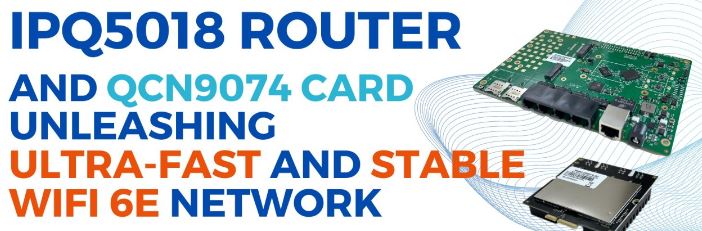
IPQ5018 Router and QCN9074 Card: Ultra-Fast and Stable WiFi 6E Network

Experience the Power of WiFi 6E with IPQ5018 Router and QCN9074 Card Duo

Get ready to experience unparalleled speed and stability with the IPQ5018 Router and QCN9074 Card duo. Designed for high-performance wireless networking, the IPQ5018 boasts integrated 802.11ax Wi-Fi/Bluetooth 5.1 subsystems, delivering cost-effective and efficient connectivity.

IPQ5018

The IPQ5018 is a highly integrated System-on-Chip (SoC) designed and manufactured for high-performance and efficient wireless network applications, including home routers, mesh nodes, and gateways. It features integrated 802.11ax Wi-Fi/Bluetooth 5.1 subsystems, providing high efficiency and cost-effectiveness.

Key Features:

– Wi-Fi subsystem supports IEEE802.11ax, incorporating a wireless radio operating in the 2.4 GHz band with 2 antennas (2×2/40).

– Network subsystem:

– Low-power PCIe interface with L1 sub-states.

– Two Ethernet ports:

– One integrated GbE PHY.

– One SerDes supporting 3.125/1.25 Gbps Ethernet ports for external 2.5/1 GbE PHY. This SerDes operates in SGMII+ or SGMII mode to connect to 2.5 GbE PHY or single-port GbE PHY.

In today’s fast-paced digital world, a reliable and lightning-fast internet connection is essential for seamless connectivity. With the advent of WiFi 6E technology, users can now enjoy unprecedented speed, stability, and coverage. The combination of the IPQ5018 Router and QCN9074 Card delivers an unparalleled WiFi 6E experience, setting new standards for home and business networks.

The IPQ5018 Router is a powerhouse in the world of networking, equipped with advanced features and cutting-edge technology to provide ultra-fast and stable connectivity. Its robust hardware ensures maximum performance, while its intelligent software optimizes network traffic for an uninterrupted online experience.

Paired with the QCN9074 Card, this duo takes WiFi 6E to new heights. The QCN9074 Card is designed to maximize the capabilities of WiFi 6E, offering higher speeds, lower latency, and increased capacity compared to previous generations. With its advanced beamforming and MU-MIMO technology, the QCN9074 Card ensures optimal signal strength and coverage throughout your home or office.

Together, the IPQ5018 Router and QCN9074 Card create a WiFi 6E network that is not only blazing fast but also incredibly stable. Whether you’re streaming 4K videos, gaming online, or video conferencing with colleagues, you can count on a seamless and lag-free experience.

But the benefits don’t stop there. The IPQ5018 Router and QCN9074 Card also prioritize security, with robust encryption protocols and built-in firewalls to protect your network from cyber threats. Additionally, advanced parental controls and network management tools allow you to customize and monitor your network with ease.

In conclusion, the IPQ5018 Router and QCN9074 Card combination is the ultimate solution for those seeking a high-performance WiFi 6E network. Experience the future of connectivity today with unparalleled speed, stability, and coverage.

Router board DRiver 5018

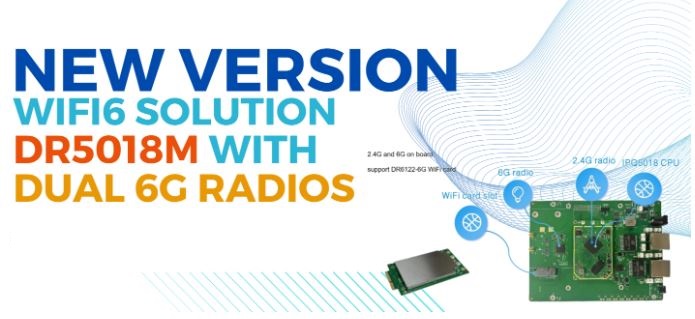
DR5018 based on IPQ5018 chipset is an enterprise wireless module integrated with BT5.1 Radio module and 2×2 2.4G high power Radio module designed specifically to provide users with mobile access to high-bandwidth video streaming, voice, and data transmission for office and challenging RF environment in factories, warehouses establishment.

CPU: Qualcomm-Atheros IPQ5018

CPU Frequency: Dual-core ARM 64-bit A53 @1.0 GHz processor

System Memory: 512MB DDR3L 16-bit interface with 32-bit memory bus design (Optional support for 1G)

Ethernet Port: 4 x 1Gbps Ethernet Ports or 1 x 1Gbps Ethernet Port & PoE

NGFF Slot: M.2 Card Slot for 5G (QUECTEL RM 500Q-GL); M.2 Card Slot for QCN9074 WIFI 6E Card

PoE: Support

DC Jack: 12V power supply

LED Header: LED for power, WiFi strength

Serial Port: Support

Wireless: On-board 2×2 2.4GHz MU-MIMO OFDMA 802.11b/802.11g/802.11n/802.11ax, max 23dBm per chain; 2x IPEX Connectors

Bluetooth: BT5.1 (optional)

Nor Flash: 8MB

Nand Flash: 128 MB

DDR: 512MB

Dimension: 170mm x 120mm x 15mm

WiFi6 module DRiver 9074

Chipset: Qualcomm Atheros QCN9074

WLAN Host Interface: PCI Express 3.0 Interface

System Memory: 2Mbit serial I²C bus EEPROM

Standard Operating Voltage: 5V

Operating Systems: QSDK

Host Interface: M.2 E Key

Antenna Cable / Port: 4 x MMCX Connectors, 4T4R

Frequency Range: 5.925GHz-7.125GHz

Data Rates: 6GHz, max 23dBm per chain, up to 4804Mbps

Channel Spectrum Widths: Support 20/40/80/160MHz at 6GHz

Modulation Techniques: OFDMA: BPSK, QPSK, DBPSK, DQPSK, 16-QAM, 64-QAM, 256-QAM, 1024-QAM

Temperature Range: Operating: -20°C to 70°C, Storage: -40°C to 90°C

Humidity: Operating: 5% to 95% (non-condensing), Storage: Max. 90% (non-condensing)

Certification: TBD

Power Consumption: TBD

Reference Design: PN02.7

Dimensions (WxHxD): 57mm x 63mm x 6mm