
Posted on

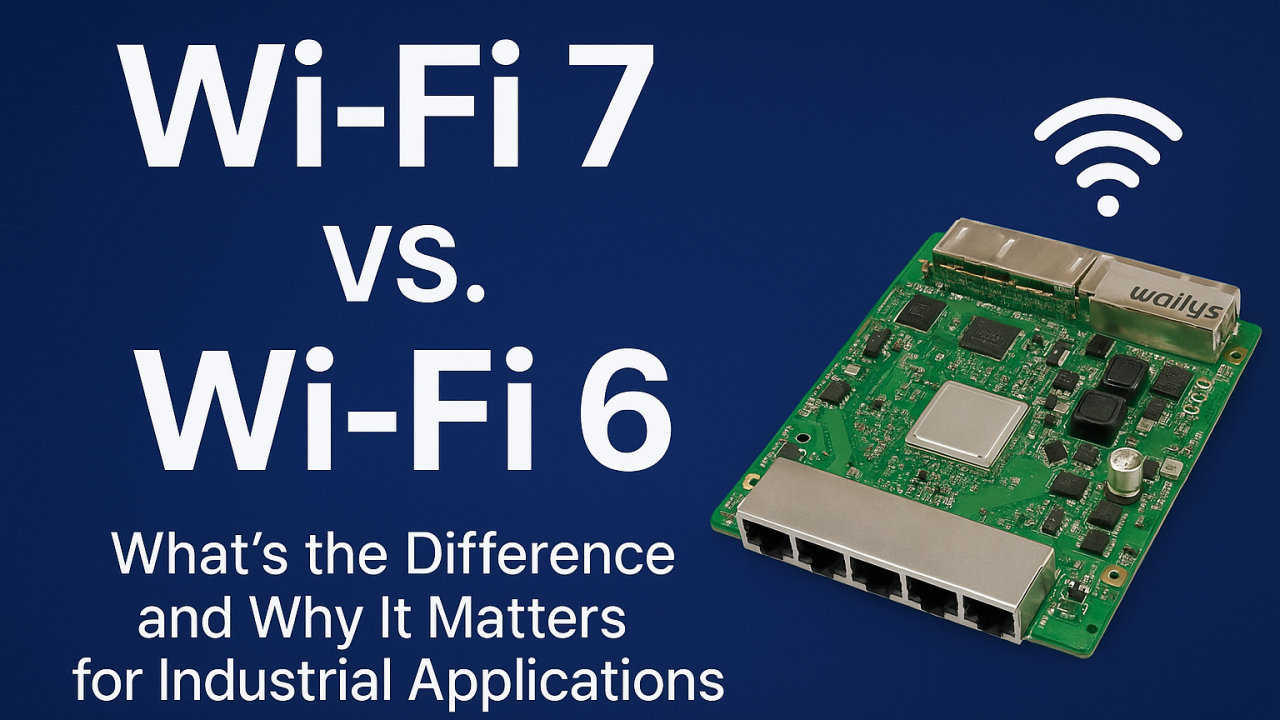
Wi-Fi 7 vs. Wi-Fi 6: What’s the Difference and Why It Matters for Industrial Applications?

As industrial environments become more automated, connected, and data-driven, the demand for a faster, more reliable wireless network continues to grow. Wi-Fi 6 has served industries well in recent years, but Wi-Fi 7 introduces features that fundamentally reshape performance, latency, and reliability—especially in mission-critical industrial applications.

Many factories, warehouses, and outdoor industrial sites are now evaluating whether upgrading to Wi-Fi 7 is worth it. The answer becomes clear once you understand the major improvements Wi-Fi 7 brings compared to Wi-Fi 6.


What’s New in Wi-Fi 7 Compared to Wi-Fi 6?

Wi-Fi 7 introduces several breakthroughs that directly benefit industrial environments:

Faster Speeds and Higher Throughput Wi-Fi 7 supports up to 320 MHz channels and 4K QAM, providing significantly higher bandwidth. This is especially beneficial for AI vision systems, 4K/8K video streams, and large volumes of sensor data in industrial scenarios.

Multi-Link Operation (MLO) This is the most important upgrade for industrial automation. MLO allows devices to connect to multiple Wi-Fi bands at the same time, dramatically enhancing:

  • Reliability
  • Latency
  • Roaming
  • Interference resistance

When one link experiences congestion or interference, data continues flowing through the other link—ideal for AGVs, AMRs, and robotic control systems.

Lower Latency for Real-Time Control Wi-Fi 7 reduces latency to sub-millisecond levels, enabling smoother machine-to-machine communication, PLC data exchange, and industrial robot coordination.

Better Performance in Noisy Industrial Environments Factories, ports, and warehouses contain many devices that create interference. Wi-Fi 7 handles these challenges through:

  • Intelligent multi-link scheduling
  • Faster channel switching
  • Improved OFDMA efficiency

This results in more stable wireless networks, even in heavily congested areas.


Why Wi-Fi 7 Matters for Industrial Applications

Enhanced Reliability for Smart Factories Real-time monitoring, predictive maintenance, and machine communication depend on uninterrupted connectivity. Wi-Fi 7 ensures stable links for sensors, controllers, and production lines.

Seamless Mobility for AGV and AMR Fleets Automated robots cannot afford Wi-Fi dead zones or packet loss. MLO supports smoother roaming, faster handovers, and high-precision navigation.

Better Edge Computing and AI Performance Industrial AI workloads often transmit large amounts of data for inference or analysis. Wi-Fi 7 accommodates high-throughput data without compromising stability.

Higher Density Support for IIoT Deployments Factories may have thousands of connected devices. Wi-Fi 7’s improved scheduling and wider channels support larger device ecosystems without congestion.

Strengthening Industrial Video Surveillance AI-enhanced cameras and real-time analytics benefit from Wi-Fi 7’s higher bitrate capacity and lower latency.


Real-World Industrial Use Cases for Wi-Fi 7

  • AGV/AMR navigation and fleet management
  • Smart logistics and warehouse management systems
  • Industrial video surveillance with AI analytics
  • Real-time sensor networks in smart factories
  • Wireless backhaul bridging for ports and outdoor sites
  • Edge computing devices with high data demands
  • Autonomous machines and robotics

Wi-Fi 7 enables smoother, safer, and more efficient industrial operations.


Why Choose 524WiFi and Wallys Wi-Fi 7 Routerboards?

We provide industrial-grade Wi-Fi 7 routerboards such as DR5322S (IPQ5322) and next-generation DR9574 (IPQ9574) that support:

  • Wi-Fi 7 + MLO
  • POE/POE Out
  • Long-distance transmission
  • Industrial temperature rating
  • Customizable hardware and firmware
  • Mesh & roaming solutions
  • OEM/ODM/JDM services for industry customers

Each board is optimized for harsh industrial deployment and supports custom configurations for automation, logistics, or edge computing projects.


Wi-Fi 7 is not just an incremental improvement over Wi-Fi 6—it’s a major leap designed for industries that require reliability, speed, and real-time responsiveness. For industrial automation companies planning future-proof networks, upgrading to Wi-Fi 7 can unlock significant performance and operational advantages.

For customized Wi-Fi 7 routerboards and industrial wireless solutions, contact us !
Posted on

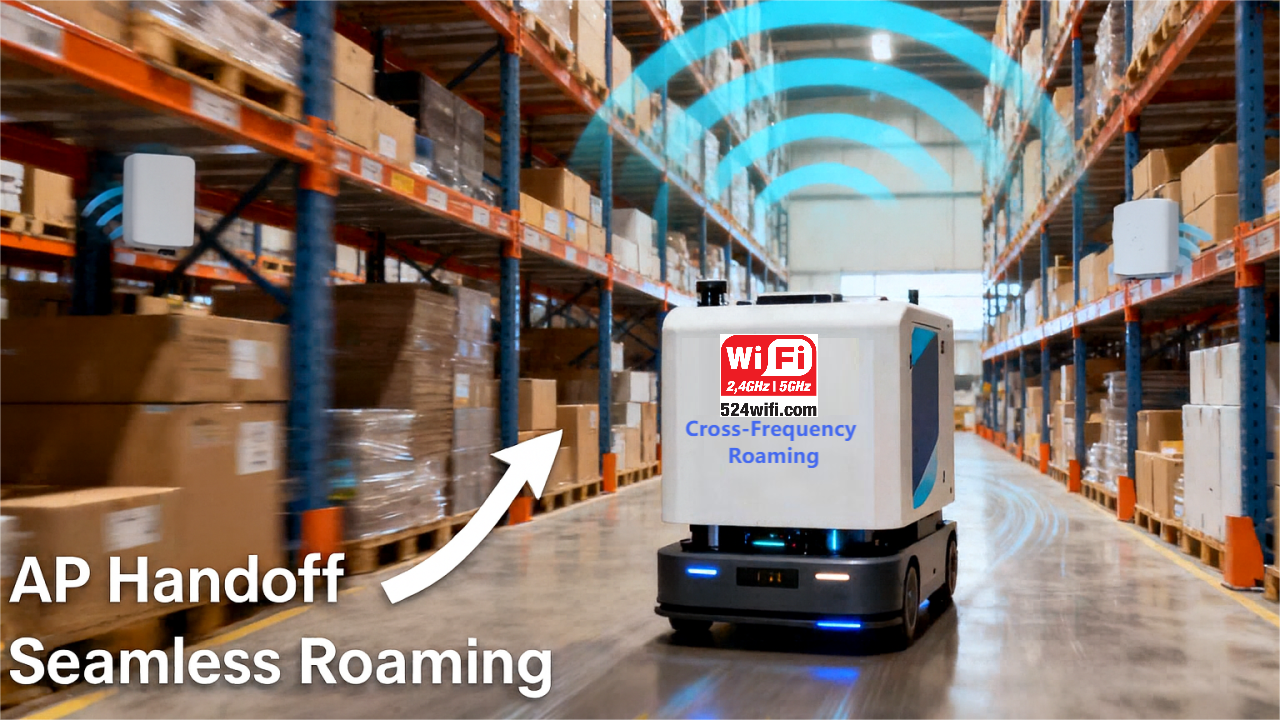
IPQ5018 + QCN6102 Enable Seamless Same & Cross Frequency Roaming for AGVs and AMRs

Seamless Same-Frequency & Cross-Frequency Roaming for AGVs and AMRs

In modern automated warehouses, stable and uninterrupted wireless connectivity is essential. Autonomous vehicles such as AGVs and AMRs depend on real-time communication for navigation, safety, and task execution. Any packet loss or delay can disrupt operations.

To meet these challenges, 524WiFi and Wallys Communications introduces its next-generation 5G Roaming Technology, engineered for mission-critical industrial environments requiring both same-frequency roaming and cross-frequency roaming. This new solution builds on the proven foundation of our Peacock Series while delivering significantly enhanced stability for complex warehouse deployments.


Why 524WiFi & Wallys 5G Roaming Is a Game Changer

Traditional roaming solutions often struggle when APs operate on different channels or when robots move rapidly across overlapping wireless coverage zones.

Wallys 5G Roaming enables instantaneous transitions between APs, whether the next AP is operating on:

  • The same frequency and same channel
  • The same frequency but a different channel
  • A different frequency band entirely

This flexibility eliminates typical roaming delays and ensures continuous operation in heterogeneous RF environments.


1. Cross-Frequency Roaming

AGVs and AMRs can move seamlessly between APs operating on different channels or different frequency bands. This is ideal for large warehouses where RF planning varies across zones.

Key benefit: ✔ Smooth transitions even when moving from Channel 36 to Channel 149, Channel 165, or mixed-band coverage areas.


2. Same-Frequency Roaming

In environments where APs share the same channel—common in dense warehouse layouts—Wallys roaming provides uninterrupted handoffs with zero packet loss.

Key benefit: ✔ Reliable connectivity even in high-density, same-channel deployments.


3. Zero Packet Loss & Ultra-Low Latency

Whether roaming is same-frequency or cross-frequency, the system consistently maintains:

  • Zero packet loss during handoff
  • Sub-millisecond switching times
  • Stable connectivity during continuous movement

This eliminates lag, communication gaps, and navigation issues associated with traditional roaming.


Real-World Warehouse Application

Imagine a fleet of AGVs navigating:

  • Narrow aisles
  • Large open areas
  • Mixed indoor and semi-outdoor regions
  • Zones where APs operate on different 5G channels

As each AGV moves from one coverage zone to another, Wallys roaming ensures instant, seamless transitions:

  • Channel 36 → Channel 149 → Channel 165
  • Same-channel AP-to-AP switching
  • Transition between heterogeneous frequency zones

Connectivity remains solid throughout—no interruptions, no delays, no impact on workflows.


Why Warehouse Leaders Are Choosing 524WiFi & Wallys

  • Supports both same-frequency and cross-frequency roaming
  • Designed for AGVs, AMRs, and industrial IoT environments
  • Demonstrated performance in complex, high-interference warehouses
  • Backed by 524WiFi’ extensive wireless engineering expertise

This positions warehouses for higher automation efficiency and long-term scalability.


Upgrade Your Warehouse Connectivity

524WiFi and Wallys 5G Roaming Technology delivers the reliability required for next-generation warehouse automation. Enable your AGVs and AMRs to operate consistently, safely, and efficiently—no matter how challenging the RF environment.

Posted on

Understanding Wireless Roaming: The Backbone of Seamless Connectivity.

wireless roamin

In today’s hyper-connected world, the expectation of uninterrupted wireless connectivity has become a given, whether we’re in an office, a factory, or a moving vehicle. Behind the scenes, one key technology enables this seamless experience: wireless roaming. This article explores the core principles of roaming, its significance in industrial applications, and how companies like Wallys are optimizing this technology for critical environments.

What is Wireless Roaming?

Wireless roaming refers to the process by which a device maintains its network connection while moving between different wireless access points (APs) within the same network. As a device moves out of the range of one AP, it must connect to another AP without dropping the connection or disrupting the user experience. This handover needs to be smooth and fast, especially in environments where continuous connectivity is crucial.

For example, think about walking through an office building while on a video call. As you move from one area to another, your device will transition between different APs. If roaming is well-implemented, you won’t even notice this transition; your call will continue uninterrupted.

The Technical Standards Behind Roaming

Roaming is made possible through a combination of advanced wireless standards that help devices decide when and how to switch between APs. The most critical of these standards include:

  • 802.11k: This standard allows devices to make informed decisions about which AP to connect to next. It does this by gathering information about the surrounding network, such as the signal strength of neighboring APs. By having this data in advance, the device can more quickly and intelligently choose the best AP when it’s time to switch.
  • 802.11r: Also known as Fast BSS Transition, this standard is crucial for minimizing the delay during AP handovers. In typical scenarios, when a device switches APs, it has to go through a re-authentication process, which can cause a noticeable delay. 802.11r speeds up this process by allowing the device to pre-authenticate with the next AP while still connected to the current one, enabling a faster and more seamless transition.
  • 802.11v: This standard provides network management features that optimize roaming performance. For instance, it allows the network to “advise” devices on which APs they should connect to based on current network conditions, such as load balancing or signal strength. This proactive management can lead to more efficient roaming and better overall network performance.

Challenges in Wireless Roaming

Despite these advanced standards, implementing effective roaming can be challenging, particularly in complex environments. Some of the key challenges include:

  • Handoff Delays: Even with fast protocols like 802.11r, there’s always a risk of delays during the handoff process. This can be particularly problematic in environments where even a brief interruption is unacceptable, such as in automated industrial systems or real-time communication platforms.
  • Signal Interference and Coverage Gaps: In large or densely populated areas, signal interference from other devices or physical obstructions can disrupt the roaming process. Similarly, coverage gaps between APs can cause a device to lose connection before it finds the next AP, leading to dropped connections.
  • Security Considerations: Each time a device switches APs, it typically has to re-authenticate, which can create a window of vulnerability. Ensuring that this process is both fast and secure is a major concern in environments where data security is critical.

Roaming in Industrial Applications

The importance of effective roaming becomes even more apparent in industrial and enterprise environments, where seamless connectivity is often mission-critical. In these settings, devices might be continuously on the move—whether they are automated guided vehicles (AGVs) in a warehouse, mobile devices used by workers on a factory floor, or surveillance cameras in a smart city.

For example:

  • In Smart Cities: Public transportation systems often rely on roaming to maintain live video feeds from buses or trains as they move through the city. Here, uninterrupted connectivity ensures real-time monitoring and security.
  • In Warehouses: AGVs that move goods around large storage areas must remain connected to the central control system at all times. Any interruption in connectivity could halt operations or cause errors in the logistics process.
  • In Manufacturing: Factory automation systems depend on reliable wireless communication to coordinate complex processes. Roaming ensures that these systems can operate smoothly even as components or devices move throughout the facility.

524WiFi and Wallys’ Solutions for Optimized Roaming

524WiFi and Wallys have developed a range of wireless solutions specifically designed to address the challenges of roaming in industrial environments. By integrating high-performance hardware with advanced firmware, 524WiFI ensures that devices can roam seamlessly between APs with minimal delay and maximum reliability.

  • High-Performance Hardware: 524WiFI’ wireless modules are built with robust components that enhance signal strength and reduce the likelihood of interference. This hardware foundation is critical for ensuring strong, stable connections that can support fast and efficient roaming.
  • Optimized Firmware: Wallys’ custom firmware is tailored to optimize roaming performance. This includes intelligent algorithms that manage AP selection and transition processes, ensuring that devices always connect to the best available AP with minimal disruption.
  • Ease of Integration: 524WiFi’ solutions are designed to be easily integrated into existing networks, making it simple for enterprises to upgrade their systems with advanced roaming capabilities. Whether you’re deploying a new network or enhancing an existing one, we provide the tools and support needed for a smooth implementation.

The Future of Roaming – Wi-Fi 6E and Wi-Fi 7

As wireless technology continues to evolve, the future of roaming looks promising. With the advent of Wi-Fi 6E and Wi-Fi 7, we can expect even faster and more reliable roaming capabilities, especially in high-density environments. Additionally, the integration of AI and machine learning into network management could enable even smarter and more predictive roaming, further enhancing the user experience.

Moreover, the convergence of Wi-Fi and 5G networks is likely to play a significant role in the future of roaming, particularly in industrial applications. The ability to seamlessly switch between different types of networks, such as Wi-Fi and cellular, will open up new possibilities for continuous connectivity in the most demanding environments.

Conclusion

Wireless roaming is a critical component of modern networking, enabling seamless connectivity in a wide range of environments. As the demand for uninterrupted wireless communication continues to grow, especially in industrial and enterprise settings, the importance of optimized roaming technology cannot be overstated. Companies like 524WiFi and Wallys are at the forefront of this field, developing solutions that ensure reliable, fast, and secure roaming for today’s most demanding applications.

If you’re interested in learning more about how 524WiFi can enhance your network’s roaming capabilities, feel free to reach out to our team. We’re here to help you achieve the seamless connectivity your operations depend on.