
Posted on

Tuning TDMA Scheduling for a Multi-Station PtMP Deployment: A Field Case

A recent PtMP deployment we worked on had a familiar problem: the hardware checked every box on paper — right frequency band, right range, right radio — but once more than a handful of remote stations came online, performance got uneven. Some stations ran fine. Others lagged, dropped packets under load, or just underperformed relative to what the spec sheet promised.

The instinct in situations like this is usually to blame the radio hardware. In our experience, the actual bottleneck is almost always the scheduling layer — how airtime gets allocated across stations, not the raw RF performance.
Article content

What we found

Standard TDMA firmware implementations often use static or near-static slot allocation — every remote station gets a roughly equal time slice, regardless of what that station actually needs or how far it is from the base station. That works fine at low station counts. It breaks down as deployments scale, because distance, interference, and per-station data demand aren’t equal across a real network — a fixed schedule fights the physical reality it’s trying to serve.

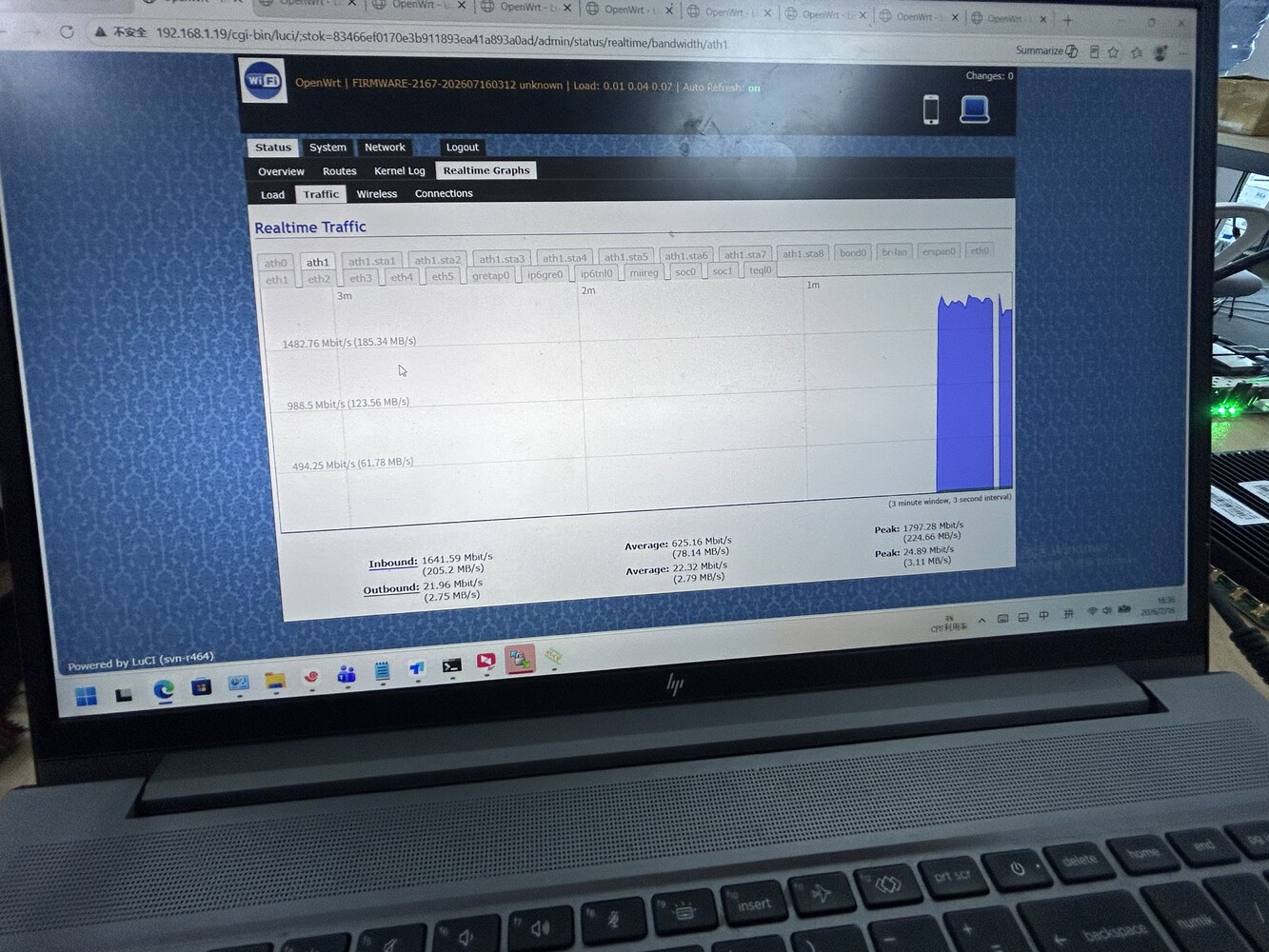
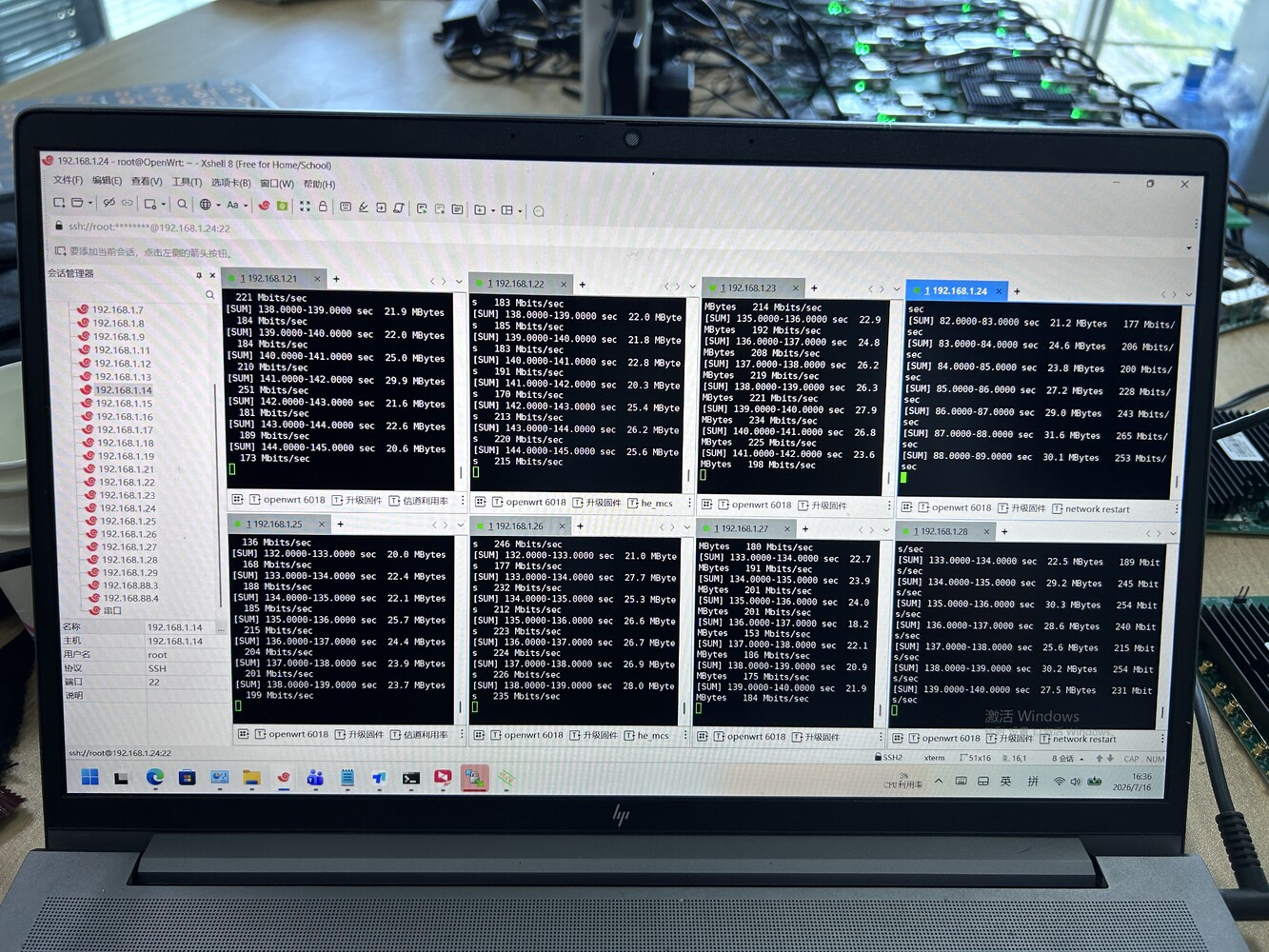
We rebuilt the scheduling logic on the firmware side to allocate airtime dynamically — closer to a priority/demand-weighted model than a fixed round-robin — and re-ran the same deployment topology: 8 remote stations, one base station, downlink test, same OpenWrt-based platform.

Result: per-station throughput of 130–265 Mbit/s, aggregate peak of 1,797.28 Mbit/s, aggregate average of 625.16 Mbit/s — with the spread between best- and worst-performing stations narrowing noticeably compared to the default static-scheduling baseline.
Article content

Why this matters beyond one deployment

The hardware didn’t change. The module, the antenna, the base station — none of it changed. What changed was the software layer managing how that hardware gets used across multiple simultaneous stations. That’s usually the part vendors don’t customize, because it means going deeper than swapping a chipset or bumping a spec sheet number.

This is also where we think there’s room for more collaboration than the industry typically does. A lot of teams building PtMP or multi-node wireless products — robotics, drones, distributed sensor networks — have strong hardware instincts but limited bandwidth to go deep on scheduling firmware, OpenWrt customization, or protocol-level tuning. That’s specifically the kind of work we do on the software side, independent of whether the hardware itself comes from us.

If your team has a multi-station deployment that’s hitting a similar wall — good radios, uneven real-world performance — we’re happy to compare notes, or scope what a scheduling-level fix would look like for your specific topology.
Posted on

Wi-Fi 7 vs. Wi-Fi 6: What’s the Difference and Why It Matters for Industrial Applications?

As industrial environments become more automated, connected, and data-driven, the demand for a faster, more reliable wireless network continues to grow. Wi-Fi 6 has served industries well in recent years, but Wi-Fi 7 introduces features that fundamentally reshape performance, latency, and reliability—especially in mission-critical industrial applications.

Many factories, warehouses, and outdoor industrial sites are now evaluating whether upgrading to Wi-Fi 7 is worth it. The answer becomes clear once you understand the major improvements Wi-Fi 7 brings compared to Wi-Fi 6.


What’s New in Wi-Fi 7 Compared to Wi-Fi 6?

Wi-Fi 7 introduces several breakthroughs that directly benefit industrial environments:

Faster Speeds and Higher Throughput Wi-Fi 7 supports up to 320 MHz channels and 4K QAM, providing significantly higher bandwidth. This is especially beneficial for AI vision systems, 4K/8K video streams, and large volumes of sensor data in industrial scenarios.

Multi-Link Operation (MLO) This is the most important upgrade for industrial automation. MLO allows devices to connect to multiple Wi-Fi bands at the same time, dramatically enhancing:

  • Reliability
  • Latency
  • Roaming
  • Interference resistance

When one link experiences congestion or interference, data continues flowing through the other link—ideal for AGVs, AMRs, and robotic control systems.

Lower Latency for Real-Time Control Wi-Fi 7 reduces latency to sub-millisecond levels, enabling smoother machine-to-machine communication, PLC data exchange, and industrial robot coordination.

Better Performance in Noisy Industrial Environments Factories, ports, and warehouses contain many devices that create interference. Wi-Fi 7 handles these challenges through:

  • Intelligent multi-link scheduling
  • Faster channel switching
  • Improved OFDMA efficiency

This results in more stable wireless networks, even in heavily congested areas.


Why Wi-Fi 7 Matters for Industrial Applications

Enhanced Reliability for Smart Factories Real-time monitoring, predictive maintenance, and machine communication depend on uninterrupted connectivity. Wi-Fi 7 ensures stable links for sensors, controllers, and production lines.

Seamless Mobility for AGV and AMR Fleets Automated robots cannot afford Wi-Fi dead zones or packet loss. MLO supports smoother roaming, faster handovers, and high-precision navigation.

Better Edge Computing and AI Performance Industrial AI workloads often transmit large amounts of data for inference or analysis. Wi-Fi 7 accommodates high-throughput data without compromising stability.

Higher Density Support for IIoT Deployments Factories may have thousands of connected devices. Wi-Fi 7’s improved scheduling and wider channels support larger device ecosystems without congestion.

Strengthening Industrial Video Surveillance AI-enhanced cameras and real-time analytics benefit from Wi-Fi 7’s higher bitrate capacity and lower latency.


Real-World Industrial Use Cases for Wi-Fi 7

  • AGV/AMR navigation and fleet management
  • Smart logistics and warehouse management systems
  • Industrial video surveillance with AI analytics
  • Real-time sensor networks in smart factories
  • Wireless backhaul bridging for ports and outdoor sites
  • Edge computing devices with high data demands
  • Autonomous machines and robotics

Wi-Fi 7 enables smoother, safer, and more efficient industrial operations.


Why Choose 524WiFi and Wallys Wi-Fi 7 Routerboards?

We provide industrial-grade Wi-Fi 7 routerboards such as DR5322S (IPQ5322) and next-generation DR9574 (IPQ9574) that support:

  • Wi-Fi 7 + MLO
  • POE/POE Out
  • Long-distance transmission
  • Industrial temperature rating
  • Customizable hardware and firmware
  • Mesh & roaming solutions
  • OEM/ODM/JDM services for industry customers

Each board is optimized for harsh industrial deployment and supports custom configurations for automation, logistics, or edge computing projects.


Wi-Fi 7 is not just an incremental improvement over Wi-Fi 6—it’s a major leap designed for industries that require reliability, speed, and real-time responsiveness. For industrial automation companies planning future-proof networks, upgrading to Wi-Fi 7 can unlock significant performance and operational advantages.

For customized Wi-Fi 7 routerboards and industrial wireless solutions, contact us !