Posted on

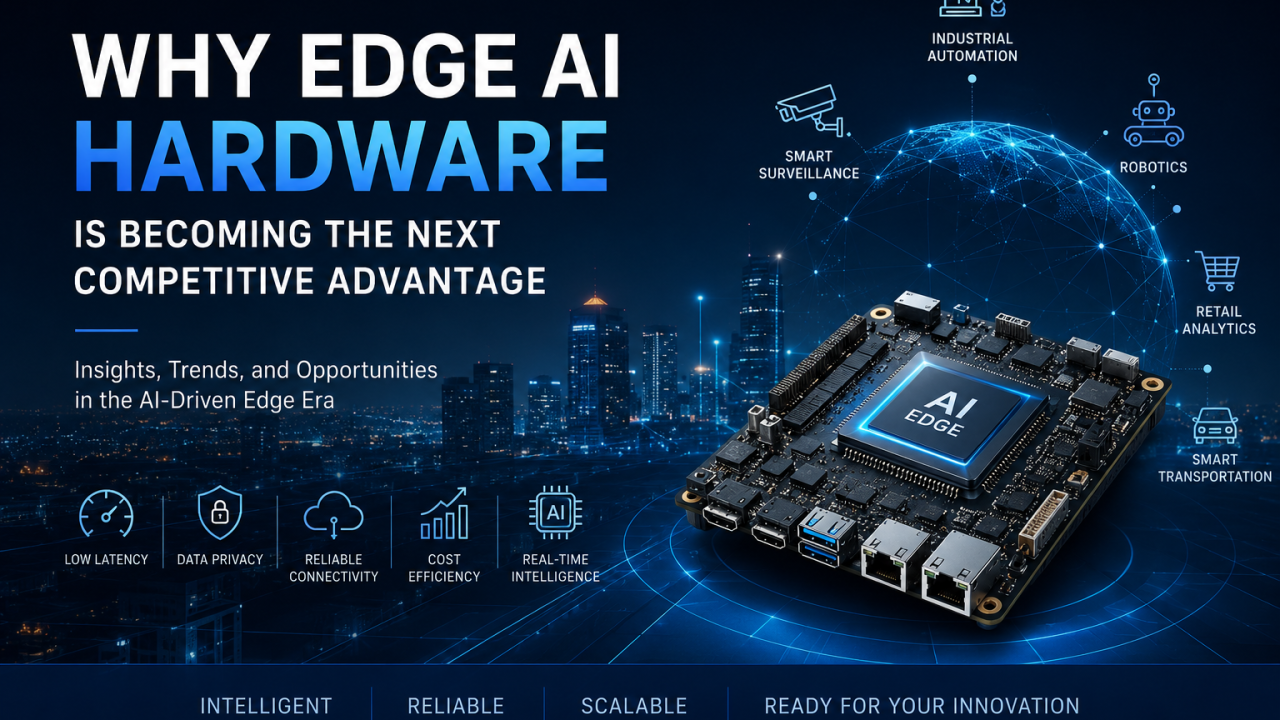
Why Edge AI Hardware Is Becoming the Next Competitive Advantage

Artificial Intelligence has evolved at an incredible pace over the past few years. From large language models to computer vision and predictive analytics, AI software has become increasingly powerful and accessible.

But as AI adoption accelerates, I’ve noticed a shift in conversations with customers and partners.

The discussion is no longer just about models.

It’s about deployment.

AI Doesn’t Create Value Until It Reaches the Edge

Training an AI model is only part of the journey. Real business value is created when AI runs where decisions need to be made—inside factories, warehouses, vehicles, retail stores, hospitals, and smart cities.

For many applications, relying entirely on cloud computing creates several challenges:

  • High latency
  • Expensive bandwidth
  • Privacy concerns
  • Unstable network connectivity
  • Ongoing cloud operating costs

This is why Edge AI has become one of the fastest-growing segments of the AI industry.

Processing data locally enables faster responses, better reliability, and greater control over sensitive information.

The New Bottleneck Isn’t Software

Five years ago, companies asked:

“Which AI framework should we use?”

Today they ask:

“Which hardware platform should we build on?”

Many AI startups have exceptional software teams, yet hardware development often delays commercialization.

Designing an embedded AI system involves far more than selecting a processor. Teams must address thermal management, power optimization, connectivity, storage, operating system support, long-term component availability, manufacturing, and certification.

For companies whose core strength lies in AI algorithms or industry expertise, developing custom hardware from scratch may not be the best use of resources.

Why OEM and ODM Partnerships Matter More Than Ever

Instead of reinventing the hardware platform, many companies are choosing to collaborate with experienced OEM and ODM manufacturers.

This approach allows engineering teams to focus on what truly differentiates their products:

  • AI applications
  • Software platforms
  • User experience
  • Industry-specific solutions

Meanwhile, hardware partners provide mature platforms that reduce development risk and shorten time-to-market.

In today’s competitive environment, launching six months earlier can be more valuable than achieving marginal improvements in hardware performance.

Flexibility Is Becoming More Important Than Raw Performance

The AI industry often focuses on TOPS, GPU cores, and benchmark scores.

While computing power certainly matters, customers increasingly ask different questions:

  • Can this platform be customized?
  • Does it support industrial environments?
  • Can wireless connectivity be added?
  • Is storage expandable?
  • Will the platform still be available in three years?
  • Can it scale from prototype to mass production?

These practical considerations often determine whether a product succeeds in the market.

Performance attracts attention.

Flexibility wins projects.

Looking Ahead

Edge AI is no longer an emerging trend—it is becoming the standard architecture for many intelligent devices.

Whether it’s machine vision, robotics, industrial automation, transportation, or smart retail, demand for reliable, customizable AI hardware continues to grow.

I believe the next wave of innovation won’t come solely from more powerful AI models.

It will come from making AI easier to deploy in real-world environments.

Companies that can combine intelligent software with reliable, scalable hardware will be best positioned to deliver practical AI solutions.

As someone working closely with Edge AI platforms, it’s exciting to see how quickly the industry is evolving.

I’m curious to hear your perspective.

What do you think will become the biggest challenge for Edge AI over the next five years—computing power, deployment, cost, or something else?

Let’s discuss.
Posted on

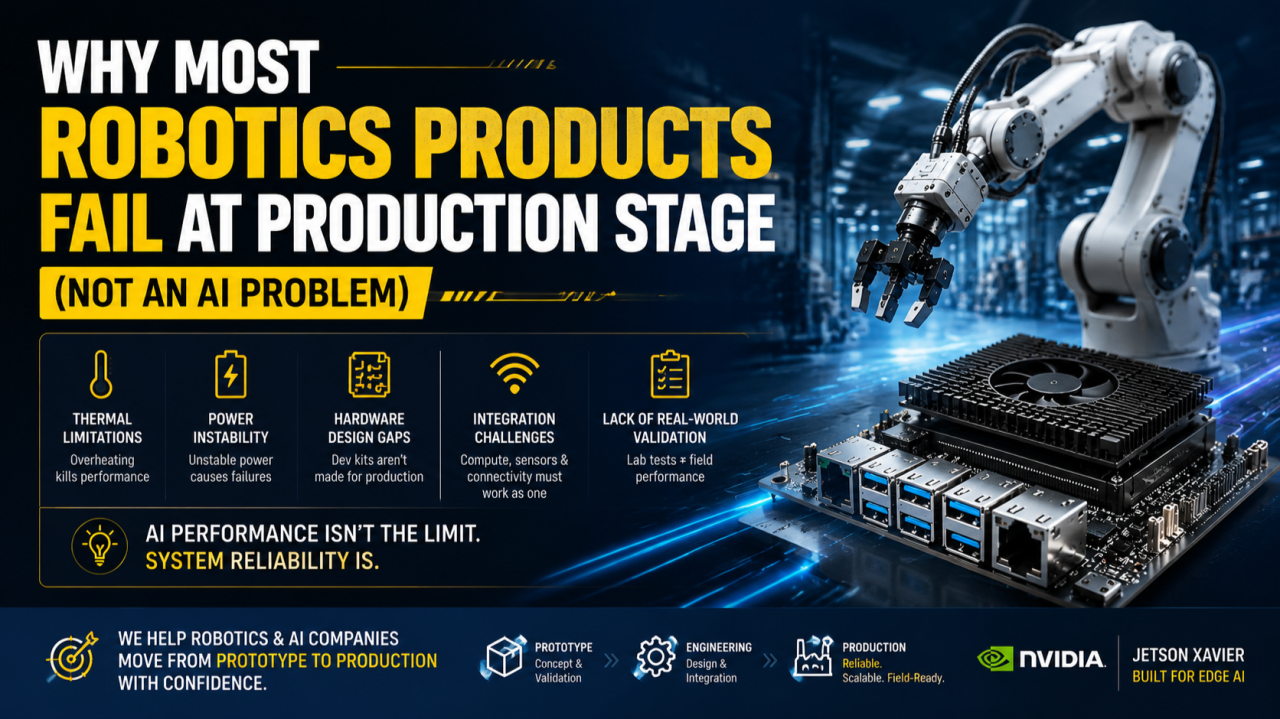
Why most robotics products fail at production stage (not an AI problem)

Introduction

In the robotics and edge AI industry, there is a common assumption:

If the AI model works, the product is ready.

But in reality, many robotics products fail not because of AI algorithms — but because of system-level engineering challenges that only appear in real-world deployment.

After working with industrial wireless systems and edge AI hardware platforms, we consistently observe the same pattern:

The gap between prototype and production is where most products break.


1. The real problem is not AI — it is system engineering

Most robotics teams are strong in:

  • Computer vision
  • Deep learning models
  • Path planning / autonomy algorithms

However, production environments introduce constraints that are often underestimated:

  • Continuous workload (not short demos)
  • Temperature variations
  • Power fluctuations
  • Mechanical constraints
  • Interference in wireless environments

These are not AI problems — they are system integration problems.


2. Why Jetson-based systems still fail in production

Even with powerful platforms like Jetson Xavier, many teams encounter issues when scaling:

❌ Thermal limitations

AI workloads in production run continuously, not intermittently like in lab tests.

❌ Power instability

Robotics platforms often operate in environments with fluctuating power conditions.

❌ Carrier board limitations

Development kits are not designed for enclosure integration or mass manufacturing.

❌ System integration gaps

Compute, sensors, and wireless modules are often designed separately, leading to instability.

❌ Lack of production validation

Many systems are never tested under real industrial conditions before deployment.

Article content

3. Prototype vs Production gap

In prototype stage:

  • Functionality is the focus
  • Short test cycles
  • Controlled environment

In production stage:

  • Reliability becomes critical
  • Continuous operation
  • Real-world environmental stress

This transition is where many robotics products fail.


4. The missing layer: system-level engineering

Successful robotics products require more than AI models.

They require:

✔ Production-grade hardware design

✔ Thermal and power system engineering

✔ Embedded system optimization

✔ Wireless + compute integration

✔ Field deployment validation

Without these, even the most advanced AI system will struggle in real-world environments.


5. Key insight

Robotics success is not determined by AI capability alone, but by how well the entire system is engineered for reality.


6. How we approach this problem

We work with robotics and AI vision companies to help bridge the gap between prototype and production by supporting:

  • Edge AI hardware platform design
  • Carrier board development
  • System integration for industrial deployment
  • Wireless + embedded system architecture optimization
  • Production readiness engineering

Our focus is on helping teams move from concept validation to scalable real-world products.


Conclusion

The future of robotics will not be defined only by better AI models.

It will be defined by systems that are:

  • Reliable
  • Scalable
  • Deployable in real environments

Because in the real world:

AI that works in demo is not enough — it must work in production.

Article content
Posted on

QCN9274 & QCN6274 Wi-Fi 7 with Multi-Link Operation (MLO) on X86 Devices: A New Era of Connectivity

Wi-Fi 7 with Multi-Link Operation (MLO) on X86 Devices: A New Era of Connectivity

As the world of wireless technology continues to evolve, the introduction of Wi-Fi 7 is nothing short of a game-changer. With its potential for significantly higher speeds, lower latency, and enhanced reliability, Wi-Fi 7 is set to revolutionize industries and applications ranging from industrial IoT to high-performance consumer devices. At Wallys, we’re always driven by customer needs, and as part of our commitment to offering cutting-edge solutions, we’re focused on expanding the possibilities for Wi-Fi 7 technology—specifically by enabling Multi-Link Operation (MLO) support on X86 platforms.

Expanding the Reach of Wi-Fi 7: A New Level of Compatibility

Last year, we introduced X86 driver support for our Wi-Fi 6 module, DR9074, which enabled seamless integration across a broader range of motherboard platforms, not just Qualcomm devices. This support empowered our customers to experience high-quality, stable Wi-Fi data transmission and opened the door for new applications that demand reliable and high-throughput wireless connections.

With the introduction of Wi-Fi 7, cross-platform compatibility becomes even more critical. Wi-Fi 7 brings with it a new set of features designed to push the boundaries of wireless connectivity, and one of the most significant is Multi-Link Operation (MLO). But to harness the full potential of MLO, we need to ensure that our solutions can operate on multiple platforms—something we’re excited to announce we’re working on with our DR9274 (QCN9274) and QCN6274 Wi-Fi 7 modules.

wifi6 vs wifi7

What is MLO? And Why Does It Matter?

Multi-Link Operation (MLO) is one of the standout features of Wi-Fi 7. MLO allows devices to transmit data across multiple frequency bands (like 2.4 GHz, 5 GHz, and 6 GHz) simultaneously. This multi-band transmission significantly improves throughput and reliability, while reducing latency and congestion, making it an ideal solution for environments that require high-speed and low-latency communication.

In simple terms, MLO will enable your devices to leverage the full bandwidth potential of Wi-Fi 7, resulting in faster speeds, more stable connections, and more efficient use of available spectrum.

Introducing the QCN9274 & QCN6274 Wi-Fi 7 Modules

To enable the full potential of MLO, we’re leveraging the power of QCN9274 and QCN6274—two of Qualcomm’s latest Wi-Fi 7 chipsets, both designed for high-performance applications.

  1. QCN9274 (Waikiki)
  2. QCN6274 (Waikiki)
MLO

These two powerful chipsets represent the future of Wi-Fi 7 and provide the foundation for expanding compatibility across a variety of platforms. With MLO support, both the QCN9274 and QCN6274 enable better utilization of the 2.4, 5, and 6 GHz bands, delivering faster speeds and more reliable connections.

wifi7 new features

What Will MLO Bring to Your X86 Devices?

By introducing MLO support for X86 devices, we’re pushing the envelope on what’s possible in wireless networking. Users of X86 platforms will now be able to tap into the full power of Wi-Fi 7, unlocking:

  • Higher Throughput: With MLO, data is split across multiple channels, leading to faster speeds and higher data rates, ideal for bandwidth-hungry applications like streaming, gaming, and industrial IoT.
  • Enhanced Reliability: MLO ensures that devices can maintain stable connections, even in environments with interference or congestion, by balancing traffic across different frequency bands.
  • Reduced Latency: Faster communication between devices can significantly reduce lag and improve the responsiveness of real-time applications, from virtual reality to autonomous systems.

The implications are significant. Wi-Fi 7, combined with MLO, could transform industries that rely on seamless, high-performance wireless connectivity—think smart cities, industrial automation, healthcare, and beyond.

524WiFi Adapter Card (wifi7 adapter card coming soon)

What’s Next for Wi-Fi 7 on X86?

At 524WiFi, we’re committed to ensuring that our solutions are as versatile and adaptable as possible. With the upcoming X86 driver support for DR9274 and MLO functionality, you’ll be able to take full advantage of Wi-Fi 7 speeds and unlock new potential for your devices.

Thoughtput testing:achieve 8Gbps+ speed

This new capability will open up new opportunities for a variety of applications, and we’re eager to see how our customers will integrate this powerful technology into their own use cases.

DR9274 wifi7 M.2 card

Are You Ready for the Future of Wireless Connectivity?

With Wi-Fi 7’s blazing-fast speeds and MLO’s game-changing capabilities, the possibilities are endless. How do you envision using Wi-Fi 7 with MLO on your X86 platforms? Whether it’s enhancing your industrial IoT devices, supporting next-gen gaming applications, or powering high-bandwidth communications, the potential is vast.

At 524WiFi, we’re excited to continue innovating and providing the tools you need to stay ahead in the rapidly evolving wireless landscape. If you’re interested in learning more about our Wi-Fi 7 solutions or how we can help with your next project, feel free to reach out to us.

Let’s shape the future of connectivity, together.