The 524WiFi and Wallys DR5018S router board, based on the Qualcomm IPQ5018 chipset, is widely used in industrial wireless applications. VLAN functionality allows network segmentation, optimized traffic management, and enhanced security. This guide provides a step-by-step tutorial to configure Access VLAN and Trunk VLAN on the DR5018S.
2. Understanding VLAN, Access, and Trunk
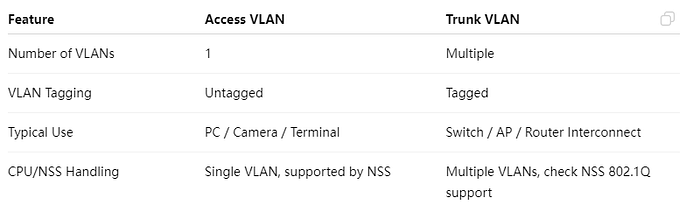
Access VS Trunk
3. Prerequisites
Wallys DR5018S router, firmware: wallys firmware
Admin access via Web GUI or SSH
VLAN ID plan and IP addressing plan
Optional: VLAN-aware NIC or Vlan Switch for testing
4. VLAN Configuration on DR5018S
Steps:
Log in to the Web GUI.
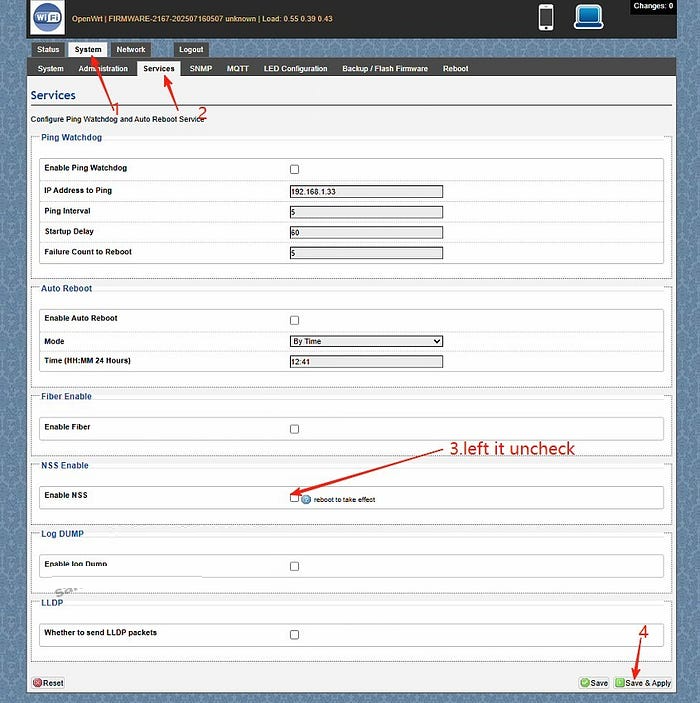
Go to System → Services. Left the Enable NSS uncheck and click “save and apply”
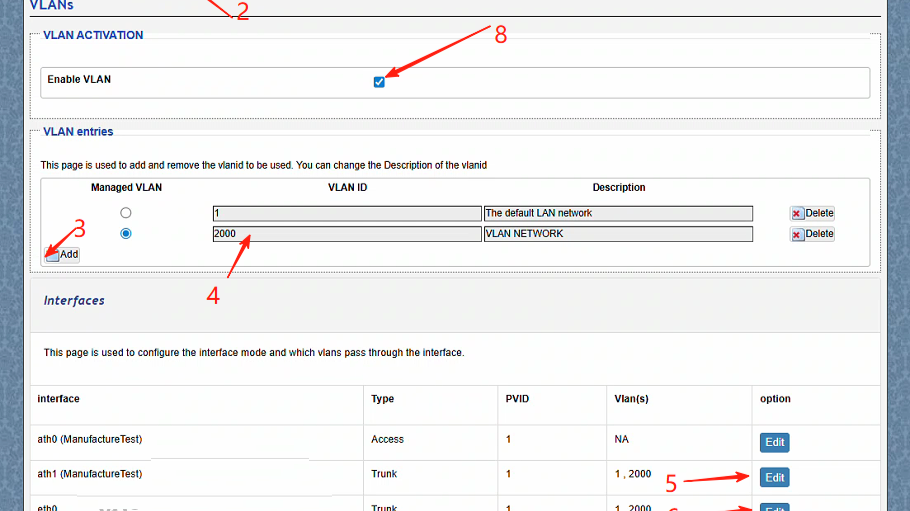
Go to Network → Vlans.Create a VLAN (e.g., VLAN 2000).
Edit the ath1(the working radio) and eth0(the ethernet port connected) port mode to Trunk.
ath1 setting:Select type Trunk,Assign the PVID as 1,select Vlans 2000,save changes
ath1 setting:Select type Trunk,Assign the PVID as 1,select Vlans 2000,save changes.
Assign an IP address to the VLAN interface (static or DHCP).
Save and apply the configuration.
Test connectivity: connect a PC to the port, get an IP, and ping the radio.
5. Troubleshooting
Cannot access the device → check VLAN ID, PVID, and tagging.
Trunk traffic lost → verify VLAN configuration on the remote end.
PC cannot ping → ensure the IP address is in the VLAN subnet.
Check NSS hardware acceleration
With this guide, you can easily configure Access VLAN and Trunk VLAN on the DR5018S router board. VLANs help isolate traffic, improve security, and optimize performance in industrial wireless networks.
For more technical support and inquiry for industrial wireless products, contact 524WiFi at info@524wifi dot com or net!
As the logistics industry continues to evolve, there is a growing need for efficient, stable, and flexible networking solutions. Virtual Local Area Networks (VLANs) provide a powerful tool for managing network traffic, optimizing resources, and improving both efficiency and security within logistics operations. Below are several key VLAN application scenarios within the logistics industry.
1. Smart Warehouse & Automation Systems
Smart warehouses, equipped with automated systems like robotic arms, conveyor belts, sensors, and RFID systems, rely on a robust network for seamless data exchange. VLANs can improve network performance by segmenting traffic based on device type.
VLAN Segmentation:
VLAN 10 (Automated Guided Vehicle Network): Ensures low-latency, high-priority communication for automated guided vehicles (AGVs).
VLAN 20 (RFID & Scanners): Provides dedicated bandwidth for RFID systems and scanners, ensuring real-time tracking.
VLAN 30 (Surveillance Network): Segregates video surveillance data from other traffic to prevent congestion.
VLAN helps ensure that critical devices such as AGVs and RFID scanners can communicate without interference, enhancing warehouse efficiency.
2. Sorting Systems in Distribution Centers
Sorting systems in distribution centers often involve complex automation machinery that requires real-time communication to optimize the sorting of parcels. VLANs help ensure smooth operation by prioritizing the traffic of sorting equipment.
VLAN Segmentation:
VLAN 100 (Sorting Equipment Network): Dedicated VLAN for the machinery that handles sorting, minimizing delays caused by high data traffic.
VLAN 200 (Office Management Network): Separates office traffic from operational machinery, avoiding disruptions to real-time sorting tasks.
VLAN 300 (Customer Service Interface): Isolates customer-facing systems, ensuring customer data remains secure while other operational processes run smoothly.
VLANs optimize data flow within the sorting systems and prevent network congestion, increasing overall throughput.
3. IoT Devices and Wireless Networks
In the logistics industry, IoT devices such as temperature sensors, GPS trackers, and smart locks play an integral role in monitoring and managing goods during transit and storage. VLANs are essential for managing and securing wireless network traffic.
VLAN Segmentation:
VLAN 50 (IoT Device Network): Creates a dedicated VLAN for all IoT devices, ensuring reliable data transfer while isolating traffic from other networks.
VLAN 60 (Customer Wi-Fi Network): Segregates visitor and employee Wi-Fi access from critical business systems to ensure security.
Using VLANs ensures that sensitive logistics data from IoT devices is protected and prioritized, enabling real-time monitoring and secure communications.
4. Security and Data Isolation
The logistics industry handles sensitive customer data, inventory management information, and delivery details. VLANs are used to isolate these critical data streams from other less sensitive traffic, adding an additional layer of security.
VLAN Segmentation:
VLAN 10 (Management and Control Network): Isolates administrative systems and critical control networks to prevent unauthorized access.
VLAN 20 (Customer Data Network): Protects customer and order information by creating a separate VLAN for processing sensitive data.
VLAN 30 (Surveillance Network): Ensures video feeds from surveillance cameras are kept within a dedicated network, preventing bandwidth overload.
VLANs improve data security by isolating sensitive systems from regular traffic, reducing the risk of data breaches or unauthorized access.
5. Integration with 5G Networks
As logistics operations increasingly incorporate 5G technology, VLANs help ensure that high-priority devices, such as autonomous delivery vehicles and drones, have dedicated network resources for efficient communication.
VLAN Segmentation:
VLAN 70 (Autonomous Vehicle Network): Dedicated VLAN for vehicles and drones that require low-latency and high-bandwidth communication.
VLAN 80 (Public-facing Network): Provides separate VLANs for external systems, ensuring no interference with mission-critical logistics systems.
Integrating VLANs with 5G allows logistics companies to optimize network performance for high-demand devices, ensuring smooth and efficient operations.
Router board DR4019 Vlan Solution
✅ Industrial-Grade Performance
Qualcomm IPQ4019/IPQ4029 chipset for stable, 24/7 operation.
Frequency range: 4.940GHz–5.825GHz & 2.400GHz–2.482GHz.
MMCX connectors for flexible antenna deployment.
Supports 5MHz/10MHz/20MHz/40MHz/80MHz bandwidth.
✅ VLAN & Network Optimization
VLAN-ready for secure network segmentation in logistics hubs.
802.11s Mesh support for seamless warehouse connectivity.
Fixed data rate for AGVs, RFID, and IoT tracking.
✅ Flexible Firmware & Integration
Supports OpenWRT, QSDK, OpenWiFi.
Compatible with Quectel modules for LTE/5G expansion.
✅ Environmentally Safe
RoHS compliant, ensuring safety and sustainability.
DR4019 mainboard ipq4019
Conclusion
VLAN technology plays a crucial role in optimizing network performance, improving security, and supporting the growth of smart logistics systems. By segmenting traffic based on device type and use case, logistics companies can improve data flow, reduce congestion, and ensure secure communication across their networks. As the logistics industry continues to evolve with IoT, automation, and 5G, VLANs will remain a key component in driving efficiency, security, and innovation.