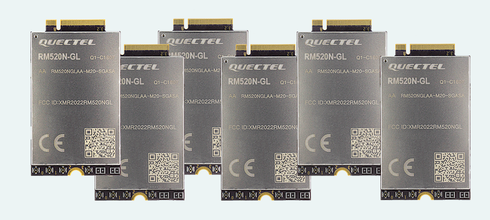
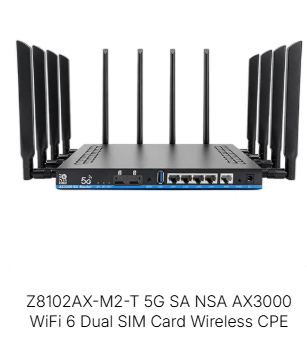
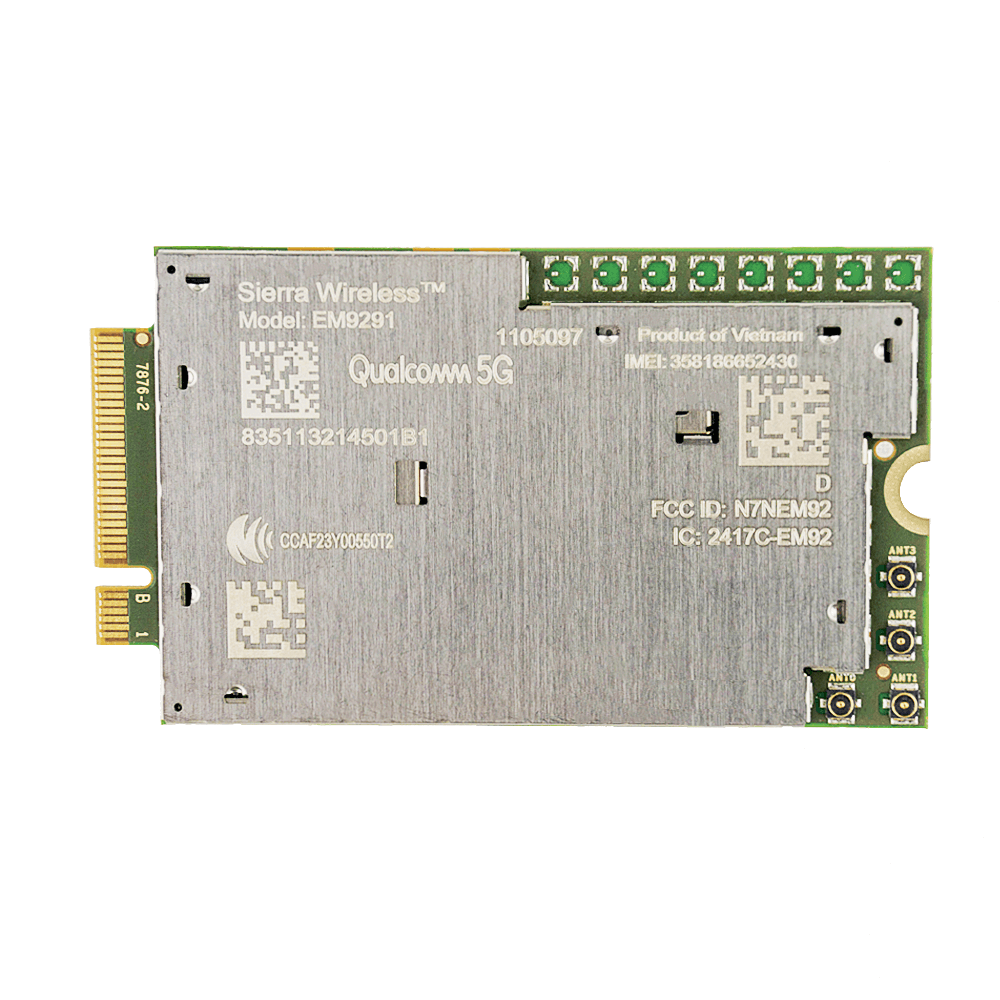
With downlink speeds up to 4.7 Gbps and uplink speeds up to 1.25 Gbps, the RM520N-GL is ideal for applications requiring ultra-low latency and high throughput, such as industrial automation, CPE routers, telematics, video surveillance, and AR/VR platforms.
Among the most sold 5G NR modules out there, the Quectel RM520N-GL is engineered to deliver blazing-fast connectivity for next-generation broadband applications. Supporting both 5G NR (SA/NSA) and fallback to high-speed LTE and 3G, this module ensures reliable coverage and seamless global deployment.
Your device will connect to 5G. But will it be Standalone or Non-Standalone? The answer depends on the network, and the Quectel RM520N-GL handles both. With fallback to LTE and 3G, it keeps devices connected wherever they are deployed.
That flexibility is one reason it’s among the best-selling 5G NR modules available. Add up to 4.7 Gbps downlink and 1.25 Gbps uplink, and it’s a proven choice for CPE routers, industrial automation, telematics and video surveillance.
Welcome to 524wifi – home of the best WiFi & LTE 5G NR & Internet over Coax & GEPON Passive Optical networks! Certified by UK Joscar Hellios, from automotive for sample by VW group , telecomunications Nokia, for onlne Google certified … and tons of others big companies we have over 40 security clearances and certificates for to sale and for implement into USA and EU and globally.
There is no continent, where we would not have a satisfied customer! Yes, our modules works and we have already delivered our Wi-Fi modules even to Antarctica ! You can find our modules, for example, in wind turbines, drones, ships, trains (Norway, Czech SK and many more),public transportation comm systems, aircrafts, both civil, acrobatic and military… on land, on water and in the air. NASA has also ordered samples, so the next goal is to get them into the outer Space! 524WiFi Pro+ modules! Well if you do someting well for almost 25 years, you have lot of customers…..
With more than 24 years of experience in the Networking Industry, our partners as Wodaplug Quectel & SIMcom, Compex & Wallys communications and lot more. Wodaplug offers reliable solution for Ethernet Data over Coax (EOC), G EPON and 4G 5G LTE routers & backup units. Quectel leads market in LTE 5G 4G modules & IoT technologies. 524wifi is part of Google Customers Reviews program to assure customers satisfaction – Google Approved. Eshop owner is located in EU – CZ.
If that huge time period we developed ourselves as connecting bridge between modules and chips designers, drivers designers and practical users , industrial aplications
v oblasti síťové bezpečnosti se objevil závažný nález, který se týká populárních routerů značky Zbtlink. Bezpečnostní analytici ze společnosti VulnCheck objevili v továrním softwaru těchto zařízení kritickou zranitelnost, která funguje jako zadní vrátka (backdoor)
Chceme vás okamžitě ujistit, že našich zákazníků se toto riziko netýká. Jako integrátor a dodavatel síťových řešení do zařízení Zbtlink dlouhodobě neinstalujeme tovární software, ale nahrazujeme jej bezpečným a ověřeným firmwarem ROOter Golden Orb.
O co jde: Zranitelnost „ENDLESSDOORS“ (CVE-2026-66747)
Bezpečnostní experti identifikovali vestavěný škodlivý kód pojmenovaný jako ENDLESSDOORS. Tento implantát je přítomen v podstatě ve všech publikovaných verzích továrního firmwaru napříč celou produktovou řadou Zbtlink (např. modely řady WE, WG či CPE). [1]
Jak tento backdoor funguje?
Maskování v systému: Škodlivý kód se spouští hned při startu routeru pod názvem procesu kworker, aby záměrně splynul s legitimními procesy operačního systému (jádra). [1]
Volání řídicího serveru: Zařízení neotevírá žádné viditelné porty zvenčí. Místo toho každých cca 35 sekund samo aktivně kontaktuje nezašifrovaným TCP spojením předem pevně definovaný server (tzv. Command-and-Control server). [1]
Plná kontrola jako Root: Pokud útočník na druhé straně odpoví, získá okamžitý přístup k interaktivnímu shellu s nejvyššími právy (root/uid=0). Vzhledem k tomu, že komunikace neobsahuje žádné ověření ani šifrování, může zařízení ovládnout kdokoliv, kdo obsadí danou síťovou cestu nebo doménu. [1, 2]
Tato chyba získala mimořádně vysoké hodnocení nebezpečnosti CVSS 9.3 (Kritická).
✅ Proč jsou naši zákazníci stoprocentně chráněni?
Základem naší filozofie je dodávat řešení, která jsou nejen výkonná, ale především bezpečná. Z toho důvodu při přípravě routerů pro naše klienty kompletně mažeme původní tovární software.
Namísto něj instalujeme pokročilý, otevřený firmware ROOter Golden Orb:
Absence škodlivého kódu: ROOter Golden Orb je postaven na čistém, komunitou kontrolovaném základu OpenWrt. Neobsahuje žádné proprietární knihovny výrobce Zbtlink, a tedy ani skrytý implantát librctl.so (ENDLESSDOORS). [1]
Transparentnost: Veškeré procesy běžící v tomto firmwaru jsou plně auditovatelné. Neexistuje zde žádné skryté „telefonování domů“ na neznámé servery. [1]
Vyšší stabilita a funkce: Vedle stoprocentní bezpečnosti přináší Golden Orb našim zákazníkům také mnohem lepší správu mobilních (LTE/5G) modemů, pokročilé možnosti routování a dlouhodobou stabilitu.
💡 Shrnutí na závěr
Pokud máte router zakoupený a nakonfigurovaný od nás s firmware Rooter, nemusíte podnikat žádné kroky ani se obávat zneužití této zranitelnosti. Vaše zařízení již v momentě instalace dostalo imunitu vůči této tovární chybě. Pokud má vaše zařízení tovární OpenWRT firmware, doporučujeme ihned přejít na Rooter firmware. Je ke stažení zdarma a rádi vám jej zašleme.
Pokud byste měli k této problematice jakékoliv technické dotazy nebo si chtěli ověřit stav specifického zařízení, neváhejte kontaktovat naši technickou podporu.
5One common assumption we encounter is that moving from 4G LTE to 5G will automatically improve network coverage. After all, newer technology should be better… right? The reality is a bit more complicated – again and again.
For many IoT applications, coverage is determined far more by frequency than by the generation of cellular technology itself. An LTE device operating on low-band can often outperform a 5G device using mid-band when it comes to indoor penetration and reach into challenging environments such as basements and utility cabinets.
Part of the early promise of 5G was that technologies such as Dynamic Spectrum Sharing (DSS) would allow operators to introduce 5G while leveraging the coverage footprint already established by LTE. While DSS certainly accelerated early deployments, many operators are now evolving their strategies as networks mature, balancing capacity, efficiency, and spectrum utilization to meet growing demand (https://www.lightreading.com/5g/the-quiet-sunset-of-5g-dynamic-spectrum-sharing).
Then there’s another point: 5G Standalone (SA) vs Non-Standalone (NSA). Most of today’s 5G deployments are still NSA, meaning they continue to rely on the existing LTE core network for signalling and control. True 5G SA deployments offer the full promise of 5G with network slicing and super low latency being key factors, but they remain relatively uncommon. Or, to put it another way: 5G Standalone deployments are quite (stand)alonely!
You also have the “LPWA is 5G” proponents but we’re talking real 5G here. So what’s the takeaway? The “best” cellular technology isn’t necessarily the newest one; the right choice depends on what you’re trying to achieve.
If your application requires high throughput, low latency, or is designed with future 5G capabilities in mind, then 5G may well be the obvious choice for you. On the other hand, if your priorities are coverage in difficult environments, low power consumption and/or cost control, LTE technologies still make a very compelling case. The good news? We really love this stuff.
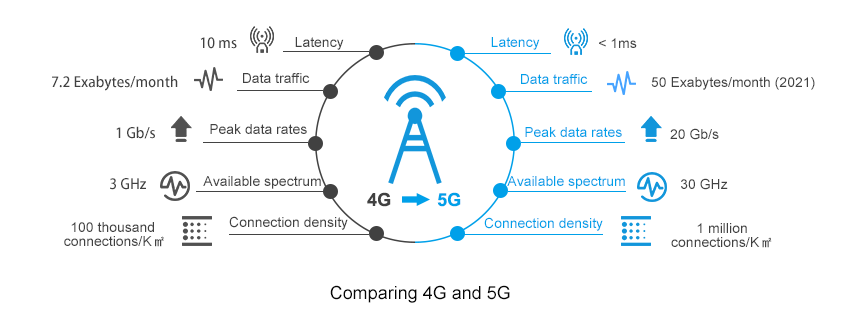
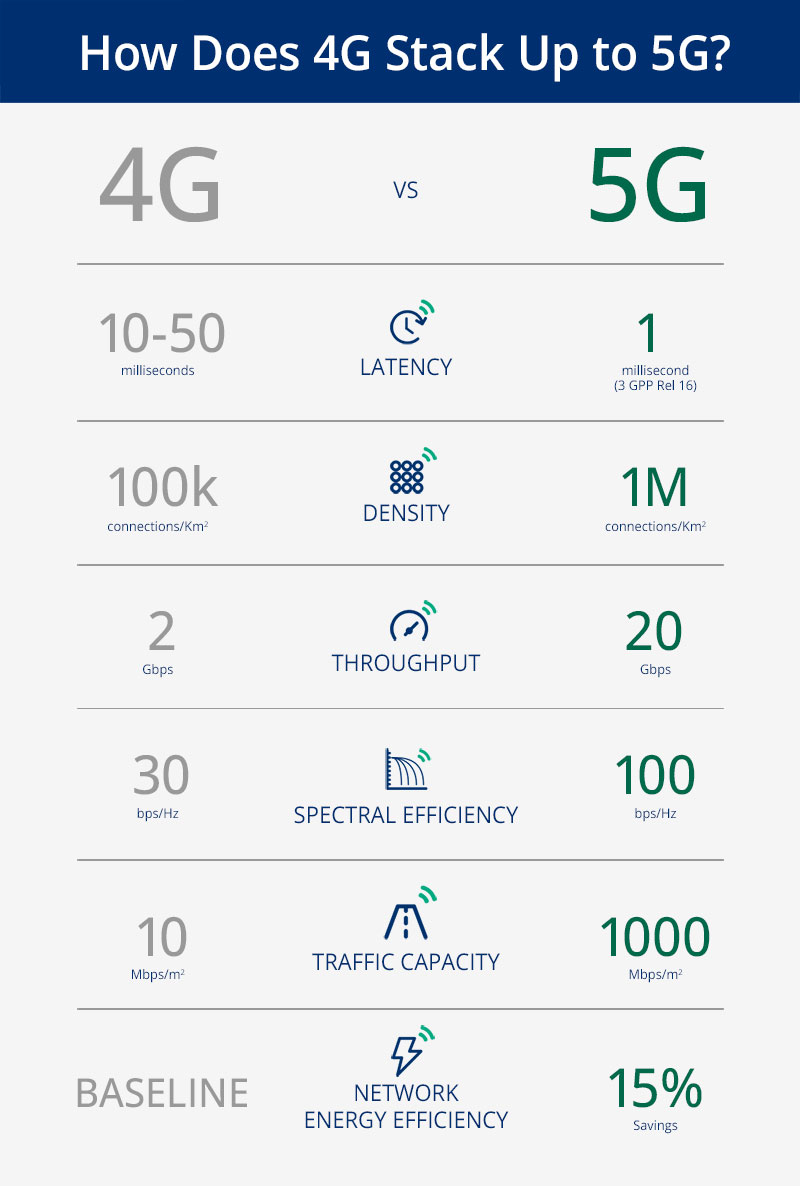
4G Vs. 5G Key Technology Differences
Choosing the right cellular technology isn’t always straightforward, but that’s where we can help. Whether you’re evaluating LPWA, LTE, or NR, we’d be happy to discuss your application, and help you navigate the intricacies of module selection to find the best fit for your project.
In this article, I will address and review the Key technology differences between 4G and 5G; reading this topic is crucial, especially if you have a good background in 4G and have just started your 5G Career.
This article will cover the differences between 4G & 5G for the following
Content
RAN Structure: 4G, 5G NSA & 5G SA
From the Radio Access Network side, The overall structure looks very similar, for example;
X2 interface connecting different 4G Nodes was replaced by the Xn interface
S1 interface connecting BTS Side to the Core network replaced by Ng interface
MME replaced by AMF and SGW replaced by UPF
From a superficial view, it is a matter of naming change; however, there are subtle changes implemented that leads to huge improvement; we will be addressing one of the points which can lead to improving latency in 5G SA.
RAN Structure
One of the main differences provided in 5G SA Architecture is that the User plane and Control function has separated; see below comments and the 4G & 5G Full Architecture for more details.
An important Characteristic of the 5G System is separating the user plane and control plane functions, which differs from the original 4G System architecture in the following:
In 4G: P-GW provides both control plane and user plane functions(IP Address allocation & Packet Forwarding)
In 5G: SMF Provides IP Allocation, and UPF provides packet forwarding
2. User and Control plane separation allows independent scaling of the two functions
Operators can add more user plane capabilities without having to add more control plane
Minimize latency by distributing User plane and keeping it geographically close to the AN
Packet Gateway provides both User plane and Control Plane function in 4G
4G Architecture
While in 5G, Only UPF provides User plane function.
5G Architecture: Pictures captured from 5G NR in Bullets
Quality of Service: 4G & 5G
For the QoS Part, there is an essential change in the way of how the QoS is being allocated.
In 4G, EPS Bearer is responsible for providing E2E User Plane connectivity between the UE and Access Point Name “APN” within the Packet Gateway
*APN defines the interface to the external data network
The point here is that EPS Bearer has a one-to-one mapping to the QoS, This means that the User needs to establish a new EPS bearer every time there is a new QCI assignment, Only One QoS(Example QCI 9 can be assigned to one DRB) with no flexibility.
4G QoS
In 5G, PDU Sessions is responsible for providing E2E User Plane connectivity between the UE and Data Network Name “DNN” within the User Plane Function ( UPF)
*DNN defines the interface to the external data network
However, Unlike 4G EPS Bearer, PDU Session supports one or more QoS Flows, Which means that QoS Flow to radio bearer mapping is not necessarily one-to-one mapping and multiple QoS can be mapped to the same Radio Bearer.
5G QoS
Note: QoS Flows belonging to different PDU Sessions are mapped onto different DRBs.
Radio Protocol Stack: 4G & 5G
SDAP Primary Task:
Service Data Application Protocol (SDAP) is responsible for mapping QoS bearers to radio bearers according to their quality-of-service requirements. This protocol layer is not present in LTE but introduced in NR when connecting to the 5G core network due to the new quality-of-service handling
The new SDAP (Service Data Adaptation Protocol) primary function maps each QoS Flow onto a specific Data Radio Bearer
•Multiple QoS Flows can be mapped onto a single DRB or,
•Single QoS Flow can be mapped onto a single DRB.
Radio Protocol Stack: SDAP Layer added in User-PlaneSDAP Layer
Overall Technology Comparison
4G Vs. 5G Bandwidth
4G Supports a maximum up to 20Mhz BW, While 5G is up to 400Mhz
5G offers less Guard Band(2~5) and Higher Spectrum Utilization(Utilizing up to 95% of the Channel BW, While 4G Utilize 90%)
Up to 20x Higher Bandwidth and New Spectrum Definition. (ex. mmwave)
NR Offers Less Guard-band and Higher spectrum utilization
*Source: 3GPP TS 38.101 & TS38.104
Frame Structure Comparison: 4G & 5G
The following summarized the main differences between 4G & 5G Frame Structure
Frame and Subframe duration remained the Same for 5G
Number of Symbols in a slot is now fixed to 14 in 5G (4G is fixed to 7)
5G has a flexible numerology, which allows different configurations as the Slot Duration relies on SCS(Sduration = 1 /SCS)
5G is now using a Slot as a scheduling Unit instead of Sub-frame compared to 4G
NR RB Resource Grid is double 4G(14 vs. 7 OFDM symbols in one RB )
Physical Channel & Signals Comparison : 4G & 5G
The below table summarizes the main differences in Physical Channel and Signals
Downlink Comparison: Physical Downlink Control Channel(PDCCH)
In LTE, PDCCH control channels are always distributed across the entire system bandwidth.
NR PDCCHs are designed to transmit in a configurable control resource set (Called CORESET).
Uplink Comparison: Physical Uplink Control Channel(PUCCH)
In 4G, PUCCH is transmitted in one or more Physical Resource Blocks (PRB) at the edges of the system bandwidth and is only supporting Long-Format(duration 1 ms)
While 5G supports both Long and short format, Where short format provides the following:
1~2 Symbols over the complete
Provides Better Latency
PBCH & Synchronization Signals: 4G & 5G
There are 2 main changes in PBCH and SS compared to 4G:
PBCH and SS are now being combined into SSB
SSB Frequency domain location is flexible and can be configured at different locations based on the network requirements(4G PBCH & SS are fixed at the center of Channel BW)
Broadcast Channel Comparison: 4G & 5G
4G Provide Wide Beam coverage, while 5G provides narrow beam coverage for broadcast channels, which can improve the Coverage and Quality
Reference Signal Overhead comparison: 4G & 5G
5G Overhead is almost half 4G, and the mean reason behind that 5G has no Cell Specific Reference Signal as 4G
As you know that CRS was all the time transmitted “Always on” over the entire BW and consume a large number of resource elements within the Resource block
While 5G uses DMRS for channel demodulation instead of CRS.
PDSCH DMRS offers much less overhead compared to CRS due to the following:
DMRS is transmitted within the set of RBs allocated to PDSCH. i.e, if a UE is allocated 10RBs for PDSCH, then both PDSCH and DMRS will be transmitted across those BW
DMRS Configuration type 1 uses 6 RS within one or two symbols, which add around 3.6% up to 7% overhead to 5G, while 4G offers from 9% to 17% overhead. Please see the below picture for more details and refer to the below-attached video for more information.
Key differences in Link Budgets: 4G & 5G
4G & 5G almost have the same Link Budget Basic Methodology
Link Budget is counting all of the gains and losses from the TX through the medium(Free Space, Cables, etc.) to the receiver
Powered by the Qualcomm X61 modem, the Semtech EM9295 brings cost-optimized 5G connectivity in the well known M.2 30x52mm form factor. It supports 3GPP Release 16 and downlink speeds reaching up to 2.5 Gbps. This latest addition to Semtech’s portfolio hits a sweetspot between capability and affordability.
Whether you’re deploying routers, industrial gateways, or edge computing platforms, the EM9295 delivers the right balance of speed, functionality, and cost – making 5G a practical choice for value-driven projects where every design decision matters. Get your sample today, or reach out to our experts to discuss your project needs.
5G NR Sub-6 GHz embedded module delivers up to 4.9Gbps downlink speed and 660Mbps uplink speed. With automatic 4G and 3G fallback networks and integrated GNSS receiver (GPS, GLONASS, BeiDou, and Galileo satellite systems supported), the EM9295 is applicable to a wide range of IoT applications such as industrial routers, home gateways, industrial and consumer laptops, rugged tablet PCs, video surveillance and digital signage.
Key Benefits
Worldwide coverage on a single module
Dual Sim Single Standby (DSSS)
Industrial grade
Optional Embedded Consumer eUICC to simplify and add flexibility to IoT deployment
Among the best-selling 5G NR modules on the market, the Quectel RM520N-GL is engineered to deliver blazing-fast connectivity for next-generation broadband applications. Supporting both 5G NR (SA/NSA) and fallback to high-speed LTE and 3G, this module ensures reliable coverage and seamless global deployment. With downlink speeds up to 4.7 Gbps and uplink speeds up to 1.25 Gbps, the RM520N-GL is ideal for applications requiring ultra-low latency and high throughput, such as industrial automation, CPE routers, telematics, video surveillance, and AR/VR platforms.
We also offer many suitable accessory for this modem.
Your device will connect to 5G. But will it be Standalone or Non-Standalone? The answer depends on the network, and the Quectel RM520N-GL handles both. With fallback to LTE and 3G, it keeps devices connected wherever they are deployed.
That flexibility is one reason it’s among the best-selling 5G NR modules available. Add up to 4.7 Gbps downlink and 1.25 Gbps uplink, and it’s a proven choice for CPE routers, industrial automation, telematics and video surveillance.
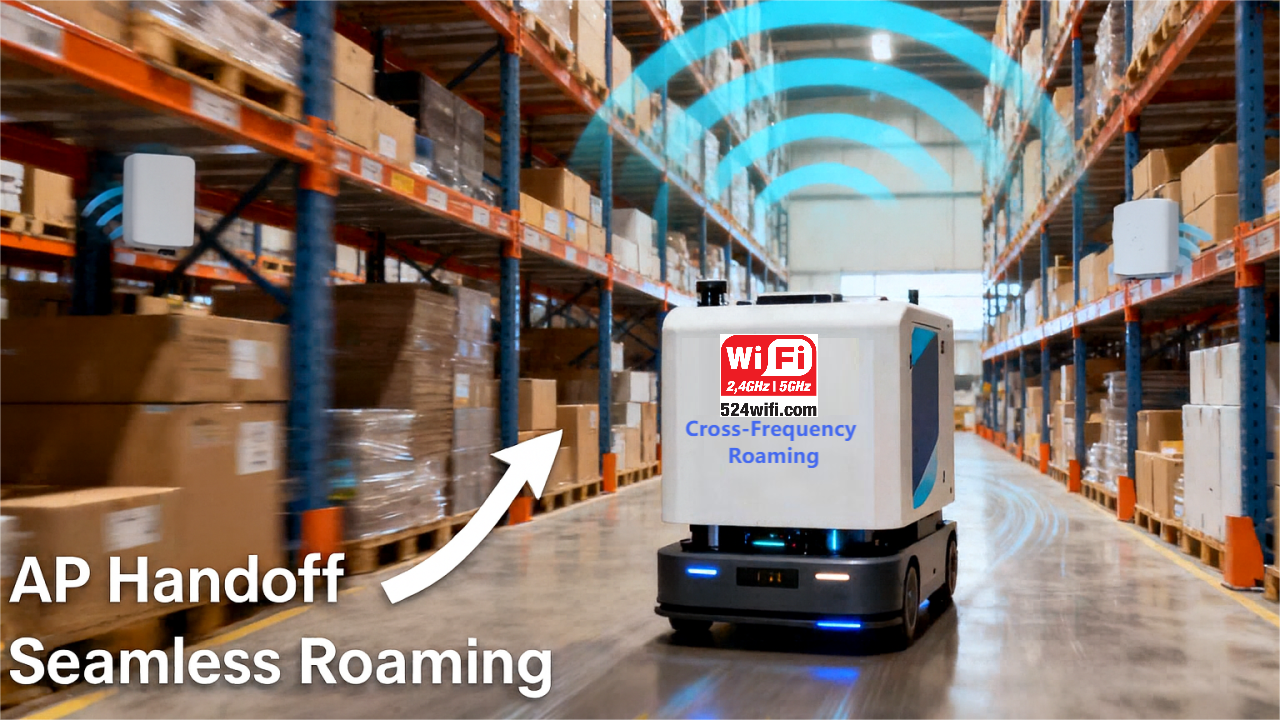
Seamless Same-Frequency & Cross-Frequency Roaming for AGVs and AMRs
In modern automated warehouses, stable and uninterrupted wireless connectivity is essential. Autonomous vehicles such as AGVs and AMRs depend on real-time communication for navigation, safety, and task execution. Any packet loss or delay can disrupt operations.
To meet these challenges, 524WiFi and Wallys Communications introduces its next-generation 5G Roaming Technology, engineered for mission-critical industrial environments requiring both same-frequency roaming and cross-frequency roaming. This new solution builds on the proven foundation of our Peacock Series while delivering significantly enhanced stability for complex warehouse deployments.
Why 524WiFi & Wallys 5G Roaming Is a Game Changer
Traditional roaming solutions often struggle when APs operate on different channels or when robots move rapidly across overlapping wireless coverage zones.
Wallys 5G Roaming enables instantaneous transitions between APs, whether the next AP is operating on:
The same frequency and same channel
The same frequency but a different channel
A different frequency band entirely
This flexibility eliminates typical roaming delays and ensures continuous operation in heterogeneous RF environments.
1. Cross-Frequency Roaming
AGVs and AMRs can move seamlessly between APs operating on different channels or different frequency bands. This is ideal for large warehouses where RF planning varies across zones.
Key benefit: ✔ Smooth transitions even when moving from Channel 36 to Channel 149, Channel 165, or mixed-band coverage areas.
2. Same-Frequency Roaming
In environments where APs share the same channel—common in dense warehouse layouts—Wallys roaming provides uninterrupted handoffs with zero packet loss.
Key benefit: ✔ Reliable connectivity even in high-density, same-channel deployments.
3. Zero Packet Loss & Ultra-Low Latency
Whether roaming is same-frequency or cross-frequency, the system consistently maintains:
Zero packet loss during handoff
Sub-millisecond switching times
Stable connectivity during continuous movement
This eliminates lag, communication gaps, and navigation issues associated with traditional roaming.
Real-World Warehouse Application
Imagine a fleet of AGVs navigating:
Narrow aisles
Large open areas
Mixed indoor and semi-outdoor regions
Zones where APs operate on different 5G channels
As each AGV moves from one coverage zone to another, Wallys roaming ensures instant, seamless transitions:
Channel 36 → Channel 149 → Channel 165
Same-channel AP-to-AP switching
Transition between heterogeneous frequency zones
Connectivity remains solid throughout—no interruptions, no delays, no impact on workflows.
Why Warehouse Leaders Are Choosing 524WiFi & Wallys
Supports both same-frequency and cross-frequency roaming
Designed for AGVs, AMRs, and industrial IoT environments
Demonstrated performance in complex, high-interference warehouses
Backed by 524WiFi’ extensive wireless engineering expertise
This positions warehouses for higher automation efficiency and long-term scalability.
Upgrade Your Warehouse Connectivity
524WiFi and Wallys 5G Roaming Technology delivers the reliability required for next-generation warehouse automation. Enable your AGVs and AMRs to operate consistently, safely, and efficiently—no matter how challenging the RF environment.
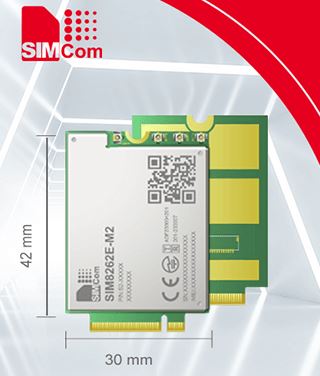
SIMCom, a global leader in IoT communication solutions, is proud to announce that its 5G R16 module SIM8262E-M2 has received a wide range of international certifications, including CE (RED), RoHS, REACH, JATE, TELEC, GCF, ANATEL, and Deutsche Telekom approval. These certifications reinforce SIMCom’s commitment to global market and accelerate the adoption of 3GPP Release 16 5G devices across the world.
Based on the Qualcomm Snapdragon X62 platform, the SIM8262E-M2 supports Sub-6GHz TDD/FDD and WCDMA, delivering enhanced data throughput and broader network coverage. Engineered for performance, flexibility, and scalability, the module is well-suited for a variety of IoT scenarios—including CPE, MIFI, industrial IoT, connected vehicles, and more.
The SIM8262E-M2 features a compact M.2 form factor (30.0 × 42.0 × 2.3mm), aligned with industry interface standards. With support for USB 3.1, PCIe, and GPIO, it simplifies system design and integration, helping developers reduce time-to-market.
With major global certifications secured, the SIM8262E-M2 is already enabling large-scale 5G rollouts and helping partners around the world unlock new opportunities in next-generation IoT. As SIMCom continues to expand its 5G product portfolio, it remains committed to delivering certified, market-ready solutions that drive the global digital transformation.
As 5G is moving in to it’s fifth generation chipset with the Qualcomm SDX8x series 3GPP Rel-18 compliant architecture, a question of the network side of 5G still lingers among many of our customers. We have already covered what 5G RedCap (NR-Light) is, it’s pros and cons and what it will mean for the future of IoT connectivity, but for the attentive reader one thing stands out: it requires 5G SA. And in reality, a lot of the promises of a future with 5G evolves around this technology, namely a complete 5G network, from the core (datacenter) to the RAN (base station) and everything in between being 5G.
In this post we will dive in to some of the so called options in 5G networking, the multitude of abbreviations, as well as the differences in technology.
5G Networking – Non-Standalone vs Standalone 5G New Radio
LTE Networking
Let’s start by taking a step back and look at LTE (4G) networking. The so-called Option 1 consists of an Evolved Packet Core (EPC – the 4G core network) and eNodeB (eNB – 4G cellular base stations). It can be defined as an SA option as it utilizes 4G from backend to frontend, and as long as you have a 4G LTE capable device you can connect to the network and use it’s functions as we’ve all come to know it.
Simplified picure of LTE Networking
5G networking
Non-Standalone
When looking at 5G networking, things quickly became more complex. As previously mentioned 5G NSA was introduced as a way to ease the burden on the operators when deploying 5G base stations, by utilizing part of the existing 4G network already in place. The most popular approach to this dual-networking is called Option 3 with it’s abbreviation EN-DC (E-UTRA-New Radio Dual-Connectivity – IE 4G and 5G dual-mode).
Worth noting is that Option 3 in turn contains 3 sub-options 3, 3a and 3x. Most of which are available in eMBB (high-speed) 5G modules today, but notably not in RedCap.
By using NSA the modules and network uses some intelligence to know when to utilize the 5G side of the network, vs the 4G side of the same. This has been around for quite a while now, and we are starting to see 5G SA investments increasing globally.
Simplified picture of 3x, as we can see here, the 4G core of the network is connected with both an LTE eNB and 5G gNB (base station).
Simplified picture of NSA
Standalone
5G SA is the final step in the migration to 5G networks, where you switch the core of the network itself to 5G so that it acts as option 1 but with 5G, now called option 2. Don’t get us wrong, it’s nowhere near as easy as “remove this and replace with that” but in an overly simplified manner it now looks like the picture below.
Simplified picure of 5G SA
The options a module can work with are typically outlined in the datasheet or hardware guide. As mentioned above however, most new eMBB (high-speed) 5G modules can use both 5G NSA (typically ENDC Option 3/3a/3x) and 5G SA (Option 2) + LTE fallback (Option 1).
If you want to learn more about Standalone deployments, Ookla and Omdia has released a report with information on the current state of deployments: https://www.ookla.com/articles/europe-5gsa-2025
As 5G networks expand rapidly, effective communication between signal towers and controllers is essential for optimal network performance. This article examines the characteristics, challenges, costs, advantages, and market prospects of wired, wireless, and Wi-Fi transmission solutions.
Wired Transmission: Fiber Optic Connections
Fiber optic connections are the most widely used wired transmission solution, enabling high-speed and stable data transfer between 5G signal towers and controllers or core networks.
Advantages include:
High Bandwidth: Fiber optics provide exceptional bandwidth, accommodating the large data volumes required by 5G networks.
Low Latency: With minimal delay, fiber optics are ideal for applications needing real-time data transfer, such as telemedicine and autonomous driving.
Stability and Reliability: Fiber optics are highly stable and immune to electromagnetic interference, ensuring consistent performance across various environments.
Challenges include:
High Cost: The initial investment for fiber optics is substantial, covering materials, labor, and maintenance. Deployment can be particularly challenging in areas with complex geography or dense urban infrastructure.
Deployment Time: Installing fiber networks involves considerable construction work, which can extend the deployment timeline.
In the market, fiber optic transmission is a mature sector, widely adopted globally, especially in urban and densely populated areas. As 5G networks continue to grow, the demand for fiber optics is expected to rise, though high costs may limit its adoption in some regions.
Wireless Transmission: Microwave, Millimeter Wave, and Satellite
Wireless transmission solutions, including microwave and millimeter wave technologies, are commonly used, with satellite connections serving as a solution for extreme geographical conditions or where other methods are impractical.
Advantages include:
Deployment Flexibility: Wireless solutions do not require cable installation, allowing for quick deployment in challenging or remote areas.
Lower Initial Costs: Compared to fiber optics, wireless solutions have a lower initial deployment cost and are more adaptable to temporary or rapidly changing network needs.
Challenges include:
Bandwidth Limitations: Wireless transmission generally provides lower bandwidth compared to fiber optics, which might not meet the demands of high-performance 5G applications.
Environmental Impact: Wireless signals can be affected by environmental factors such as weather, terrain, and buildings, impacting stability and reliability.
Higher Latency and Interference: Wireless solutions can experience higher latency and are more susceptible to interference from other devices, especially in densely populated areas.
Wireless transmission solutions are seeing rapid growth in the market, particularly where fiber optic deployment is costly or time-sensitive. In remote and rural areas, the market potential for wireless solutions is significant, though long-term stability and performance issues need to be addressed.
Wi-Fi Transmission: Industrial-Grade Wi-Fi
Wi-Fi transmission solutions, especially those using industrial-grade equipment, are emerging as viable alternatives or complements to wired and traditional wireless methods. Advanced Wi-Fi 6 and Wi-Fi 7 technologies can efficiently handle high-performance data transfers over short distances, making them suitable for specific industrial applications.
Advantages:
Cost-Effectiveness: Wi-Fi solutions are generally more affordable and easier to install than fiber optics or microwave links.
Rapid Deployment: Wi-Fi networks can be quickly established and expanded, making them ideal for temporary or dynamic network requirements.
High Bandwidth and Low Latency: Wi-Fi 6 and Wi-Fi 7 offer enhanced bandwidth and reduced latency, suitable for industrial automation, smart cities, and other high-performance applications.
Challenges:
Limited Coverage Range: Wi-Fi is best suited for shorter distances and may not cover large areas as effectively as fiber optics.
Interference Issues: Wi-Fi signals can suffer from interference in high-density environments, impacting network stability and reliability.
High Security Requirements: For industrial applications, strong security measures are essential to protect data from breaches or attacks.
Solution Comparison and Market Trends
In terms of cost, fiber optic connections involve a high initial investment but offer lower long-term operational costs, making them suitable for high-capacity, high-reliability scenarios. Wireless solutions, with lower initial costs, may incur additional expenses over time due to equipment and frequency needs. Wi-Fi solutions provide notable advantages in initial cost and deployment speed but are limited by range and potential interference.
Application Scenarios:
Fiber optics are optimal for urban areas or situations requiring high bandwidth and low latency.
Wireless solutions are better for remote areas or scenarios requiring rapid deployment.
Wi-Fi is ideal for specific industrial applications or short-distance high-bandwidth needs.
Looking ahead, a hybrid approach combining fiber optics, wireless, and Wi-Fi might become prevalent, balancing cost, flexibility, and performance. As technology advances, the capacity and reliability of wireless and Wi-Fi solutions are expected to improve, broadening their market potential.
524 WiFi 6 DR6018 Solution: Shijiazhuang 5G Base Station and Controller Wireless Transmission Application
The DR6018 has proven effective in delivering stable wireless transmission between 5G base stations and controllers. For practical applications and more details about our DR6018-outdoor solution, visit our DR6018-Outdoor Solution page.
DR6018-Outdoor mounted outdoorTopology of the WiFi Transmission5G Base Station