Traditional WiFi upgrades mainly focus on higher throughput.
WiFi 7 introduces several technologies that improve not only speed, but also network efficiency and reliability.
1. Multi-Link Operation (MLO)
MLO allows devices to use multiple wireless links simultaneously.
Benefits include:
Higher throughput
Better connection stability
Improved latency performance
More reliable wireless communication
For industrial environments with robots, cameras, sensors, and mobile devices, maintaining stable connectivity is often more important than peak speed.
2. 320MHz Channel Support
WiFi 7 doubles channel bandwidth compared with previous generations.
This enables:
Higher wireless capacity
Better support for high-bandwidth applications
More efficient network utilization
Applications such as industrial vision inspection, AI cameras, and real-time data transmission can benefit from this increased capacity.
3. 4096-QAM
Higher-order modulation improves data efficiency, allowing more data transmission within the same spectrum conditions.
This helps maximize wireless performance in modern high-density networks.
Built for Industrial Product Development
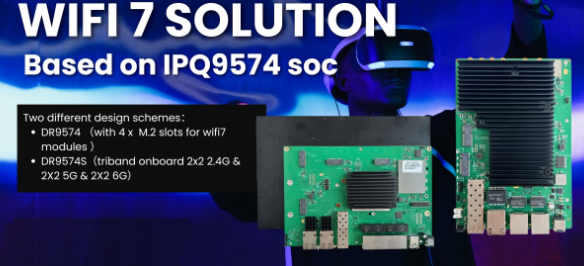
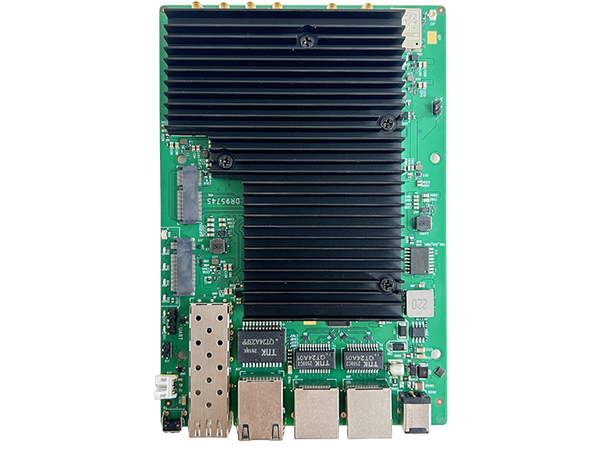
DR9574S is designed for companies that need a reliable WiFi 7 hardware foundation without starting from zero.
Wallys provides:
Hardware Platform
Qualcomm IPQ9574 platform
WiFi 7 architecture
High-performance CPU processing
Enterprise-level wireless capability
Flexible hardware customization
Development Support
Our engineering team supports:
Hardware customization
Antenna optimization
Thermal design
Firmware integration
OEM/ODM/JDM projects
Helping customers accelerate their product development cycle.
WiFi 7 + Industrial AI: The Next Connectivity Era
As AI moves from the cloud to the edge, wireless networks are becoming a critical infrastructure component.
Future applications such as:
Autonomous mobile robots (AMR)
Industrial automation
AI vision systems
Smart factories
Drones
Edge computing devices
will require wireless networks that are faster, more stable, and more intelligent.
WiFi 7 is not just an upgrade in speed.
It is becoming the foundation for next-generation industrial connectivity.
Build Your Next WiFi 7 Product with 524WiFi
Whether you are developing an industrial AP, enterprise wireless solution, or customized networking product, DR9574S provides a powerful Qualcomm-based platform to accelerate your innovation.
Contact 524WiFi to explore your next WiFi 7 project!
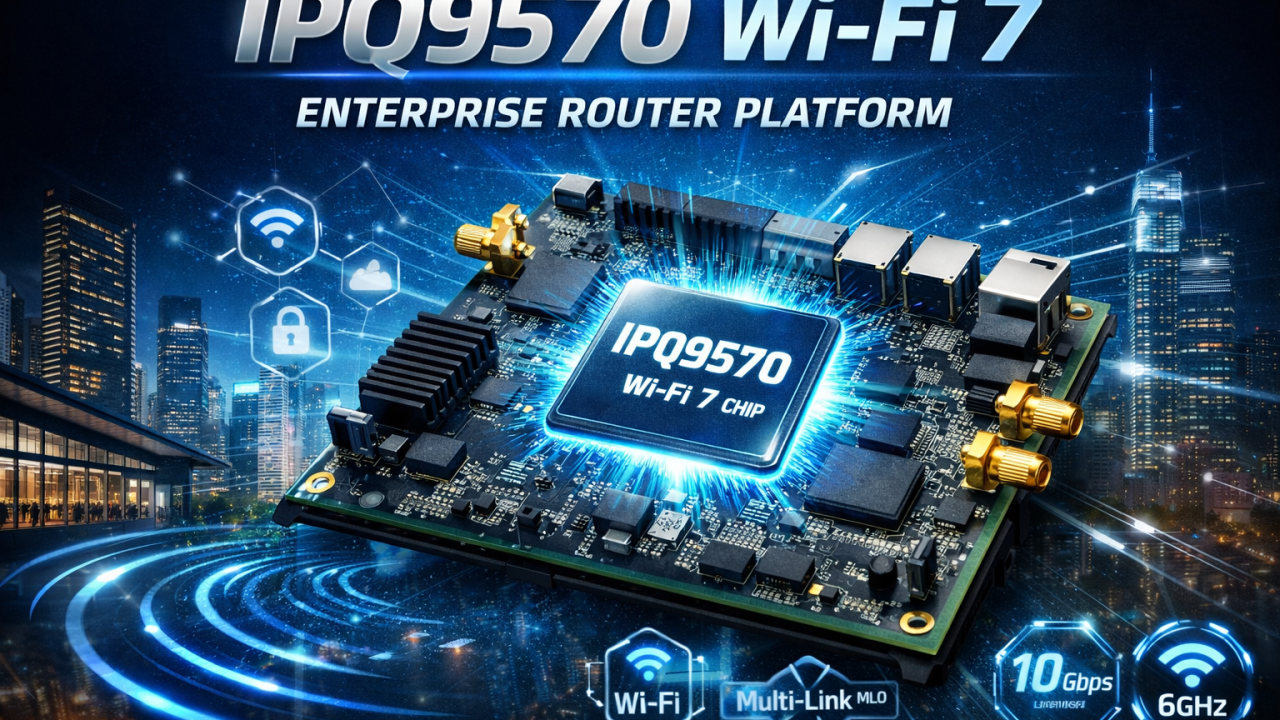
As Wi-Fi 7 (IEEE 802.11be) enters commercial deployment, enterprises and industrial users are demanding higher throughput, lower latency, stronger reliability, and scalable networking platforms. The Qualcomm IPQ9570 is designed precisely for these needs, positioning itself as a high-end Wi-Fi 7 router SoC for enterprise, industrial, and mission-critical networking applications.
This article provides a comprehensive overview of the IPQ9570 Wi-Fi 7 chipset, its key features, advantages, and typical application scenarios.
What Is IPQ9570?
The IPQ9570 is a flagship networking processor from Qualcomm’s Wi-Fi 7 router platform lineup. It targets enterprise-grade access points, high-performance gateways, and industrial routers, delivering advanced compute power, next-generation wireless capabilities, and rich wired connectivity.
Built for multi-gigabit networking, IPQ9570 is ideal for deployments where performance, stability, and long-term scalability are critical.
Key Features of IPQ9570 Wi-Fi 7 Platform
1. Wi-Fi 7 (802.11be) Support
IPQ9570 fully supports Wi-Fi 7, bringing major enhancements over Wi-Fi 6/6E:
320 MHz channel bandwidth
Multi-Link Operation (MLO)
4096-QAM
Significantly improved throughput and spectrum efficiency
These features enable ultra-fast wireless performance while maintaining stable connections in dense environments.
2. Multi-Link Operation (MLO)
One of the most important Wi-Fi 7 innovations, MLO, allows devices to transmit and receive data across multiple bands (2.4 GHz / 5 GHz / 6 GHz) simultaneously.
Benefits include:
Lower latency
Seamless roaming
Higher reliability
Reduced packet loss in mission-critical applications
This makes IPQ9570 particularly suitable for enterprise roaming, industrial mobility, and real-time communication systems.
This ensures stable operation even under heavy traffic loads and complex network conditions.
4. Multi-Gigabit Ethernet Connectivity
To eliminate wired bottlenecks, IPQ9570 supports:
2.5G / 5G / 10G Ethernet interfaces
High-speed LAN and WAN configurations
This enables full utilization of Wi-Fi 7 wireless speeds and supports modern enterprise network architectures.
5. Enterprise-Grade Security and Reliability
IPQ9570 is designed with enterprise and industrial reliability in mind, offering:
Hardware-accelerated security
Secure boot and encryption
Long-term platform support
It is well suited for 24/7 operation in demanding environments.
Typical Applications of IPQ9570
Thanks to its high-end positioning, IPQ9570 is widely applicable in:
Enterprise Wi-Fi 7 Access Points
High-performance Wi-Fi 7 Routers & Gateways
Industrial Wireless Routers
Smart Factories & Industrial Automation
Smart Ports, Airports, and Transportation Systems
Mesh & Seamless Roaming Networks
Edge Computing Gateways
IPQ9570 vs Previous-Generation Platforms
Compared with Wi-Fi 6/6E platforms, IPQ9570 offers:
Up to 2×–3× higher wireless throughput
Lower latency for real-time applications
Better performance in high-density environments
Improved future-proofing for next-generation devices
For enterprises planning long-term network upgrades, IPQ9570 provides a solid foundation.
Why Choose IPQ9570 for Wi-Fi 7 Projects?
Choosing IPQ9570 means investing in:
Future-ready Wi-Fi 7 performance
Enterprise-grade stability
Scalable hardware and software architecture
Support for advanced features like MLO and multi-gig Ethernet
It is an ideal solution for customers who require high reliability, customization flexibility, and long product lifecycle support.
Conclusion
The Qualcomm IPQ9570 stands out as a high-end Wi-Fi 7 router platform designed for enterprise and industrial applications. With support for Wi-Fi 7, MLO, multi-gigabit Ethernet, and strong processing power, IPQ9570 enables next-generation wireless networks that are faster, more reliable, and ready for the future.
For companies planning to deploy Wi-Fi 7 enterprise routers, industrial APs, or custom wireless solutions, IPQ9570 is a powerful and forward-looking choice.
524WiFi and Wallys IPQ9570 Router Board & ODM Services
We provide IPQ9570-based Wi-Fi 7 router boards and customized ODM solutions for enterprise and industrial applications.
With in-house R&D, manufacturing, and software customization capabilities, Wallys helps customers accelerate Wi-Fi 7 product development, from concept to mass production. Our IPQ9570 router board solutions support:
Wi-Fi 7 (802.11be) architecture with MLO support
Multi-gigabit Ethernet (2.5G / 5G / 10G) designs
Industrial-grade hardware options
Customized RF, antenna, and enclosure design
OpenWrt / Linux-based firmware customization
OEM / ODM / JDM project support
Whether you are building enterprise Wi-Fi 7 routers, industrial gateways, mesh & roaming systems, or customized wireless platforms, 524WiFi delivers flexible, reliable, and scalable solutions tailored to your project requirements.
Welcome back to 524WiFi! In today’s video, we’ll walk you through the process of loading firmware and configuring MLO for the IPQ9574 board.
If you’re setting up advanced hardware, this guide will help you get everything up and running smoothly. Let’s dive in! First, we’ll connect the hardware.
You’ll need a UART cable, and here’s how to connect the pins:
GND connects to the black cable, TX to the white cable, RX to the green cable. Remember, VCC is not needed.
Once that’s connected, we can move on to the software configuration.
Next, we’ll load the firmware. Make sure the firmware file is in the same folder as tftpd32. Follow these steps:
Open the terminal and enter U-Boot mode. Modify the machid and configure the card slots.
If you’re using the DR9274-2G, DR9274-5G, and DR9274-6G modules, input the following commands: Open the tftpd32 tool and input the following command to re-flash the firmware:
Finally, input reset to reboot the system and proceed with AP configuration.
Now, we’ll configure the Access Points (AP). After the reboot, log in as root with the password asdf1234. Then, input the following command to edit the wireless configuration file: Modify the AP settings as needed.
Here’s an example configuration: Once done, press ESC, then shift+zz to save and exit.
To finalize the setup, enable the configuration by typing:wifi
Then, check if the radios are up by entering:iwconfig
And that’s it! Your APs are configured, and the new firmware has been successfully loaded! Next, we’ll be testing the DR9574kit’s MLO throughput performance. Stay tuned to our channel for the latest updates and test results. Don’t forget to hit the notification bell, so you don’t miss out! Thank you for watching this firmware loading and MLO configuration tutorial! If you found this video helpful, make sure to give us a thumbs up and subscribe to Wallystech for more technical guides and hardware tutorials. See you in the next video!
Powering the WiFi 7 Era: QCN9274 & QCN6274 Modules in Action
WiFi 7 isn’t just faster — it’s smarter, more efficient, and built for the future of connectivity. At the heart of this transformation are Qualcomm’s QCN9274 and QCN6274 WiFi 7 modules, engineered for high-throughput, low-latency wireless environments.
These modules are perfect for: ???? Industrial APs and high-density public deployments ???? Mesh systems requiring seamless roaming ???? Ultra-responsive applications like AR/VR, video streaming, and edge AI
???? Pair It with Wallys DR5322 (IPQ5322)
To bring these modules to life, 524WiFi offers the DR5322 router board, a powerhouse based on the IPQ5322 SoC, featuring:
✅ 10G SFP port for fiber uplink
✅ 1GB DDR4 (16-bit) RAM
✅ Mini PCIe & M.2 slots for flexible wireless expansion
✅ Perfectly compatible with QCN9274 / QCN6274 modules
Wallys is preparing to release a new generation of boards based on Qualcomm’s IPQ5424 (Quad-core ARM A55 @1.8GHz) — codename Marina — offering enhanced processing power, optimized wireless efficiency, and designed with enterprise-level networking in mind.
Stay tuned for updates on our IPQ5424 platform launch!
With the rapid development of AI and IoT, traditional network architectures are no longer capable of handling the growing demands for data traffic and ultra-low latency. 524WiFis WiFi 7 hardware, with its groundbreaking technology, is specifically designed for AI-driven applications, offering infinite possibilities for the future of networking.
Core Advantages of WiFi 7 for AI Applications:
🔌 Ultra-High Bandwidth WiFi 7 hardware supports an impressive 46.116 Gbps link speed(maximum 6ghz peak data rate 11.529 Gbps x 4), effortlessly handling the massive data transfers required by AI algorithms. It ensures smooth operation for AI applications such as machine learning, data analysis, and automation, while also managing high-bandwidth device connections.
🌐 Seamless AI Device Connectivity WiFi 7 supports multiple devices simultaneously, ensuring AI-driven endpoints like smart cameras, industrial robots, and automation control systems enjoy ultra-stable, high-bandwidth connections. This meets the demands of industrial automation and smart city infrastructure.
💡 Future-Proofing Capability Wallys WiFi 7 hardware is compatible with future 5G networks and edge computing, offering ultra-low latency and efficient transmission to allow real-time interaction between AI applications and IoT devices, building a smarter and more interconnected ecosystem.
Solutions Tailored for Industrial AI Applications
Whether in smart factories, smart cities, autonomous driving, or telemedicine, 524WiFi WiFi 7 ensures seamless connectivity and ultra-fast transmission, guaranteeing real-time performance and stability for AI applications.
Maximizing Wireless Performance with the Qualcomm IPQ9574: A Wi-Fi 7 Powerhouse
In today’s fast-paced digital world, industries are increasingly relying on advanced wireless technologies to support high-speed data transfer and seamless connectivity. The Qualcomm IPQ9574, a cutting-edge chipset powering the DR9574 router board, is revolutionizing wireless communication by supporting Wi-Fi 7 and offering industry-leading performance for demanding applications. This article delves into the key features and specifications of the IPQ9574 and DR9574, highlighting how they are shaping the future of wireless networking.
Why the Qualcomm IPQ9574 is a Game-Changer for Wi-Fi 7 Networks
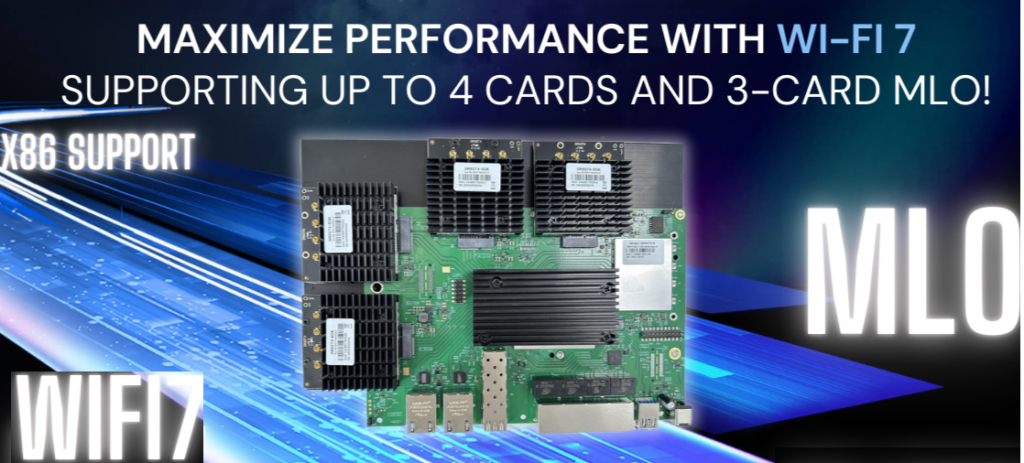
The IPQ9574 chipset is at the heart of the DR9574, delivering unmatched wireless capabilities. It supports up to 4 Wi-Fi 7 cards, allowing flexibility for a variety of MLO (Multi-Link Operation) configurations, including compatibility with any 3-card MLO setup. This level of flexibility and performance ensures that industries can scale their networks to meet the growing demand for high-speed wireless communication.
Key Features of the IPQ9574-Based DR9574
Advanced Quad-Core ARM Processor: The IPQ9574 chipset is powered by a Quad-Core ARM-A73 processor running at 2.2GHz. This ensures high-speed processing for data-intensive tasks and complex networking functions.
Support for Wi-Fi 7: The IPQ9574 is designed to support the latest Wi-Fi 7 technology, providing faster speeds, better efficiency, and higher network capacity compared to its predecessors.
Multiple M.2 E Key Interfaces: The DR9574 offers 4 M.2 E Key interfaces with PCIe 3.0, enabling support for up to four Wi-Fi 7 cards. This flexibility is crucial for environments that require high-performance networking.
Excellent Power Efficiency: The board consumes 13W without the onboard Wi-Fi and up to 23W with Wi-Fi integrated, striking a balance between power efficiency and high-performance operation.
Broad Operating Range: With operating temperatures between -20°C to 70°C and storage temperatures from -40°C to 90°C, the DR9574 is built to endure harsh industrial environments.
Optimized for High-Speed Data: The 2.4GHz band supports 802.11b/g/n/ax standards, with data rates reaching 24dBm per chain, ensuring robust and fast wireless connections.
Key Hardware Specifications of the DR9574 Router Board
Power Consumption13W (Board only), 23W (with onboard Wi-Fi)
Temperature RangeOperating: -20°C to 70°C, Storage: -40°C to 90°C
Applications of the DR9574 in Industry
With its robust feature set and Wi-Fi 7 capabilities, the DR9574 is perfect for a variety of industries, including:
Smart Cities: The ability to support multiple Wi-Fi 7 cards and MLO configurations makes it ideal for managing the wireless backbone of smart cities, where high-speed and reliable communication are essential.
Industrial IoT (IIoT): As industrial applications increasingly rely on wireless technology for device communication, the DR9574 ensures reliable data transfer, low latency, and the ability to scale as the number of connected devices grows.
Telecommunications: The IPQ9574 chipset allows telecommunications providers to build next-generation infrastructures that offer superior performance and capacity.
Absolute Maximum Ratings for Reliable Operation
Parameter/RatingUnit
Operating Temperature-20 ~ 70ºC
Storage Temperature-40 ~ 90ºC
Operating Humidity5% ~ 95 (non-condensing)%
Storage Humidity0% ~ 90 (non-condensing)%
Conclusion: Future-Proof Your Network with IPQ9574 and DR9574
The Qualcomm IPQ9574 and DR9574 router board are poised to lead the charge in Wi-Fi 7 technology, providing businesses and industries with the high-performance, reliable, and scalable networking solutions they need. With support for multiple Wi-Fi 7 cards, MLO configurations, and the ability to operate in challenging environments, the DR9574 is an ideal choice for industries looking to upgrade their wireless networks for the future.
As Wi-Fi 7 continues to gain traction in the industry, the IPQ9574 is at the forefront of delivering the connectivity that next-gen applications demand, from industrial IoT to smart cities and beyond.
op IPQ9574 Chip Features for Next-Gen Wi-Fi 7 Connectivity
As the demand for faster, more reliable wireless networks continues to grow, the introduction of Wi-Fi 7 has become a game-changer in the world of wireless technology. At the heart of this new generation of Wi-Fi is the IPQ9574 chip, designed by Qualcomm, which is quickly emerging as one of the leading chips for Wi-Fi 7 connectivity. With its advanced features, the IPQ9574 is set to unlock unprecedented speeds, capacity, and reliability, paving the way for cutting-edge applications across industries. In this article, we’ll take a closer look at the top features of the IPQ9574 chip and how it is revolutionizing the way we connect.
1. Multi-Link Operation (MLO) for Ultra-Fast Speeds
One of the standout features of the IPQ9574 chip is its support for Multi-Link Operation (MLO), a critical component of Wi-Fi 7. MLO allows devices to simultaneously connect to multiple frequency bands (e.g., 2.4 GHz, 5 GHz, and 6 GHz) instead of relying on a single band. This results in faster data transfer speeds and improved network efficiency.
With MLO, the IPQ9574 can combine multiple data streams from different channels, enhancing throughput and reducing latency. This makes it ideal for demanding applications such as 4K/8K video streaming, virtual reality (VR), and high-speed gaming, where a seamless and ultra-fast connection is essential.
2. Increased Capacity for Dense Environments
The IPQ9574 chip is built with the capacity to handle a large number of devices simultaneously, which is critical in today’s increasingly connected world. Whether it’s a smart home, a busy office, or a large public venue, the chip ensures that network congestion is minimized, allowing for smooth communication even in dense environments.
With the Wi-Fi 7 technology powered by the IPQ9574, your network will be able to efficiently handle more devices without sacrificing performance. This is especially important as the Internet of Things (IoT) continues to expand and more smart devices are added to networks every day.
3. Better Spectrum Utilization with 320 MHz Channel Width
The IPQ9574 chip supports 320 MHz channel width, which significantly increases the amount of data that can be transmitted over the network. This feature is crucial for taking full advantage of the newly available 6 GHz spectrum offered by Wi-Fi 7, allowing for less interference and more bandwidth.
With wider channels, users can expect higher throughput and faster data speeds. For example, large file transfers, high-definition video streaming, and bandwidth-intensive tasks will see massive improvements in speed and efficiency.
4. Enhanced Reliability and Reduced Latency
One of the most important factors in ensuring a reliable network is minimizing latency—the delay between sending and receiving data. The IPQ9574 chip addresses this with advanced features that optimize network reliability and ensure a low-latency experience.
In applications such as live streaming, online gaming, and real-time video conferencing, low latency is essential for smooth, uninterrupted experiences. The IPQ9574 chip’s ability to provide consistent, stable connections is what sets it apart, ensuring high performance even during heavy traffic periods.
5. Seamless Connectivity with Enhanced Roaming
The IPQ9574 chip supports seamless roaming, which allows devices to smoothly transition between access points without interruption. Whether you’re walking around your home or office, the network will automatically hand off your connection to the nearest access point, ensuring a continuous, reliable experience.
This is especially beneficial in larger spaces or environments with many users, such as hotels, hospitals, or large campuses, where maintaining an uninterrupted connection is crucial.
6. Backward Compatibility with Wi-Fi 5 and Wi-Fi 6
Although the IPQ9574 chip is built for the future with Wi-Fi 7, it also maintains backward compatibility with older Wi-Fi standards, such as Wi-Fi 5 and Wi-Fi 6. This means that users with older devices can still enjoy fast and reliable connections on Wi-Fi 7 networks, without the need to upgrade all their devices at once.
Conclusion: The Future of Wireless Connectivity
The IPQ9574 chip is a powerhouse for Wi-Fi 7 technology, offering game-changing features like Multi-Link Operation (MLO), higher capacity, wider channels, and seamless roaming. These features make it the perfect choice for applications demanding high-speed, reliable, and efficient wireless connections—whether it’s for streaming, gaming, smart cities, or enterprise networks.
At Wallys Communications, we leverage the IPQ9574 chip to deliver cutting-edge solutions that meet the needs of modern wireless networks. Additionally, we have developed AI-driven solutions, such as human recognition and vehicle detection, powered by QCN9074 chips, offering innovative applications in security and automation.
Contact us today to learn more about how our Wi-Fi 7 solutions powered by IPQ9574 can elevate your wireless network and unlock the full potential of next-gen connectivity.
In the era of Industry 4.0, Automated Guided Vehicles (AGVs), Autonomous Mobile Robots (AMRs), and Collaborative Robots (Cobots) are transforming industrial operations, boosting efficiency and flexibility. Behind this revolution, wireless communication plays a crucial role.
Traditional WiFi struggles in industrial environments due to high latency, interference, and unstable connections, limiting the full potential of automation. However, WiFi 7 (802.11be) is here to change the game. 📡
🚀 Why Is WiFi 7 the Future of Industrial Automation?
WiFi 7 introduces four key breakthroughs that optimize industrial communication:
QSDK 12.5 support for industrial Linux applications
long-range transmission, ideal for large-scale industrial deployments
Wallys WiFi 7 SolutionsWallys WiFi 7 Solutions
3 Key Transformations WiFi 7 Brings to Industrial Automation
✅ Near-zero latency, enabling real-time AGV and robotic operations
✅ Higher bandwidth, supporting AI-powered vision, video streaming, and smart monitoring
✅ Stronger interference resistance, ensuring stable communication in complex environments
💡 WiFi 7 isn’t just an upgrade—it’s the ultimate game-changer for Industry 4.0! 🚀 With 524WiFi’ WiFi 7 solutions, smart factories, automated logistics, and cobots are stepping into a new era!
📢 Where else do you think WiFi 7 will revolutionize industrial applications? Let’s discuss!
The integration of AI into industrial Wi-Fi networks is revolutionizing how industries operate, creating smarter, more efficient systems that can process data in real-time, automate processes, and enhance security. One notable advancement in AI technology is DeepSeek, an AI-powered solution leveraging deep learning models to accelerate data processing. As these technologies make their way into industrial networks, they present both exciting opportunities and unique challenges. In this article, we explore how DeepSeek can benefit industrial Wi-Fi networks, the advantages it offers, and the hurdles businesses must overcome to successfully implement these systems.
1. Opportunities: Enhancing Industrial Wi-Fi with AI
AI technologies, such as DeepSeek, are significantly improving how industrial systems handle and analyze data. Here’s a look at how DeepSeek can unlock new possibilities in industrial Wi-Fi networks:
1.1. Improved Network Efficiency and Real-Time Data Processing
With DeepSeek AI models, industrial Wi-Fi networks can process massive amounts of data generated by IoT devices, sensors, and cameras in real-time. Platforms like the Rockchip RK3588, which integrates a 6 TOPS NPU, offer the perfect environment for running these AI models. According to a recent post on CNX Software, DeepSeek running on the RK3588 achieves up to 15 tokens per second, which significantly accelerates real-time data analysis and decision-making. This performance boost is especially important in industries like smart manufacturing and security, where low latency and rapid data processing are essential.
AI-powered networks can reduce delays, boost decision-making speed, and improve operational efficiency by quickly analyzing large data sets. For industries that rely on real-time decision-making, this can translate into faster responses to changing conditions.
1.2. Predictive Maintenance and Automation
Predicting machine malfunctions before they occur is another advantage of integrating AI into industrial Wi-Fi systems. By analyzing data from machines, sensors, and connected devices, DeepSeek can detect patterns and predict potential failures. This is known as predictive maintenance—a key element of Industry 4.0.
The ability to identify early warning signs of equipment issues reduces the risk of costly downtime and improves overall equipment efficiency. Moreover, AI automation powered by DeepSeek can enhance processes like inventory management, quality control, and production scheduling, all while reducing human error.
1.3. Enhanced Security and Surveillance
Security is a major concern for industries that rely on connected systems and devices. AI enables smarter surveillance systems that are capable of face recognition, license plate detection, and anomaly detection in real time. When integrated into industrial Wi-Fi networks, DeepSeek models can significantly enhance security systems by processing video feeds and sensor data quickly and accurately.
AI-powered surveillance is especially useful in smart cities and sensitive industrial environments, where constant monitoring is crucial to prevent unauthorized access or security breaches.
2. Challenges: Barriers to AI Integration in Industrial Wi-Fi
While the advantages of integrating AI into industrial Wi-Fi systems are clear, there are several challenges that organizations must address to make the most of these technologies.
2.1. Hardware Compatibility and Performance
To run AI models like DeepSeek effectively, industrial systems need powerful hardware. In many cases, this means upgrading legacy infrastructure to include AI-capable hardware and ensuring compatibility between existing Wi-Fi equipment and AI acceleration platforms like Rockchip RK3588. These advanced NPU systems, capable of handling complex computations, are crucial for enabling real-time AI workloads.
As mentioned in the CNX Software article, the RK3588 platform’s AI acceleration allows for high-speed data processing, achieving up to 15 tokens per second, an impressive feat for industrial applications. However, organizations need to ensure that their systems can support these platforms and leverage their full potential.
2.2. Power Consumption and Thermal Management
AI workloads are energy-intensive, and the increased power consumption of AI systems can be a concern in industrial environments. High-performance AI accelerators, such as those using NPUs, generate substantial heat, which requires efficient thermal management systems to prevent overheating.
In industries where equipment runs continuously, managing the power consumption and heat generated by AI-enabled devices is critical. Companies must factor in these needs when implementing AI solutions like DeepSeek.
2.3. Data Security and Privacy
As AI systems process vast amounts of data, especially sensitive operational or security data, data security becomes a significant concern. Industrial Wi-Fi networks must ensure that AI models like DeepSeek are deployed with strong security frameworks in place.
Ensuring data privacy and compliance with regulatory standards is essential to avoid breaches or misuse of sensitive information. As AI models become more integrated into industrial systems, companies must adopt robust encryption and data protection protocols.
2.4. High Initial Costs and Complexity
The cost of upgrading infrastructure to support AI models can be prohibitively high for some businesses, especially small and medium-sized enterprises. Integrating advanced hardware, such as Rockchip RK3588 with NPU support, along with AI software like DeepSeek, requires a significant financial and resource investment. Additionally, these systems often require specialized personnel to implement and manage them.
The complexity of deploying and maintaining AI-powered industrial networks, combined with the need for specialized skills and hardware, can be a barrier to entry for many organizations.
3. 524WiFi’ Solutions for Optimizing Industrial Wi-Fi with AI
To address these challenges, 524WiFi and Wallys provide tailored solutions that integrate AI acceleration into industrial Wi-Fi networks. Products such as the DR9574 Router Board and the DR9074-triband module are designed to support high-performance AI applications, ensuring that companies can leverage AI-powered networks without sacrificing security, performance, or energy efficiency.
Wallys’ customized hardware and software support make it easier for industries to adopt AI technologies like DeepSeek, enabling seamless integration and efficient operation.
4. Conclusion
The integration of AI into industrial Wi-Fi networks brings remarkable opportunities for industries such as smart manufacturing, surveillance, and smart cities. With solutions like DeepSeek, powered by platforms like Rockchip RK3588, businesses can enhance network efficiency, enable predictive maintenance, and improve security.
However, the implementation of these technologies comes with its own set of challenges, such as hardware compatibility, energy consumption, data security, and cost. By addressing these issues with customized solutions from companies like 524WiFi or Wallys, industries can unlock the full potential of AI in their Wi-Fi networks, driving innovation and operational efficiency.