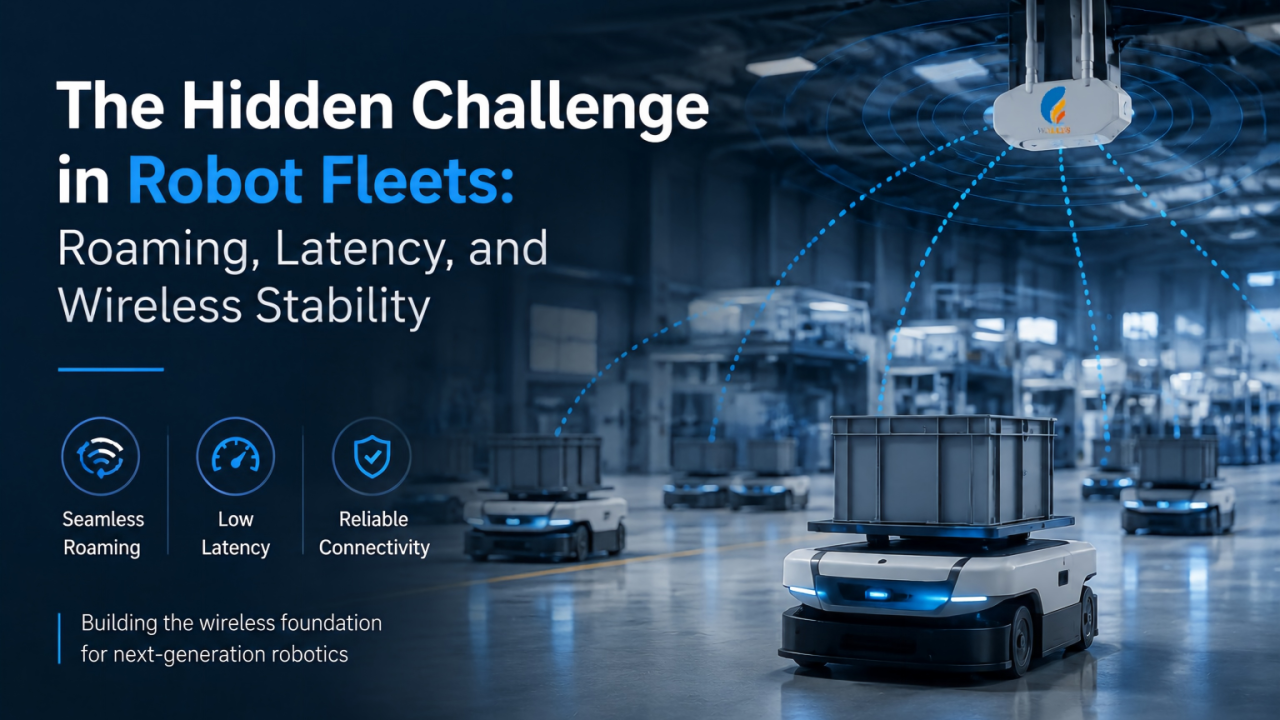
Mobile robots used to be limited mainly by batteries and mechanics. Increasingly, the limit is data movement. A modern AMR or UGV carries multiple cameras, LiDAR, and depth sensors. It runs perception models on board, and it has to stay connected while roaming across a warehouse, port, or factory floor. Compute has advanced quickly with NVIDIA Jetson. The wireless link has often stayed one generation behind.
Pairing Jetson-class edge compute with a Wi-Fi 7 network is one practical way to close that gap.
Why Jetson and Wi-Fi 7 belong in the same architecture
Jetson runs perception, localization, and navigation on the robot itself, so the robot does not depend on the network for real-time decisions. But the network still carries the data that matters at fleet level:
Compressed multi-camera streams for remote monitoring and teleoperation
Map and model updates pushed to many robots at once
Fleet telemetry, task dispatch, and OTA firmware
Handover of the robot’s connection between access points while moving
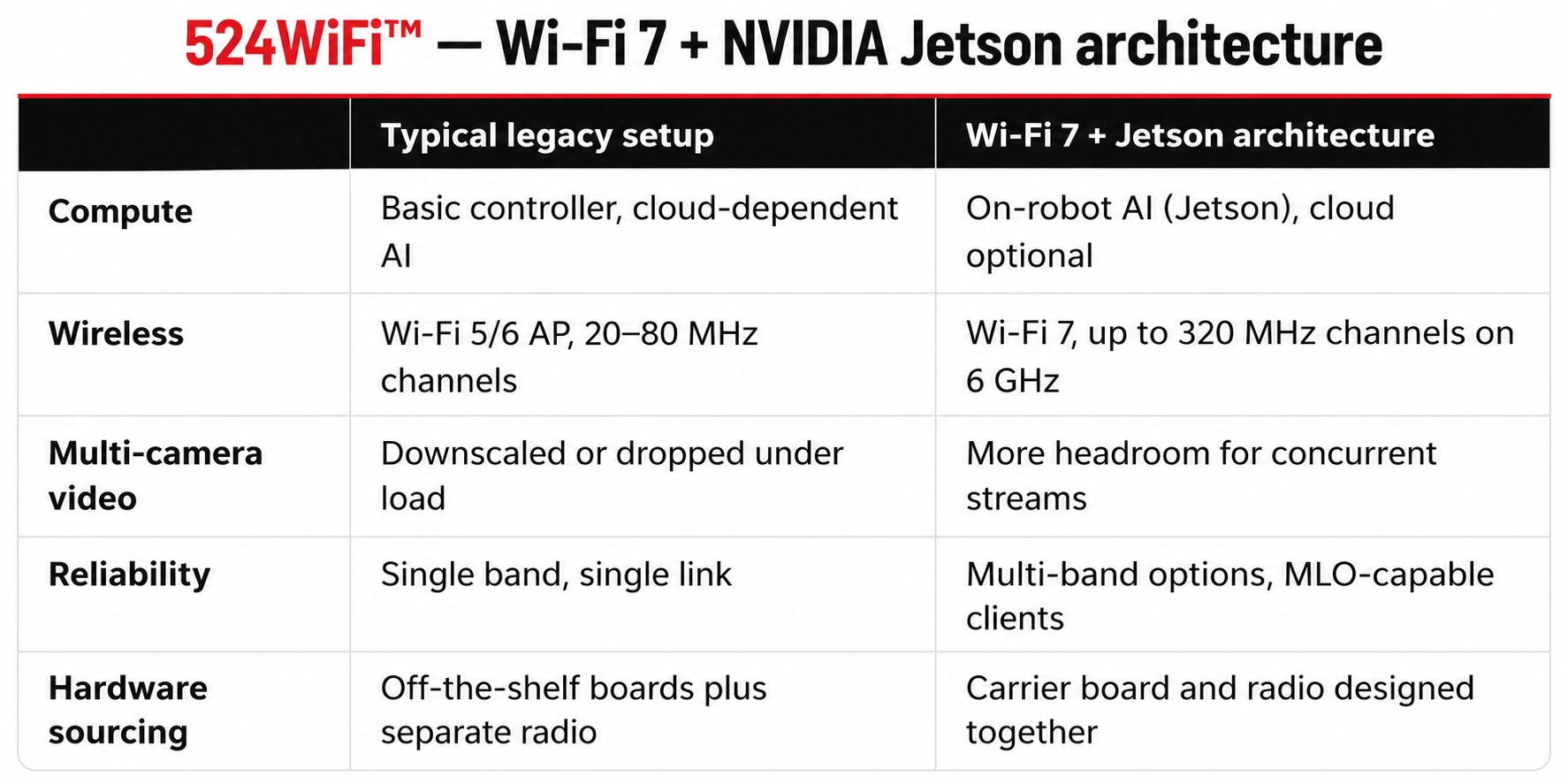
Wi-Fi 7 (IEEE 802.11be) addresses these directly. Channels of up to 320 MHz in the 6 GHz band raise per-link capacity. 4K-QAM raises spectral efficiency. Multi-Link Operation (MLO) lets a client use more than one band to improve reliability and reduce latency variation. Multi-RU scheduling helps when many small clients share a channel, which is the typical multi-robot case.
How the pieces fit together: 524WiFi™ edge platform
At 524WiFi™, we treat the robot’s compute and its radio as one design problem rather than two separate purchases.
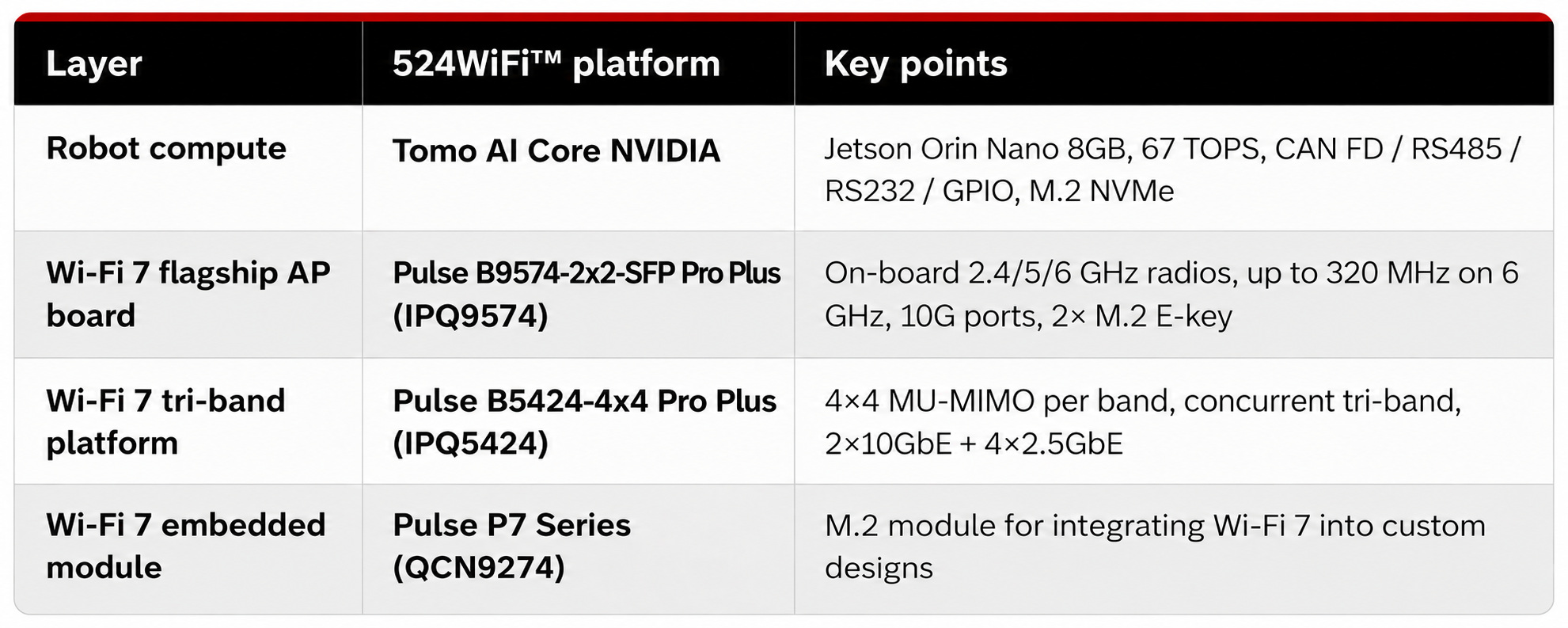
On the robot: the Tomo AI Core NVIDIA is built on the NVIDIA Jetson Orin Nano 8GB module with an industrial carrier board. It offers 67 TOPS of AI performance. Connectivity includes Gigabit Ethernet (one port with 48V PoE), optional Wi-Fi, and optional 4G/5G. Robot-side I/O includes CAN FD, RS485, RS232, GPIO, USB 3.0, and an M.2 NVMe slot. Select the compute, carrier I/O and wireless configuration around the requirements of the robot application.
On the infrastructure side: Wi-Fi 7 platforms based on Qualcomm silicon serve as the access point layer. Examples are the Pulse B9574-2×2-SFP Pro Plus (IPQ9574), the Pulse B5424-4×4 Pro Plus (IPQ5424), and the Pulse P7 Series M.2 modules (QCN9274) for embedding Wi-Fi 7 into your own hardware.
One point worth stating clearly: tri-band does not always mean the same thing. On the Pulse B5424-4×4 Pro Plus and Pulse B9574-2×2-SFP Pro Plus, the 2.4 GHz, 5 GHz, and 6 GHz radios are three independent chains running concurrently. Some tri-band cards are tri-band switchable, meaning one radio moves between bands to avoid interference. Both approaches are useful, but they suit different designs, so check which one a product actually is before planning around it.
Compared with the usual approach
Wi-Fi 7 is not a magic fix. Real roaming performance still depends on AP placement, channel planning, and client support. But the higher-capacity link and the multi-band tools give the network more room to work with.
Where this architecture applies
Warehouse and logistics AMRs: dense multi-robot fleets with steady roaming and continuous telemetry
Port and yard vehicles: long-range coverage with camera-based monitoring
Machine vision on the move: multi-camera, high-resolution image transfer to inspection systems
Inspection and security robots: live video plus on-board detection
Agricultural and field robotics: long-range control and video links, with custom transmission software where needed
Hardware summary
Talk to us
If you are building mobile robots on Jetson and would rather not develop the wireless hardware yourself, we can supply the modules, routerboards, and custom carrier boards, and discuss the application software and transmission requirements of the complete system.
When people talk about autonomous robots, the conversation usually focuses on AI models, sensors, cameras, and navigation algorithms.
But there is another critical layer that often determines whether a robot system succeeds in real-world deployment:
Wireless connectivity.
A robot can have advanced AI capabilities, but without reliable communication, even the smartest robot may struggle in a dynamic industrial environment.
For large-scale robot fleets, connectivity is no longer just a networking feature. It becomes part of the robot’s operational reliability.
The Reality of Wireless Challenges in Robot Deployments
In warehouses, factories, farms, and outdoor industrial environments, robots are constantly moving.
An AMR (Autonomous Mobile Robot), for example, may need to:
Move across different areas with changing RF conditions
Maintain real-time communication with control systems
Upload high-resolution camera data
Receive navigation and task instructions
Coordinate with other robots in the same environment
During these operations, wireless networks face several challenges:
1. Roaming: Staying Connected While Moving
A robot moving through a large facility often needs to transition between multiple access points.
A poor roaming experience can cause:
Packet loss
Video interruption
Control delays
Temporary disconnection
For industrial robots, even a short communication interruption can affect efficiency and safety.
Advanced roaming mechanisms such as 802.11k/v/r help devices make faster and smarter roaming decisions by improving network awareness and reducing handover time.
However, successful roaming also depends on:
Proper RF planning
AP deployment strategy
Client behavior optimization
Network management
2. Latency: Every Millisecond Matters
Many industrial robot applications require real-time communication.
Examples include:
Remote monitoring
Vision-based inspection
Autonomous navigation
Robot fleet coordination
High latency can impact:
Motion control
Response time
Task execution efficiency
The challenge is not only achieving high throughput.
A network can provide high speed but still suffer from unstable latency due to:
Network congestion
Interference
Poor link quality
Inefficient routing
Reliable industrial wireless networks need predictable performance, not just peak speed.
3. Wireless Stability in Complex Environments
Industrial environments are very different from homes or offices.
Factories and outdoor deployments may include:
Metal structures causing reflections
Moving equipment blocking signals
Multiple wireless networks creating interference
Large numbers of connected devices
A robot fleet may experience changing wireless conditions every moment.
This requires networks that can adapt dynamically.
Important capabilities include:
Intelligent channel management
Interference detection
Dynamic path optimization
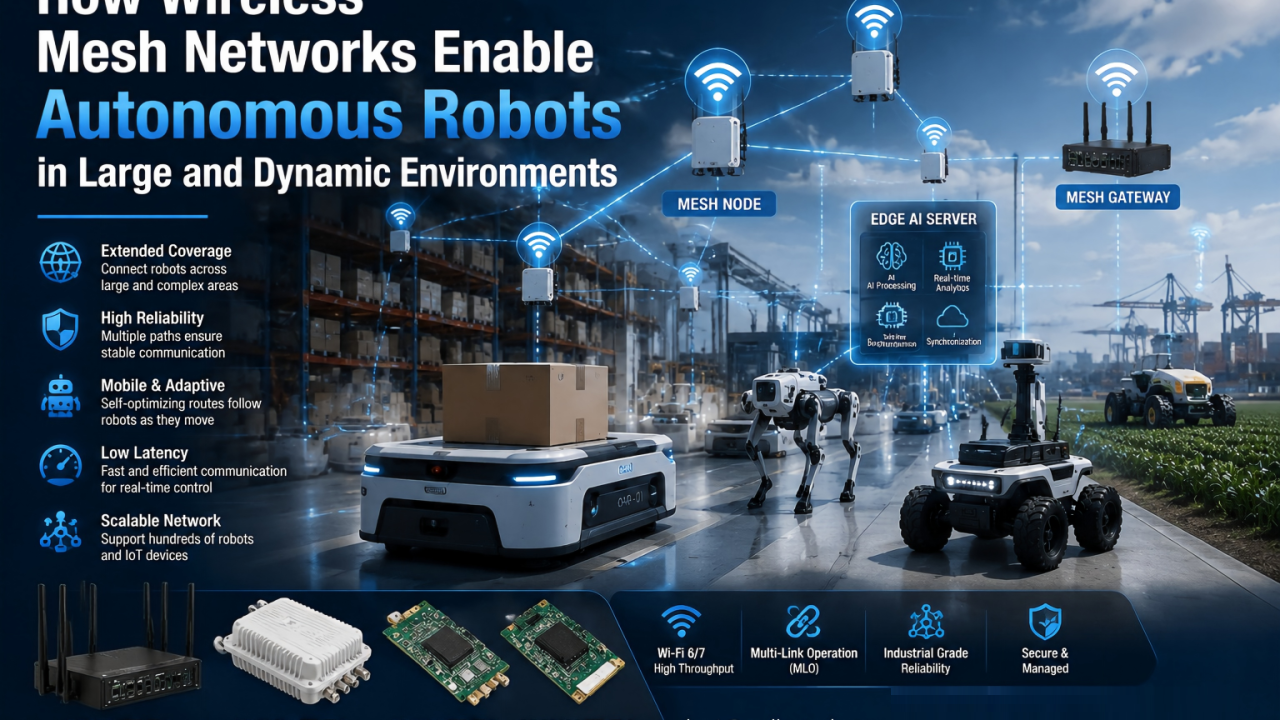
Mesh networking
Traffic prioritization
Why Traditional Wi-Fi Approaches Are Not Always Enough
A standard Wi-Fi deployment may work well for static users.
However, robot fleets introduce new requirements:
Mobility
High device density
Continuous connectivity
Low latency
Reliable uplink performance
The network needs to be designed around the robots’ movement and operational workflow.
Building the Wireless Foundation for Next-Generation Robots
The future of autonomous systems will depend on the combination of:
AI + Robotics + Reliable Connectivity
Advanced wireless technologies such as Wi-Fi 6 and Wi-Fi 7 bring important improvements:
Higher capacity
Better multi-device performance
Lower latency
Multi-band operation with MLO
Improved reliability in demanding environments
But technology alone is not enough.
Successful industrial deployments require:
The right wireless architecture
Proper RF optimization
Reliable hardware platforms
Long-term firmware support
Real-world validation
Final Thoughts
Autonomous robots are becoming smarter every day.
But intelligence alone does not guarantee successful deployment.
Behind every reliable robot fleet is a reliable communication infrastructure.
The next generation of industrial automation will not only depend on better AI algorithms — it will depend on wireless networks that can keep robots connected, responsive, and operational in the real world.
Reliable connectivity is the foundation that allows autonomous robots to truly become autonomous.
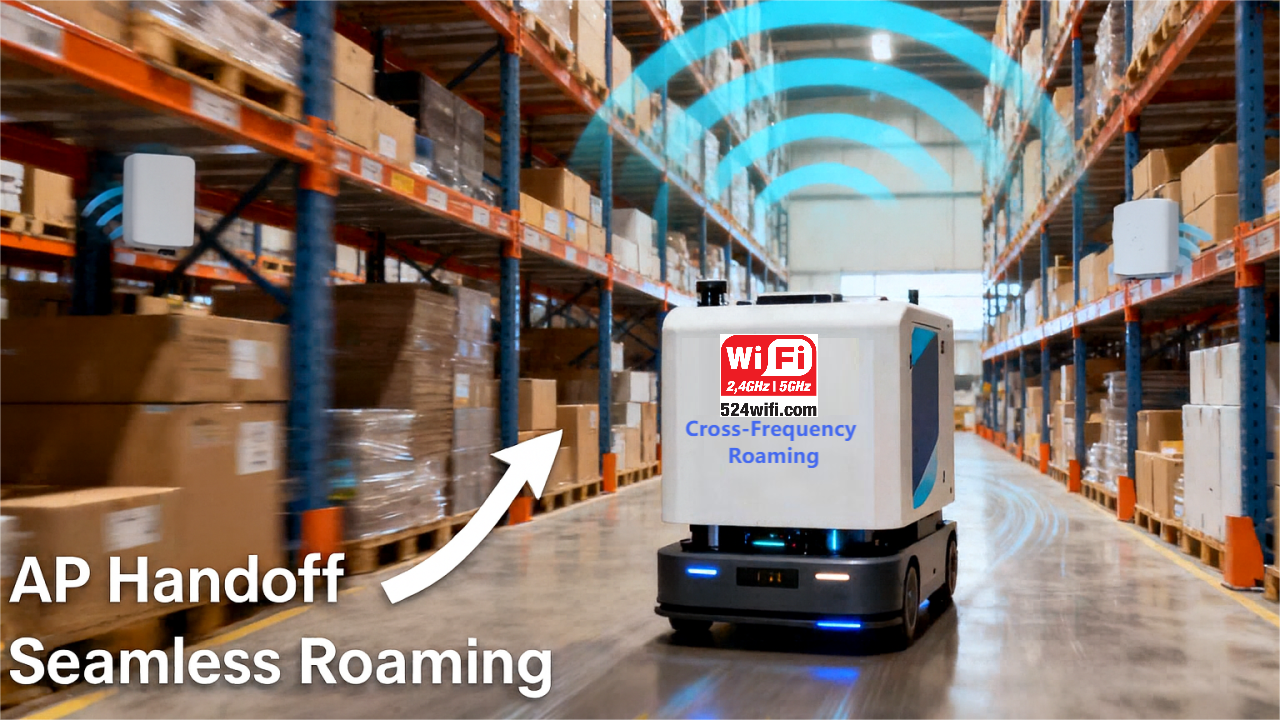
Seamless Same-Frequency & Cross-Frequency Roaming for AGVs and AMRs
In modern automated warehouses, stable and uninterrupted wireless connectivity is essential. Autonomous vehicles such as AGVs and AMRs depend on real-time communication for navigation, safety, and task execution. Any packet loss or delay can disrupt operations.
To meet these challenges, 524WiFi and Wallys Communications introduces its next-generation 5G Roaming Technology, engineered for mission-critical industrial environments requiring both same-frequency roaming and cross-frequency roaming. This new solution builds on the proven foundation of our Peacock Series while delivering significantly enhanced stability for complex warehouse deployments.
Why 524WiFi & Wallys 5G Roaming Is a Game Changer
Traditional roaming solutions often struggle when APs operate on different channels or when robots move rapidly across overlapping wireless coverage zones.
Wallys 5G Roaming enables instantaneous transitions between APs, whether the next AP is operating on:
The same frequency and same channel
The same frequency but a different channel
A different frequency band entirely
This flexibility eliminates typical roaming delays and ensures continuous operation in heterogeneous RF environments.
1. Cross-Frequency Roaming
AGVs and AMRs can move seamlessly between APs operating on different channels or different frequency bands. This is ideal for large warehouses where RF planning varies across zones.
Key benefit: ✔ Smooth transitions even when moving from Channel 36 to Channel 149, Channel 165, or mixed-band coverage areas.
2. Same-Frequency Roaming
In environments where APs share the same channel—common in dense warehouse layouts—Wallys roaming provides uninterrupted handoffs with zero packet loss.
Key benefit: ✔ Reliable connectivity even in high-density, same-channel deployments.
3. Zero Packet Loss & Ultra-Low Latency
Whether roaming is same-frequency or cross-frequency, the system consistently maintains:
Zero packet loss during handoff
Sub-millisecond switching times
Stable connectivity during continuous movement
This eliminates lag, communication gaps, and navigation issues associated with traditional roaming.
Real-World Warehouse Application
Imagine a fleet of AGVs navigating:
Narrow aisles
Large open areas
Mixed indoor and semi-outdoor regions
Zones where APs operate on different 5G channels
As each AGV moves from one coverage zone to another, Wallys roaming ensures instant, seamless transitions:
Channel 36 → Channel 149 → Channel 165
Same-channel AP-to-AP switching
Transition between heterogeneous frequency zones
Connectivity remains solid throughout—no interruptions, no delays, no impact on workflows.
Why Warehouse Leaders Are Choosing 524WiFi & Wallys
Supports both same-frequency and cross-frequency roaming
Designed for AGVs, AMRs, and industrial IoT environments
Demonstrated performance in complex, high-interference warehouses
Backed by 524WiFi’ extensive wireless engineering expertise
This positions warehouses for higher automation efficiency and long-term scalability.
Upgrade Your Warehouse Connectivity
524WiFi and Wallys 5G Roaming Technology delivers the reliability required for next-generation warehouse automation. Enable your AGVs and AMRs to operate consistently, safely, and efficiently—no matter how challenging the RF environment.