
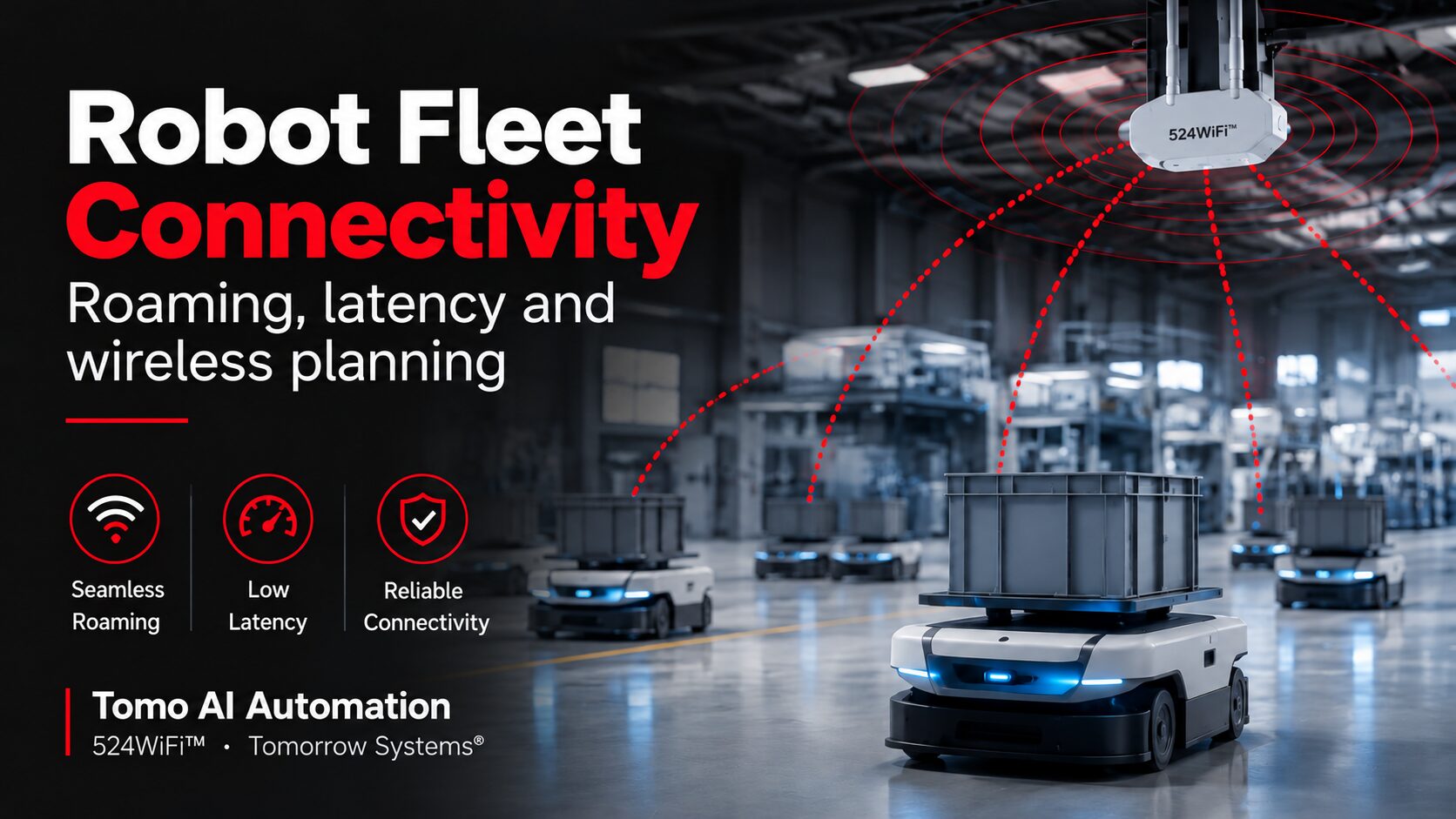
When people talk about autonomous robots, the conversation usually focuses on AI models, sensors, cameras, and navigation algorithms.
But there is another critical layer that often determines whether a robot system succeeds in real-world deployment:
Wireless connectivity.
A robot can have advanced AI capabilities, but without reliable communication, even the smartest robot may struggle in a dynamic industrial environment.
For large-scale robot fleets, connectivity is no longer just a networking feature. It becomes part of the robot’s operational reliability.
The Reality of Wireless Challenges in Robot Deployments
In warehouses, factories, farms, and outdoor industrial environments, robots are constantly moving.
An AMR (Autonomous Mobile Robot), for example, may need to:
- Move across different areas with changing RF conditions
- Maintain real-time communication with control systems
- Upload high-resolution camera data
- Receive navigation and task instructions
- Coordinate with other robots in the same environment
During these operations, wireless networks face several challenges:
1. Roaming: Staying Connected While Moving
A robot moving through a large facility often needs to transition between multiple access points.
A poor roaming experience can cause:
- Packet loss
- Video interruption
- Control delays
- Temporary disconnection
For industrial robots, even a short communication interruption can affect efficiency and safety.
Advanced roaming mechanisms such as 802.11k/v/r help devices make faster and smarter roaming decisions by improving network awareness and reducing handover time.
However, successful roaming also depends on:
- Proper RF planning
- AP deployment strategy
- Client behavior optimization
- Network management
2. Latency: Every Millisecond Matters
Many industrial robot applications require real-time communication.
Examples include:
- Remote monitoring
- Vision-based inspection
- Autonomous navigation
- Robot fleet coordination
High latency can impact:
- Motion control
- Response time
- Task execution efficiency
The challenge is not only achieving high throughput.
A network can provide high speed but still suffer from unstable latency due to:
- Network congestion
- Interference
- Poor link quality
- Inefficient routing
Reliable industrial wireless networks need predictable performance, not just peak speed.
3. Wireless Stability in Complex Environments
Industrial environments are very different from homes or offices.
Factories and outdoor deployments may include:
- Metal structures causing reflections
- Moving equipment blocking signals
- Multiple wireless networks creating interference
- Large numbers of connected devices
A robot fleet may experience changing wireless conditions every moment.
This requires networks that can adapt dynamically.
Important capabilities include:
- Intelligent channel management
- Interference detection
- Dynamic path optimization
- Mesh networking
- Traffic prioritization
Why Traditional Wi-Fi Approaches Are Not Always Enough
A standard Wi-Fi deployment may work well for static users.
However, robot fleets introduce new requirements:
- Mobility
- High device density
- Continuous connectivity
- Low latency
- Reliable uplink performance
The network needs to be designed around the robots’ movement and operational workflow.
Building the Wireless Foundation for Next-Generation Robots
The future of autonomous systems will depend on the combination of:
AI + Robotics + Reliable Connectivity
Advanced wireless technologies such as Wi-Fi 6 and Wi-Fi 7 bring important improvements:
- Higher capacity
- Better multi-device performance
- Lower latency
- Multi-band operation with MLO
- Improved reliability in demanding environments
But technology alone is not enough.
Successful industrial deployments require:
- The right wireless architecture
- Proper RF optimization
- Reliable hardware platforms
- Long-term firmware support
- Real-world validation
Final Thoughts
Autonomous robots are becoming smarter every day.
But intelligence alone does not guarantee successful deployment.
Behind every reliable robot fleet is a reliable communication infrastructure.
The next generation of industrial automation will not only depend on better AI algorithms — it will depend on wireless networks that can keep robots connected, responsive, and operational in the real world.
Reliable connectivity is the foundation that allows autonomous robots to truly become autonomous.
524WiFi™ Pulse Options for Your Project
These are separate own-brand product variants. Select the model and configuration against your host, software, antenna system and operating requirements.
Plan your project with Tomo AI Automation
Bring your application, enclosure, interfaces, power requirements, software environment and expected quantity into one project brief. Tomorrow Systems® and 524WiFi™ can review the engineering scope with you.