

Posted on

How to Build Reliable Wireless Infrastructure for Autonomous Mobile Robots?

When companies deploy autonomous mobile robots (AMRs) in real environments, the biggest challenge is often not the robot itself.

It is the network that keeps the robot connected.

An AMR depends on continuous communication for:

– Real-time navigation

  • Vision data transmission

⚡ Edge AI inference

– Fleet coordination

☁️ Cloud and remote management

A short network interruption may result in:

  • Navigation delays
  • Video stream drops
  • Task interruptions
  • Reduced operational efficiency

So, what does a reliable wireless infrastructure for AMRs require?

1. Seamless Roaming

AMRs continuously move through different areas.

A reliable network must allow robots to switch between access points without interrupting communication.

2. Low and Stable Latency

For autonomous systems, average speed is not enough.

What matters is consistent response time.

Network jitter and packet loss can directly impact robot performance.

3. Strong Coverage and Scalability

Factories and warehouses often have:

  • Large areas
  • Metal structures
  • RF interference
  • Hundreds of connected devices

A scalable wireless architecture is essential.

4. Edge-Optimized Connectivity

Modern robots combine:

– AI computing – Wireless communication – Sensors ⚙️ Real-time control

Email: [email protected] or [email protected]

The wireless network is no longer just an access layer.

It becomes part of the AI system.

As Physical AI moves from laboratories into factories, warehouses, and outdoor environments, reliable connectivity will become a key factor determining whether autonomous systems can scale.

AI gives robots intelligence.

Connectivity gives robots the ability to operate.

What challenges have you experienced when deploying wireless networks for autonomous robots?

Building the next generation of AI-powered edge devices requires reliable connectivity. Explore how WallysTech helps robotics, AI vision, and industrial applications achieve stable wireless performance.
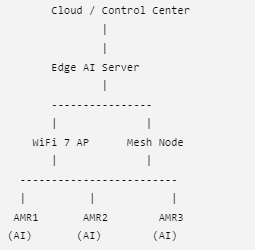
Article content
Posted on

Mediatek Unveils the New Wi-Fi 7 Platform AP7988-002, Delivering High-Performance Wireless Solutions for the AI Era

As AI development and the IoT market continue to mature, Wi-Fi has become one of the most universal and indispensable transmission methods in everyday life. However, with the growing demand for data traffic, existing networking technologies are facing challenges. To address these needs, 524WiFi proudly introduces its latest generation Wi-Fi 7 router development board, the AP7988-002. Designed to provide exceptional performance and seamless connectivity in the wireless communications field, the AP7988-002 is powered by the four-core ARM Cortex-A73 MediaTek MT7988A processor, making it the ideal choice for AI-driven communication and high-bandwidth applications.

In terms of wireless performance, the AP7988-002 is equipped with the MediaTek MT7996 Wi-Fi chipset, supporting Wi-Fi 7 technology and offering ultra-high-speed connectivity of up to 19,000 Mbps. This ensures ultra-low latency and outstanding data transmission capabilities, providing the perfect solution for next-generation network applications. To further enhance wireless signal coverage, the AP7988-002 features a high-power amplifier front-end module, significantly boosting signal strength and transmission range. This makes it especially suitable for large-scale infrastructure and environments requiring stable connections, positioning it as an essential networking device for both enterprise and residential applications.

The AP7988-002 is built around versatility, combining Tri-Band Triple Concurrent (TBTC) technology with 10G PHY high-speed wired connectivity. This allows it to handle substantial data transmissions simultaneously, ensuring optimal performance in multi-device connected environments and providing a stable network foundation for high-bandwidth applications.

Additionally, the product comes with an integrated M.2 B Key slot, supporting 4G/5G WWAN modules to offer flexible mobile network connectivity options. The M.2 M Key slot enables storage expansion, making it especially suitable for data-intensive applications such as large-scale data processing needed by small to medium-sized businesses. An integrated GPS module further enhances the device’s positioning capabilities, broadening its adaptability in modern network environments.

The launch of the AP7988-002 solidifies Mediatek’s leadership in wireless connectivity solutions, demonstrating the company’s commitment to technological innovation and laying a solid foundation for IoT applications. 524WiFi continues to drive advancements in wireless technology, striving to improve the performance and ease of use of IoT technologies, expanding the ways people live and work.

This product’s release marks a new milestone for Mediatek in the wireless technology field. With its exceptional performance and flexible application options, it brings an unprecedented network experience to both industries and individual users. For more information, please visit the 524WiFi official website for the latest updates and technical support.

Posted on

IPQ9574 + QCN9274 From AGVs to Cobots: How WiFi 7 Optimizes Industrial Automation Communication

In the era of Industry 4.0, Automated Guided Vehicles (AGVs), Autonomous Mobile Robots (AMRs), and Collaborative Robots (Cobots) are transforming industrial operations, boosting efficiency and flexibility. Behind this revolution, wireless communication plays a crucial role.

Traditional WiFi struggles in industrial environments due to high latency, interference, and unstable connections, limiting the full potential of automation. However, WiFi 7 (802.11be) is here to change the game. 📡


🚀 Why Is WiFi 7 the Future of Industrial Automation?

WiFi 7 introduces four key breakthroughs that optimize industrial communication:

✅ Multi-Link Operation (MLO): Parallel Transmission, Ultra-Low Latency

  • Traditional WiFi operates on a single link, making it prone to congestion.
  • WiFi 7’s MLO technology enables 2.4GHz + 5GHz + 6GHz simultaneous transmission, ensuring seamless connectivity.
  • For AGVs and cobots, this means millisecond-level response times, preventing delays in automated workflows.

✅ 320MHz Bandwidth & 4096-QAM: Blazing-Fast Data Transmission

  • WiFi 7 doubles the bandwidth (160MHz → 320MHz), achieving 30Gbps+ speeds.
  • Industrial AI, real-time quality inspection, and robotic vision require high-speed data processing, which WiFi 7 easily supports.

✅ Ultra-Low Latency for Real-Time Control

  • Traditional WiFi latency is 10–30ms, causing robotic systems to lag.
  • WiFi 7 reduces latency to below 1ms, making it ideal for real-time industrial IoT, smart factories, and remote operations.

✅ Superior Interference Resistance for Industrial Stability

  • WiFi congestion in factories often leads to network dropouts.
  • WiFi 7’s dedicated 6GHz band reduces interference, ensuring AGVs, AMRs, and cobots operate without disruptions.

🔧 WiFi 7 in AGV & Cobot Applications

📦 1. AGVs & AMRs in Smart Warehousing

✅ Scenario:

  • AGVs navigate warehouses to transport goods autonomously, but unstable WiFi often causes navigation failures or stops.

✅ WiFi 7 Solution:

  • MLO ensures continuous, low-latency connections, even when AGVs move between different zones.
  • <1ms latency enables real-time obstacle avoidance, improving efficiency and safety.

🤖 2. Cobots in Smart Manufacturing

✅ Scenario:

  • Cobots work alongside human operators in electronics assembly and automotive manufacturing, requiring high precision.

✅ WiFi 7 Solution:

  • 30Gbps+ speeds enable seamless AI-powered quality control and robotic vision.
  • Dedicated 6GHz band ensures stable cloud connectivity, preventing cobots from experiencing data lag.

🏭 3. Industrial IoT & Remote Monitoring

✅ Scenario:

  • Factories deploy IoT sensors for temperature, pressure, and machine health monitoring.

✅ WiFi 7 Solution:

  • Ultra-wide bandwidth & low latency allow instant cloud updates, improving predictive maintenance.
  • Massive device connectivity supports thousands of IoT sensors simultaneously.

🌟 524WiFi WiFi 7 Solutions 🌟

🔥 Wallys DR9574 WiFi 7 Router Board

  • Qualcomm IPQ9574 + QCN9274 chipset
  • Supports 2.4G / 5G / 6G bands, optimized for industrial automation
  • QSDK 12.5 support for industrial Linux applications
  • long-range transmission, ideal for large-scale industrial deployments
Wallys WiFi 7 Solutions


3 Key Transformations WiFi 7 Brings to Industrial Automation

✅ Near-zero latency, enabling real-time AGV and robotic operations

✅ Higher bandwidth, supporting AI-powered vision, video streaming, and smart monitoring

✅ Stronger interference resistance, ensuring stable communication in complex environments

💡 WiFi 7 isn’t just an upgrade—it’s the ultimate game-changer for Industry 4.0! 🚀 With 524WiFi’ WiFi 7 solutions, smart factories, automated logistics, and cobots are stepping into a new era!

📢 Where else do you think WiFi 7 will revolutionize industrial applications? Let’s discuss!

Posted on

Enter Target Wake Time – TWT – the unsung hero of wireless communication!

Ever wondered how modern WiFi networks manage to keep countless devices connected without a hitch? Enter Target Wake Time (TWT) — the unsung hero of wireless communication!

 Here’s how it works:TWT schedules when devices should wake up and communicate, reducing interference and conserving energy. The result? Faster, more efficient networks and smoother IoT operations.

At 524WiFi, we’re pushing the boundaries of WiFi 7 innovation with our cutting-edge wireless cards. Our WiFi 7 cards support customization and are compatible with a variety of motherboard platforms, making them perfect for industrial and enterprise applications.

Struggling with High-Density Networks? WiFi 7 on Ubuntu Has the Answer

In the fast-evolving world of wireless technology, staying ahead means embracing innovation. WiFi 7, the latest generation of wireless networking, is not just an incremental upgrade—it’s a game changer. Combined with the flexibility and reliability of Ubuntu, deploying WiFi 7 network cards can open doors to unparalleled performance, adaptability, and security. Let’s explore how this powerful duo can address the growing demands of modern networks.

How WiFi 7 Network Cards on Ubuntu Can Future-Proof Your Networking Needs

In the fast-evolving world of wireless technology, staying ahead means embracing innovation. WiFi 7, the latest generation of wireless networking, is not just an incremental upgrade—it’s a game changer. Combined with the flexibility and reliability of Ubuntu, deploying WiFi 7 network cards can open doors to unparalleled performance, adaptability, and security. Let’s explore how this powerful duo can address the growing demands of modern networks.

Meeting High-Performance Networking Demands

  1. High-Speed Local Area Networks (LANs) Enterprises require robust and ultra-fast LANs to handle data-intensive operations. WiFi 7’s Multi-Link Operation (MLO) and wider channel bandwidths deliver a seamless, high-speed experience for local connections.
  2. High-Speed Wireless Bridging Connecting remote sites without sacrificing performance is a critical challenge. WiFi 7 enables stable, high-speed wireless bridges, making it ideal for industries like smart cities, ports, and remote offices.
  3. Optimizing Networks in High-Density Scenarios Managing heavy traffic in environments like stadiums, campuses, and smart factories demands superior technology. WiFi 7’s advanced features, such as improved spectral efficiency and enhanced MU-MIMO capabilities, ensure optimal performance even under peak loads.

Why Ubuntu?

Ubuntu, as an open-source operating system, offers unparalleled flexibility for developers and enterprises. Its active community support, security features, and adaptability make it the ideal platform for integrating WiFi 7 network cards. Together, they create an ecosystem where innovation thrives and networks operate at their full potential.

Advantages of WiFi 7 Network Cards on Ubuntu

  • Performance: Exceptional speeds and reduced latency redefine network efficiency.
  • Flexibility: Open-source compatibility allows tailored solutions for unique use cases.
  • Security: Enhanced encryption and network integrity to protect sensitive data.

Why 524WiFi ?

For 22 years, 5254WiFi and Wallys R&D teams have specialized in WiFi protocols, continuously innovating to meet the needs of industrial and enterprise clients. Whether you’re building cutting-edge WiFi 7 solutions or optimizing existing networks, our team is here to support your goals.

Posted on

How the Signal-to-Noise Ratio SNR can affect communication quality depending on the environment?

Here’s a breakdown of how SNR varies in different settings and its implications:

1. Urban Environment

In urban areas, numerous electronic devices—like smartphones and Wi-Fi routers—create electromagnetic interference, raising noise levels. Additionally, high-rise buildings can obstruct signals, leading to attenuation. This reduction in signal strength lowers SNR, resulting in more data transmission errors and unstable connections.

2. Rural Environment

Contrarily, rural regions typically experience less interference, leading to lower noise levels. However, being too far from the base station can result in insufficient signal strength, decreasing SNR. This can affect the reliability and speed of communication in these areas.

3. Indoor Environment

Inside buildings, materials such as walls and furniture can absorb or reflect signals, causing attenuation. Different materials impact signal strength differently. Moreover, indoor environments often lead to multipath effects, where signals take various paths to reach the receiver, increasing noise and lowering SNR. This can result in packet loss or delays.

4. Mobile Environment

In moving vehicles or devices, signal strength and noise levels can fluctuate, leading to unstable SNR. This instability may cause frequent connection drops or variations in speed. Additionally, while on the move, devices may switch between base stations, and changes in SNR can affect the smoothness of these transitions.

5. Severe Weather

Weather conditions like rain and snow can attenuate signals, reducing SNR—particularly affecting satellite and microwave communications. Furthermore, strong winds and lightning can increase noise levels, further compromising signal stability.

A high SNR generally signifies better communication quality, with lower error rates and faster data transfer. Variations in SNR across environments directly influence signal strength, stability, and reliability, impacting overall communication performance.

Posted on

5G Technology and Its Impact on Communication: Unleashing the Next Era of Connectivity

In the rapidly evolving landscape of communication technology, the advent of 5G has emerged as a groundbreaking force, promising to redefine the way we connect and communicate. As the fifth generation of wireless technology, 5G brings unprecedented speed, reliability, and low latency, setting the stage for transformative changes across various industries.

>Lightning-Fast Speeds: Redefining Connectivity

One of the most significant advancements that 5G brings to the table is its remarkable speed. With data transfer rates up to 100 times faster than its predecessor, 4G, 5G opens the door to near-instantaneous downloads, seamless streaming, and real-time communication. This speed revolutionizes the user experience, enabling applications that were once impractical, such as augmented reality (AR) and virtual reality (VR), to flourish.

>Low Latency: Enhancing Real-Time Interactions

Low latency, or the minimal delay in data transmission, is a critical aspect of 5G technology. This reduction in lag is particularly crucial for applications that demand real-time interactions, such as online gaming, video conferencing, and autonomous vehicles. The responsiveness of 5G ensures that actions and communications occur almost instantaneously, creating a more immersive and efficient user experience.

>Internet of Things (IoT): Connecting the Unconnected

5G is a catalyst for the widespread adoption of the Internet of Things (IoT). The enhanced connectivity and capacity of 5G networks can support a massive number of devices simultaneously, paving the way for a seamlessly interconnected world. From smart homes and cities to industrial automation, 5G empowers the growth of IoT applications, fostering greater efficiency and convenience in our daily lives.

>Transforming Industries: From Healthcare to Manufacturing

The impact of 5G extends beyond personal communication to reshape entire industries. In healthcare, for instance, 5G enables remote patient monitoring, telemedicine, and faster transmission of medical data, revolutionizing healthcare delivery. In manufacturing, the low latency of 5G facilitates the implementation of smart factories, where machines can communicate and coordinate in real time, optimizing production processes.

>Challenges and Considerations

While the promise of 5G is immense, it comes with challenges. The deployment of 5G infrastructure requires substantial investment, and concerns about security and potential health effects have sparked debates. Striking a balance between reaping the benefits of 5G and addressing these challenges is crucial for the successful integration of this technology.

>Global Connectivity and Collaboration

5G technology also holds the potential to bridge digital divides globally, providing reliable connectivity in remote areas and fostering collaboration on a global scale. As nations continue to roll out 5G networks, international cooperation becomes essential to create a cohesive and interconnected digital ecosystem.

In conclusion, 5G technology is ushering in a new era of communication, characterized by unparalleled speed, low latency, and transformative possibilities. As the world becomes more interconnected, the societal, economic, and technological impacts of 5G are set to reshape the way we communicate and collaborate, unlocking a future of innovation and connectivity.