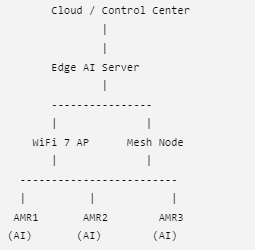
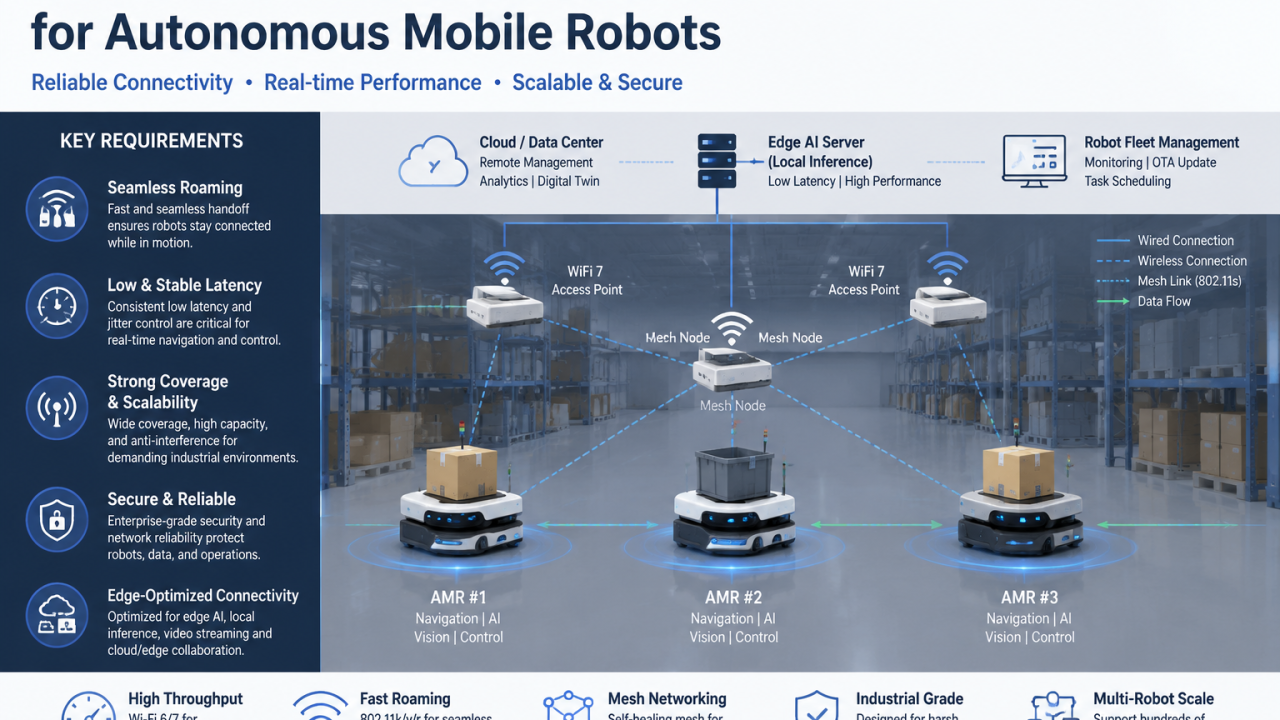
When companies deploy autonomous mobile robots (AMRs) in real environments, the biggest challenge is often not the robot itself.
It is the network that keeps the robot connected.
An AMR depends on continuous communication for:
– Real-time navigation
- Vision data transmission
⚡ Edge AI inference
– Fleet coordination
☁️ Cloud and remote management
A short network interruption may result in:
- Navigation delays
- Video stream drops
- Task interruptions
- Reduced operational efficiency
So, what does a reliable wireless infrastructure for AMRs require?
1. Seamless Roaming
AMRs continuously move through different areas.
A reliable network must allow robots to switch between access points without interrupting communication.
2. Low and Stable Latency
For autonomous systems, average speed is not enough.
What matters is consistent response time.
Network jitter and packet loss can directly impact robot performance.
3. Strong Coverage and Scalability
Factories and warehouses often have:
- Large areas
- Metal structures
- RF interference
- Hundreds of connected devices
A scalable wireless architecture is essential.
4. Edge-Optimized Connectivity
Modern robots combine:
– AI computing – Wireless communication – Sensors ⚙️ Real-time control

Email: [email protected] or [email protected]
The wireless network is no longer just an access layer.
It becomes part of the AI system.
As Physical AI moves from laboratories into factories, warehouses, and outdoor environments, reliable connectivity will become a key factor determining whether autonomous systems can scale.
AI gives robots intelligence.
Connectivity gives robots the ability to operate.
What challenges have you experienced when deploying wireless networks for autonomous robots?
Building the next generation of AI-powered edge devices requires reliable connectivity. Explore how WallysTech helps robotics, AI vision, and industrial applications achieve stable wireless performance.