Most industrial mesh networks start choking after 3-4 hops — latency spikes, throughput collapses, and your robots lose their control link exactly when you need it most.
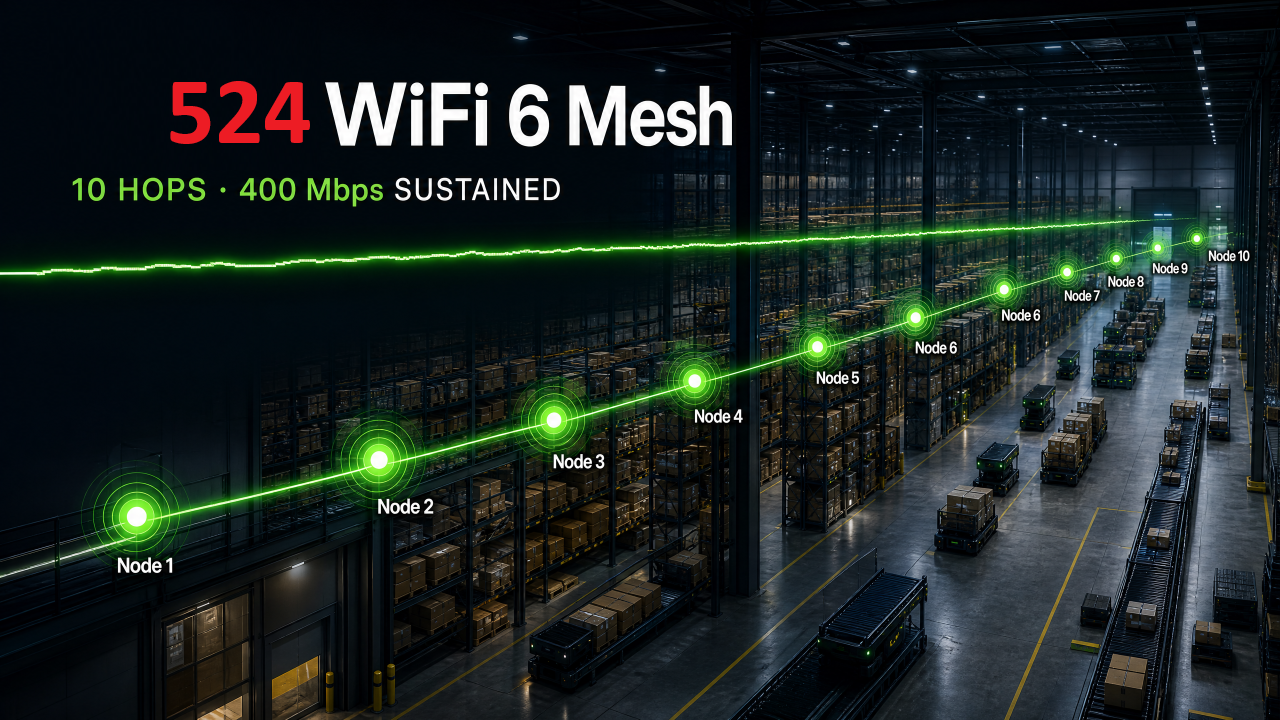
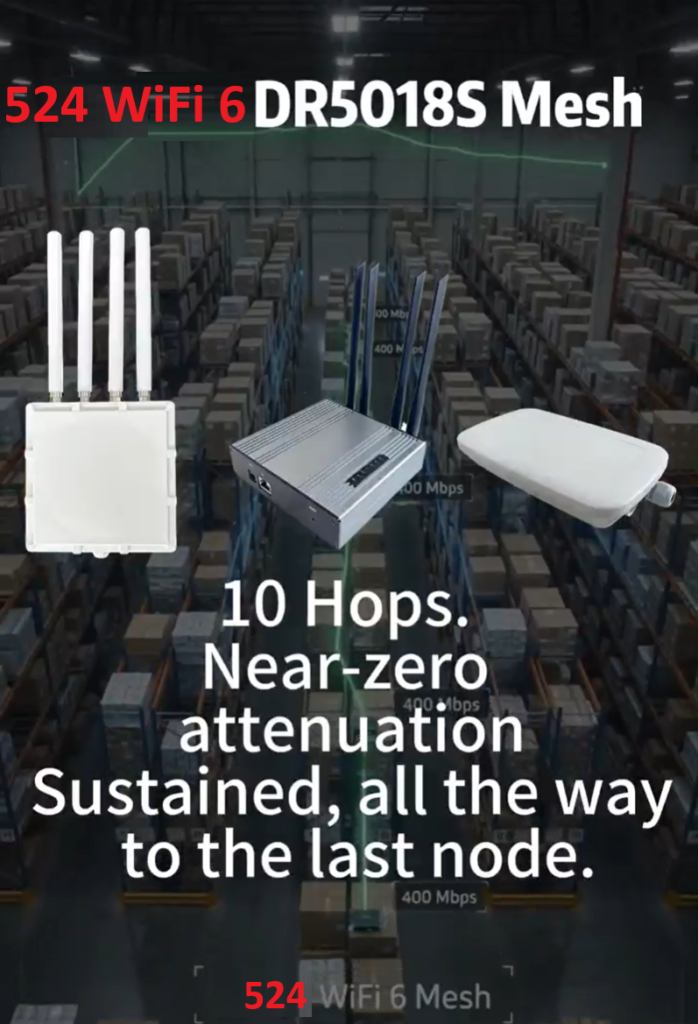
We just wrapped a 10-hop mesh stress test on our WiFi 6 platform, and the results speak for themselves: near-zero attenuation across all 10 hops, with sustained throughput of 400Mbps at the final node.
524WiFI mesh 10 hops testing environment
For AMR fleets, warehouse automation, and multi-robot deployments, this isn’t a lab number — it’s the difference between a robot that stays connected across a 50,000 sq ft facility and one that drops out the moment it turns a corner.
From PC1 to PC2 10 HOPS THROUGHPUT TEST RESULTS
No more compromising on coverage. No more babysitting mesh hops. Just reliable, high-throughput connectivity that scales with your facility, not against it — no need for WiFi 7 to get there.
🚀 WallysTech Releases Open-Source DR5018S Mesh Solution on GitHub!
We’re excited to announce that the DR5018S Mesh solution — optimized, tested, and production-ready — has now been fully open-sourced on GitHub. Built on OpenWrt and enhanced through extensive real-world deployments, this solution is designed for teams working on Wi-Fi 6 / ath11k Mesh networks.
🔍 Why We Open-Sourced It
Mesh networking is essential in industrial IoT, outdoor coverage, enterprise networking, and large-scale distributed systems. Yet many teams still struggle with: • Unstable links • Slow backhaul recovery • Performance drops in high-density environments • Limited ath11k Mesh reference designs
After deep testing and tuning in our own projects, we’ve created a stable, engineering-grade Mesh implementation — and we want to share it with the community.
⭐ What’s Inside
✔ Optimized Mesh link logic ✔ Faster reconnection & self-healing ✔ Lower latency during link interruptions ✔ NSS-accelerated forwarding ✔ Mesh configs, tuning parameters, and deployment guides ✔ Driver & firmware-related adjustments for ath11k
💡 About DR5018S
Powered by the Qualcomm IPQ5018 Wi-Fi 6 SoC, DR5018S is proven in harsh environments such as mines, oil fields, campuses, smart cities, and enterprise networks. It supports flexible roles as both access and backhaul nodes — and is available with an industrial IP68 outdoor enclosure.
We’ve included examples, configs, debugging tips, and FAQs to help teams go from “it works” to “it works reliably.”
🤝 Join the Mesh Open-Source Community
If you’re building on Wi-Fi 6 or ath11k Mesh, we invite you to try the solution, share feedback, open issues, or submit PRs. For large-scale deployments or custom requirements, our team is happy to support — just reach out.
Let’s build the next generation of Mesh networks together. 💡🌐
🚀 Key Features
1. High-Performance Platform Based on IPQ5018
Qualcomm IPQ5018 chip, dual-core ARM Cortex-A53 @ 1.0GHz
512MB DDR3L system memory, 128MB NAND Flash storage
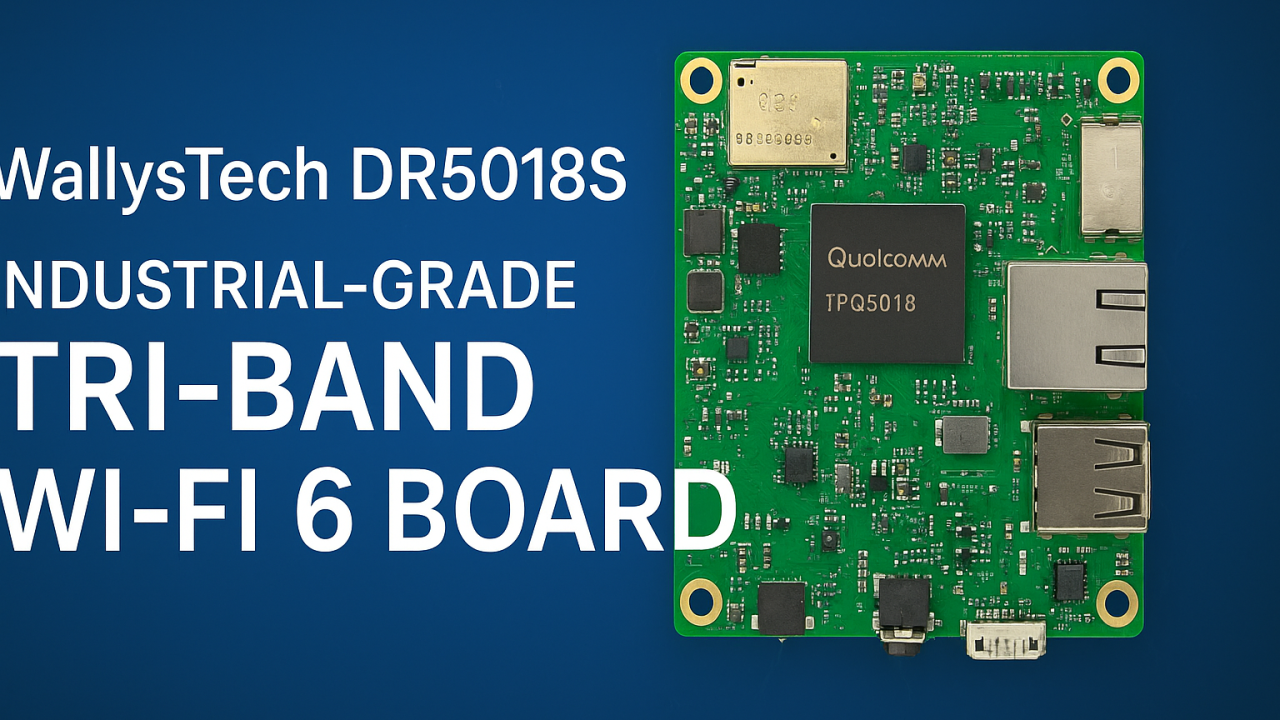
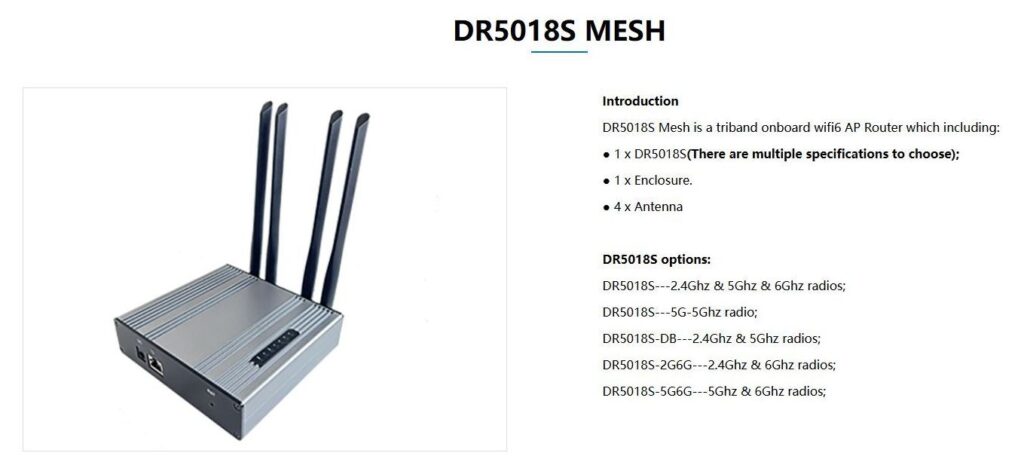
🌐 Introducing DR5018S — Industrial-Grade Tri-Band WiFi 6 Board for OpenWRT and OpenWiFi development
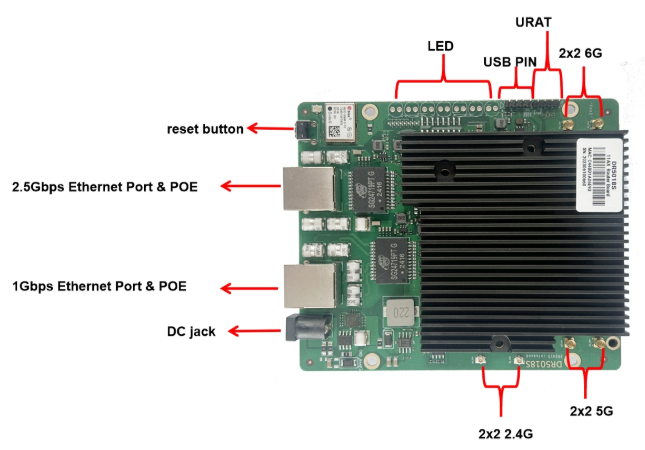
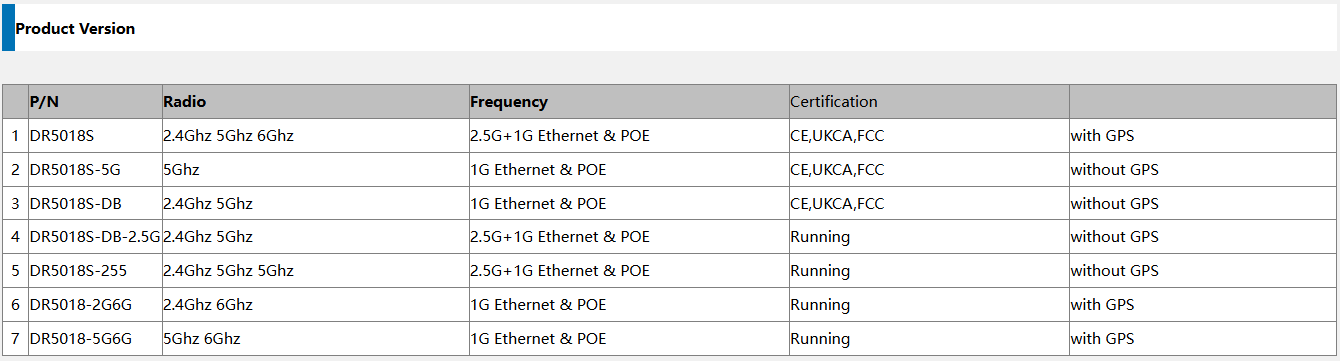
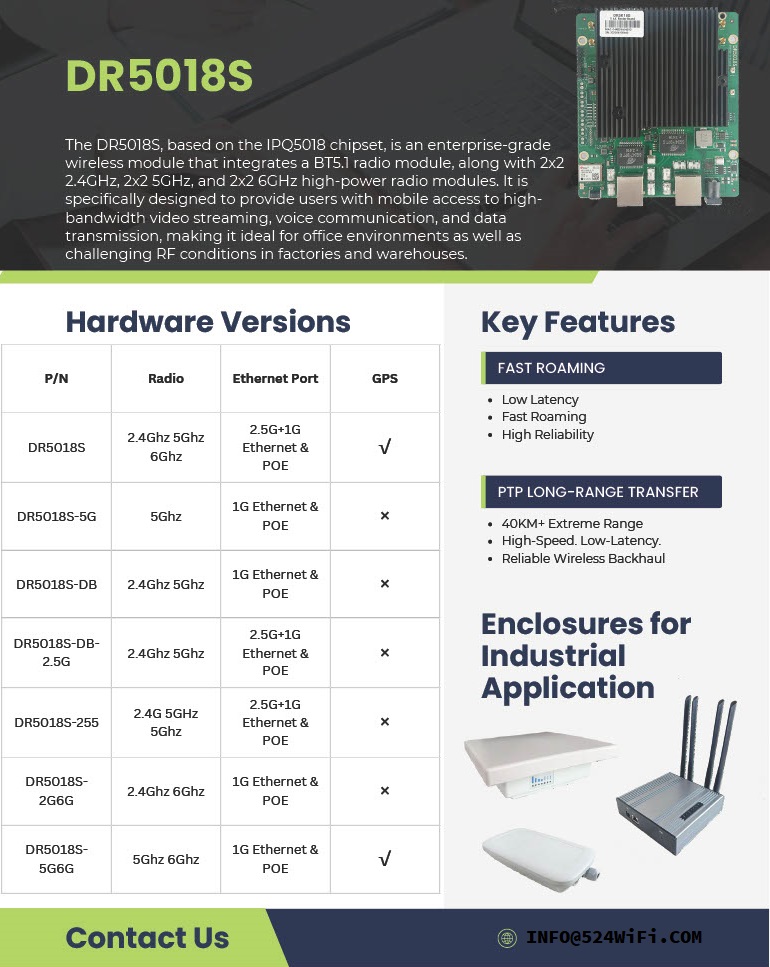
524WiFi introduces the WallysTech DR5018S, a high-performance industrial-grade WiFi 6 platform built for the next generation of wireless networks. Powered by the Qualcomm IPQ5018 SoC, the DR5018S integrates 2.4GHz, 5GHz, and 6GHz bands into one compact board — offering exceptional throughput, low latency, and strong adaptability for modern wireless environments.
⚙️ Key Features
Qualcomm IPQ5018 SoC — Dual-core ARM 64-bit A53 @1.0GHz
Operating temperature: –40 °C ~ +70 °C (industrial-grade)
Certifications: CE / FCC / UKCA
💡 Why DR5018S Stands Out
✅ Tri-band flexibility — handle high-density environments and interference-free operations
✅ Future-ready with 6GHz — prepared for WiFi 6E and early WiFi 7 transition
✅ Industrial-grade reliability — wide temperature, PoE, and durable design
✅ Open-source platform — OpenWRT/OpenWiFi for customization and fast development
✅ 2.5GbE interface — for high-throughput backhaul and mesh deployments
🏭 Real-World Applications
The DR5018S is designed for industrial and enterprise-grade wireless networks, enabling reliable connectivity in demanding conditions:
🔹 Mining & Oilfield Operations — establish long-distance wireless mesh links for remote monitoring, sensors, and field communication networks.
🔹 Smart Cities & Urban Infrastructure — build tri-band APs and gateways for IoT devices, cameras, and autonomous systems.
🔹 Industrial IoT & Automation — integrate into factory APs or gateways with OpenWRT for flexible control and connectivity.
🔹 Edge Computing & AI Gateways — combine compute + tri-band WiFi for edge data collection and analysis.
🔹 Warehouse & Logistics — enable low-latency mesh communication for autonomous AGVs and real-time tracking.
🔹 Outdoor Mesh & Backhaul Nodes — leverage 6GHz as a dedicated backhaul channel for high-speed, interference-free wireless mesh.
Its flexibility also makes DR5018S an excellent foundation for OEM/ODM wireless solutions, custom AP design, and smart industrial routers.
🚀 Empowering Wireless Innovation
At 524WiFi, we help partners accelerate product development and reduce evaluation costs through open, modular, and stable platforms. The DR5018S continues our mission to bridge industrial-grade reliability with open-source innovation — enabling faster time-to-market and future-ready WiFi 6/6E connectivity.
As industries evolve toward automation and intelligent infrastructure, connectivity has become the invisible backbone of every operation. From smart factories to autonomous logistics, reliable wireless communication defines success. And when the network must cover kilometers, handle hundreds of devices, and stay always online — DR5018S delivers.
⚙️ Powered by Qualcomm IPQ5018 — Designed for Industrial Mesh Intelligence
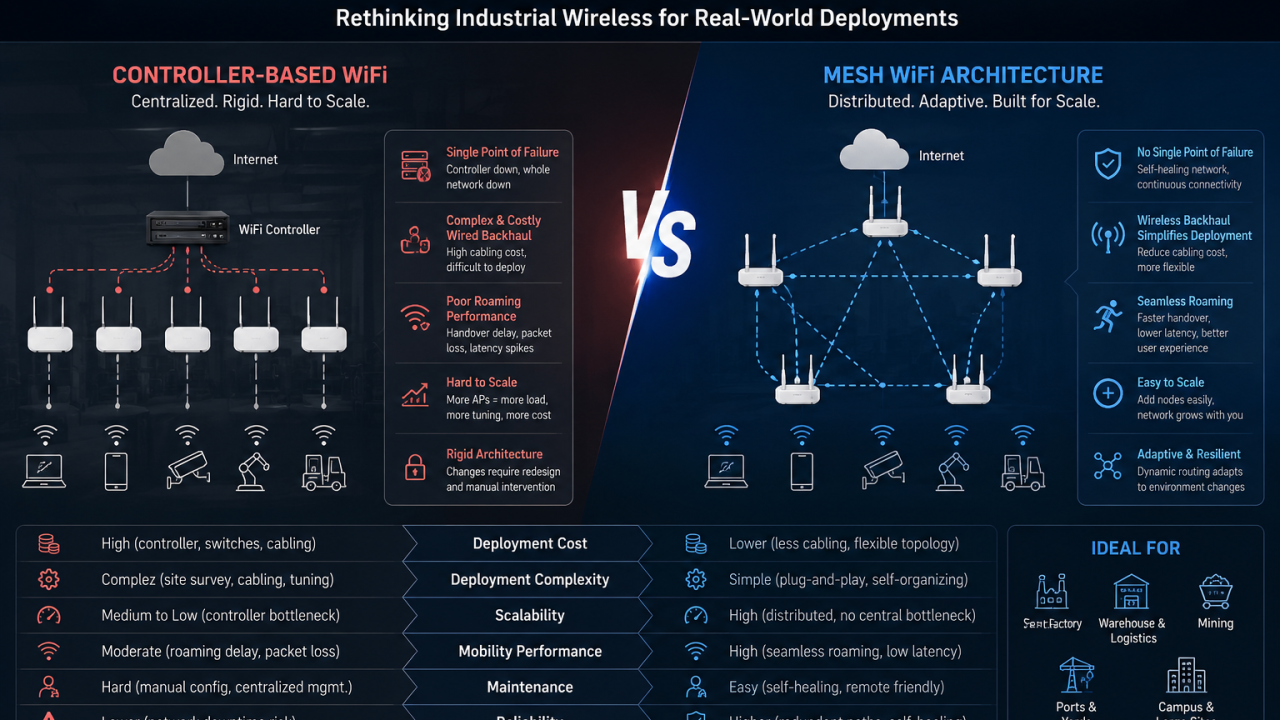
At the heart of the 524WiFi WallysTech DR5018S lies the Qualcomm IPQ5018 dual-core processor, paired with QCN6102 (5GHz) and QCN6122 (6GHz) radios. This tri-band WiFi 6 architecture enables true Mesh networking — where every node communicates, learns, and heals automatically.
✅ Auto-discovery & self-organization ✅ Dynamic mesh joining without manual setup ✅ Instant rerouting when nodes fail
It’s not just a router board — it’s an intelligent wireless ecosystem that keeps your network alive, aware, and adaptive.
🚶♂️ 802.11k/v/r Seamless Roaming — Stay Connected Without Thinking About It
Imagine walking through a smart factory or logistics park while streaming video or managing AGVs. With DR5018S, your devices switch between access points instantly, thanks to advanced roaming support:
802.11k — Finds nearby APs faster
802.11v — Guides clients to the best AP
802.11r — Enables fast handover with no dropouts
From office corridors to outdoor yards, DR5018S keeps your network uninterrupted — wherever you move.
🏭 Industrial-Grade Reliability — Built for the Harshest Environments
The DR5018S is more than powerful — it’s purpose-built for tough conditions:
🌧 IP68 waterproof & dustproof
🌡 Wide temperature tolerance
⚡ PoE power input for flexible deployment
📍 Integrated GPS for tracking and synchronization
Whether it’s a mining site, oil field, logistics base, or city infrastructure, DR5018S is engineered to stay online where others fail.
🌐 Fully Open Platform — OpenWRT & OpenWiFi Ready
Developers and integrators love flexibility. That’s why DR5018S is fully open-source friendly, supporting OpenWRT and OpenWiFi. It’s ideal for:
Custom control logic
Centralized controller management
Cloud-based applications
Integration with third-party systems
Build your own network intelligence on top of a proven industrial foundation.
The next generation of wireless isn’t just about speed — it’s about continuity. The 524WiFi WallysTech DR5018S combines Qualcomm’s IPQ5018 performance with Mesh and Roaming intelligence, giving industries the one thing that matters most: unbreakable connectivity.
🚀 Introducing the DR5018S – Built for Industrial-Grade Wireless
From smart ports to logistics hubs to long-range PTP connections, the DR5018S is engineered to deliver: ✅ Fast Roaming ✅ 40km+ PTP Long-Range Transmission ✅ Flexible Enclosures for Any Industrial Application
Whether it’s powering connectivity in smart cities, transportation, or critical infrastructure, the DR5018S ensures powerful performance with reliability you can trust.
xperience next-level WiFi 6 tri-band performance with the DR5018S Mesh – designed for industrial, enterprise, and large-scale applications. Seamless connectivity, EasyMesh support, and robust hardware all in one compact solution. 💡 Learn more and explore full specifications on our website:
: Introducing the DR5018S – Built for Industrial Grade Wireless – Qualcomm IPQ5018
🚀 When 5G NR Meets Mesh: Filling the Coverage Gaps
5G NR provides standardized, high-performance connectivity — but there are still scenarios where base station deployment is difficult or impractical:
Drone swarms requiring real-time coordination in remote airspace Robots in underground mines where signals can’t penetrate Military field operations demanding resilient, ad-hoc communication In such environments, Mesh networks step in as a complementary layer, ensuring local connectivity even when 5G NR coverage is limited.
👉 Question for the community: Do you see Mesh as a temporary patch until 5G expands everywhere, or as a long-term complement to 3GPP 5G NR in mission-critical deployments?
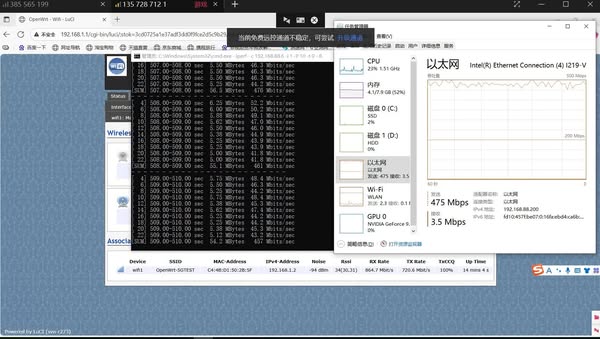
Wallystech DR5018S-AP crushed a 14 km 5 GHz link test in Dongbei at 50 m high — hitting 475 Mbps unidirectional throughput! We prepare more detailed test report.
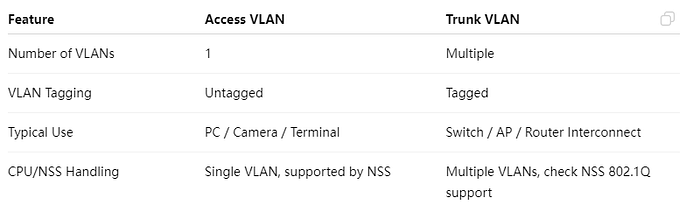
The 524WiFi and Wallys DR5018S router board, based on the Qualcomm IPQ5018 chipset, is widely used in industrial wireless applications. VLAN functionality allows network segmentation, optimized traffic management, and enhanced security. This guide provides a step-by-step tutorial to configure Access VLAN and Trunk VLAN on the DR5018S.
2. Understanding VLAN, Access, and Trunk
Access VS Trunk
3. Prerequisites
Wallys DR5018S router, firmware: wallys firmware
Admin access via Web GUI or SSH
VLAN ID plan and IP addressing plan
Optional: VLAN-aware NIC or Vlan Switch for testing
4. VLAN Configuration on DR5018S
Steps:
Log in to the Web GUI.
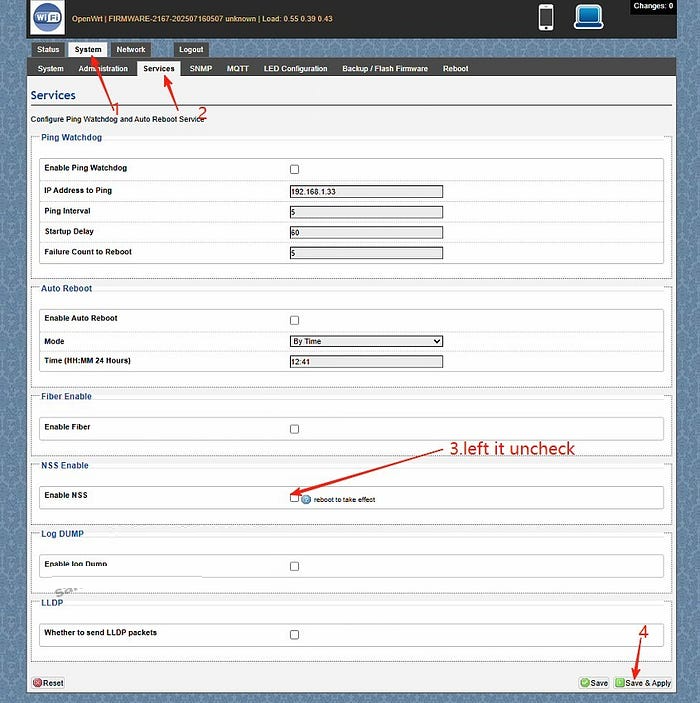
Go to System → Services. Left the Enable NSS uncheck and click “save and apply”
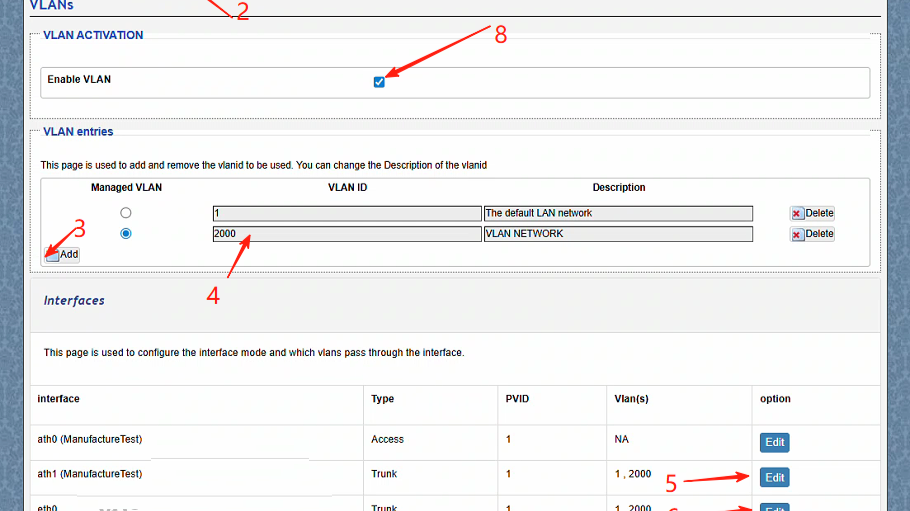
Go to Network → Vlans.Create a VLAN (e.g., VLAN 2000).
Edit the ath1(the working radio) and eth0(the ethernet port connected) port mode to Trunk.
ath1 setting:Select type Trunk,Assign the PVID as 1,select Vlans 2000,save changes
ath1 setting:Select type Trunk,Assign the PVID as 1,select Vlans 2000,save changes.
Assign an IP address to the VLAN interface (static or DHCP).
Save and apply the configuration.
Test connectivity: connect a PC to the port, get an IP, and ping the radio.
5. Troubleshooting
Cannot access the device → check VLAN ID, PVID, and tagging.
Trunk traffic lost → verify VLAN configuration on the remote end.
PC cannot ping → ensure the IP address is in the VLAN subnet.
Check NSS hardware acceleration
With this guide, you can easily configure Access VLAN and Trunk VLAN on the DR5018S router board. VLANs help isolate traffic, improve security, and optimize performance in industrial wireless networks.
For more technical support and inquiry for industrial wireless products, contact 524WiFi at info@524wifi dot com or net!
In the world of embedded networking, visibility is everything. Whether you’re an engineer troubleshooting a client deployment or a developer fine-tuning a custom OpenWrt-based application, packet-level insights can save hours — if not days — of guesswork.
We’re excited to announce that tcpdump is now fully supported on our DR5018S router board, bringing enterprise-grade packet analysis directly to your industrial WiFi 6 hardware.
🧰 Why Tcpdump Matters
Tcpdump is a powerful, command-line packet analyzer tool that allows users to:
Monitor live traffic on specific interfaces
Capture and filter packets based on IP, port, protocol, and more
Export logs for deeper analysis or compliance purposes
Debug intermittent network issues with precision
Now with tcpdump on DR5018S, you don’t need a separate laptop or tap device — your router board becomes the diagnostic tool.
📡 About DR5018S
The DR5018S is based on the Qualcomm IPQ5018 SoC, designed for advanced industrial WiFi 6 applications. It supports:
2.4G/5G concurrent dual-band
M.2 slot for LTE/5G modem expansion
Optional PoE support
Flexible OpenWrt/QSDK firmware environment
By adding tcpdump support, we’re giving system integrators, OEMs, and network developers more control and clarity at the edge.
📝 Documentation & Access
An updated user manual with tcpdump usage examples, interface configurations, and filtering tips will be released shortly. In the meantime, you can check out the DR5018S hardware details here:
In high-density networking environments such as stadiums, shopping malls, and enterprise campuses, the demand for robust and efficient wireless solutions is greater than ever. While the IPQ5010 chipset offers a solid foundation for WiFi 6 applications, our DR5018 – IPQ5018 provides an enhanced solution designed to tackle key pain points in these challenging scenarios. This article explores how the IPQ5018 outperforms its predecessor and why it is the optimal choice for high-density networking.
The Limitations of IPQ5010 in High-Density Environments
The IPQ5010 chipset, part of Qualcomm’s WiFi 6 portfolio, delivers substantial improvements over previous generations but has limitations when handling large numbers of concurrent connections. Key constraints include:
Lower processing power – Struggles with managing large-scale connections efficiently.
Limited memory – Reduced ability to handle simultaneous data streams.
Reduced MIMO capabilities – Less effective in environments with multiple devices competing for bandwidth.
Basic security features – May not meet the increasing security demands of modern enterprises.
How 524WiFi and Wallys IPQ5018 Overcome These Challenges
Wallys has integrated the IPQ5018 chipset into its latest networking solutions, addressing the limitations of the IPQ5010 and enhancing performance in several key areas:
1. Improved Processing Power and Efficiency
The IPQ5018 features a more powerful quad-core ARM Cortex-A53 processor compared to the IPQ5010’s dual-core setup. This results in:
Faster data processing speeds.
Reduced latency in high-demand environments.
Enhanced ability to manage concurrent client connections.
2. Higher Memory and Storage Capabilities
With support for 1GB DDR memory, the IPQ5018 provides greater capacity for buffering and handling multiple high-bandwidth applications simultaneously. This is crucial for high-density venues where seamless performance is required.
3. Advanced MIMO and OFDMA Support
Our IPQ5018 boards support 2×2 MU-MIMO and OFDMA (Orthogonal Frequency-Division Multiple Access) technology, allowing:
More efficient data transmission to multiple users.
Reduced interference and congestion in dense environments.
Higher overall network throughput and stability.
4. Enhanced Security Features
Security is a growing concern for enterprises, and Wallys IPQ5018 includes:
WPA3 encryption support for stronger network security.
Advanced firewall and packet filtering features for enterprise-grade protection.
Secure boot and firmware validation, ensuring system integrity against cyber threats.
5. Power Efficiency and Thermal Management
Wallys has optimized the IPQ5018 platform for low power consumption, making it an ideal choice for applications requiring 24/7 operation. Its improved thermal management reduces overheating risks, ensuring stable performance in high-traffic areas.
Applications of IPQ5018 in High-Density Networking
With its superior capabilities, the IPQ5018 chipset is an excellent choice for:
Smart cities & public WiFi deployments – Handles thousands of simultaneous connections with ease.
Corporate and industrial networks – Offers secure and high-speed connectivity for enterprise applications.
Hospitality & retail – Supports seamless guest WiFi experiences in hotels, malls, and airports.
Educational institutions – Ensures smooth online learning with high-capacity support.
Conclusion
524WiFi and Wallys’ IPQ5018 is a game-changer for high-density networking, delivering better processing power, enhanced MIMO support, stronger security, and improved efficiency over the IPQ5010. Whether for large-scale enterprise deployments or public WiFi solutions, this chipset is designed to meet the growing demands of modern connectivity.