Most industrial WiFi networks are still built on a controller-based architecture.
And in controlled lab environments, it works.
But in real industrial deployments, the story is very different.
Factories, mines, ports, and warehouses are not static environments. They are dynamic, noisy, and constantly changing systems.
And that’s exactly where controller-based WiFi starts to fail.
The Hidden Assumption Behind Controller WiFi
Traditional enterprise WiFi is built on one assumption:
A centralized controller can efficiently manage the entire network.
That assumption only holds when the environment is predictable.
Industrial environments are not.
Once you scale into real deployment scenarios, WiFi becomes less about “AP management” and more about:
- mobility
- interference
- topology changes
- real-time traffic behavior
And centralized control starts becoming a limitation rather than an advantage.
Where Controller-Based WiFi Fails in Practice
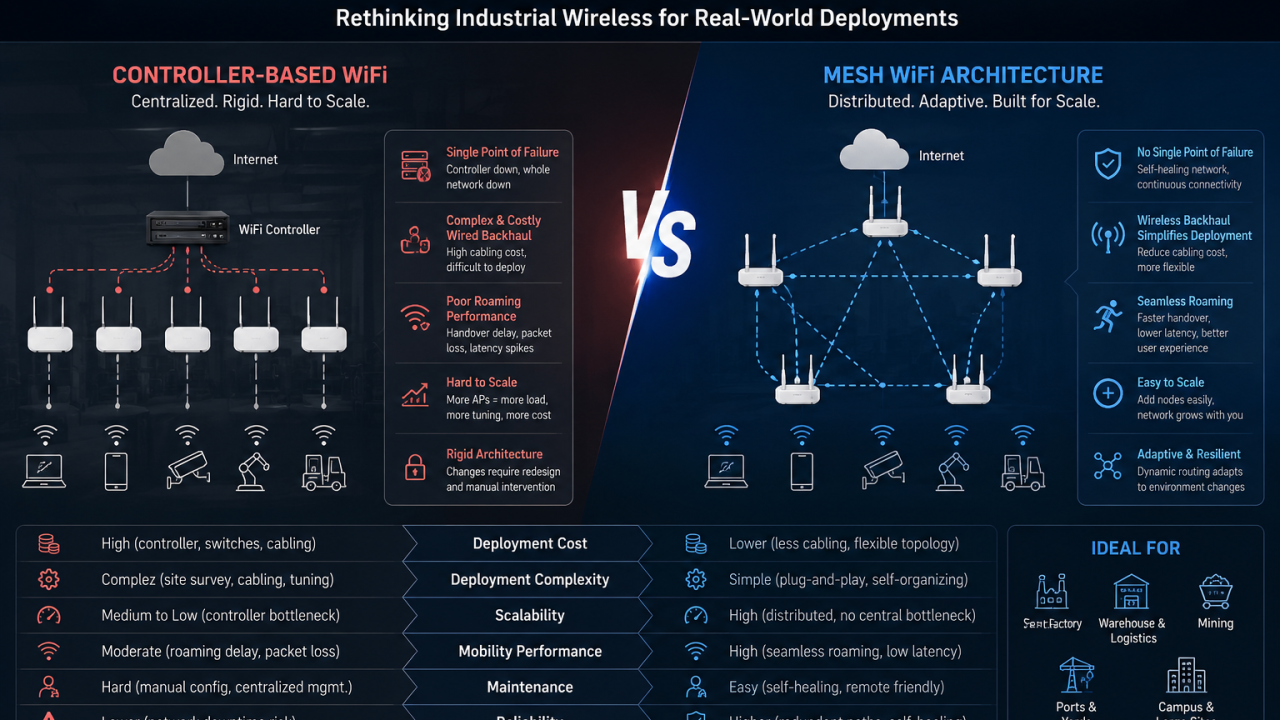
1. Roaming is still not truly seamless
Even with controller-based optimization:
- handover delay still exists
- packet loss happens during movement
- latency spikes under load are unavoidable
This is especially critical for AGVs, mobile robots, and real-time monitoring systems.
2. Wired backhaul limits deployment flexibility
Controller-based architectures heavily depend on wired infrastructure.
But industrial sites are:
- expensive to cable
- frequently reconfigured
- physically difficult to retrofit
This creates a gap between “ideal network design” and “real deployment reality”.
3. Scaling introduces complexity, not simplicity
Adding more APs does not mean linear scalability.
Instead, it introduces:
- higher controller load
- complex RF planning
- continuous tuning effort
- increased operational cost
At scale, the network becomes harder to manage, not easier.
4. Centralized failure domains are too rigid
In controller-based systems:
- architecture is tightly coupled
- dependencies are centralized
- failure impact can cascade
A small issue can affect a disproportionately large part of the network.
Why Mesh Architecture Is Gaining Real Adoption
Mesh WiFi is not new—but industrial requirements are forcing a structural shift.
Instead of forcing traffic through a central controller, Mesh builds a distributed network where nodes collaborate dynamically.
Key advantages include:
Distributed control
No single point of dependency for network decisions.
Self-healing topology
Traffic dynamically adapts when nodes fail or conditions change.
Flexible expansion
New nodes can be added without redesigning the entire system.
This aligns far better with how industrial environments actually evolve.
Important Reality Check: Mesh Is Not a Silver Bullet
Mesh does NOT eliminate RF physics.
In real deployments, you still need to consider:
- interference in industrial environments
- bandwidth sharing between backhaul and access
- multi-hop latency trade-offs
- proper RF planning
But the key difference is:
Mesh adapts to real-world constraints instead of fighting against them.
The Real Shift in Industrial WiFi
This is not a feature comparison between Mesh and Controller WiFi.
It is a structural shift in architecture thinking:
- From centralized control → distributed intelligence
- From static topology → adaptive topology
- From planned deployments → evolving networks
Industrial WiFi is no longer about perfect design.
It is about surviving real-world complexity.
Final Thought
Controller-based WiFi still works in controlled enterprise environments like offices and campuses.
But in industrial deployments, the question is no longer:
“How powerful is your controller?”
It becomes:
“Why are you still forcing a centralized architecture into a distributed environment?”
If you are building industrial networking products…
If you are currently working on:
- Industrial routers
- Mesh WiFi systems
- OEM/ODM networking platforms
- Edge connectivity devices
- WiFi solutions for AGVs, robotics, or smart factories
and are facing challenges such as roaming instability, deployment complexity, or scalability limitations—
We can share practical architecture insights based on real-world industrial WiFi deployments, including Qualcomm-based WiFi 6 Mesh platform designs.
Feel free to connect or message me to discuss your project.