Posted on

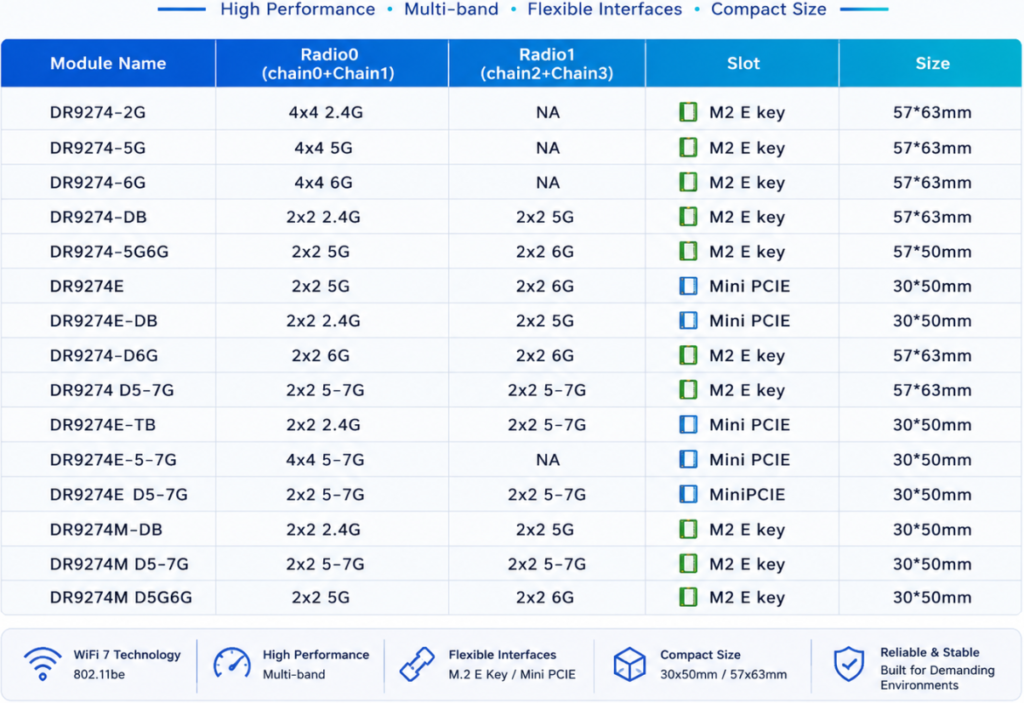
List of our Qualcomm WiFi 7 modules – new populer versions !

Module NameBDwlanRadio0
(chain0+Chain1)
Radio1
(chain2+Chain3)
SlotStatusNote
DR9274-2GB00014×4 2.4GNAM2 E keyavailable 
DR9274-5GB00024×4 5GNAM2 E keyavailableB0015
DR9274-6GB00044×4 6GNAM2 E keyavailableB0016
DR9274-DBB10032×2 2.4G2×2 5GM2 E keyavailable 
DR9274-5G6GB10062×2 5G2×2 6GM2 E keyavailable 
DR9274-5GKB00114×4 5GNAM2 E keyavailablebdwlanKCT.b0002
DR9274-6GKB00134×4 6GNAM2 E keyavailablebdwlanKCT.b0004
DR9274EB10182×2 5G2×2 6GMini PCIEavailableNew bdwlan
DR9274E-DBB10172×2 2.4G2×2 5GMini PCIEavailableNew bdwlan
DR9274-D6GB10192×2 6G2×2 6GM2 E keyavailableNew bdwlan
DR9274 D5-7GB100d2×2 5-7G2×2 5-7GM2 E keyavailableNew bdwlan
DR9274E-TBB100e2×2 2.4G2×2 5-7GMini PCIEComing soonNew bdwlan
DR9274E-5-7G 4×4 5-7GNAMini PCIEComing soon 
DR9274E D5-7G 2×2 5-7G2×2 5-7GMini PCIEComing soon 

Why Wi-Fi 7 Matters for Robotics

Wi-Fi 7 introduces several capabilities that directly address the requirements of next-generation robotics.

1. Higher Throughput for AI Data Streams

With features such as:

  • 320MHz channel bandwidth
  • 4096-QAM modulation
  • Multi-Link Operation (MLO)

Wi-Fi 7 significantly improves wireless capacity.

This enables robots to transmit and receive more data, supporting applications such as:

  • Real-time HD/4K video analysis
  • Multi-camera perception
  • Digital twin visualization
  • Remote robot operation

For industrial environments, higher bandwidth means more robots can operate simultaneously without creating network bottlenecks.


2. Lower Latency for Real-Time Control

Latency is critical for autonomous systems.

A delayed wireless connection can impact:

  • Robot navigation
  • Collision avoidance
  • Remote control
  • Human-machine collaboration

Wi-Fi 7’s Multi-Link Operation allows devices to utilize multiple frequency bands simultaneously, improving connection stability and reducing congestion.

For mobile robots operating in complex environments, maintaining a consistent connection is often more important than achieving maximum peak speed.


3. Better Connectivity in High-Density Environments

Future factories and warehouses may contain:

  • Hundreds of autonomous mobile robots (AMRs)
  • AI cameras
  • Industrial sensors
  • Wireless controllers
  • Edge computing nodes

A wireless infrastructure designed only for consumer environments may not be enough.

Industrial Wi-Fi requires:

  • Stable roaming
  • RF optimization
  • Enterprise-level management
  • Long-term hardware reliability

Wi-Fi 7 provides a stronger foundation for these high-density deployments.


Edge AI + Wi-Fi 7: Bringing Intelligence Closer to Machines

While cloud computing remains important, many robotic applications are moving toward edge AI.

Why?

Because robots need:

  • Faster response times
  • Reduced dependence on cloud connectivity
  • Better privacy protection
  • More reliable operation in industrial environments

Edge AI platforms process data locally, allowing robots to make decisions in real time.

But edge intelligence requires a powerful communication layer.

The relationship is simple:

Edge AI provides the intelligence. Wi-Fi 7 provides the nervous system.

Together, they enable robots to:

  • Understand their environment faster
  • Coordinate with other machines
  • Adapt to changing conditions
  • Operate autonomously at scale

Beyond Speed: Industrial Wireless Requires Reliability

A common misunderstanding is that the future of industrial wireless is simply about faster Wi-Fi.

In reality, industrial applications require much more:

Reliable roaming

Mobile robots need seamless handover between access points while moving across large facilities.

Stable performance under interference

Factories often contain metal structures, machinery, and RF noise.

Long-term platform support

Industrial customers expect hardware platforms that can operate reliably for years.

Flexible deployment options

Different environments require different designs:

  • Indoor industrial APs
  • Outdoor wireless bridges
  • Embedded Wi-Fi modules
  • Custom router platforms

The Future: AI Robots Need AI-Ready Networks

As robotics continues to evolve, wireless connectivity will become a strategic infrastructure layer.

The next generation of robots will not work alone.

They will communicate with:

  • Other robots
  • Edge servers
  • AI vision systems
  • Factory automation platforms
  • Cloud management systems

A powerful AI model without reliable connectivity cannot deliver its full value.

The future belongs to systems where:

AI intelligence + Edge computing + Advanced wireless connectivity work together.

Wi-Fi 7 is not just a faster wireless standard.

It is becoming the communication backbone for intelligent machines.


Building the Industrial Wireless Foundation for Tomorrow

At 524WiFi and Wallys, we are exploring the next generation of industrial wireless platforms by combining:

  • Qualcomm-based Wi-Fi 6 / Wi-Fi 7 solutions
  • Industrial-grade router boards
  • High-performance wireless modules
  • Edge AI application platforms
  • OEM/ODM customization capability

Our goal is to help robotics companies, AI developers, and industrial solution providers build reliable wireless infrastructure for the intelligent world.

Because the future of robotics will not only depend on smarter machines.

It will depend on how well those machines can communicate.
Posted on

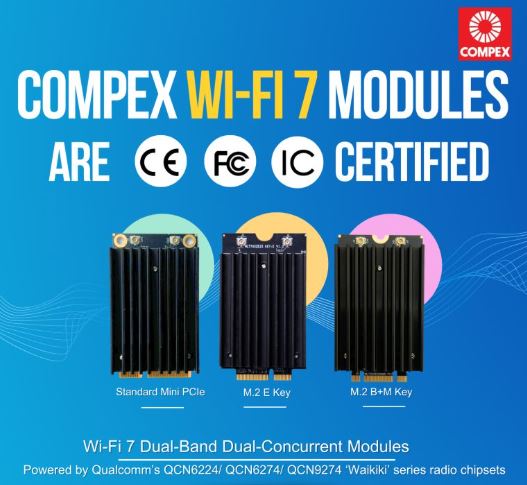
Compex Wi-Fi 7 Dual-Band Dual-Concurrent Modules are CE, FCC and IC certified and Ready for the World

𝗖𝗲𝗿𝘁𝗶𝗳𝗶𝗲𝗱 𝗮𝗻𝗱 𝗥𝗲𝗮𝗱𝘆 𝗳𝗼𝗿 𝘁𝗵𝗲 𝗪𝗼𝗿𝗹𝗱.

Compex Wi-Fi 7 Dual-Band Dual-Concurrent Modules are CE, FCC and IC certified, bringing together global compliance and industry-leading performance. Available in Standard MiniPCIe form factor and M.2 variants, our Qualcomm-powered modules deliver reliable and high-performance wireless connectivity for markets worldwide.

✅Powered by Qualcomm’s QCN6224 / QCN6274 / QCN9274 “Waikiki” series chipsets
✅Comes with band options: 2.4+5GHz, 2.4+6GHz, 5+5GHz and 5+6GHz
✅Multi-Link Operation (MLO) for higher throughput, lower latency and improved reliability
✅Diplexer Design to reduce the need for multiple Wi-Fi antennas for transmission
✅Open Source Ath12k Support

📩 Reach out to us at info@524wifi dot net or com to explore how we can power your next project.

Posted on

524 WiFi 7 DR9274E – QCN 9274 / 6274 Dual band concurrent miniPCIE Network Cards

The DR9274E is a family of high-performance WiFi 7 radio modules built on Qualcomm’s QCN9274 or QCN6274 ‘Waikiki’ series chipsets.

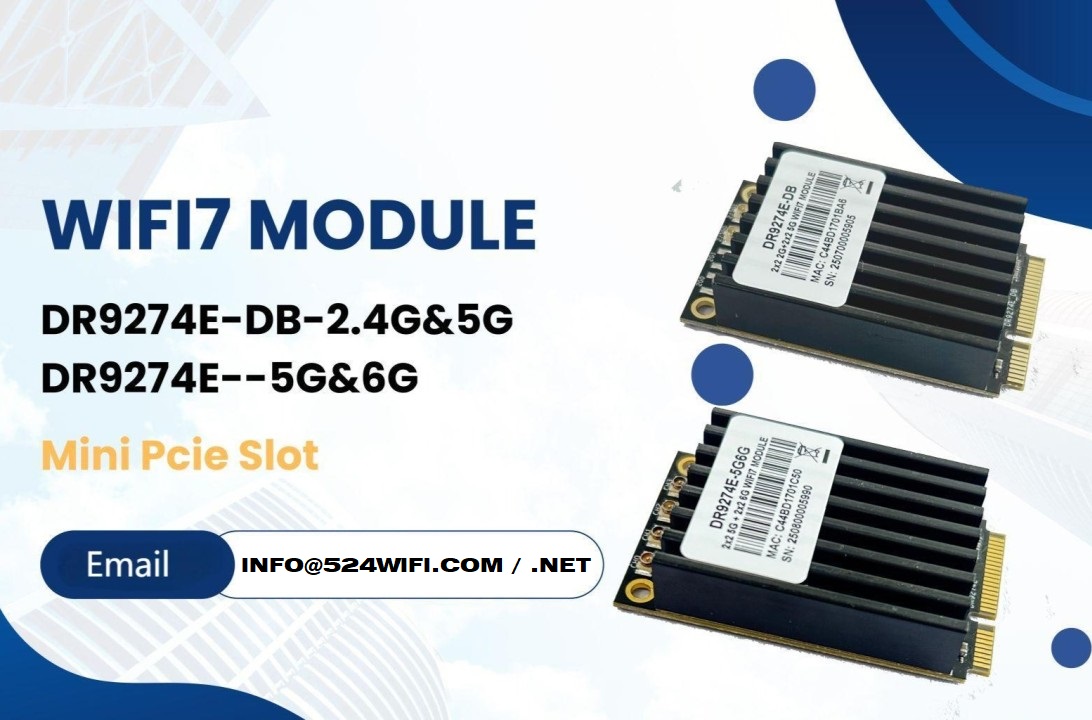
524WiFi is proud to announce the launch of two brand-new WiFi 7 MiniPCIe modules — the DR9274E-DB and DR9274E-5G6G, engineered to meet the demands of today’s most advanced industrial and commercial wireless applications.

These modules are part of the DR9274E family, built on Qualcomm’s QCN9274 / QCN6274 ‘Waikiki’ series chipsets, and designed to unlock the full potential of WiFi 7 in a compact MiniPCIe form factor. Samples available with QCN9274 chipset now !


🔧 Product Variants


⚙️ Key Features at a Glance

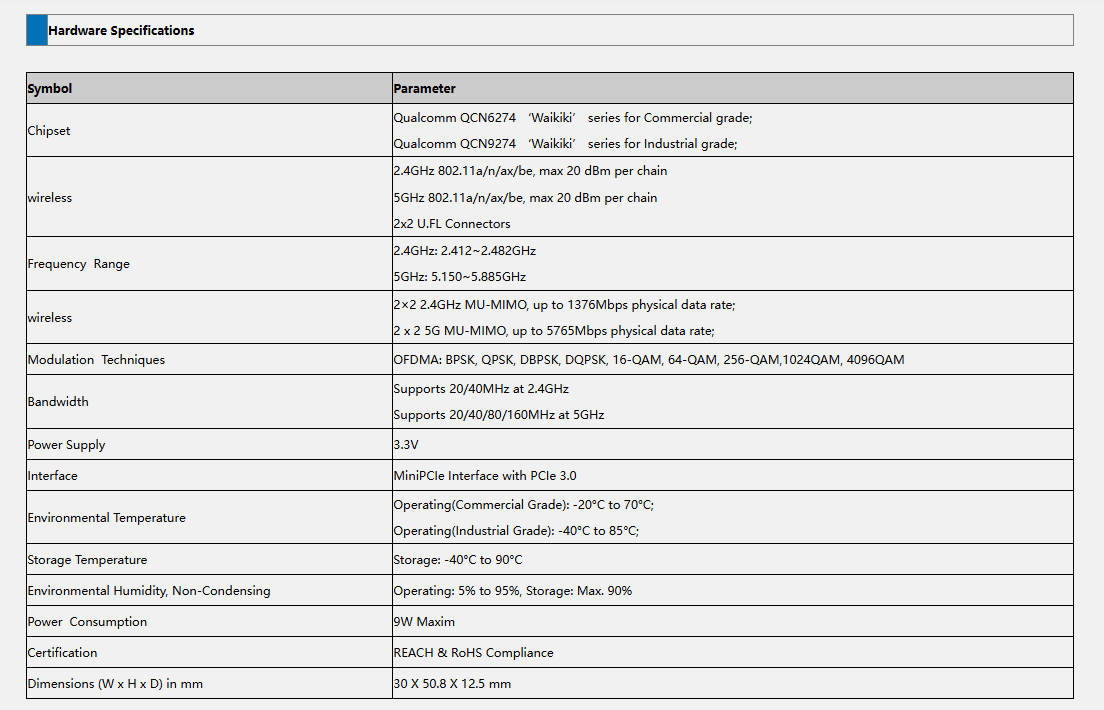
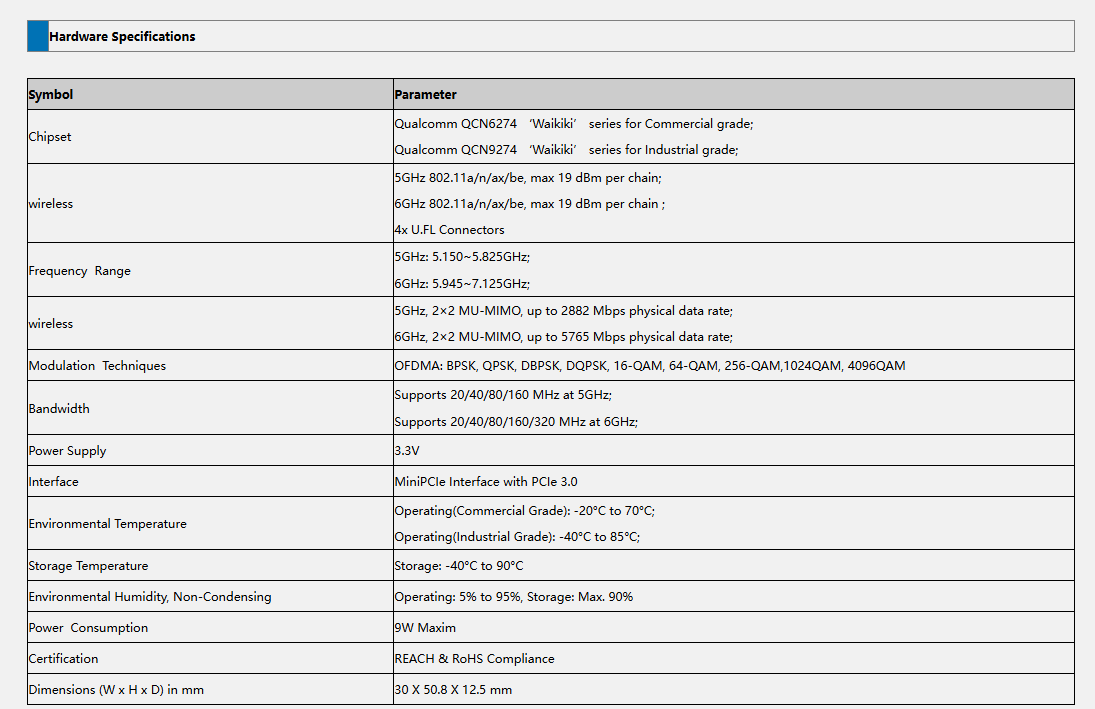
✅ Based on Qualcomm QCN6274 (Commercial Grade) or QCN9274 (Industrial Grade)

✅ Supports WiFi 7 (802.11be) for next-generation speed and efficiency

✅ 2×2 MU-MIMO at 5GHz and 6GHz

✅ Max throughput: 2882 Mbps (5GHz) and 5765 Mbps (6GHz)

✅ 320 MHz ultra-wide bandwidth support in 6GHz

✅ MiniPCIe interface with PCIe 3.0

✅ Ultra-rugged: Operating Temp up to -40°C to 85°C (Industrial)

✅ REACH & RoHS Compliant


🌐 Perfect for Demanding Applications

Whether you’re building the next smart city or designing rugged outdoor systems, the DR9274E modules are built for:

  • Industrial & Commercial WiFi Infrastructure
  • Security Surveillance Systems
  • Hotel and Campus Wireless Coverage
  • Forest Fire Monitoring Projects
  • Remote Area Connectivity
  • Custom Applications in Challenging Environments

📏 Tech Specs Snapshot

Article content
DR9274E-DB
Article content
DR9274E-5G6G

💼 Looking to Integrate WiFi 7 Into Your Product?

524WiFi and Wallys specialize in custom industrial wireless solutions, and we’re ready to support your projects with:

  • Hardware customization
  • Software/driver support
  • Long-term supply guarantee
  • Technical documentation and enclosure design references

📩 Contact our sales team today at [email protected] to request datasheets, samples, or technical consultation.

Posted on

Entering the Multi-Link Era of Wi-Fi 7 with 524WiFi. Maximize coverage. Boost performance.

Unlock the future.
By combining DR9274-2G5G and DR9274-5G6G, 524WiFi delivers a true tri-band Wi-Fi 7 platform ready for tomorrow’s wireless demands. X86 Linux supported!


Powered by Multi-Link Operation (MLO), our solution enables:


✅ Simultaneous dual 5GHz operation
✅ Aggregated bandwidth for higher throughput
✅ More resilient and flexible wireless networks


Ready to go Multi-Link? Contact us !

Posted on

How to Upgrade the Wallys DR4019 Router Board to OpenWrt 23.05 – A Step-by-Step Guide

How to Upgrade the Wallys DR4019 Router Board to OpenWrt 23.05 – A Step-by-Step Guide for Industrial Networks

In the world of industrial WiFi, staying ahead of the curve is key to ensuring your network operates at peak efficiency. That’s why we’re excited to share a new tutorial on upgrading the Wallys DR4019 router board to the latest OpenWrt 23.05 firmware.

Here’s what you’ll learn in the video:

  1. Hardware Setup: The first step is ensuring you have all the required components for the upgrade, including your Wallys DR4019 router board, Ethernet cable, and UART cable. We’ll walk you through the setup to get everything ready for the firmware flash.
  2. Loading the Firmware: Once you’re set up, we guide you through the process of loading the latest OpenWrt 23.05 firmware via TFTP. This simple process ensures your router is ready to take advantage of the latest features.
  3. Verifying the Upgrade: After rebooting, we show you how to check that the firmware has been successfully installed. You’ll learn how to access the updated OpenWrt interface and ensure everything is running smoothly.

Stay Ahead of the Game

This tutorial simplifies the upgrade process for you, helping you stay ahead with the latest technology. If you’re looking for customized industrial WiFi solutions or have any hardware inquiries, feel free to reach out to us at [email protected].

Don’t Miss Out on Our Next Tutorial!

In our upcoming video, we’ll dive deeper into the DR4019’s Mesh capabilities and test its performance across multiple devices. Be sure to follow us for more insights and updates!

Watch the video now to upgrade your DR4019 router board and unlock the full potential of your industrial wireless network!

Posted on

Mastering MLO on the IPQ 5332 Board with DR 9274 5G6G Card: Step-by-Step Video Guide

Are you working on industrial wireless projects and looking for a reliable guide to set up Multi-Link Operation (MLO)? Look no further! At 524WiFi and WallysTech, we’ve just released a comprehensive tutorial video to help you configure MLO on the IPQ5332 board (DR5332) paired with the DR9274-5G6G card.

This video covers everything you need to know, including:

✅ Hardware connection setup

✅ Firmware loading instructions

✅ Access Point (AP) configuration

✅ Practical tips to optimize your industrial wireless network

Why MLO Matters

MLO is a game-changing feature in WiFi 7 that allows simultaneous use of multiple bands for enhanced throughput and reliability. With industrial applications demanding higher speeds and more stable connections, mastering MLO is key to staying ahead.

Watch the Tutorial Now

Click below to watch the full step-by-step guide: 👉 How to Set Up MLO on the IPQ5332 Board with DR9274-5G6G Card

Need This Hardware? We’ve Got You Covered!

If you’d like to test this setup or integrate it into your project, contact our sales team at [email protected]. We’re here to provide tailored solutions and support your success.


💬 We’d love to hear from you! What other topics would you like us to cover? Comment below with your suggestions, and don’t forget to share this article with your network.

📢 Follow us for more updates, tutorials, and insights into the latest wireless technologies!

Posted on

Unlock the Future of Connectivity: Explore Dual-Band Dual-Concurrent DBDC Cards for Industrial Applications

DBDC Cards: A Solution for High-Density, High-Interference, and High-Bandwidth Network Environments

In today’s network landscape, the rapid increase in connected devices has introduced unprecedented challenges for stable and high-speed connectivity. In environments with high device density, strong signal interference, and high bandwidth requirements, traditional single-band networks often fall short of meeting users’ demands. Enter the Dual-Band Dual-Concurrent (DBDC) card, a breakthrough solution that redefines network performance. This article delves into the advantages of DBDC cards in tackling these network challenges, along with some recommended DBDC products from 524WiFi.

Key Advantages of DBDC Cards

1. Dual-Band Concurrency to Distribute Network Load

DBDC cards’ primary feature is their ability to operate simultaneously on both 2.4GHz and 5GHz bands. This dual-band functionality effectively expands total bandwidth, allowing devices to spread across two frequency bands, reducing congestion on a single channel. In high-density environments, DBDC cards enable devices to efficiently locate open channels, significantly decreasing signal interference and delays.

2. Interference Reduction for Stable Connections

In interference-heavy environments, such as public venues or industrial zones, DBDC cards’ dual-band capability is essential. The 5GHz band, which is typically less congested, is allocated for high-bandwidth, high-stability tasks, while the 2.4GHz band is reserved for low-bandwidth, non-time-sensitive tasks. This smart frequency allocation minimizes interference, ensuring stable connections for critical devices.

3. High Throughput for Future Bandwidth Needs

With increased demands for bandwidth due to high-resolution video, VR/AR applications, and cloud computing, DBDC cards provide substantial throughput improvements. Dual-band usage enables faster data transfers, reducing latency and supporting high-bandwidth applications, making DBDC cards ideal for bandwidth-heavy environments.

4. Enhanced Network Reliability

DBDC cards offer a dual-frequency safety net for devices, maintaining connection stability even if one band experiences interference or connection issues. This built-in redundancy is crucial for industries that rely on uninterrupted data transmission, providing higher levels of reliability across connected devices.

DBDC Card Applications Across Industries

1. Enterprise Environments

In office settings, DBDC cards improve network efficiency by managing multiple users and devices on separate bands. Enterprises that depend on video conferencing, data sharing, and collaborative work benefit from DBDC cards’ stability, optimizing productivity through smoother network performance.

2. Industrial IoT (IIoT)

DBDC cards are ideal for Industrial IoT applications, where a network of sensors, monitoring systems, and data collectors are continuously connected. Their high stability and resistance to interference enable DBDC cards to support IIoT environments with real-time data transmission, enhancing industrial device performance.

3. Public Venues and Smart Cities

In high-density public areas like airports and sports arenas or within smart city networks, countless IoT devices are connected simultaneously. DBDC cards’ dual-band functionality effectively reduces channel congestion and enhances connectivity between devices. In addition, DBDC-enabled devices in public networks can substantially improve user experience with smoother connections.

Recommended DBDC Products from 524WiFi

524WiFi offers a range of high-performance DBDC modules. Here are a few standout DBDC card options:

MediaTek MT 7915 / 7916

  • Overview: Powered by MediaTek’s MT7915 or 7916 chip, this WiFi 6 / 6E DBDC card supports 2T2R and is compatible with OpenWRT.
  • Highlights: Supports 802.11AX standard and features a MiniPCIe interface, making it suitable for enterprise and industrial IoT applications.
  • Product link : https://524wifi.net/?s=mediatek

DR 9274

  • Overview: The latest WiFi 7 dual-band module powered by Qualcomm’s QCN9274 and QCN6274 chips, designed for future high-bandwidth demands.
  • Highlights: Features an M.2 interface and supports 2×2 dual-band concurrent operation, perfect for high-bandwidth, high-resilience applications.
  • Product Link

Conclusion

DBDC cards offer an innovative approach to networking in high-density, high-interference, and high-bandwidth environments. By leveraging dual-band concurrent operation, DBDC cards effectively address pain points like channel congestion, signal interference, and bandwidth bottlenecks, improving network reliability and stability. 524WiFi’ DBDC products, with their robust performance and reliable design, are paving the way for enterprises and industrial users to meet the future of networking with confidence.

Posted on

QCA9880 or QCA9882: The Wi-Fi Showdown You Need to Know

QCA9880 vs QCA9882: A Comprehensive Comparison of Qualcomm-Atheros Wi-Fi Chipsets for Industrial and Enterprise Applications

In today’s rapidly evolving wireless communication landscape, selecting the right Wi-Fi chipset can make a significant difference in the performance and reliability of a network. Qualcomm-Atheros, a leader in wireless technology, offers a range of Wi-Fi chipsets tailored for different applications. Among these, the QCA9880 and QCA9882 are two highly-regarded chipsets known for their strong performance and versatility. But which one is the best fit for your needs? In this article, we will break down the key differences between these two chipsets, their technical features, and their ideal applications.

1. Introduction to QCA9880 and QCA9882

  • QCA9880: This high-end Wi-Fi chipset supports the 802.11ac standard and features 3×3 MIMO technology, enabling higher throughput and broader coverage. It is ideal for applications where performance and robust connectivity are critical, such as enterprise-grade routers, access points, and wireless gateways.
  • QCA9882: Positioned as a cost-effective solution, the QCA9882 also supports the 802.11ac standard but uses a 2×2 MIMO configuration. While offering slightly lower throughput than the QCA9880, its compact design and energy-efficient operation make it suitable for embedded systems, industrial devices, and smaller-scale networking applications.

2. Key Technical Specifications

Key Technical Specifications

3. Performance Comparison: QCA9880 vs QCA9882

MIMO Technology

  • QCA9880 is equipped with 3×3 MIMO (Multiple Input Multiple Output) technology, allowing it to transmit and receive data on three spatial streams simultaneously. This setup is especially useful in environments with high device density, such as large office buildings or public spaces, where the demand for reliable, high-speed Wi-Fi is constant. The ability to handle multiple streams means greater bandwidth and less interference, which translates into a superior user experience.
  • QCA9882, on the other hand, uses a 2×2 MIMO configuration. While this is more than adequate for smaller networks or embedded devices, it does not offer the same level of performance as the QCA9880. However, its reduced complexity makes it ideal for environments where cost, power consumption, and space are more critical considerations, such as in IoT devices or compact industrial gateways.

Dual-band Operation

Both QCA9880 and QCA9882 support dual-band operation on the 2.4GHz and 5GHz frequency bands. The 2.4GHz band is commonly used for longer-range communications, while the 5GHz band provides faster data transfer speeds over shorter distances. This flexibility ensures that both chipsets can be used in a variety of scenarios, allowing devices to switch between frequency bands based on network demand and interference.

Data Rates

  • QCA9880 supports data rates of up to 1.3 Gbps, making it an excellent choice for high-bandwidth applications such as video streaming, online gaming, or large data transfers. The 3×3 MIMO configuration ensures that it can handle multiple simultaneous connections without a dip in performance, making it ideal for enterprise-level networks.
  • QCA9882, with its 2×2 MIMO configuration, supports data rates of up to 867 Mbps, which is still a significant improvement over older Wi-Fi standards but not quite as fast as the QCA9880. For smaller-scale applications, such as smart industrial devices or IoT gateways, this data rate is more than sufficient.

4. Core Applications and Use Cases

QCA9880: High-performance Wireless Networking

Due to its powerful 3×3 MIMO capabilities and high data rates, QCA9880 is well-suited for environments that require robust, high-speed wireless communication, including:

  • Enterprise networks: QCA9880 is ideal for use in enterprise-level access points (APs) and wireless gateways where multiple devices need to connect simultaneously without compromising speed or reliability.
  • Public Wi-Fi hotspots: Its ability to manage high-density device environments makes it perfect for deployment in public spaces like shopping malls, airports, and stadiums.
  • Video streaming and gaming: With its high throughput, the QCA9880 can handle bandwidth-heavy applications such as 4K video streaming and online gaming with minimal latency.

QCA9882: Embedded Systems and Industrial IoT

The QCA9882 is designed for more specialized use cases where power efficiency and space optimization are critical. Some typical applications include:

  • Industrial IoT (IIoT): In environments such as factories or remote sensor networks, the QCA9882’s compact design and reliable performance are perfect for maintaining stable wireless connections across devices in challenging conditions.
  • Embedded systems: For products like industrial gateways or compact routers, the QCA9882 offers a cost-effective, low-power solution that still delivers high-speed 802.11ac Wi-Fi performance.
  • Small and medium businesses (SMBs): QCA9882 can be integrated into networking products for SMBs that require a balance between performance and cost, ensuring reliable Wi-Fi without the need for enterprise-grade features.

5. Choosing the Right Chipset for Your Needs

When choosing between QCA9880 and QCA9882, the decision ultimately depends on the specific requirements of your application:

  • QCA9880 is the better choice for high-performance, enterprise, or high-density networking environments. Its 3×3 MIMO configuration and high data rates make it a powerful solution for demanding use cases.
QCA9880 VS QCA9882
  • QCA9882 is ideal for applications where space, power consumption, and cost are critical considerations, such as in industrial IoT and embedded systems.
QCA9880 VS QCA9882

6. Conclusion

Both the QCA9880 and QCA9882 from Qualcomm-Atheros are excellent Wi-Fi chipsets that cater to different market segments. The QCA9880 excels in high-performance networking scenarios, while the QCA9882 is a perfect fit for cost-conscious applications with lower power requirements. Whether you’re building a cutting-edge enterprise network or integrating Wi-Fi into an industrial IoT device, Qualcomm’s chipsets offer reliable, scalable, and future-proof solutions for every need.

524WiFi 600VX / 900VX modules for industrial applications :

Posted on — 1 Comment

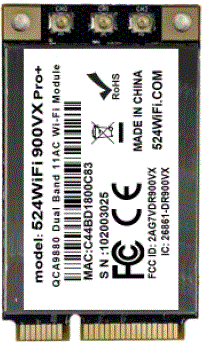
524WiFi 600VX / 900VX ProPlus Mini PCIe Wi-Fi Module, Dual Band, 2,4GHz / 5GHz Designed for Enterprise Wireless Dual Band Access Points

QCA9880 based 2×2 and 3×3 MIMO 802.11ac Mini PCIe Wi-Fi Module with improved XB140 reference design, Dual Band, 2,4GHz / 5GHz

We supply wireless Wi-Fi data and 4G 5G LTE modules worldwide. There is no continent, where we would not have a satisfied customer! Yes, we have already supplied our Wi-Fi modules to Antarctica! You can find our modules, for example, in wind turbines, drones, ships, aircraft, both civil, acrobatic and military… on land, on water and in the air. NASA has also ordered samples, so the next goal is to get them into the outer Space!

524WiFi 900VX Pro+(and 600VX Pro+) based on QCA9880 chipset – 524WiFi version has better power amplifier, higher sensitivity a higher tx power (check data) . Enterprise wireless modules integrated with 3×3 5G high power Radio module and 3×3 (or 2×2) 2.4G high power. Mass transportation infrastructure use cases available, already works in many EU countries! Radio module designed specifically to provide users with mobile access to high-bandwidth video streaming, voice, and data transmission for office and challenging RF environment in factories, HW projects cooperation available . Specially designed for higher volume of clients & loads. CE RED, UK CA, IC Canada  and FCC certified and full test reports available! FCC 4,9GHZ Certified!

It is based on XB140 reference design from the QCA for QCA9880 chipset. XB140 is a dual band 802.11ac design.  What are the differences between XB140 and 524WiFi 600VX / 900VX ProPlus ?
524WiFi 600VX Pro+/ 900VX Pro+ changes the FEM, power, some RF circuit and layout. We change the FEM, that is because we always work with the Skyworks;
we change the power, we change the RF and the layout for higher performance and lower working temperature, and we do many tests for it. Please check our test reports in Blog section.

Our products are designed for higher numbers of clients connections & support for extreme loads. Very popular for Profi Hot-Spots and Internet for passengers applications!

Do you like our WiFi modules and want to test samples ? No problem ! Please contact us and provide your project description!

INDUSTRIAL WIFI MODULES –  Wi-Fi for public transport passengers – buses, trains, planes, stations…

ProPlus


 Improved QCA XB140 Reference design for QCA 9880 chipset
 Changed the FEM, power – lower real and extended working temperature range
 Improved RF circuits – Higher Tx Power, better RX sensitivity
 Improved & better layout for higher performance
 See comparison protocol ProPlus vs Standard module for details
 Designed for heavy data loads & higher amount of clients
 Cases studies available ! Approved for WiFi for passangers & Railroads

Features


 Qualcomm-Atheros QCA9880 chipset
 2.4GHz max 24dBm & 5GHz max 23dBm output power
 IEEE 802.11ac compliant & backward compatible with 802.11a/b/g/n
 2×2 MIMO Technology, up to 867Mbps
 Mini PCI Express edge connector
 RoHS compliance ensure a high level protection of human health and the environment from risks that can be
posed by chemicals
 Supports Spatial Multiplexing, Cyclic-Delay Diversity (CDD), Low-Density Parity Check (LDPC) Codes, Maximal
Ratio Combining (MRC), Space Time Block Code (STBC), Support the Frequency 4920MHz~4980MHz for US
region.
 Supports IEEE 802.11d, e, h, i, k, r, v time stamp, and w standards
 Supports Dynamic Frequency Selection (DFS)
 Cards are individually calibrated for Quality Assurance
 Designed for higher numbers of clients connections & support for extreme loads
 Linux drivers support – Ath10k, Candela wireless drivers, based on QCA reference design
 Certifications : CE RED, UK CA, FCC, IC Canada

Applications

 Profi WiFi hotspot coverage
 Commercial radio coverage
 Hotel Wireless application
 Country coverage
 Internet for passengers (bus, train, plane, …)
 Security Surveillance
 Some special scene application
 Heavy-duty industrial environment use

The adapter works great in Ubuntu. We get a net throughput of more than 70 MB/s, tested with iperf3! Very much of an upgrade compared to the COMPEX WLE 200NX.

Furthermore I can confirm that the card is working in Windows 10 as well. Please read related article about Windows drivers for these modules.


Product Description


524WiFi 600VX ProPlus based on QCA9880 chipset is an enterprise wireless module integrated with 2×2 5G high
power Radio module and 2×2 2.4G high power Radio module designed specifically to provide users with mobile access
to high-bandwidth video streaming, voice, and data transmission for office and challenging RF environment in factories,
warehouses establishment. Designed for higher volume of clients & loads. CE RED, IC and FCC certified and full test
reports available! FCC 4,9GHZ Certified for US market !

For more protocols, certifications and details check:


http://wifi5.eu/dls/524wifi/524wifi600vxProPlus/

What we’re really good at

We offer consultations in the field of IT – information and data networks – capacity, throughput, risk analysis, penetration tests, definition of security measures. We also supply wireless Wi-Fi data and 4G 5G LTE modules worldwide. There is no continent, where we would not have a satisfied customer! Yes, we have already supplied our Wi-Fi modules to Antarctica! You can find our modules, for example, in wind turbines, drones, ships, aircraft, both civil, acrobatic and military… on land, on water and in the air. NASA has also ordered samples, so the next goal is to get them into the outer Space!

Latest changes to improve possible. All right reserved by their respective owners. Designed by and manufactured for Tomorrow systems s.r.o. In Prague 2021

Posted on

2024 – THE ERA OF WI-FI 6E / WI-FI 7

WiFi 7 in Q1-Q2 2024 – QCN 9574 boards and QCN 9274 / 6274 DBDC radio modules available for testing now ! 

QCN 9074 / 9024 / 6024 WiFi 6 / 6E 11ax 4×4 WiFi Modules and new Mediatek MT7915 / 7916 Wi-Fi 6 / 6E miniPCIE modules available now and tested successfully for mas production! 

524WiFi  the pioneers in connectivity solutions, introduces an array of advanced WiFi 7 modules designed to cater to diverse needs. Let’s delve into the details of 524WiFi WiFi 7 modules and compare their specifications through informative data sheets.A Quick Overview

wifi 7 chipsets

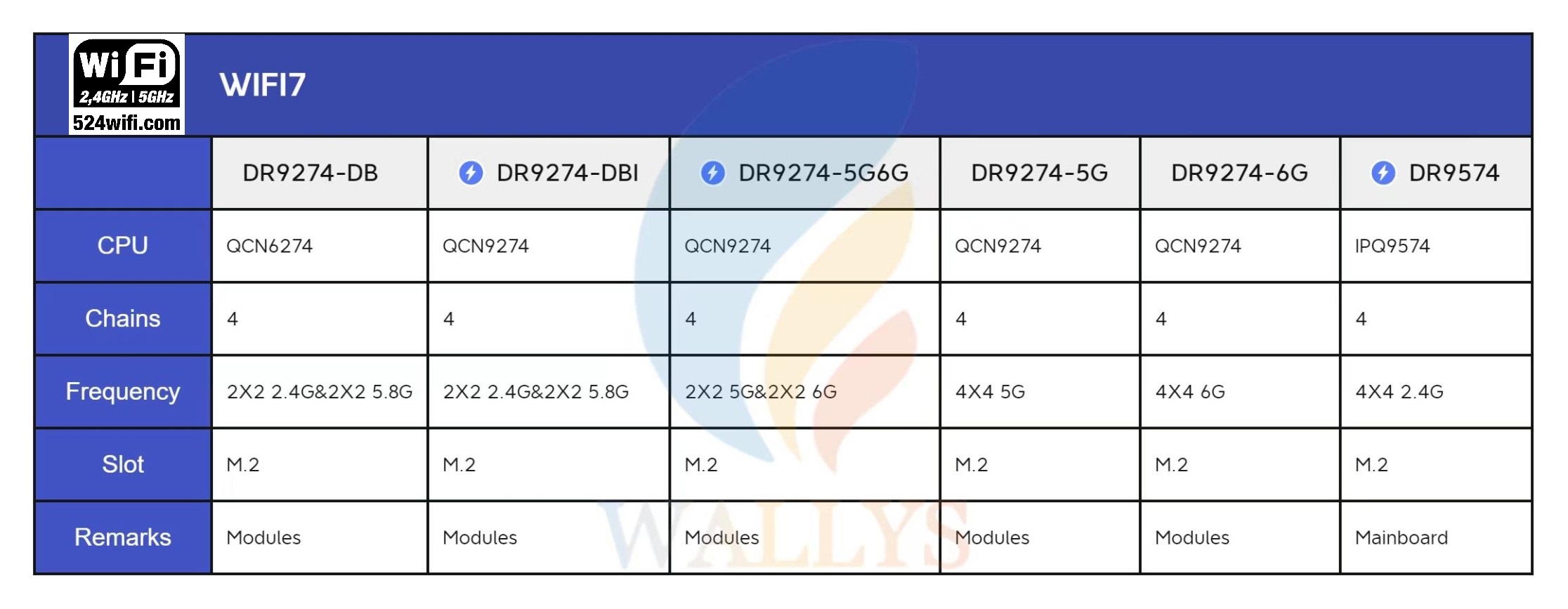
1.DRiver 9274-5G|QCN9274/QCN6274 WIFI7 SINGLE BAND 5G

  • Tailored for single-band 5G applications,Powered by Qualcomm’s QCN9274 ‘Waikiki’ series,Features 4×4 MU-MIMO and supports up to 4096-QAM,Operating temperature ranges from -20°C to 70°C for commercial grade and -40°C to 85°C for industrial grade

Key Feature:

  • Qualcomm Atheros QCN9274 for Industrial Grade;
  • Qualcomm Atheros QCN6274 for Commercial Grade;
  • Maxim Tx power 20dBm per chain;
  • 4×4 5G MU-MIMO, up to 5765Mbps physical data rate;
  • Support up to 4096-QAM;
  • M.2 connector;
  • PCI Express 3.0 Interface

2.DRIVER 9274-6G|QCN9274/QCN6274 WIFI7 SINGLE BAND 6G

  • Specifically designed for single-band 6G requirements,Utilizes Qualcomm’s QCN6274 ‘Waikiki’ series for robust performance,Boasts a 4T4R (4×4) MU-MIMO 6GHz solution,Achieves up to 11.530Gbps with 4 spatial streams.

Key Feature:

  • Qualcomm Atheros QCN9274 for Industrial Grade;
  • Maxim Tx power 22dBm per chain;
  • 4×4  6G MU-MIMO, up to 11530Mbps physical data rate;
  • Support up to 4096-QAM;
  • M.2 connector;
  • PCI Express 3 .0 Interface

3.DRIVER 9274-DB|QCN9274/QCN6274 WIFI7 DUAL BAND DUAL CONCURRENT-2.4G&5G

  • Perfect for dual-band, dual-concurrent operation in both 2.4G and 5G,Employs Qualcomm’s QCN6274 ‘Waikiki’ series for exceptional connectivity,Supports both Access Point (AP) and Station (STA) modes simultaneously

Key Feature:

  • Qualcomm Atheros QCN6274;
  • Qualcomm Atheros QCN9274 for Industrial Grade;
  • Maxim Tx power 20dBm per chain;
  • 2×2 2.4GHz MU-MIMO, up to 1376Mbps physical data rate;
  • 2×2 5GHz MU-MIMO, up to 5765Mbps physical data rate;
  • Support up to 4096-QAM;
  • M.2 connector;
  • PCI Express 3 .0 Interface

4.DRIVER 9274-5G6G|QCN9274/QCN6274 WIFI7 DUAL BAND DUAL CONCURRENT-5G&6G

  • Tailored for dual-band, dual-concurrent operation in 5G and 6G frequencies,Utilizes Qualcomm’s QCN9274 ‘Waikiki’ series for reliable performance,Wide signal coverage with a 5V design

Key Feature:

  • Qualcomm Atheros QCN9274 for Industrial Grade;
  • Maxim Tx power 22dBm per chain;
  • 2×2 5G & 2×2 6G MU-MIMO, up to 8,647Mbps physical data rate;
  • Support up to 4096-QAM;
  • M.2 connector;
  • PCI Express 3 .0 Interface

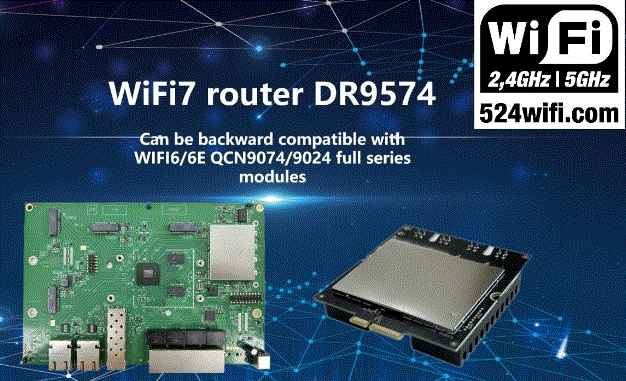
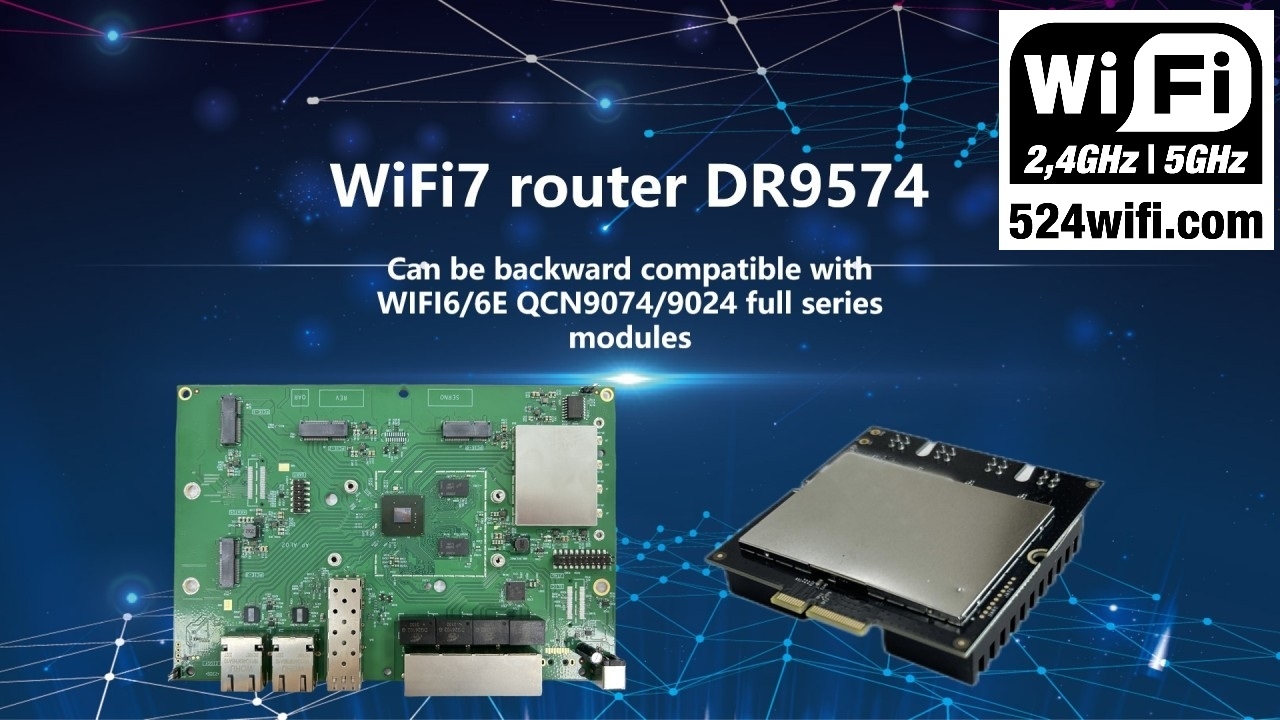
5.WIFI7 PLATFORM DRIVER 9574-IPQ9574

  • Support 11ax 2.4G 4×4 radio on board
  • A robust platform featuring the Qualcomm IPQ9574 or IPQ9554
  • Designed specifically for WiFi 7 applications Industrial
  • Backward compatible with WiFi6/6E QCN9074 QCN9024 full series modules
wifi 7 router boards

524WiFi WiFi 7 modules are engineered for versatility and reliability, making them ideal for Enterprise, Industrial, Cybersecurity, Transportation, and SMB applications. The modules support Multi-Link Operation (MLO) for reduced latency, Preamble Puncturing for improved spectral efficiency, and unique features like FIPS L2 for enhanced cryptographic protection.

Wi-Fi 7 samples from Compex available for orders
The latest Wi-Fi standard is brought to market by Compex with the new WLW7000 series, based on Qualcomm’s QCN6274 or QCN9274 chipsets for commercial and industrial versions respectively. The 5V design enables wider signal coverage along with all the benefits of the new standard such as preamble puncturing. The new series comes in 4 different configurations with one Dual-Band-Dual-Concurrent on the 2.4/5 GHz bands as well as 3 Single-Band versions for 2.4/5/6 GHz respectively, with the 6 GHz verison reaching theoretical speeds of over 11.5 Gbps.  

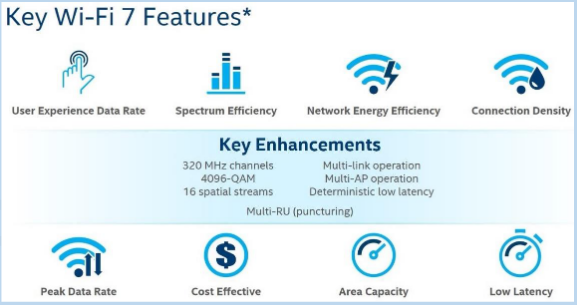
WHAT’S WI-FI 7?

WI-FI 7 HAS THE FOLLOWING FEATURES:


– provide over 3 times faster data rates of 46 Gbps using a 320 MHz channel in the 6 GHz
– one 160 MHz channel in the 5 GHz band with up to 4096-QAM (4K-QAM) modulation
– 16 spatial streams MU-MIMO, 

– New Multi-Link  Operation (MLO) enables Wi-Fi 7 to combine several frequencies across bands into a single and steady connection.

Wi-Fi 7 is being designed to be optimized for these video applications like gaming, streaming, smart home devices and services, cloud computing, video conferencing , etc.

wifi 7 features

WI-FI 6E/7 COMPARISON

WI-FI 6E

IEEE 802.11ax
Frequency 2.4GHz, 5GHz, 6GHz
Channel bandwidth 160 MHz
QAM 1024-QAM 4096-QAM
Theoretical maximum  speed 9.6 Gbps
Spatial streams  16×16 MU-MIMO
Application Ac cess point, high quality video streaming, etc.

WI-FI 7

802.11be EHT

Frequency  2.4GHz, 5GHz, 6GHz

Channel b-QAM

Theoreticaandwidth Up to 320 MHz

QAN 4096l maximum  speed  46 Gbps

Spatial streams 16×16 MU-MIMO

Video applications like gaming, streaming, smart home devices, cloud computing, video conferencing, etc.

2023 NEW PRODUCTS – WIFI 7  QCA AP AND CLIENT SOLUTIONS FROM SPARKLAN:

Sparklan wifi 7 solution

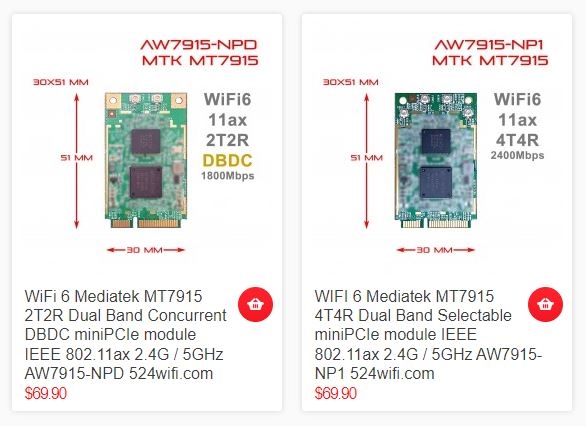
MEDIATEK WIFI 6 MINIPICE MODULES BASED ON MT7915 CHIPSET WITH WIDE LINUX AND OPENWRT DRIVERS SUPPORT

WE DEVELOPPED NEW DBDC (DUAL BAND DUAL CONCURRENT) WIFI6 MODULE FOR HEAVY LOAD APPLICATIONS BASED ON MEDIATEK MT7915-DAN CHIPSET ! PLEASE READ OUR TEST REPPORT FOR THESE MODULES.

QCN 9074 524WIFI 6, 6E AND TRIBAND SELECTABLE 11AX 4X4 WIFI MODULE AVAILABLE NOW !

QCN9074 VS QCN9024 | WIFI6E IOT 4X4 TRIBAND 2.4G 5G 6G NETWORK CARD AND APPLICATION

WHAT ARE THE APPLICATIONS OF AN INDUSTRIAL TRI-BAND NETWORK CARD SUPPORTING 2.4GHZ, 5GHZ, AND 6GHZ?

triband wifi6 modules

Imagine the boundless possibilities that come with an industrial Tri-Band network card, seamlessly embracing the 2.4GHz, 5GHz, and lightning-fast 6GHz frequency bands. Here’s a glimpse into the exciting realms of its potential applications:


1. Smart Manufacturing & IoT Revolution: In the heart of smart manufacturing, these Tri-Band cards orchestrate a symphony of devices. From factory robots to floor sensors, they unite the Internet of Things (IoT) to make real-time data analytics and intelligent production a reality.

2. Robotic Precision & Automation: When it comes to industrial robots and automated machinery, precision and speed are paramount. Tri-Band network cards deliver high-speed data transfers and unwavering connections, ensuring uninterrupted automation.


3. Surveillance with Clarity: Industrial sites demand top-tier security. Tri-Band cards support high-definition video streams, fortifying security systems. They extend the eyes and ears of surveillance networks, enhancing vigilance.


4. Scientific Excellence: In the world of scientific research and high-performance computing, these network cards are the lifeline. They enable lightning-fast data transfer, facilitating experiments, simulations, and data analysis at astonishing speeds.


5. Connecting the Unreachable: When it’s about connecting distant devices in remote locations, Tri-Band cards are the bridge. They make remote monitoring, diagnostics, and maintenance a breeze, minimizing downtime.


6. Agriculture & Environmental Guardians: In the fields of agriculture and environmental monitoring, they enable large-scale sensor networks. These networks collect invaluable data for better decision-making, crop management, and environmental preservation.


7. Aerospace & Beyond: Think of satellite communications and aerospace ventures. Tri-Band cards empower high-speed data exchanges between spacecraft, satellites, and ground stations, venturing into the far reaches of the cosmos.


With the 6GHz band, an integral part of the WiFi 6E, industrial Tri-Band network cards offer an abundance of spectrum resources. They cater to the insatiable appetites of high bandwidth and low latency. The future of industrial connectivity shines brighter than ever before!

524WIFI 6E IOT 4X4 TRIBAND 2.4G 5G 6G NETWORK CARD:DR9074

Both the QCN9074 and QCN9024 are Qualcomm chips, and Wallys has chosen this platform for the development of Tri-Band card due to its exceptional stability and superior performance.

Let me share the fascinating story of its inception. Before the advent of the remarkable DR9074 Tri-Band Network card, Wallys had already pioneered single-band network cards like the DR9074-2.4G, DR9074-5G, and DR9074-6E, each earning a reputation for top-notch performance.

Then came an intriguing request from one of our valued customers: ‘The DR9074-5G and DR9074-6E deliver exceptional performance; do you have plans for a Tri-Band version of this card?’ As an innovation-centric company, this question ignited a spark among our engineers.

Fuelled by passion and driven by the pursuit of excellence, our engineers toiled day and night. And voilà, Wallys proudly presents the DR9074 Tri-Band Network card, a testament to our commitment to innovation and customer satisfaction.


Now, let’s dive into the exciting features of this groundbreaking card!

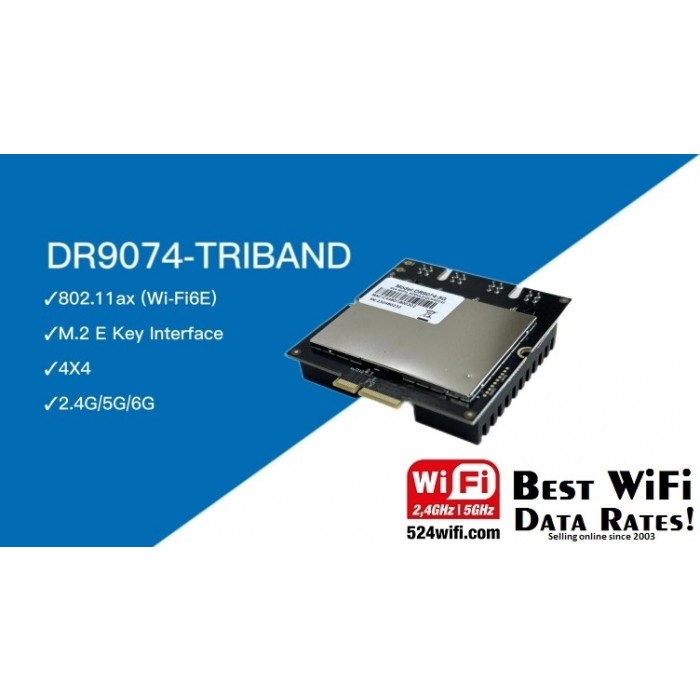
DR9074-TRIBAND

■ Qualcomm Atheros QCN9024

■ Maxim 23 dBm per chain,up to 4949Mbps

■ Data Rateup to 4949Mbps

■ Support  Tri Band 2.4GHz&5GHz&6GHz 4×4 WiFi 6E (802.11ax)

■ 4 spatial streams (4SS)

■ M.2 E Key Interface

■ PCI Express 3 .0 Interface


Symbol/Parameter

Chipset:Qualcomm Atheros QCN9024

WLAN Host Interface:PCI Express 3.0 Interface

System Memory:2Mbit serial I²C bus EEPROM

Standard Operating Voltage:5V

Operating Systems:QSDK

Host Interface:M.2 E Key

Antenna Cable / Port:4 x MMCX Connectors,4T4R

Frequency Range:2.412GHz-2.472GHz & 5.18GHz-5.825GHz & 5.925GHz-7.125GHz

Data Rates for WALN:Maxim 23dBm per chain, up to 4949Mbps

Channel Spectrum Widths for WLAN:Support 20/40/80/160MHz

Modulation Techniques:OFDMA: BPSK, QPSK, DBPSK, DQPSK, 16-QAM, 64-QAM, 256-QAM, 1024-QAM, 4096-QAM

Temperature Range:

Operating: -20°C to 70°C,

Storage: -40°C to 90°C

Humidity

Operating: 5% to 95% (non-condensing),

Storage: Max. 90% (non-condensing)

Reference Design:PN02 .7

Power Consumption:TBD

Dimensions (WxHxD):57mm x 63mm x 6mm

Get yourself some samples to test – availbe now ! Race towards the adoption of WiFi 6E in your wireless solution! –  HOW WE MAKE QCA QCN9074 WLAN WIFI 6 MODULE DR9074 4X4 WORK ON X86 LINUX PLATFORM – PLEASE READ HERE.

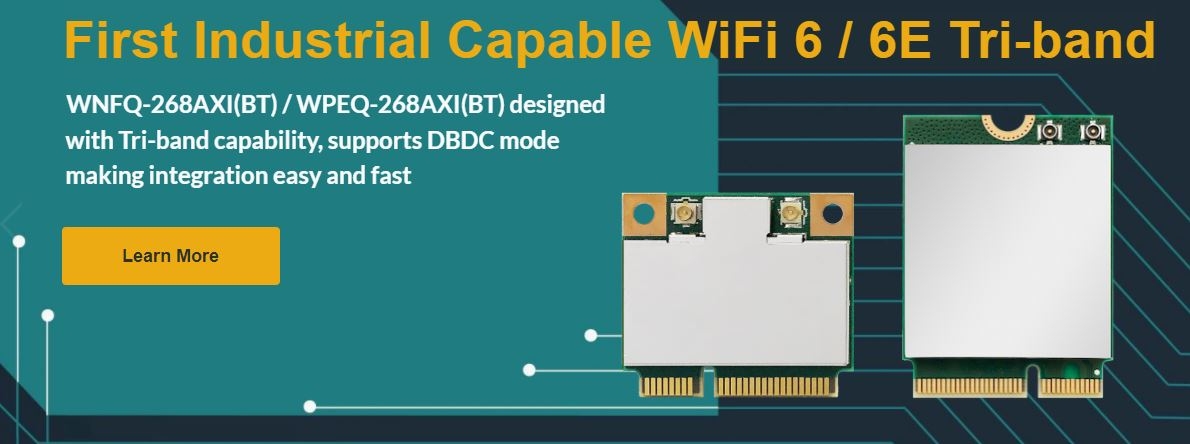
FIRST INDUSTRIAL CAPABLE WIFI 6 / 6E TRI-BAND

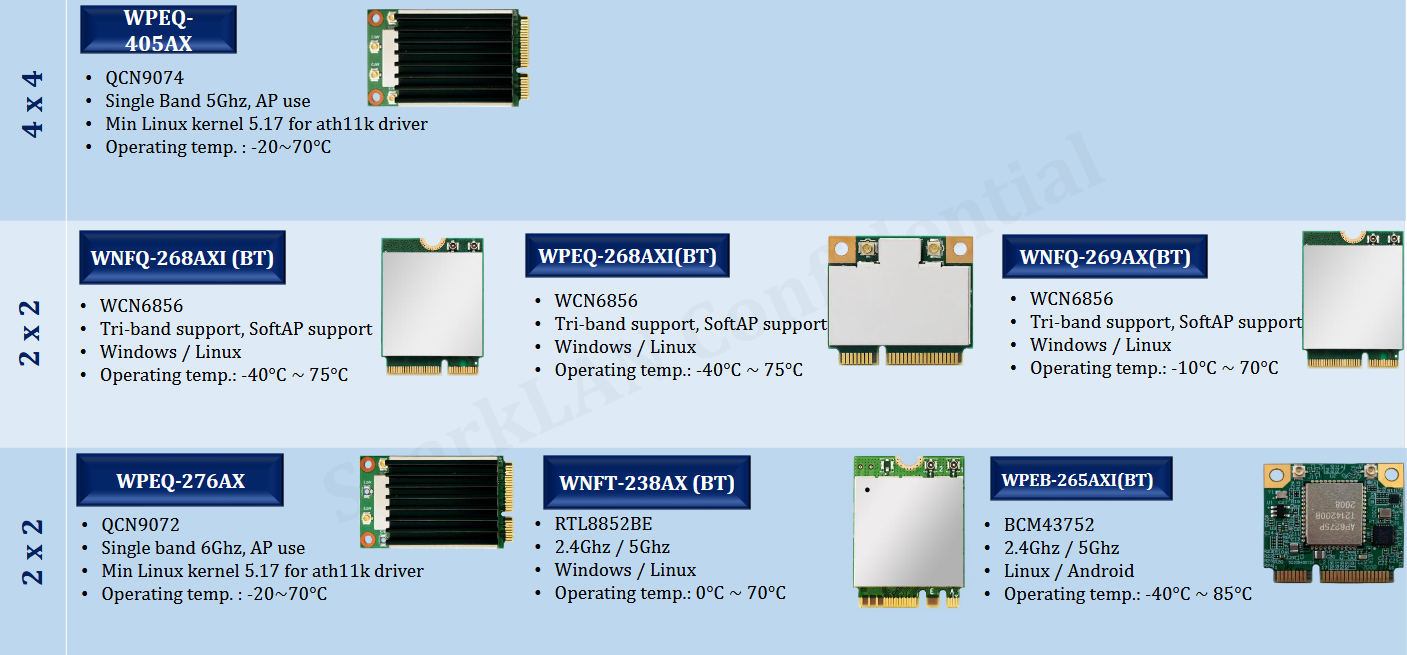
Sparklan WNFQ-268AXI(BT) / WPEQ-268AXI(BT) designed  with Tri-band capability, supports DBDC mode making integration easy and fast

SPARKLAN WIFI 6 / 6E SOLUTIONS

Sparklan wifi 6 6E solution

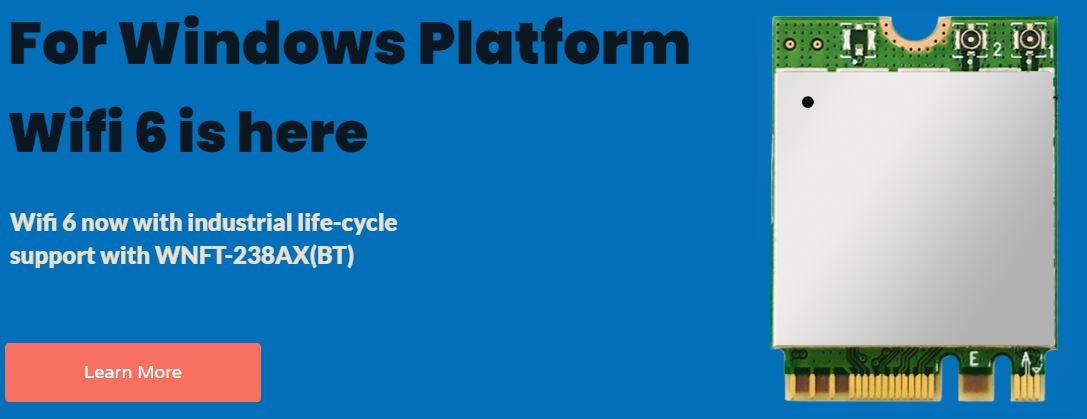
WIFI 6 FOR WINDOWS PLATFORM IS HERE !

Wifi 6 now with industrial life-cycle support with WNFT-238AX(BT)


QUECTEL 5G AND LTE-A MODEMS – 10X FASTER THAN LTE NETWORKS

New Quectel RM502Q-AE m.2 5G Global module -hot sell for better price !!