

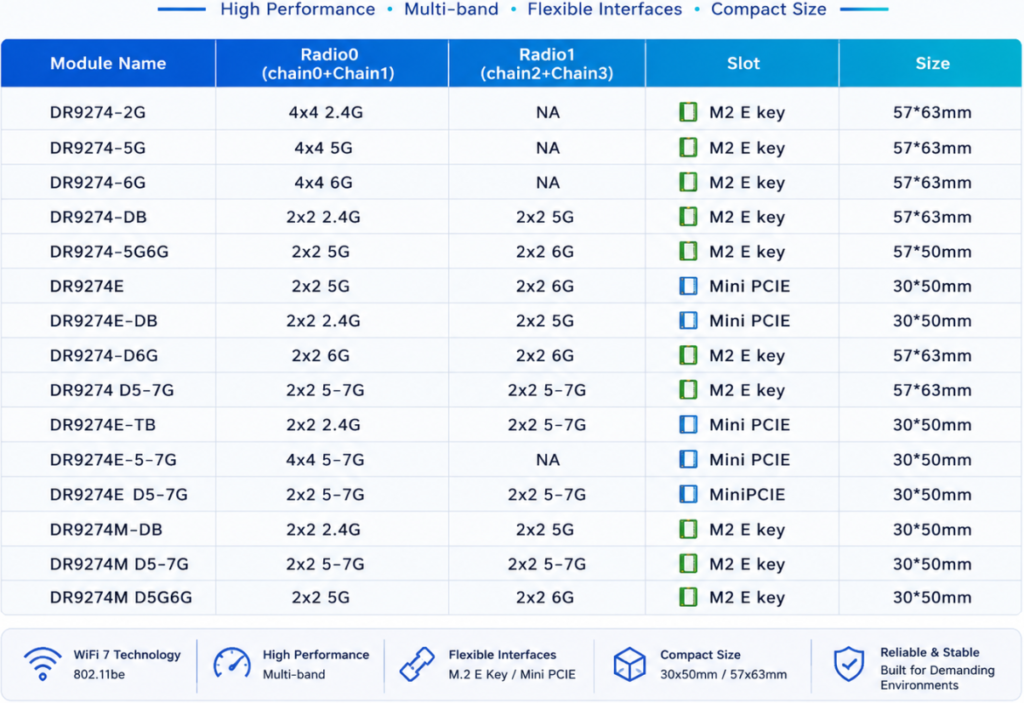
| Module Name | BDwlan | Radio0 (chain0+Chain1) | Radio1 (chain2+Chain3) | Slot | Status | Note |
| DR9274-2G | B0001 | 4×4 2.4G | NA | M2 E key | available | |
| DR9274-5G | B0002 | 4×4 5G | NA | M2 E key | available | B0015 |
| DR9274-6G | B0004 | 4×4 6G | NA | M2 E key | available | B0016 |
| DR9274-DB | B1003 | 2×2 2.4G | 2×2 5G | M2 E key | available | |
| DR9274-5G6G | B1006 | 2×2 5G | 2×2 6G | M2 E key | available | |
| DR9274-5GK | B0011 | 4×4 5G | NA | M2 E key | available | bdwlanKCT.b0002 |
| DR9274-6GK | B0013 | 4×4 6G | NA | M2 E key | available | bdwlanKCT.b0004 |
| DR9274E | B1018 | 2×2 5G | 2×2 6G | Mini PCIE | available | New bdwlan |
| DR9274E-DB | B1017 | 2×2 2.4G | 2×2 5G | Mini PCIE | available | New bdwlan |
| DR9274-D6G | B1019 | 2×2 6G | 2×2 6G | M2 E key | available | New bdwlan |
| DR9274 D5-7G | B100d | 2×2 5-7G | 2×2 5-7G | M2 E key | available | New bdwlan |
| DR9274E-TB | B100e | 2×2 2.4G | 2×2 5-7G | Mini PCIE | Coming soon | New bdwlan |
| DR9274E-5-7G | 4×4 5-7G | NA | Mini PCIE | Coming soon | ||
| DR9274E D5-7G | 2×2 5-7G | 2×2 5-7G | Mini PCIE | Coming soon |
Why Wi-Fi 7 Matters for Robotics
Wi-Fi 7 introduces several capabilities that directly address the requirements of next-generation robotics.
1. Higher Throughput for AI Data Streams
With features such as:
- 320MHz channel bandwidth
- 4096-QAM modulation
- Multi-Link Operation (MLO)
Wi-Fi 7 significantly improves wireless capacity.
This enables robots to transmit and receive more data, supporting applications such as:
- Real-time HD/4K video analysis
- Multi-camera perception
- Digital twin visualization
- Remote robot operation
For industrial environments, higher bandwidth means more robots can operate simultaneously without creating network bottlenecks.
2. Lower Latency for Real-Time Control
Latency is critical for autonomous systems.
A delayed wireless connection can impact:
- Robot navigation
- Collision avoidance
- Remote control
- Human-machine collaboration
Wi-Fi 7’s Multi-Link Operation allows devices to utilize multiple frequency bands simultaneously, improving connection stability and reducing congestion.
For mobile robots operating in complex environments, maintaining a consistent connection is often more important than achieving maximum peak speed.
3. Better Connectivity in High-Density Environments
Future factories and warehouses may contain:
- Hundreds of autonomous mobile robots (AMRs)
- AI cameras
- Industrial sensors
- Wireless controllers
- Edge computing nodes
A wireless infrastructure designed only for consumer environments may not be enough.
Industrial Wi-Fi requires:
- Stable roaming
- RF optimization
- Enterprise-level management
- Long-term hardware reliability
Wi-Fi 7 provides a stronger foundation for these high-density deployments.
Edge AI + Wi-Fi 7: Bringing Intelligence Closer to Machines
While cloud computing remains important, many robotic applications are moving toward edge AI.
Why?
Because robots need:
- Faster response times
- Reduced dependence on cloud connectivity
- Better privacy protection
- More reliable operation in industrial environments
Edge AI platforms process data locally, allowing robots to make decisions in real time.
But edge intelligence requires a powerful communication layer.
The relationship is simple:
Edge AI provides the intelligence. Wi-Fi 7 provides the nervous system.
Together, they enable robots to:
- Understand their environment faster
- Coordinate with other machines
- Adapt to changing conditions
- Operate autonomously at scale
Beyond Speed: Industrial Wireless Requires Reliability
A common misunderstanding is that the future of industrial wireless is simply about faster Wi-Fi.
In reality, industrial applications require much more:
Reliable roaming
Mobile robots need seamless handover between access points while moving across large facilities.
Stable performance under interference
Factories often contain metal structures, machinery, and RF noise.
Long-term platform support
Industrial customers expect hardware platforms that can operate reliably for years.
Flexible deployment options
Different environments require different designs:
- Indoor industrial APs
- Outdoor wireless bridges
- Embedded Wi-Fi modules
- Custom router platforms
The Future: AI Robots Need AI-Ready Networks
As robotics continues to evolve, wireless connectivity will become a strategic infrastructure layer.
The next generation of robots will not work alone.
They will communicate with:
- Other robots
- Edge servers
- AI vision systems
- Factory automation platforms
- Cloud management systems
A powerful AI model without reliable connectivity cannot deliver its full value.
The future belongs to systems where:
AI intelligence + Edge computing + Advanced wireless connectivity work together.
Wi-Fi 7 is not just a faster wireless standard.
It is becoming the communication backbone for intelligent machines.
Building the Industrial Wireless Foundation for Tomorrow
At 524WiFi and Wallys, we are exploring the next generation of industrial wireless platforms by combining:
- Qualcomm-based Wi-Fi 6 / Wi-Fi 7 solutions
- Industrial-grade router boards
- High-performance wireless modules
- Edge AI application platforms
- OEM/ODM customization capability
Our goal is to help robotics companies, AI developers, and industrial solution providers build reliable wireless infrastructure for the intelligent world.
Because the future of robotics will not only depend on smarter machines.
It will depend on how well those machines can communicate.