Posted on

IPQ5018 + QCN6102 Enable Seamless Same & Cross Frequency Roaming for AGVs and AMRs

Seamless Same-Frequency & Cross-Frequency Roaming for AGVs and AMRs

In modern automated warehouses, stable and uninterrupted wireless connectivity is essential. Autonomous vehicles such as AGVs and AMRs depend on real-time communication for navigation, safety, and task execution. Any packet loss or delay can disrupt operations.

To meet these challenges, 524WiFi and Wallys Communications introduces its next-generation 5G Roaming Technology, engineered for mission-critical industrial environments requiring both same-frequency roaming and cross-frequency roaming. This new solution builds on the proven foundation of our Peacock Series while delivering significantly enhanced stability for complex warehouse deployments.


Why 524WiFi & Wallys 5G Roaming Is a Game Changer

Traditional roaming solutions often struggle when APs operate on different channels or when robots move rapidly across overlapping wireless coverage zones.

Wallys 5G Roaming enables instantaneous transitions between APs, whether the next AP is operating on:

  • The same frequency and same channel
  • The same frequency but a different channel
  • A different frequency band entirely

This flexibility eliminates typical roaming delays and ensures continuous operation in heterogeneous RF environments.


1. Cross-Frequency Roaming

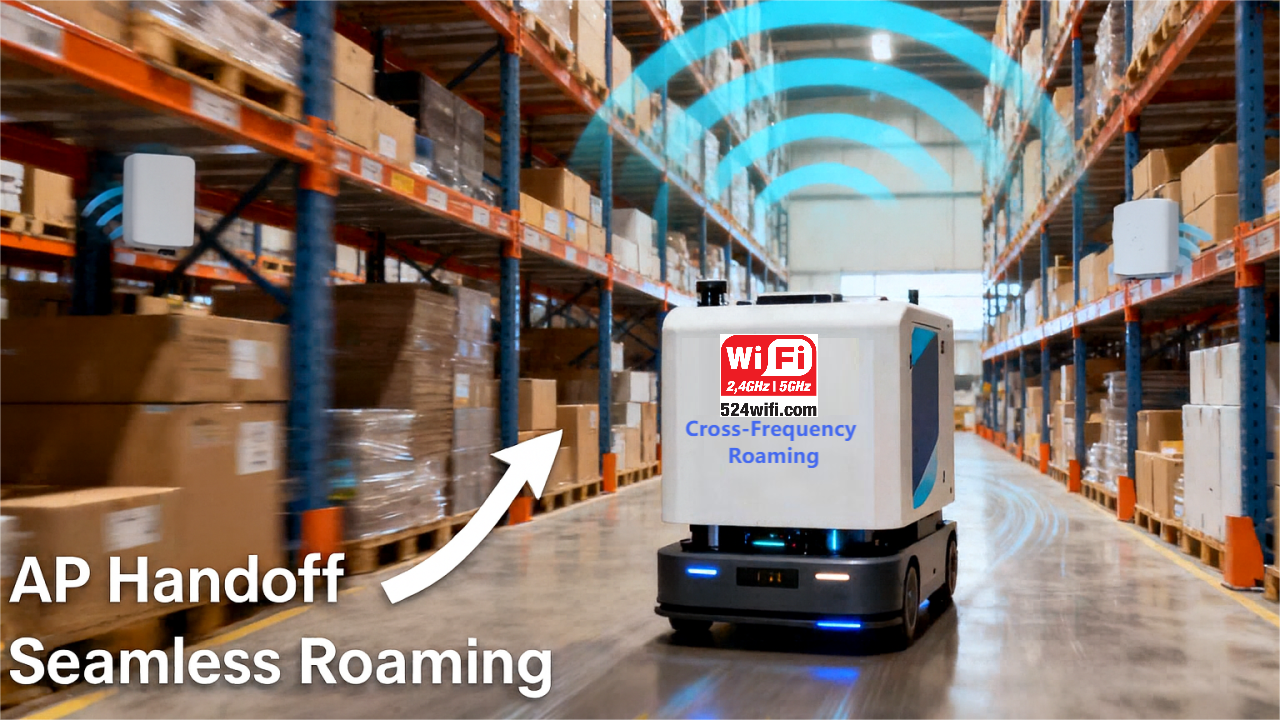
AGVs and AMRs can move seamlessly between APs operating on different channels or different frequency bands. This is ideal for large warehouses where RF planning varies across zones.

Key benefit: ✔ Smooth transitions even when moving from Channel 36 to Channel 149, Channel 165, or mixed-band coverage areas.


2. Same-Frequency Roaming

In environments where APs share the same channel—common in dense warehouse layouts—Wallys roaming provides uninterrupted handoffs with zero packet loss.

Key benefit: ✔ Reliable connectivity even in high-density, same-channel deployments.


3. Zero Packet Loss & Ultra-Low Latency

Whether roaming is same-frequency or cross-frequency, the system consistently maintains:

  • Zero packet loss during handoff
  • Sub-millisecond switching times
  • Stable connectivity during continuous movement

This eliminates lag, communication gaps, and navigation issues associated with traditional roaming.


Real-World Warehouse Application

Imagine a fleet of AGVs navigating:

  • Narrow aisles
  • Large open areas
  • Mixed indoor and semi-outdoor regions
  • Zones where APs operate on different 5G channels

As each AGV moves from one coverage zone to another, Wallys roaming ensures instant, seamless transitions:

  • Channel 36 → Channel 149 → Channel 165
  • Same-channel AP-to-AP switching
  • Transition between heterogeneous frequency zones

Connectivity remains solid throughout—no interruptions, no delays, no impact on workflows.


Why Warehouse Leaders Are Choosing 524WiFi & Wallys

  • Supports both same-frequency and cross-frequency roaming
  • Designed for AGVs, AMRs, and industrial IoT environments
  • Demonstrated performance in complex, high-interference warehouses
  • Backed by 524WiFi’ extensive wireless engineering expertise

This positions warehouses for higher automation efficiency and long-term scalability.


Upgrade Your Warehouse Connectivity

524WiFi and Wallys 5G Roaming Technology delivers the reliability required for next-generation warehouse automation. Enable your AGVs and AMRs to operate consistently, safely, and efficiently—no matter how challenging the RF environment.


Posted on

Wi-Fi 7 for AIoT: How IPQ9574 and QCN9274 Enable Real-Time Edge AI

When we talk about Wi-Fi 7 (802.11be), most discussions focus on its impressive speed upgrades — and rightly so. But beneath the surface, Wi-Fi 7 is quietly becoming a critical enabler for Artificial Intelligence (AI) and AIoT (Artificial Intelligence of Things). It’s not just about faster wireless — it’s about making intelligent devices truly efficient, real-time, and scalable.

🚀 What Makes Wi-Fi 7 Different?

Wi-Fi 7 introduces groundbreaking features like:

  • Multi-Link Operation (MLO) — enabling devices to connect across multiple bands simultaneously, improving reliability and reducing latency.
  • Higher throughput — supporting up to 46 Gbps, ideal for high-data AI workloads.
  • Lower latency — essential for real-time AI inference.
  • Improved concurrency — allowing more smart devices to communicate simultaneously without congestion.

These capabilities make Wi-Fi 7 a natural fit for the AI revolution — both in the cloud and at the edge.


🧠 AI + Wi-Fi 7: A Perfect Match

1. Faster Real-Time Inference at the Edge

Edge AI devices like smart cameras, traffic sensors, or inspection drones require:

  • Constant data streams
  • Real-time decision-making
  • High connection reliability

Wi-Fi 7 ensures ultra-low latency and high bandwidth — perfect for AI models processing data in real time, directly on edge devices.

📍 Example: In smart manufacturing, a defect detection system running AI vision models can send high-resolution images instantly over Wi-Fi 7 for sub-second inference.


2. Scalable AIoT Networks

AIoT means connecting and managing hundreds or thousands of smart devices, often with edge AI capabilities.

Wi-Fi 7 supports:

  • Massive device concurrency
  • Dynamic bandwidth allocation
  • Superior QoS (Quality of Service)

This allows factories, campuses, or smart buildings to scale up their AIoT systems without overloading the network.

📍 Example: A smart office can deploy hundreds of AI-enabled occupancy sensors and environmental monitors — all reporting in real time — without lag.


3. Wireless Edge AI Gateways

Many AIoT systems use a local AI gateway that:

  • Aggregates data from various sensors
  • Runs local AI models
  • Connects wirelessly to the cloud or central system

Wi-Fi 7’s multi-band capabilities ensure that these gateways maintain stable, high-speed connections — even in noisy RF environments.

📍 Example: In a hospital, an AI-powered patient monitoring system can use a Wi-Fi 7-enabled gateway to transmit continuous multi-sensor data with minimal delay or risk of interruption.


🌐 AI-Powered Devices Need a Smarter Network — That’s Wi-Fi 7

As AI models become more complex and real-time applications more common, the network needs to evolve as well. Wi-Fi 7 is not just keeping up — it’s paving the way forward.

Whether it’s in:

  • Retail analytics
  • Autonomous vehicles
  • Healthcare monitoring
  • Smart agriculture
  • or Industrial robotics…

AI + Wi-Fi 7 is the new power couple for connected intelligence.


🔧 524WiFi and Wallys Wi-Fi 7 Hardware: Designed for AI and AIoT Deployments

At 524WiFi and Wallys, we offer industrial-grade Wi-Fi 7 solutions based on Qualcomm platforms such as IPQ9574 and QCN9274. Our high-performance router boards and wireless modules are ideal for:

  • AI-enabled edge computing devices
  • Custom AIoT gateways
  • High-bandwidth data streaming systems

🔹 DR9574 Router Board – (CPU:Qualcomm IPQ9574) Perfect for AI gateways with multiple high-speed interfaces

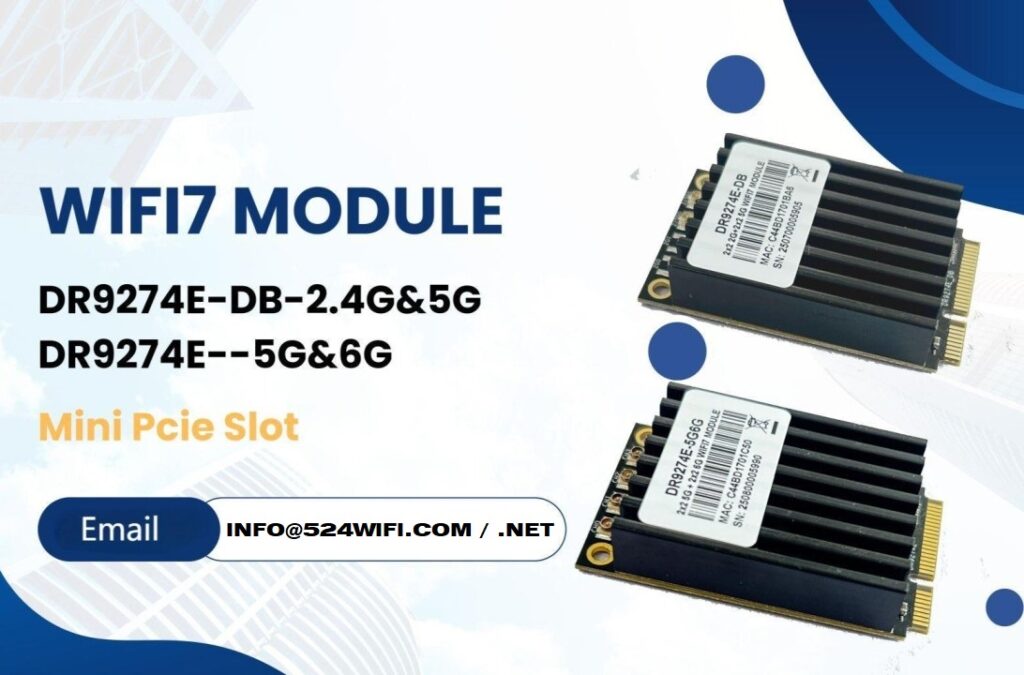
🔹 DR9274 Mini PCIe Module – (CPU:Qualcomm QCN9274/QCN6274) Compact and powerful Wi-Fi 7 module for embedded AI system

🔹 Custom ODM/OEM support – Tailor-made solutions for your AI product roadmap

👉 Contact our team at info@524wifi dor net or com to discuss your AI project and how Wi-Fi 7 can help you scale it smarter and faster.

Posted on

AIoT & Robotics Boom: How WiFi 6/7 Enables Seamless Wireless Networks

The rapid rise of AIoT (Artificial Intelligence of Things) and robotics is transforming industries, from smart manufacturing and autonomous logistics to healthcare and consumer robotics. As robots become more intelligent and interconnected, the need for high-speed, low-latency, and reliable wireless communication is greater than ever. WiFi 6 and WiFi 7 are emerging as key enablers of seamless connectivity in the AIoT-driven robotics revolution.

Challenges in Wireless Communication for AIoT and Robotics

AI-powered robots rely heavily on real-time data exchange, cloud processing, and collaborative operations. However, traditional wireless networks face several challenges in meeting these demands:

  • High Latency: Robotics applications, such as autonomous mobile robots (AMRs) and industrial automation, require ultra-low latency to ensure precise control and real-time decision-making.
  • Interference & Congestion: Dense industrial environments often experience significant wireless interference, affecting communication reliability.
  • Bandwidth Limitations: High-resolution sensors, AI-driven vision systems, and cloud-based data processing generate massive data streams that require high-throughput connectivity.
  • Seamless Roaming: Robots moving within factories, warehouses, or hospitals need smooth network transitions without disruptions.

How WiFi 6 and WiFi 7 Solve These Challenges

WiFi 6 and WiFi 7 introduce groundbreaking advancements that make them ideal for AIoT and robotic applications:

1. Ultra-Low Latency for Real-Time Control

  • WiFi 6: Features OFDMA (Orthogonal Frequency Division Multiple Access) and MU-MIMO, allowing multiple devices to communicate simultaneously, reducing latency.
  • WiFi 7: Introduces Multi-Link Operation (MLO), enabling robots to use multiple frequency bands simultaneously, further reducing latency and ensuring stable connectivity.

2. Enhanced Interference Resistance in Industrial Environments

  • WiFi 6: Uses BSS (Basic Service Set) Coloring to minimize co-channel interference, improving efficiency in dense environments.
  • WiFi 7: Supports Adaptive Preamble Puncturing, allowing devices to avoid interference dynamically and maintain high-speed connections.

3. High Bandwidth for AI-Driven Applications

  • WiFi 6: Expands channel width up to 160 MHz, supporting high-throughput applications like AI-powered vision systems.
  • WiFi 7: Doubles the bandwidth with 320 MHz channels, significantly boosting data rates for real-time AI processing and high-resolution sensor data transmission.

4. Seamless Roaming for Mobile Robots

  • WiFi 6 & 7: Both support enhanced roaming protocols, ensuring robots moving within large-scale environments (factories, warehouses, hospitals) maintain uninterrupted connectivity.

524WiFi’ WiFi 6/7 Solutions for Robotics & AIoT

524WiFi and Wallys, a leading providers of industrial wireless solutions, offers a range of high-performance WiFi 6 and WiFi 7 modules and router boards designed for AIoT and robotic applications. Key products include:

  • DR5018S (WiFi 6) – A robust router board featuring Qualcomm IPQ5018, optimized for low-latency and high-speed industrial connectivity.
  • DR9574 (WiFi 7) – A next-gen WiFi 7 router board powered by IPQ9574, delivering exceptional performance with Multi-Link Operation and 320MHz bandwidth.
  • DR9074 Network Card – A high-speed WiFi 6E module for seamless AIoT data transmission in robotic applications.

Conclusion: WiFi 6 & 7—The Future of AIoT and Robotics Connectivity

As AIoT and robotics continue to evolve, reliable and high-performance wireless networks will be the backbone of their success. WiFi 6 and WiFi 7 provide the speed, low latency, and seamless connectivity required for next-generation robotic applications. By integrating cutting-edge WiFi solutions, businesses can unlock the full potential of AI-powered automation and create truly intelligent, interconnected environments.