Posted on 1 Comment

Wi-Fi 8 Multi-AP Coordination: How It Works

Key takeaways

  • Multi-AP Coordination changes access points from independent competitors into coordinated network participants.
  • Coordinated airtime and spatial reuse can improve consistency in dense, interference-heavy deployments.
  • Implementation quality will determine how effectively products translate the standard into real performance.

Among the technologies defining Wi-Fi 8 (IEEE 802.11bn), Multi-AP Coordination stands out as the one that changes network architecture, not just radio performance.

The Mechanism Traditionally, each access point schedules its own transmissions independently — even when it’s sitting a few meters from another AP on an overlapping channel. Multi-AP Coordination replaces this with a shared, real-time scheduling layer: participating APs exchange timing and channel-state information, then jointly decide transmission order, channel assignment, and power levels. The two core techniques are coordinated beamforming (nulling interference toward neighboring cells) and coordinated spatial reuse (letting multiple APs transmit simultaneously without stepping on each other).

How This Differs From Wi-Fi 6/7 Wi-Fi 6E and 7 pushed hard on per-AP spectral efficiency and standardized faster handoff mechanisms (802.11k/v/r), but interference management between APs remained largely reactive — each radio senses and avoids, rather than actively coordinating. Multi-AP Coordination is proactive and network-initiated: the system prevents interference by design instead of working around it after the fact.

Applications Enabled

  • Seamless, network-managed roaming for AMR/AGV fleets moving continuously across many AP cells
  • Stable control-link performance in multi-robot cells with tight overlap tolerances
  • Higher effective throughput in high-density outdoor deployments (ports, yards, campuses) where channel reuse was previously constrained by self-interference
  • Simplified RF planning in environments where AP density was previously capped by interference budgets, not coverage needs

Bottom Line Multi-AP Coordination turns a group of APs from independent competitors into a coordinated system — which is exactly the shift dense industrial and robotics deployments have been waiting for.

On our end: 524WiFi™ and Wallys’ Wi-Fi 8 routerboards are currently in sample production. Early units are limited and allocated on a priority basis — reach out if you’d like to get on the list – info@524wifi.net

Posted on

Wi-Fi 8 Multi-AP, SMD and DSO Explained

Key takeaways

  • Multi-AP Coordination lets neighboring access points manage airtime and interference as a system.
  • Single Mobility Domain targets cleaner handoffs for robots, scanners and other moving clients.
  • Dynamic spectrum operation helps mixed devices use available channel capacity more efficiently.

Every new Wi-Fi generation arrives with a fresh batch of jargon. Wi-Fi 6 gave us OFDMA and TWT. Wi-Fi 7 brought MLO and 320MHz ultra-wide channels. Now Wi-Fi 8 is rolling out its own set: Multi-AP Coordination, Single Mobility Domain, dynamic spectrum allocation.

If you’re building networking equipment for dense, high-device-count environments — industrial IoT, enterprise campuses, hospitality, warehousing, robotics, transit, or any deployment where dozens of devices share the same airspace — your first reaction is probably: this sounds like marketing noise that’s still years away from mattering to me.

We’d argue the opposite. These three terms were essentially written with exactly this kind of deployment in mind — Wi-Fi 8 isn’t chasing consumer peak-speed bragging rights this time. It’s chasing dense, multi-device, can’t-afford-to-drop scenarios, which is precisely what a crowded venue, a large facility, or a fleet of moving devices looks like from the network’s perspective.

The headline first: Wi-Fi 8 isn’t faster. It’s steadier.

The theoretical peak throughput of Wi-Fi 8 is roughly on par with Wi-Fi 7. The standard’s official designation even says it outright: Ultra High Reliability (UHR). The name tells you where the priorities are — not benchmark numbers, but consistency under real-world conditions.

For the consumer market, that pivot might feel underwhelming — most households were never saturating Wi-Fi 7’s peak bandwidth anyway. But for high-density deployments, this is exactly the right direction. The real pain points in these environments were never “is there enough bandwidth.” They were: does a device drop connection at the edge of AP coverage, do dozens of devices fighting for the same channel start colliding, does a few-hundred-millisecond handoff between APs interrupt a time-sensitive session. These are precisely the problems the next three features are aimed at.

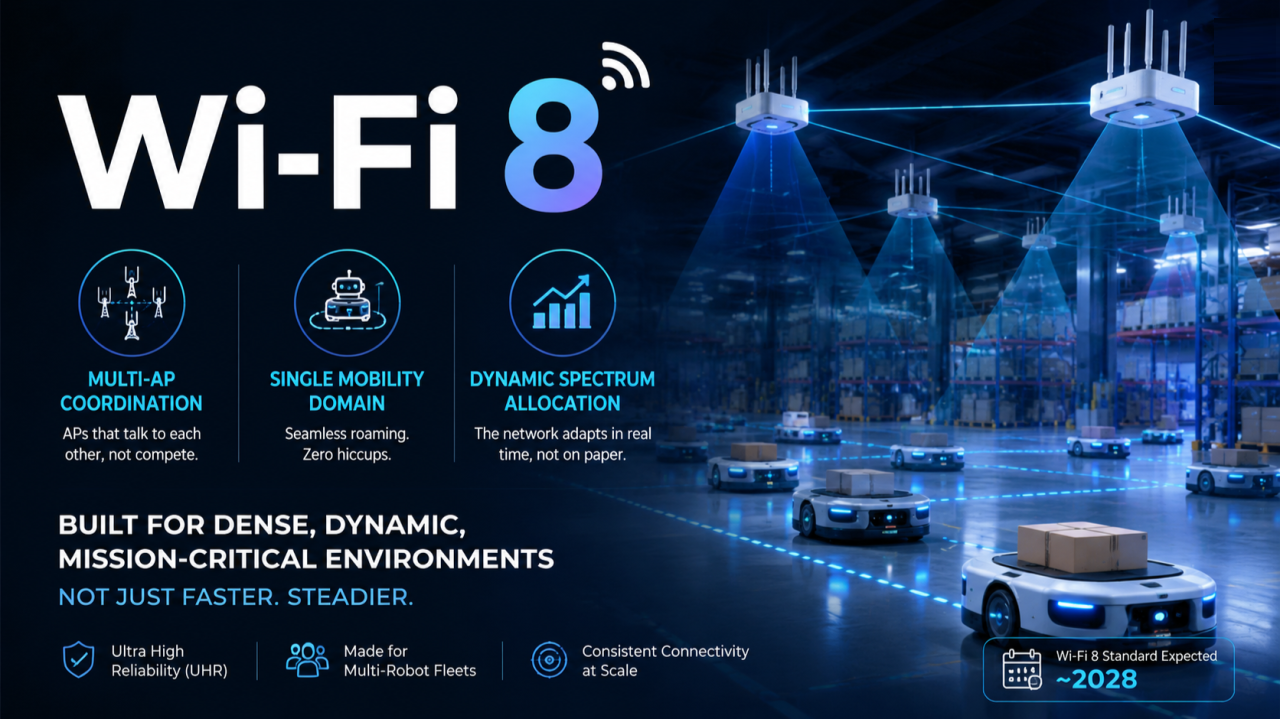
Multi-AP Coordination: from “every AP for itself” to “APs that actually talk to each other”

Traditionally, each access point in a deployment operates independently — it decides on its own who gets to transmit and when, with zero coordination with neighboring APs. In a dense environment (say, ten-plus APs across a warehouse, office campus, or venue), this leads to constant interference: adjacent APs competing for the same spectrum, unaware of what their neighbor is doing.

Multi-AP Coordination (MAPC) is designed to fix exactly this. Neighboring APs negotiate in advance — dividing up time slots, spatial resources, or transmit power — instead of colliding blindly. There are several coordination schemes under this umbrella: splitting a transmission window into slices and rotating through APs (Co-TDMA), transmitting simultaneously with carefully managed power to avoid interference (Co-SR), and combinations of both, applied dynamically depending on traffic conditions.

Why this matters: if a deployment involves dense AP coverage — a large warehouse, a multi-floor facility, a hotel, a stadium, a factory floor — Multi-AP Coordination directly determines whether the network can hold up under load. The packet loss and jitter that dense deployments have historically suffered from is largely a symptom of APs not talking to each other. This is the first generation of the standard to tackle that at the protocol level.

Single Mobility Domain: no more “hiccup” when a device crosses AP boundaries

This term sounds abstract, but the problem it solves is very concrete: how does a moving device hand off cleanly between access points as it moves through a space, instead of dropping the connection, re-authenticating, and reconnecting.

Traditional roaming works like this: the device itself decides “signal’s getting weak, time to find the next AP,” then kicks off a full re-authentication and reconnection process. That process might only take tens to a few hundred milliseconds — imperceptible for casual browsing, but more than enough to interrupt a real-time control loop, a live video stream, a VoIP call, or a tracking session, depending on what the device is doing.

Single Mobility Domain aims to logically merge multiple APs into what behaves like one continuous network, so a device moving through the space experiences something closer to a smooth signal-strength transition rather than a disconnect-and-reconnect event. This connects directly to something we’ve already tested ourselves: our own 8-node Co-TDMA testing hit an aggregate throughput of 1797 Mbit/s — but what actually determines the real-world experience in any dense, mobile-device deployment was never just peak throughput. It’s whether roaming stays stable. Single Mobility Domain is the standard finally addressing that pain point head-on.

Why this matters: anywhere devices move across AP coverage areas — mobile robots on a warehouse floor, handheld scanners in a retail store, tablets and carts moving through a hospital, passengers moving through a transit hub — this is the single Wi-Fi 8 feature most directly relevant to the deployment, and worth scrutinizing closely in any vendor’s actual implementation.

Dynamic spectrum allocation: letting the network improvise

Wi-Fi 7 already supports 320MHz ultra-wide channels, but how channels get allocated and when the network shifts bands has largely followed fairly fixed rules. Wi-Fi 8 pushes this further: spectrum allocation becomes dynamic, adjusting in real time based on current traffic and interference conditions instead of following a static, pre-set policy.

On its own, this feature might sound unremarkable, but it’s actually the foundation that lets Multi-AP Coordination and Single Mobility Domain deliver on their promise. Without flexible spectrum allocation, there’s limited room for APs to coordinate with each other or for devices to hand off smoothly.

Why this matters: in environments with multiple device types and mixed traffic priorities — control commands, video feeds, voice, general data — dynamic spectrum allocation determines whether the network can automatically make room for the most critical traffic, rather than requiring rigid, manually pre-planned channel assignments.

The bottom line: these aren’t marketing terms. They were built for scenarios like these.

Put these three features side by side and a pattern emerges: nearly every core improvement in Wi-Fi 8 is described in terms of dense deployments, multiple devices, zero tolerance for drops. That profile fits an enormous range of real deployments — AMR warehouses, multi-robot production lines, hospitality and retail environments, transit and campus networks, industrial IoT sites — not the living-room, one-or-two-device scenario Wi-Fi standards were traditionally optimized for.

But there’s a question the industry itself is already debating: the standard only defines the “grammar” of coordination — how APs negotiate, how resources get sliced up. What actually determines real-world performance is a layer the standard doesn’t dictate: when to coordinate, with whom, and using which strategy. That decision-making intelligence is left entirely to chipset vendors and solution providers to implement. Two products can both claim Wi-Fi 8 compliance and still perform wildly differently in a dense deployment — the gap lives in that unwritten layer of coordination intelligence.

That’s also why we didn’t wait for the standard to be finalized (expected around 2028) before starting work. Wallys is currently designing our Wi-Fi 8 routerboard and network card lineup based on Qualcomm’s reference platform. If you’re planning to get ahead on Wi-Fi 8, feel free to reach out to info@524wifi.net


Posted on 1 Comment

What Is Wi-Fi 8? Practical 802.11bn Guide for Developers

Key takeaways

  • Wi-Fi 8 focuses on reliability, mobility and predictable performance rather than a new peak-speed headline.
  • SMD, Multi-AP Coordination, DSO and ELR address distinct roaming, density, spectrum and range problems.
  • Product teams can prototype early while tracking the draft revision and interoperability path.

What Is Wi-Fi 8? A Practical Guide for Product Developers

If you’re speccing a router, gateway, or edge device roadmap for 2027-2028, “Wi-Fi 8” has probably already landed in a requirements doc somewhere — usually with no more detail than the name itself. Here’s what the standard actually is, what’s still moving, and what it means if you’re the one who has to put it on a board.

It’s not “faster Wi-Fi 7”

Every previous Wi-Fi generation sold itself on peak throughput. Wi-Fi 8 doesn’t. It’s built on the IEEE 802.11bn amendment, officially named Ultra High Reliability (UHR) — and the name is the point. The target isn’t a bigger link-rate number; it’s making real-world connections behave more predictably when a network is dense, noisy, or full of moving clients. Peak throughput stays roughly in Wi-Fi 7 territory; what improves is the worst case.

That distinction matters for how you plan a product. If your customer’s pain point is “our AP throughput number looks great in a spec sheet but connections still drop when we’ve got 40 clients in one warehouse bay,” Wi-Fi 8 is aimed squarely at you. If the pitch you need is a bigger peak-speed number, it isn’t.

The four features actually worth designing around

Strip away the marketing layer and 802.11bn comes down to four mechanisms:

  • Single Mobility Domain (SMD) — lets a station stay associated while moving between APs inside the same domain, instead of doing a full re-association each time. This is the direct answer to multi-AP roaming latency and packet loss — the exact failure mode that shows up as “the robot’s connection blips every time it crosses a cell boundary.”
  • Multi-AP Coordination (MAPC) — APs coordinate channel access and spectrum use with each other rather than competing independently. In a facility with high AP density, this is what actually improves reliability, not adding more radios.
  • Dynamic Subband Operation (DSO) — lets an AP hand a client a slice of bandwidth outside that client’s normal operating range when there’s a capability mismatch, instead of falling back to the lowest common denominator.
  • Enhanced Long Range (ELR) — addresses the link-budget imbalance between AP and station, with defined support for uplink transmission on 2.4/5/6 GHz and downlink on 2.4 GHz. Relevant to anything using a low-power, small-antenna client at range — a drone, a sensor node, a handheld.

None of these are throughput features. All four are reliability-under-real-conditions features, which is a different design conversation than the one Wi-Fi 6→7 required.

Where the standard actually stands (be honest about this)

This is the part vendors tend to blur, and it’s worth stating plainly: 802.11bn is a draft, not a shipped standard. The IEEE task group released its first draft (D1.0) in mid-2025, sponsor ballot is expected around 2027, and final ratification isn’t expected before 2028. Pre-standard silicon is expected to start appearing in 2026, with early devices based on draft specifications rather than a locked amendment.

What that means practically: anything shipping under a “Wi-Fi 8” label before ~2027-2028 is a pre-standard implementation. Features can still shift before ratification, and interoperability between different vendors’ pre-standard silicon isn’t guaranteed. If a supplier tells you otherwise, that’s the question to push on.

What we’re actually doing about it

We didn’t want to wait for a ratified spec to start learning the platform, so we’re already building out a Qualcomm-based Wi-Fi 8 reference design — not a product announcement, an engineering exercise to understand what changes at the board level once SMD/MAPC/DSO/ELR are real silicon features instead of spec-sheet lines.

A few things stand out working with early boards like this one:

Article content
Figure 1 — reference board

(Figure 1 — reference board, RF/SoC section) The RF and processing cluster on this design sits in a dedicated shielded zone with the SoC and its companion radio ICs laid out for short, controlled trace lengths — coordination features like MAPC put more demand on tight timing between radio paths than a standalone AP design ever did.

Article content
Figure 2 — reference board, underside

(Figure 2 — reference board, underside) The support circuitry — power sequencing, clocking — is denser than what we’re used to on a Wi-Fi 6/7 board of similar size, which tracks with a chipset doing more real-time coordination work rather than just more raw PHY throughput.

What this means if you’re planning a 2027 product

  • Don’t wait for ratification to start prototyping. By the time the standard is final, you want your firmware and RF integration lessons already learned on pre-standard silicon.
  • Match the feature to the actual problem. SMD solves roaming, MAPC solves density, ELR solves range, DSO solves capability mismatches. Pick the one that maps to your customer’s actual failure mode rather than treating “Wi-Fi 8” as one undifferentiated upgrade.
  • Ask suppliers exactly which draft revision their silicon targets. “Wi-Fi 8 ready” is not yet a standardized claim — it’s a pre-standard implementation claim, and the details differ by vendor and by draft version.

If you’re evaluating a Qualcomm-based Wi-Fi 8 platform for your own product — whether that’s a carrier board, an ODM hardware partnership, or just a technical sounding board while the standard finishes settling — we’re happy to compare