
Posted on

Wi-Fi 8 vs Wi-Fi 7: Reliability, Roaming and Speed

524WiFi™ Wi-Fi 8 and Wi-Fi 7 comparison: roaming, reliability and continuity

Key takeaways

  • Wi-Fi 7 emphasizes link capacity through wide channels, 4K-QAM and Multi-Link Operation.
  • Wi-Fi 8 targets continuity across access points through SMD and coordinated network operation.
  • The right generation depends on whether the application prioritizes fixed high throughput or mobile reliability.

Wi-Fi 8 vs Wi-Fi 7: What Really Changes?

Every generation of Wi-Fi promises “faster, more reliable, more efficient.” Most of the time, that just means bigger numbers on a spec sheet. Wi-Fi 8 (IEEE 802.11bn) is different — it’s the first generation explicitly designed around reliability and continuity, not just peak throughput. For anyone building multi-AP environments — warehouses full of AMRs, ports, factory floors — that shift matters more than another jump in Mbps.

What Is Wi-Fi 8, and Why Does It Exist?

Wi-Fi 7 (802.11be) was a throughput and latency story: Multi-Link Operation (MLO), 320MHz channels, 4K-QAM. Wi-Fi 8 keeps that PHY-layer foundation but adds something industrial users have been asking for since the first multi-AP AMR deployment: continuity across the coordinated network as a device moves across access points.

The headline feature is Single Mobility Domain (SMD) — a framework where multiple APs behave as one logical network from the client’s point of view. Instead of a robot or handheld scanner disassociating from AP-A and re-authenticating with AP-B, SMD is designed to make that transition invisible: no re-auth handshake, no dropped session, no packet-loss spike at the handoff point.

Wi-Fi 8 also formalizes Multi-AP Coordination (MAC) for interference management and pushes further on deterministic latency for time-sensitive traffic — both aimed less at “how fast” and more at “how consistent.”

How This Changes the Multi-Robot Network Problem

A manufacturer-reported 10-hop Wi-Fi 6 mesh test showed near-zero attenuation and a sustained 400Mbps — solid mesh performance. But mesh and multi-AP roaming are two different problems. Throughput across hops doesn’t tell you what happens in the 50–150ms window when a device actually switches APs — and in a warehouse with dozens of AMRs on the same floor, that handoff window is where control-link glitches and localization errors happen.

Wi-Fi 7’s MLO already reduces link disruption by keeping multiple radio links active in parallel. Wi-Fi 8’s SMD goes a layer further: it targets the roaming event itself, not just the link redundancy around it. For fleets doing continuous SLAM and real-time motion control, that’s the difference between “fast Wi-Fi” and “Wi-Fi designed for continuous mobility.”

Wi-Fi 8 vs Wi-Fi 7: The Practical Contrast

  • Wi-Fi 7 = maximize throughput and reduce latency on a single link (320MHz channels, 4K-QAM, MLO across bands)
  • Wi-Fi 8 = maximize continuity across a network of APs (SMD, multi-AP coordination, deterministic handoff)

They’re not competing generations so much as sequential layers: Wi-Fi 7 solved “how much data, how fast,” Wi-Fi 8 is solving “what happens when the client keeps moving.” For fixed-location industrial gear, Wi-Fi 7 already covers most needs. For anything mobile — AMRs, AGVs, tracked assets, handheld scanners — Wi-Fi 8’s roaming model is the more relevant upgrade.

Where This Applies

  • Warehouse AMR/AGV fleets: multi-AP floors where dozens of robots roam continuously between zones
  • Port and yard operations: long, multi-AP corridors where vehicles and cranes move across cell boundaries constantly
  • Mining and tunnel environments: point-to-point roaming where any re-auth gap means a control-link blackout, not just a slow download
  • Mobile industrial vision: multi-camera inspection carts that can’t tolerate a frame drop mid-handoff

Where We’re Positioned

524WiFi™ are preparing our Wi-Fi 8 routerboard line now, building on the same IPQ/QCN industrial platform architecture behind our current Wi-Fi 7 boards (524WiFi™ Pulse B9574-4M2 Pro Plus, 524WiFi™ Pulse B5424-4×4 Pro Plus) and Wi-Fi 6 roaming series (524WiFi™ Pulse R6 roaming series). If you’re evaluating multi-AP roaming for a robotics, port, or industrial mobility deployment — or want to talk through where Wi-Fi 7 is still the right call versus waiting on Wi-Fi 8 — reach out [email protected].

Posted on — 4 Comments

What Is Wi-Fi 8? Practical 802.11bn Guide for Developers

524WiFi™ practical Wi-Fi 8 guide for product developers, industrial networks and modular platforms

Key takeaways

  • Wi-Fi 8 focuses on reliability, mobility and predictable performance rather than a new peak-speed headline.
  • SMD, Multi-AP Coordination, DSO and ELR address distinct roaming, density, spectrum and range problems.
  • Product teams can prototype early while tracking the draft revision and interoperability path.

What Is Wi-Fi 8? A Practical Guide for Product Developers

If you’re speccing a router, gateway, or edge device roadmap for 2027-2028, “Wi-Fi 8” has probably already landed in a requirements doc somewhere — usually with no more detail than the name itself. Here’s what the standard actually is, what’s still moving, and what it means if you’re the one who has to put it on a board.

It’s not “faster Wi-Fi 7”

Every previous Wi-Fi generation sold itself on peak throughput. Wi-Fi 8 doesn’t. It’s built on the IEEE 802.11bn amendment, officially named Ultra High Reliability (UHR) — and the name is the point. The target isn’t a bigger link-rate number; it’s making real-world connections behave more predictably when a network is dense, noisy, or full of moving clients. Peak throughput stays roughly in Wi-Fi 7 territory; what improves is the worst case.

That distinction matters for how you plan a product. If your customer’s pain point is “our AP throughput number looks great in a spec sheet but connections still drop when we’ve got 40 clients in one warehouse bay,” Wi-Fi 8 is aimed squarely at you. If the pitch you need is a bigger peak-speed number, it isn’t.

The four features actually worth designing around

Strip away the marketing layer and 802.11bn comes down to four mechanisms:

  • Single Mobility Domain (SMD) — lets a station stay associated while moving between APs inside the same domain, instead of doing a full re-association each time. This is the direct answer to multi-AP roaming latency and packet loss — the exact failure mode that shows up as “the robot’s connection blips every time it crosses a cell boundary.”
  • Multi-AP Coordination (MAPC) — APs coordinate channel access and spectrum use with each other rather than competing independently. In a facility with high AP density, this is what actually improves reliability, not adding more radios.
  • Dynamic Subband Operation (DSO) — lets an AP hand a client a slice of bandwidth outside that client’s normal operating range when there’s a capability mismatch, instead of falling back to the lowest common denominator.
  • Enhanced Long Range (ELR) — addresses the link-budget imbalance between AP and station, with defined support for uplink transmission on 2.4/5/6 GHz and downlink on 2.4 GHz. Relevant to anything using a low-power, small-antenna client at range — a drone, a sensor node, a handheld.

None of these are throughput features. All four are reliability-under-real-conditions features, which is a different design conversation than the one Wi-Fi 6→7 required.

Where the standard actually stands (be honest about this)

This is the part vendors tend to blur, and it’s worth stating plainly: 802.11bn is a draft, not a shipped standard. The IEEE task group released its first draft (D1.0) in mid-2025, sponsor ballot is expected around 2027, and final ratification isn’t expected before 2028. Pre-standard silicon is expected to start appearing in 2026, with early devices based on draft specifications rather than a locked amendment.

What that means practically: anything shipping under a “Wi-Fi 8” label before ~2027-2028 is a pre-standard implementation. Features can still shift before ratification, and interoperability between different vendors’ pre-standard silicon isn’t guaranteed. If a supplier tells you otherwise, that’s the question to push on.

Planning a 524WiFi™ Wi-Fi 8 platform

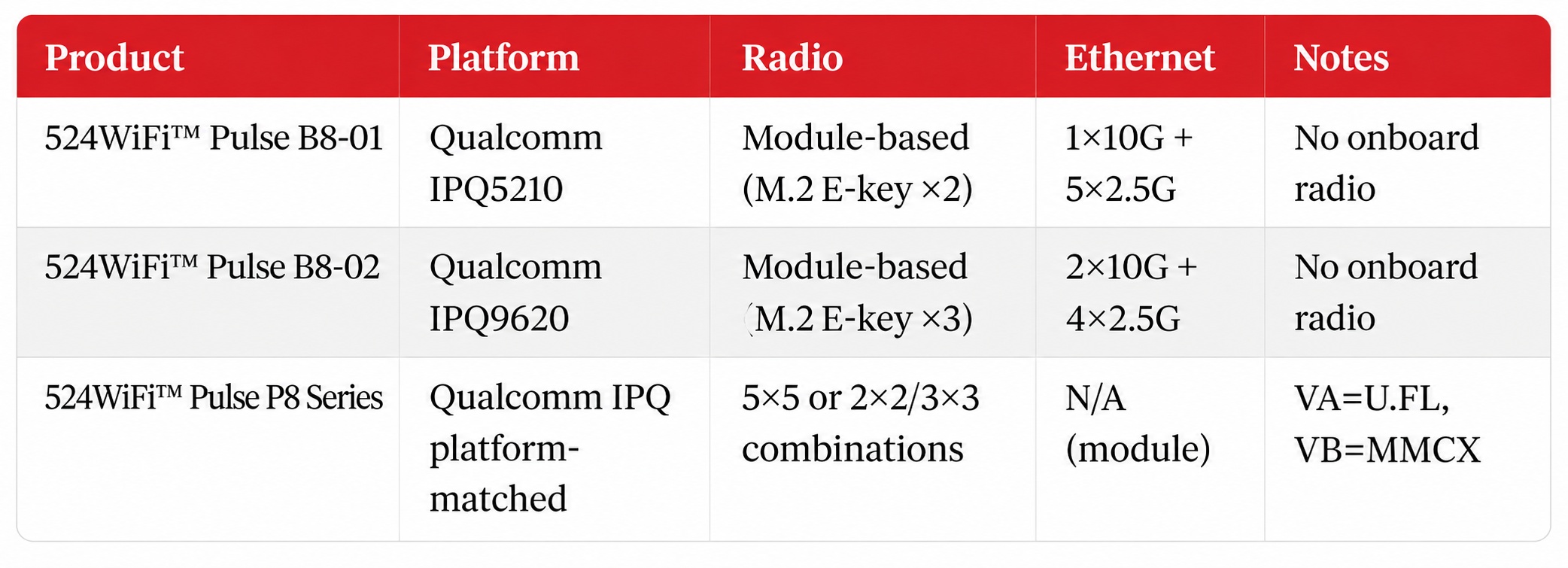
524WiFi™ platform planning combines Qualcomm-based mainboards with dedicated radio modules. The Pulse B8-01 and Pulse B8-02 mainboard architectures use M.2 E-key radio expansion, while the Pulse P8 module family provides band-specific and combined-radio configurations. This modular approach gives product teams a practical framework for host interfaces, Ethernet backhaul, RF connectors and integration requirements.

524WiFi™ Wi-Fi 8 modular mainboard and radio platform overview
524WiFi™ Wi-Fi 8 platform architectures for integration planning.

For an early design, confirm the production specification, supported draft revision, firmware interfaces and regulatory path for the selected mainboard and radio configuration. RF trace layout, radio timing, power sequencing and thermal design remain part of the complete system integration.

What this means if you’re planning a 2027 product

  • Don’t wait for ratification to start prototyping. By the time the standard is final, you want your firmware and RF integration lessons already learned on pre-standard silicon.
  • Match the feature to the actual problem. SMD solves roaming, MAPC solves density, ELR solves range, DSO solves capability mismatches. Pick the one that maps to your customer’s actual failure mode rather than treating “Wi-Fi 8” as one undifferentiated upgrade.
  • Ask suppliers exactly which draft revision their silicon targets. “Wi-Fi 8 ready” is not yet a standardized claim — it’s a pre-standard implementation claim, and the details differ by vendor and by draft version.

If you’re evaluating a Qualcomm-based Wi-Fi 8 platform for your own product — whether that’s a carrier board, an ODM hardware partnership, or just a technical sounding board while the standard finishes settling — we’re happy to compare

Posted on — 1 Comment

Industrial Wi-Fi modules with Qulacomm chipsets

524 WIFI INDUSTRIAL MODULES

Tomorrow systems (524wifi.com) offers a long-proven range of Wi-Fi modules for industrial applications with a large temperature range (-40 ° C to + 85 ° C). One of the largest manufacturers of Wi-Fi modules is significantly expanding its product portfolio in the Wi-Fi 802.11ac broadband standard. Recently, it has been choosing more and more manufacturers of industrial APs, routers and hubs. All new Tomac systems 11ac miniPCIe modules are now available in full-size standard 50.95 × 30 mm, even with a 4 × 4 MU-MIM solution.

RELIES ON QUALITY

524WiFi, founded in 2002, can successfully look back after 14 years of cooperation with Qualcomm. Some previous miniPCI Wi-Fi modules have become true legends. It can now exclusively use the latest Wi-Fi technologies developed by this world leader in wireless communication in all its miniPCIe Wi-Fi modules. In addition, we cooperate with an official ADC partner (Authorized Design Center) of Qualcomm and, in addition to reference designs, offers its customers support in customizing hardware and software designs.

CAN HANDLE HIGHER TEMPERATURES

524wifi has a long-standing good reputation in the field as a specialist in WiFi modules for demanding thermal conditions with an extended (-20 ° C to + 70 ° C) and industrial (-40 ° C to + 80 ° C) temperature range. However, the 524wifi now offers its Wi-Fi modules with an extended industrial temperature range (-40 ° C to + 85 ° C), which is marked with the letter “I” meaning Industrial. Usually, the upper limit of the operating temperature + 70 ° C is determined in relation to the surrounding area, ie outside the shielding of the Wi-Fi module. Since the temperature inside the shield is usually even higher than outside, we recommend using Wi-Fi modules with a sufficient safety margin for operating temperatures for high-speed data transmission. You will achieve long-term reliability in continuous operation.

WIDE OFFER

Most 11ac modules are available in both temperature ranges, ie in versions with and without the “I” marking. The enclosed tables provide a general overview of all available 11ac modules, divided into single and dual band types. Dual-band modules (operating in the 2.4 and 5GHz frequency bands) include 4 proven 2 × 2 and 3 × 3 MIMO modules: WLE600VX-I, WLE 900VX-I, 524WiFi 900VX Pro+ and 600VX Pro+. The first two modules represent industrial versions of the long-selling best-selling module based on the QCA 9890 chipset. Version Pro+  is a standard commercial version now with improved parameters. We also offer single-band Wi-Fi 6 (802.11ax) and MU-MIMO 4 × 4 Wi-Fi 5 modules based on popular Mediatek chipset

HIGH PERFORMANCE

Usually, these single-band modules differ in the antenna configuration used, and thus in the resulting data rate of 867Mbps @ MU MIMO 2 × 2, 1.3Gbps@MU MIMO 3 × 3 and 1.7Gbps@MU MIMO 4 × 4. Another characteristic feature is their output power. The WLE650V5-18A product family supports a maximum output power of 18dBm @ 5Ghz, the WLE650V5-25A range of high-performance modules offers an output power of 25 dBm @ 5 GHz. All 5GHz single-band modules have in common that they support multi-user (MU-MIMO) as well as 80 MHz + 80 MHz channel pooling for 1SS or 2SS (SS = Spatial Stream).

STANDARD WITH HEATSINK

Due to the high throughput and heating, all single-band modules are equipped with a heatsink as standard. However, Tomorrow systems is ready to meet any customer requirements and, according to their wishes, install them with coolers as desired, or deliver them without them due to lack of space for installation.

PREPARATION FOR IOT

While single-band modules specialize in 802.11ac and 802.11an @ 5GHz, dual-band modules also offer 802.11b / g / n @ 2.4 GHz standards. In the future, it will be even more important for the Wi-Fi module to handle a large number of simultaneously connected clients. Just like on a train, up to 50 passengers are connected to one Wi-Fi module, in the future it will not be an exception that 50 household devices will communicate with your Wi-Fi router in your home, so you must pay close attention to choosing a suitable Wi-Fi module! 524wifi modules will be ready.

FAVORITE TRANSPORT CHOICE

This is another area where 524wifi modules are gaining ground. For their reliability, stability, performance and a large number of connectable clients, our popular 524wifi 600vx Pro+ and 900vx Pro+ modules have become widely used in buses, trains, airports and train terminals throughout Europe, not only within the “Wi-Fi for passengers” application. “. They have also become very popular in the Czech Republic, where you can find them on trains on Czech railways and on buses. For example, public transport in Brno and Ostrava have opted for them, and the international carrier FlixBus, for example, also uses them in its buses.

READY FOR LTE 5G

Currently, most of the 524WiFi 600VX Pro+ and 900VX Pro+ modules are used for “Wi-Fi for passengers”, which are installed in special Embedded routers with the Linux system and, thanks to today’s best Wi-Fi chip from Qualcomm – QCA9880 – provide a stable and fast connection for 50 or more passengers in a bus or train (one wagon). The great advantage of this chip is that it is dual-band and can handle a large number of connected users, thus saving the need for additional HW (reduces the number of required routers). They also take care of the communication of the vehicle with the depot and transmit information obtained on the route from the control computer in the car. The internet connection to the car is solved by LTE modules – ie from mobile operators. However, the system is already ready for LTE 5G and carriers have already tested that all passengers on the bus will then be able to stream HD video.

CZECH FOR ALL OF EUROPE

Distribution of 524wifi Wi-Fi modules for Europe is provided by Tomorrow systems s.r.o. with headquarters in Prague. Detailed information about all 524WiFi and COMPEX Wi-Fi products can be found at www.compexshop.cz, or at 524wifi.com Contact for distributors or any questions and requirements please contact Pavel FRICE, pavel (at) 524wifi.com, tel +420 775 262 900.